
Why an Ayurvedic Consultation Feels Nothing Like a Doctor’s Visit
You are about to walk into an Ayurvedic consultation for the first time. You are probably expecting something like a doctor's visit — ten minutes, a few questions, a prescription. What actually happens is so different from that experience that most people leave saying "no one has ever listened to me like that before."
That reaction is not accidental. It is the whole point. Ayurveda is one of the oldest continuously practised medical systems on Earth — a system of health knowledge refined over thousands of years on the Indian subcontinent, long before the stethoscope or the blood test existed. The word itself comes from Sanskrit: "Ayur" meaning life, "Veda" meaning knowledge. The knowledge of how to live well. And the consultation process reflects that depth — it is more thorough, more personal, and more unhurried than most modern checkups.
You might be nervous. You might wonder if they will make you give up coffee or eat only boiled vegetables. Let us clear that up right now: a good Ayurvedic practitioner is not there to take things away from you. They are there to understand you — deeply, patiently, completely — and then guide you toward what your particular body actually needs.
Where a conventional appointment typically focuses on the symptom that brought you in, an Ayurvedic consultation reads the whole person. Think of it as detective work. Your symptom is a clue, but the practitioner wants to understand the full story — your constitution, your digestion, your sleep, your emotional landscape, your daily habits, even your family history. Every detail is a thread they follow to find the pattern underneath.

Nadi, Jihva, Sparsha: The Eight Examinations You Will Experience
The consultation begins the way you would not expect a medical visit to begin — with a long, unhurried conversation. The practitioner asks about your daily routine. What time you wake up. What you eat, and when. How you sleep. How your digestion feels. What emotions come up most often. What brought you here today, and what has been bothering you that you have not told anyone about yet.
There is no clock ticking. No sense that you need to hurry through your list of concerns. This conversation alone can take thirty to forty-five minutes, and for good reason — in Ayurveda, these details are not small talk. They are diagnostic information.
The physical assessment follows a systematic framework called Ashtavidha Pariksha — the eightfold examination described in Charaka Vimana Sthana. It covers Nadi (pulse), Mutra (urine), Mala (stool), Jihva (tongue), Shabda (voice), Sparsha (touch and skin), Drik (eyes), and Akriti (overall body build). The practitioner does not rely on one or two of these alone. They read the body through all eight channels together, each one cross-referencing and deepening the picture that the others provide. It is a remarkably thorough system of observation.
Next comes the part that surprises most first-timers: the physical assessment. The practitioner's fingers rest gently on your wrist to read your pulse. This is Nadi Pariksha, a diagnostic technique refined over centuries. It is not simply counting heartbeats. An experienced practitioner reads the pulse the way a musician listens to an instrument — feeling for rhythm, strength, depth, and subtle qualities that reveal the state of your doshas. Think of it as a conversation between the practitioner and your body, conducted through the fingertips. Our article on What Is Prakriti? explains the dosha framework in detail.
Each dosha has a characteristic pulse quality. Vata pulse is traditionally compared to a snake’s movement — Sarpa gati — irregular, thin, and rapid. Pitta pulse resembles a frog’s leap — Manduka gati — jumping and sharp. Kapha pulse moves like a swan’s glide — Hamsa gati — slow, steady, and broad. The practitioner reads at three finger positions on the radial artery, applying three distinct pressure levels at each point, which is how they distinguish surface patterns from deeper constitutional signals.
But the pulse is just one chapter. The practitioner also reads your tongue — Jihva Pariksha. A coated tongue, a trembling tongue, teeth marks along the edges — each tells a specific story about your digestion, your hydration, and which doshas may be elevated. Your eyes reveal things too — Netra Pariksha. Redness, dryness, the brightness or dullness of the sclera all carry meaning. They observe your skin, your nails, even the quality of your voice. Your body is a book, and the practitioner knows how to read every page.
Together, these observations build what Ayurveda calls an understanding of your Prakriti — your innate constitutional type — and your Vikriti, which is your current state of imbalance. The gap between the two is where the real insight lives. To understand how this assessment shapes the care you receive, see our clinical approach.
Did You Know?
Sharangadhara Samhita (Purvakhanda, Ch. 3) describes a pulse diagnosis system so refined that a practitioner can distinguish over 28 distinct pulse patterns — each indicating a specific dosha, dhatu, or srotas condition — using nothing but three fingertips on the radial artery. Modern medicine did not develop a comparable non-invasive diagnostic through touch until the 19th century, and even today, most physicians rely on instruments rather than tactile sensitivity. What Ayurveda achieved through 2,000 years of systematic clinical observation, Western medicine largely replaced with technology.
Why They Ask "Strange" Questions
If you have never been to an Ayurvedic consultation before, some of the questions will feel unusual. Do you dream vividly, or rarely remember your dreams? Do you crave sweet foods or salty ones? Are your hands and feet usually warm or cold? How are your bowel movements — regular, loose, sluggish? Do you tend toward anxiety, irritability, or lethargy when you are stressed?
These are not random questions and they are not small talk. Each one maps to a specific dosha pattern. Vivid, anxious dreams point toward Vata imbalance. Craving cold drinks and spicy food, combined with irritability, suggests elevated Pitta. Sluggish digestion, heaviness after meals, and a tendency to avoid exercise often indicate a Kapha pattern. The practitioner is assembling these individual pieces into a coherent picture of your current state — not just what hurts, but why.
There is a reason the consultation goes this deep. Ayurveda recognises six stages of disease progression — called Shat Kriyakala — from Sanchaya (initial accumulation) through to Bheda (advanced manifestation with complications). At stages one and two, a dosha imbalance is building but has not yet produced obvious symptoms. The detailed assessment tries to catch these early disturbances before the imbalance spreads to other tissues and manifests as recognisable disease. This is precisely why the practitioner asks questions that may seem unrelated to your main concern — they are looking for patterns that have not surfaced yet.
Sleep patterns are especially revealing. Ayurveda considers sleep one of the three pillars of life — alongside food and balanced living. Whether you fall asleep easily but wake at 3 AM, or sleep heavily but wake exhausted, tells the practitioner something different and specific. Even your digestion — which Ayurveda calls Agni, or digestive fire — is assessed not just by what you eat but by how you feel after eating. Our article on Agni and Digestion goes deeper into why this matters so much.
When Agni weakens, Ayurveda observes that Ama — a concept describing metabolic waste or incompletely processed material — begins to form. This is why the practitioner asks specifically about post-meal heaviness, tongue coating, and energy levels after eating. These are all considered signs the body uses to signal how well it is digesting and assimilating what it receives.
Your First Visit: What Really Happens Behind the Door
A thorough first consultation typically takes 45 minutes to an hour, sometimes longer. This is not a rushed appointment with a prescription at the end — it is a deep, considered evaluation. You will be asked to describe your concerns in your own words, in your own time. Many people say this is the first time a health practitioner truly sat and listened without interrupting.
What should you bring? A list of your current health concerns, any medications or supplements you are taking, a rough picture of your daily routine — meals, sleep, exercise — and your family health history. The more the practitioner knows, the more accurate their assessment. Our What to Bring guide has a detailed checklist.
What should you not worry about? That you will be judged for your diet, your habits, or your lifestyle. A good practitioner meets you where you are. They are not there to lecture — they are there to understand you and offer guidance that fits your actual life, not some idealised version of it.
You can browse our consultation areas to see the range of concerns that families bring — from digestive discomfort and sleep difficulties to skin concerns, joint stiffness, stress, and seasonal wellness.
Here is a perspective that changes how you think about the entire consultation process: in the Ayurvedic understanding, food is not just calories and nutrients. It is information. Every meal you eat carries a specific set of qualities — hot or cold, heavy or light, moist or dry, sharp or dull — and your body reads those qualities the way a computer reads code. When the information matches your constitution, the body runs smoothly. When it does not, errors accumulate. This is why the practitioner asks such detailed questions about what you eat and how you feel afterward. They are not counting your calories. They are reading the code your body has been receiving — and decoding where the mismatches lie. Once you understand food as information, the entire Ayurvedic dietary approach suddenly makes perfect sense.
The Formulation — Made for You, Not Off a Shelf
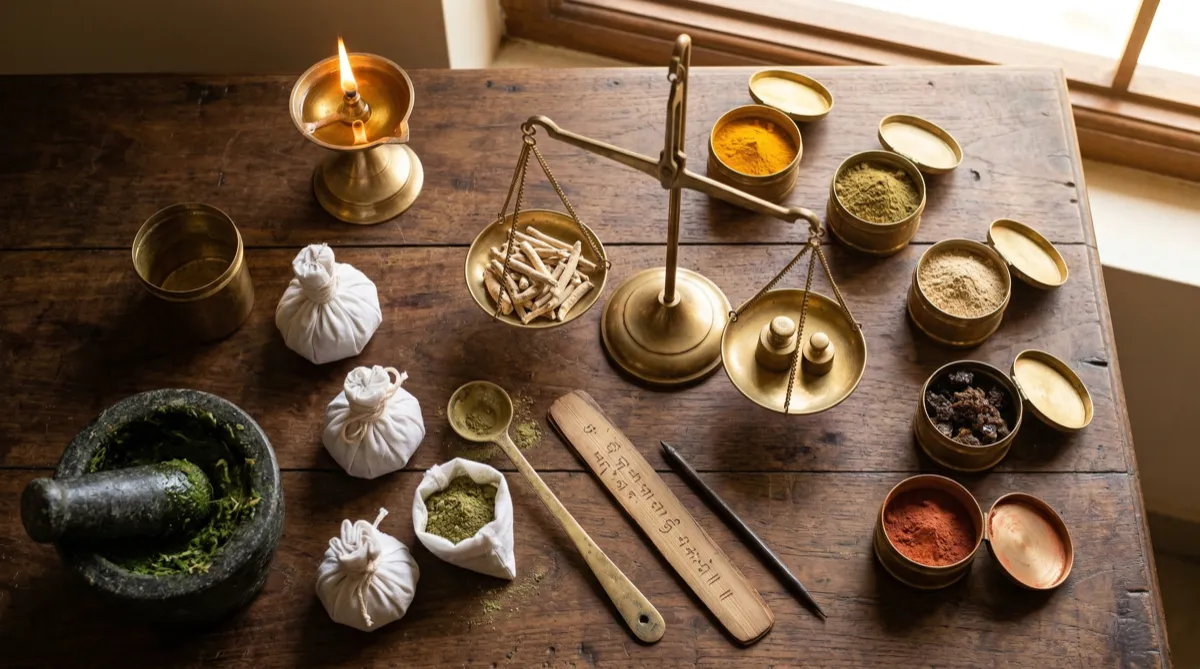
This is where Ayurveda diverges most sharply from the modern supplement aisle. After the assessment, the practitioner does not hand you a box of generic capsules. Instead, they select classical formulations — combinations of herbs, minerals, and preparations described in ancient texts like the Charaka Samhita and Ashtanga Hridaya — chosen specifically for your constitution and your current imbalance.
These might be liquid decoctions called kashayams, herbal powders called churnas, medicated ghee or oil preparations called tailams, or traditional tablets. At clinics that follow the classical tradition, many of these are prepared fresh rather than bought from mass manufacturers. The difference matters — much the way a meal cooked from scratch differs from a ready-made one.
The formulations are personalised because the assessment is personalised. Two people with similar symptoms may receive entirely different preparations, because their constitutions and the root causes of their imbalance are different. This is the logic that makes Ayurveda tick — and it is why the deep assessment at the beginning matters so much.
Did You Know?
Charaka described the ideal physician as one who masters four qualities equally: theoretical knowledge (Shastra Jnana), practical skill (Prayoga), clarity of reasoning (Yukti), and compassion (Daya). A practitioner lacking any one of the four was considered incomplete — a standard that modern medical ethics committees would recognise immediately.
Follow-Up — Why Ayurveda Is Not "One and Done"
A good Ayurvedic consultation does not end with the first visit. The practitioner will want to see you again — typically after two to four weeks — to observe how your body has responded. Did the kashayam improve your digestion? Has your sleep shifted? Are the skin changes settling? Based on your response, they adjust the formulations, refine the dietary guidance, and continue building a more complete picture of what your body needs. For a full picture of what follow-up looks like, see our Follow-Up & Continuity of Care guide.
Think of it as iterative refinement rather than a single prescription. Ayurveda works with your body's own rhythms, and those rhythms take time to shift. The practitioner is not guessing and hoping — they are observing, adjusting, and guiding you through a process. This is why families who engage with Ayurveda over time tend to see the most meaningful changes.
For families who live far away or cannot visit regularly, many practitioners offer phone follow-ups and medicine dispatch, so the continuity of care does not break.
Did You Know?
In Ayurvedic pharmacology, the same formulation taken with different Anupana (vehicles) produces different effects. A churnam taken with warm water may act on Vata, with honey on Kapha, and with ghee on Pitta. The vehicle is not incidental — it directs the preparation to the appropriate tissue layer. This is why a prescription specifies not just what to take, but how to take it.
Common Fears — Honestly Addressed
"Will I have to change everything about my life?" No. A good practitioner makes suggestions that fit your actual circumstances. You might be advised to adjust the timing of your meals, add a particular spice to your cooking, or shift your sleep routine slightly. These are nudges, not overhauls. Major changes, if they are needed, happen gradually and with your full understanding of why.
"Is it safe alongside my existing medications?" This is an important question and you should always ask it. A responsible practitioner will ask about every medication you are taking — conventional and traditional — before recommending any formulation. Some herbs can interact with certain medicines, which is why full disclosure matters on both sides. Ayurvedic care should complement your existing healthcare, not compete with it.
"How long before I see changes?" Honestly, it depends. Some people notice shifts in digestion, sleep, or energy within the first week or two. For deeper, longer-standing concerns, meaningful change often takes two to three months of consistent engagement. Ayurveda does not promise overnight results — but the changes it supports tend to be lasting, because they work with your body rather than overriding it.
"What if I have tried everything else and nothing has worked?" Many families come to Ayurveda precisely at this point. What they often find is not a miracle — but a system that asks different questions, looks at different patterns, and offers a different kind of patience. Sometimes that is exactly what was missing.
What Current Evidence and Safety Guidance Say
Interest in Ayurveda has grown within the global research community. The World Health Organisation (WHO) recognises traditional medicine systems, including Ayurveda, as part of its global health strategy. In India, the Ministry of Ayush and the Central Council for Research in Ayurvedic Sciences (CCRAS) support ongoing research into Ayurvedic practices and formulations.
The National Center for Complementary and Integrative Health (NCCIH) notes that some Ayurvedic practices show promise in areas like stress management and digestive wellness, but emphasises that more rigorous clinical research is needed before definitive conclusions can be drawn.
Important safety considerations: always inform your Ayurvedic practitioner about any existing medical conditions, ongoing treatments, or medications you are taking. Traditional herbal formulations can interact with certain medicines. Ayurvedic consultation should complement — not replace — your relationship with your primary healthcare provider.
This article is for educational purposes only and does not constitute medical advice. Ayurveda is a traditional wellness system that many families find valuable alongside conventional healthcare. Always consult your physician for medical concerns, and inform all your healthcare providers — both conventional and traditional — about any treatments you are receiving.