
Not a Routine — A Prescription for Living
What if the most powerful medicine you could take was not a pill, a powder, or a potion — but simply doing the same five things at the same time every day? What the 2017 Nobel Prize in Medicine confirmed, Ayurveda has taught as daily practice for millennia. The word Dinacharya comes from two Sanskrit roots: dina (day) and charya (conduct or practice). It appears throughout the foundational texts — the Charaka Samhita, Sushruta Samhita, and Ashtanga Hridayam — not as lifestyle advice, but as preventive medicine. The sages who wrote these texts were not guessing. They were observing, across generations, what happened to people who lived in rhythm and what happened to people who did not.
Here is the thing most people miss about Dinacharya: it is not a to-do list. It is a framework for aligning your daily life with the intelligence already built into your body. You already have a circadian clock. You already have digestive rhythms, hormonal cycles, and sleep architecture. Dinacharya does not add anything foreign — it simply helps you stop working against what your biology is already trying to do. Consistency matters far more than perfection. Three things done daily will reshape your health more than ten things done randomly.
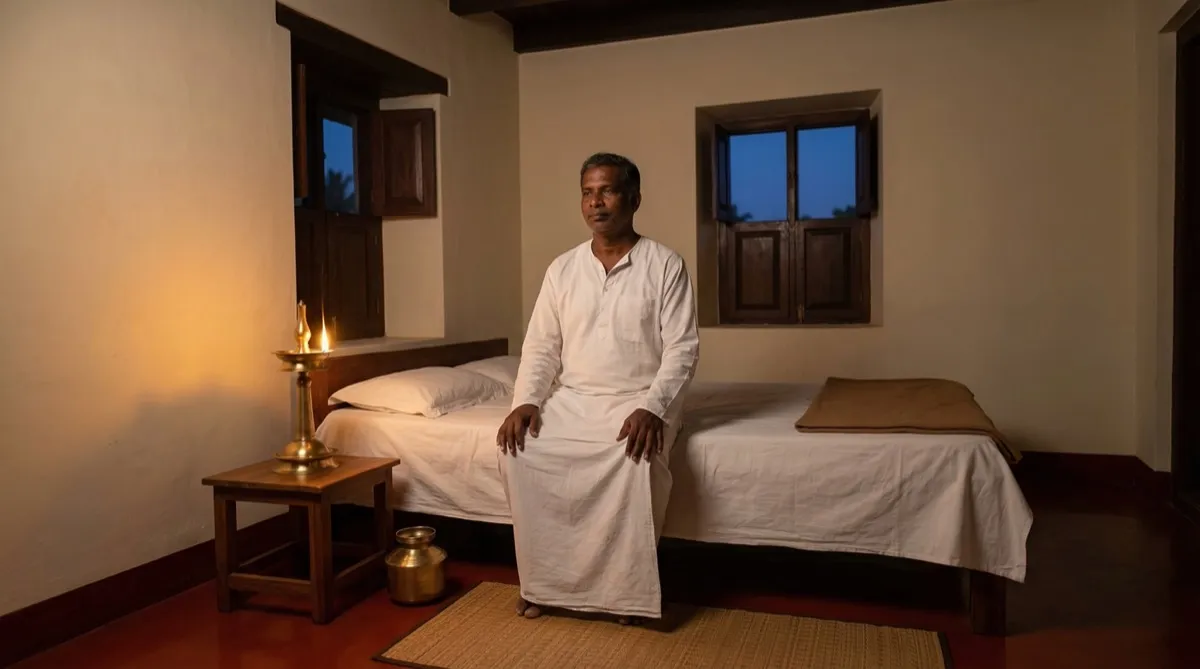
Here is something that changes how you think about habits: every cell in your body responds to your emotional state. What you experience as “stress” is actually a chemical cocktail — cortisol, adrenaline, norepinephrine — that your own body produces and floods into every organ. What you experience as “calm” is a different cocktail — serotonin, oxytocin, GABA. Dinacharya is not just about when you eat and sleep. It is about creating the conditions under which your body produces the right chemistry at the right time. A consistent routine is, in the most literal biochemical sense, a prescription for the chemical environment inside your own body.
The Dosha Clock: Your Body's Internal Seasons
Think of your body as a garden. It does not experience one uniform climate all day long — it moves through internal seasons, shifting every four hours. Ayurveda maps this through what we might call the dosha clock, and once you understand it, your entire day starts making sense in a new way. If you are unfamiliar with the three doshas — Vata, Pitta, and Kapha — our article on What Is Prakriti? explains how these forces shape individual constitution.
The cycle runs twice in every 24 hours. Kapha governs 6–10 (both AM and PM) — heavy, stable, earthy energy. Pitta governs 10–2 — sharp, hot, transformative. Vata governs 2–6 — light, mobile, creative. Each window carries a distinct quality, and when you align your activities with these qualities, everything flows more easily. When you fight them, everything feels harder.
Morning is spring — fresh, moist, a little heavy with Kapha. Noon is summer — peak fire, maximum digestive power. Afternoon is autumn — light and scattered, the Vata hours where creativity rises but so does restlessness. Evening is another round of Kapha — the body naturally winding down, asking you to slow with it. And night, from 10 PM to 2 AM, is the Pitta repair shift — your liver, your tissues, your mind all undergo deep maintenance. If you are awake during this window, you hijack that repair cycle. This is not philosophy. This is observable biology dressed in older language.
The 24-Hour Dosha Cycle
Brahma Muhurta: Why the Time You Wake Matters
Ayurvedic texts recommend waking during Brahma Muhurta — roughly 90 minutes before sunrise, during the Vata window of 2–6 AM. This is not arbitrary. Vata energy is light, clear, and expansive. Wake during this window and you feel alert. Hit snooze until 7 or 8 AM and you wake into the Kapha period — heavy, sluggish, fogged. That groggy feeling when you sleep in on weekends? That is not laziness. That is your body dragged awake during Kapha time, when every cell is telling you to stay dense and still.
The practical benefit is not mystical — it is mechanical. An early, consistent wake time sets the rhythm of your entire day: when you get hungry, when you feel sharp, when you naturally become sleepy. Modern sleep science calls this your zeitgeber — your body's primary time-setter. Ayurveda called it Brahma Muhurta and built the entire daily routine around it.
Did You Know?
The Ayurvedic “dosha clock” — Vata, Pitta, and Kapha cycling every four hours — was described over 3,000 years before the 2017 Nobel Prize in Physiology or Medicine confirmed that circadian biology governs nearly every organ in the body. The ancient observation and the modern discovery describe essentially the same phenomenon in different languages.
Morning Practices: Setting the Body's Fire
The morning routine in Dinacharya is not a productivity hack. It is about clearing the overnight accumulation and gently lighting the digestive fire for the day ahead. Think of it like opening the flue of a wood stove before striking a match — you need a clear channel before the fire can draw properly.
Tongue scraping comes first. Look at your tongue first thing in the morning and you will see a coating — that is ama, the residue of incomplete digestion. Scraping it off takes thirty seconds, removes bacteria that would otherwise be swallowed back into the gut, and sends a gentle nerve signal to the digestive organs. It is one of those practices so simple that people dismiss it, then try it for a week and never stop.
Here is what the classical reasoning actually says about that tongue coating: during sleep, Jatharagni (your central digestive fire) naturally dims. When Agni is low, any residual food material is not fully processed through the Rasa Dhatu — the first and most fundamental tissue layer, essentially the nutrient fluid that feeds every other tissue. What accumulates is unprocessed Rasa, a sticky by-product that Ayurveda calls ama. Overnight, this ama rises and coats the tongue. So that white or yellowish film you see each morning is not random debris — it is a visible indicator of how completely your previous meal was digested. Charaka Sutrasthana Chapter 5 specifically recommends Jihwa Nirlekhana (tongue scraping) as part of daily oral hygiene, and the Ashtanga Hridayam Sutrasthana Chapter 2 — the primary Dinacharya chapter — lists it among the essential morning practices. Removing that coating is not just cosmetic. It clears a micro-srotas (channel) blockage at the level of taste perception, which in turn sends a clearer signal to the digestive organs to prepare for the day's first meal.
Dantadhavana and Snana: Teeth and Bathing
Two Dinacharya components that often get overlooked in modern summaries are Dantadhavana (tooth cleaning) and Snana (bathing). Classical texts describe cleaning the teeth with twigs from astringent, bitter, or pungent-tasting trees — neem being the most commonly referenced. The reasoning is not arbitrary: these tastes are considered Kapha-reducing, and morning is Kapha time. The practice is meant to clear accumulated Kapha from the oral cavity, sharpen taste perception, and prepare the mouth for the day's nourishment. Ashtanga Hridayam Sutrasthana Chapter 2 includes Dantadhavana alongside tongue scraping as foundational morning hygiene.
Snana (bathing) is described as more than hygiene — it is considered Agni-deepana (digestive fire-kindling) and Tarpana (refreshing to the senses). Classical texts note that bathing removes fatigue, sweat, and bodily impurities while supporting clarity and alertness. The water temperature matters: warm water is generally recommended for the body (especially in Vata and Kapha seasons), while cool water for the head is considered supportive of the sense organs. The sequence matters too — bathing traditionally follows Abhyanga, allowing the oil to be partially absorbed before it is washed off, rather than applying oil to already-clean skin.
A glass of warm water follows — not hot, not cold, warm. Cold water contracts the digestive tract. Warm water gently flushes it, supports peristalsis, and helps with the morning elimination that Ayurveda considers essential. Your grandmother probably already knew this one. Oil pulling — swishing sesame or coconut oil in the mouth for a few minutes — is another classical practice (Gandusha) that supports oral hygiene and is described in the Charaka Samhita as beneficial for the gums, jaw, and voice. And if you live in a dry or dusty climate, Nasya — a tiny drop of sesame oil in each nostril — keeps the nasal passages lubricated and supports clear breathing. None of these practices take long. Together, they take perhaps five minutes, and they set the tone for the entire morning.
Abhyanga: Self-Massage as Medicine
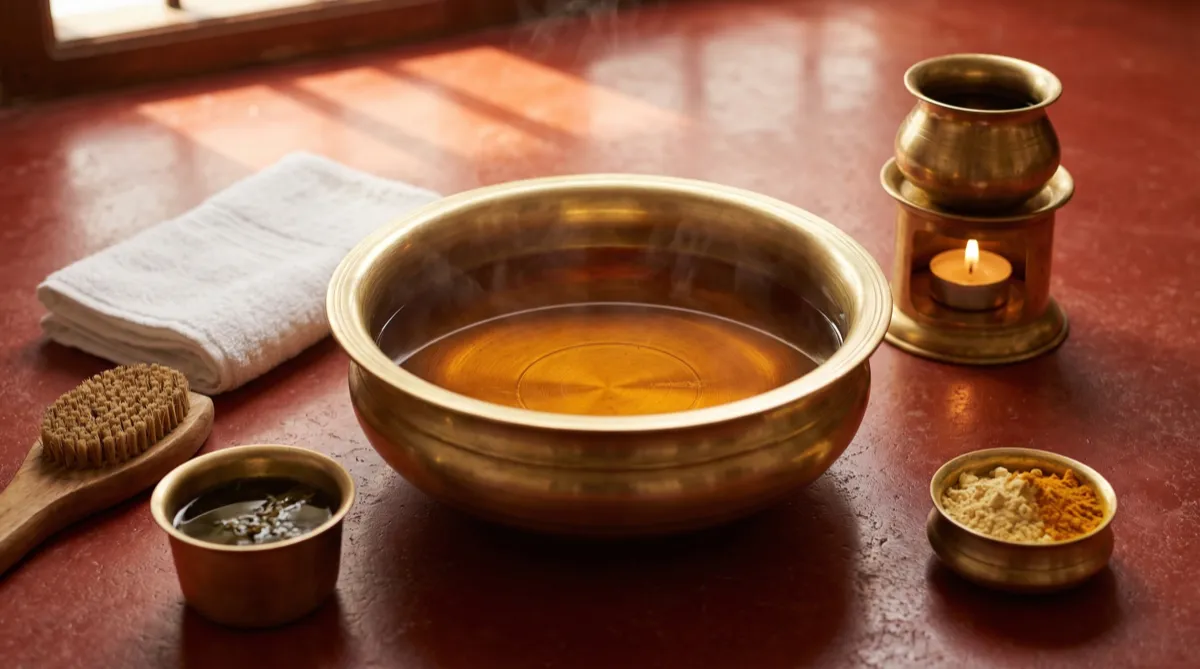
Let us be clear about what Abhyanga is: it is not a spa luxury. The Ashtanga Hridayam lists it alongside food and sleep as one of the foundational practices for health. Warming oil and massaging it into the skin for ten minutes each morning is described as nourishing to the dhatus (tissues), calming to the nervous system, and supportive of joint comfort and skin health. The Sanskrit word sneha means both "oil" and "love" — the practice is literally an act of self-nourishment.
The dhatu-level reasoning for Abhyanga is worth understanding. The skin (Tvak) is considered the seat of the sense of touch and is intimately connected with Rasa Dhatu (nutrient plasma). When warm oil is massaged into the skin, it enters through the micro-channels (Sukshma Srotas) of Tvak and begins nourishing the tissue layers sequentially — Rasa, then Rakta (blood tissue), then Mamsa (muscle tissue). This is why Abhyanga is described as building Ojas (vital essence) over time: the oil literally feeds the dhatu chain from the outside in. Classical texts also note that Abhyanga clears Srotas blockages at the superficial level, supporting the free flow of Vata through peripheral channels. This is the mechanistic reason it is considered calming — it is not a vague "relaxation" claim but a specific action on Vata's movement through the tissue channels.
The choice of oil matters. Sesame oil is warming and traditionally recommended for Vata types and cold seasons — it penetrates deeply and calms the nervous system. Coconut oil is cooling and works well for Pitta types and summer months. The reasoning is not cosmetic but constitutional — you are choosing an oil that balances your current state. Classical texts describe Abhyanga as supporting circulation, easing stiffness, improving sleep quality, and building ojas (vitality). For those interested in how such practices support long-term vitality, our article on Rasayana explores the Ayurvedic concept of rejuvenation. What modern research adds is that massage activates the parasympathetic nervous system — the "rest and digest" mode that most of us spend too little time in.
Did You Know?
Charaka recommended tongue scraping (Jihwa Nirlekhana) every morning as part of daily hygiene. Modern research now shows that tongue scraping reduces volatile sulphur compounds — the main cause of bad breath — by up to 75%, and measurably improves taste perception within days.
Vyayama: Exercise to Half Your Capacity
Here is where Ayurveda directly contradicts a deeply held modern belief. Contemporary fitness culture says push harder, sweat more, feel the burn, no pain no gain. Charaka Sutrasthana 7.31–32 says the opposite: exercise to ardha bala — half your capacity. The specific marker Charaka gives is this: when sweat appears on the forehead and armpits, when breathing shifts to the mouth, and when you feel lightness in the limbs — stop. That is your ardha bala point. Going beyond it is considered depleting rather than strengthening.
The reasoning is rooted in dhatu logic. Exercise beyond half capacity is described as consuming Rasa and depleting Ojas — the very essence of vitality that the rest of Dinacharya is designed to build. Moderate exercise, by contrast, kindles Agni, improves the flow of Vata through the Srotas, builds Mamsa Dhatu (muscle tissue) appropriately, and supports elimination. The classical ideal is not a sedentary person but an active one who knows the difference between strengthening and depleting. Notice that this is not anti-exercise — Charaka clearly states that Vyayama brings lightness, capacity for work, firmness, and endurance. The caution is against the excess, not the activity itself.
This also varies by constitution and season. A Kapha-predominant person can generally tolerate more vigorous exercise than a Vata-predominant person. In winter (Hemanta and Shishira), when Agni is naturally strong and Kapha accumulates, more exercise is appropriate. In summer (Grishma), when the body is already depleted by heat, heavy exercise is cautioned against. The principle is adaptive, not rigid — but the ceiling of half capacity remains the general guideline across all contexts.
The human body has more bacterial cells than human cells — roughly 38 trillion microbes living in your gut alone, collectively weighing about two kilograms. Ayurveda’s concept of Krimi (microbes) in the Charaka Samhita anticipated the microbiome by over 2,000 years. Charaka classified Krimi by location — external, GI tract, and blood — and described how they are either held in check or proliferate based on the quality of Agni and the presence of Ama. Modern microbiome research has confirmed exactly this: gut bacteria composition is dramatically shaped by diet quality and digestive function. The ancients were not guessing. They were observing at a resolution we are only now catching up to.
The Sacred Lunch: Why Midday Is Your Strongest Fire
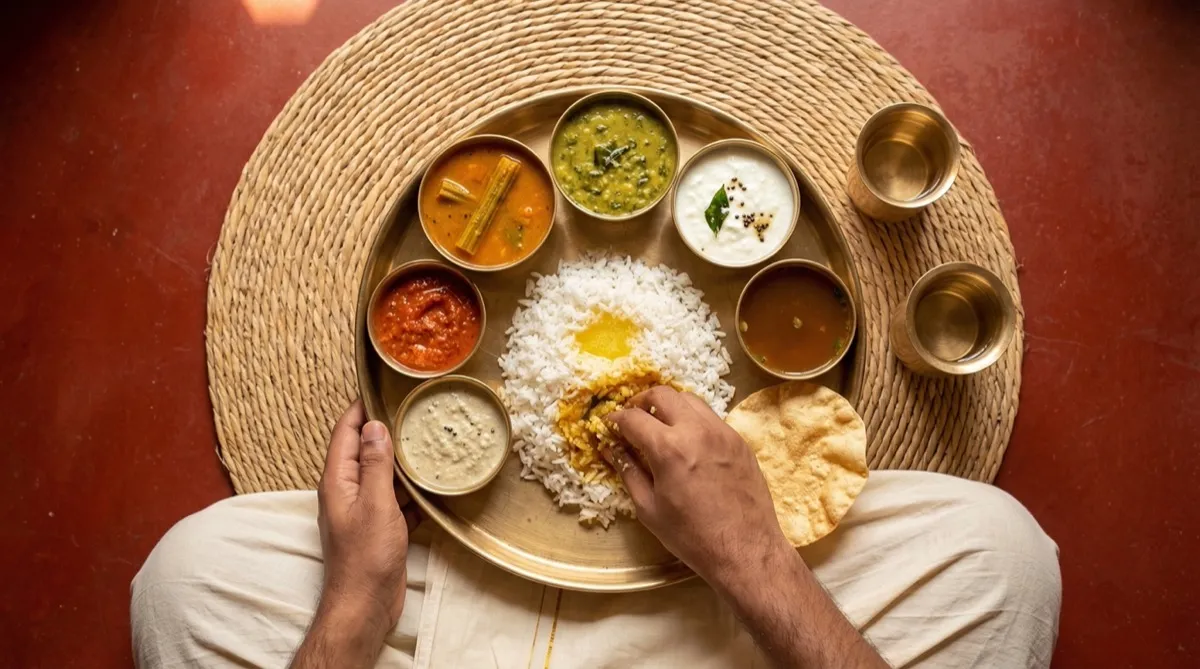
This might be the single most important thing Dinacharya teaches about eating: your biggest meal belongs at midday. Not because of some arbitrary tradition, but because 10 AM to 2 PM is the Pitta window — when the sun is highest and your internal fire (Agni) burns strongest. Our article on Agni and Digestion explores this digestive intelligence in depth. Ayurveda draws a direct parallel between the sun in the sky and the fire in your belly. When one peaks, so does the other.
The reasoning goes deeper than "Pitta time means strong digestion." Pitta dosha is inherently composed of Agni (fire) and Jala (water) — it is the only dosha that carries fire as a primary element. During the midday Pitta window, the body's Jatharagni (central digestive fire seated in the stomach and small intestine) reaches its peak intensity because it is being supported by the dominant dosha of that time period. Think of it as a furnace that burns hottest when the ambient temperature is also high. This is when the body can most efficiently break food down into Ahara Rasa (the nutrient essence) and begin the sequential nourishment of all seven dhatus. Eating a heavy meal at night, when Kapha dominates and Agni naturally banks down, means the same food is processed incompletely — generating ama instead of nourishment.
Now consider what most working people actually do: skip breakfast or grab something on the run, eat a sandwich at their desk at noon while answering emails (barely tasting it), and then sit down to their largest, heaviest meal at 8 or 9 PM — precisely when digestive capacity has dropped to its lowest point. Then they wonder why they feel bloated, sleep poorly, and wake up without appetite. The system is designed to peak at noon. Fighting that design has consequences.
Ayurveda does not say you must eat a feast at lunch. It says: make lunch your most substantial, most nourishing meal. Eat it sitting down. Eat it without distractions. Give your body the fuel when it has the fire to process it. Eat lighter in the evening — soups, cooked vegetables, something warm and easy to digest. This single shift, consistently applied, can transform how you feel by morning. For practical dietary principles tailored to your constitution, see our Diet & Lifestyle guide.
The Afternoon: Why the Slump Is Not Your Fault
Ever notice that the 2–4 PM period feels scattered, unfocused, sometimes anxious? That is the Vata window arriving. The energy shifts from Pitta's focused intensity to Vata's lighter, more mobile quality. This is not a personal failing or a sign you need more coffee. It is a natural transition. Ayurveda suggests this is a good time for creative work, gentle movement, or short walks — activities that work with Vata's mobile nature rather than against it. Trying to power through heavy analytical work during Vata time is like ploughing a field during a windstorm. You can do it, but it costs more than it should.
Evening Wind-Down: The Kapha Window for Rest
Between 6 and 10 PM, Kapha returns. The body is asking you to slow down, get heavier, prepare for sleep. This is by design. And yet this is precisely the window most people fill with their most stimulating activities — heavy dinners, intense television, bright screens, vigorous exercise, social media scrolling. The modern evening is an assault on the Kapha period's intended purpose.
Dinacharya says something different: eat lightly by 7 PM. Take a slow walk if you can. Reduce stimulation. Dim the lights. Let conversation become quieter. Ayurveda recognised centuries ago what sleep science now confirms — your nervous system needs a transition period. You cannot sprint all day, slam the brakes at 11 PM, and expect deep, restorative sleep. The wind-down is not wasted time. It is preparation for the most important physiological event of your day.
Did You Know?
The Ayurvedic advice to eat your largest meal at midday aligns with modern chrono-nutrition research showing that insulin sensitivity peaks around noon and drops by roughly 50% in the evening. Your body literally processes the same meal differently depending on when you eat it.
Sleep as Medicine: The 10 PM Threshold
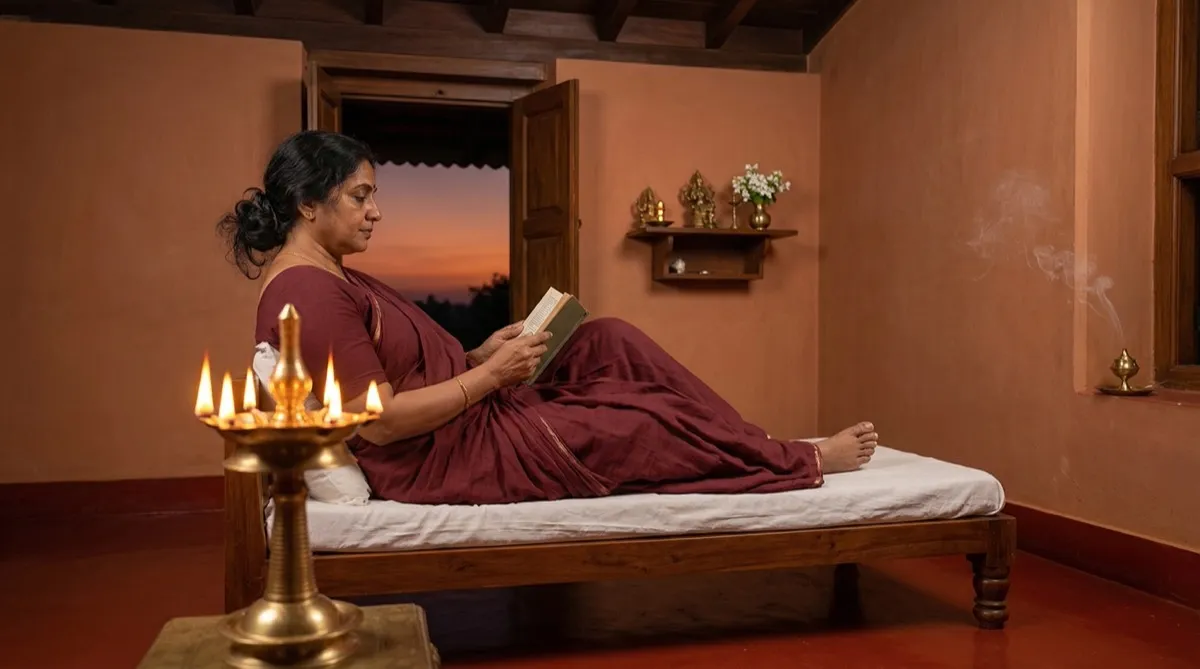
Here is where Dinacharya gets really specific, and really inconvenient for modern life: go to bed by 10 PM. Not because early bedtimes are virtuous, but because of what happens at 10 PM physiologically. The Pitta window reopens. If you are asleep, that Pitta energy goes toward internal repair — liver detoxification, tissue regeneration, memory consolidation. If you are awake, that same Pitta energy becomes a "second wind" — sudden alertness, hunger (the midnight snack craving), and mental activation that can keep you up until 1 AM.
The classical reasoning for this is precise. Ayurveda describes not one Agni but many — and the nocturnal Pitta window is when Bhuta Agni becomes most active. Bhuta Agni refers to the five elemental fires seated primarily in the liver (Yakrit), which process and refine the nutrients absorbed from digestion into forms that each specific dhatu can use. This is essentially tissue-level metabolism. When you are asleep and the body is not diverting energy to conscious activity, movement, or sensory processing, Pitta can direct its full transformative power inward — rebuilding Rasa, purifying Rakta, and consolidating the day's metabolic work. If you are awake, that same Pitta energy gets diverted to fuel wakefulness, mental activity, and often late-night eating — which then places a demand on Jatharagni at precisely the wrong time.
This is not a suggestion born of moral preference. The 10 PM–2 AM Pitta cycle is the body's maintenance shift. Skip it regularly and the effects compound: sluggish digestion the next day (because Agni is rebuilt during this window), foggy thinking, lower immunity, and a general sense that something is off without being able to name it. Modern productivity culture says hustle around the clock. Ayurveda says the most productive thing you can do is go to bed at the same time every night — and that time should be before the Pitta surge kicks in.
What you do at night directly shapes what you can do the next morning. Sleep is not downtime. It is the foundation on which tomorrow's Agni, clarity, and energy are built. The connection between sleep and next-day vitality is one reason Ayurveda treats sleep as medicine, not as a luxury to be sacrificed for productivity.
Swasthavritta: Medicine Before You Get Sick
There is a classification detail that most introductions to Dinacharya miss, and it changes how you understand the entire practice. In classical Ayurvedic literature, Dinacharya is categorised under Swasthavritta — the science of maintaining health in the already healthy — not under Chikitsa (treatment of disease). This is a fundamental distinction. Swasthavritta literally means "the conduct of one who is established in health." It is preventive, not reactive. It is not medicine for the sick. It is the daily discipline that keeps you from becoming sick in the first place.
This reframes Dinacharya entirely. It is not a treatment protocol. It is not something you start when symptoms appear. It is the ongoing maintenance that prevents the cascade from imbalance to disease. In Ayurvedic pathology (Samprapti), disease develops through six stages — from initial dosha accumulation (Sanchaya) through full manifestation (Bheda). Swasthavritta practices like Dinacharya are designed to catch and correct imbalances at the earliest stage, before they progress. This is why Ayurveda often describes daily routine as the most powerful intervention available — not because it reverses advanced disease, but because it prevents the conditions under which disease begins.
Dosha-Specific Adaptations: One Routine Does Not Fit All
While the general framework of Dinacharya applies to everyone, the specifics should be adapted based on your Prakriti (constitutional type). A first consultation can help determine which adaptations suit you best. Here is how the morning routine differs for each primary dosha:
Vata types benefit most from warmth, regularity, and grounding. Wake gently — avoid jarring alarms. Abhyanga with warm sesame oil is especially important for Vata, as it directly counters the cold, dry, mobile qualities of this dosha. Warm water, warm food, and a slightly later wake time (still before sunrise) work best. Exercise should be gentle and grounding: walking, gentle yoga, tai chi. The Vata morning needs stability above all.
Pitta types run warm and sharp by nature, so the morning routine should avoid adding more heat. Coconut oil for Abhyanga rather than sesame. Cool or room-temperature water rather than hot. Pitta types can handle a moderately vigorous morning exercise routine but should avoid competitive intensity that stokes the fire. They benefit from a few minutes of cooling pranayama or meditation before the day accelerates. The Pitta morning needs cooling and moderation.
Kapha types need the most active, stimulating morning routine. Wake earliest — ideally before 6 AM to avoid sinking deeper into Kapha time. Dry brushing before oil massage, or using lighter oils like mustard. Vigorous exercise (within the ardha bala principle) is most appropriate for Kapha, as their natural strength and endurance can handle it. Warm water with a squeeze of lemon supports their naturally slower Agni. The Kapha morning needs activation and movement.
Why Consistency Matters More Than Perfection
If you have read this far and feel overwhelmed, here is the most important paragraph in this article: you do not need to do all of this. Dinacharya is not an all-or-nothing programme. The classical texts describe a comprehensive daily routine, but the underlying principle is rhythm — and rhythm is built through repetition, not through intensity. Doing three things consistently will reshape your health more profoundly than doing ten things sporadically.
Think of it like compound interest. Waking at the same time every day is a small deposit. Eating your biggest meal at noon is another. Going to bed before 10 PM is another. Individually, each is modest. But compounded over weeks and months, the accumulated effect is remarkable. Your digestion stabilises. Your sleep deepens. Your energy becomes predictable rather than erratic. You stop needing coffee to start and melatonin to stop. The body, given consistent signals, begins to trust its own rhythms again.
What Current Evidence and Safety Guidance Say
Many elements of Dinacharya align with principles now supported by modern research. A growing body of evidence on circadian rhythms — including work recognised by the 2017 Nobel Prize in Physiology or Medicine — confirms that the body's internal clock influences metabolism, hormone regulation, immunity, and mood. Consistent daily routines that align with circadian rhythms have been associated with better health outcomes.
Research on meal timing suggests that eating earlier in the day and maintaining consistent meal times may support metabolic health — an observation that parallels Ayurveda's emphasis on a strong midday meal. The National Center for Complementary and Integrative Health (NCCIH) notes that massage therapy has shown promise for stress reduction, though research specifically on Ayurvedic Abhyanga remains limited.
Both the WHO and leading sleep researchers emphasise consistent sleep and wake times as foundational to health — a core Dinacharya principle. However, most research has examined individual components rather than the complete Dinacharya framework as described in classical texts. More integrated studies would strengthen our understanding.
Making Dinacharya Practical for Modern Families
Classical Dinacharya was written for a world without alarm clocks, electric lights, or morning commutes. Nobody expects you to replicate a 2,000-year-old monk's schedule in a modern household. The spirit of the practice matters more than rigid adherence to every detail. Here is what actually works: pick the two or three practices that feel most accessible, and do them at the same time every day for a month. That alone will teach you more about Dinacharya than reading every classical text cover to cover.
If you can only change one thing, make it your wake time. A consistent wake time is the single most powerful lever in the entire system — it cascades through everything else. If you can change two things, add a proper sit-down lunch at midday. If three, go to bed before 10 PM. These three anchors — wake, eat, sleep — are the skeleton of Dinacharya. Everything else is refinement.
Remember that your ideal Dinacharya is shaped by your individual constitution. A Vata-predominant person needs more grounding and warmth in their routine than a Kapha-predominant person who might need more stimulation and movement. Daily routine also shifts with the seasons — our article on Ritucharya: Seasonal Wellness explains how Ayurveda views seasonal adaptation. What works in summer may need adjusting in winter. This is why personalised assessment matters — see our clinical approach and consultation areas to learn how we tailor daily routine guidance to each individual.
This article is for educational purposes only and does not constitute medical advice. The daily practices described here are part of a traditional wellness philosophy. If you have existing medical conditions, are pregnant, or are taking medications, discuss any changes to your routine with your healthcare provider. Ayurvedic guidance should complement — not replace — your relationship with your primary care physician.