
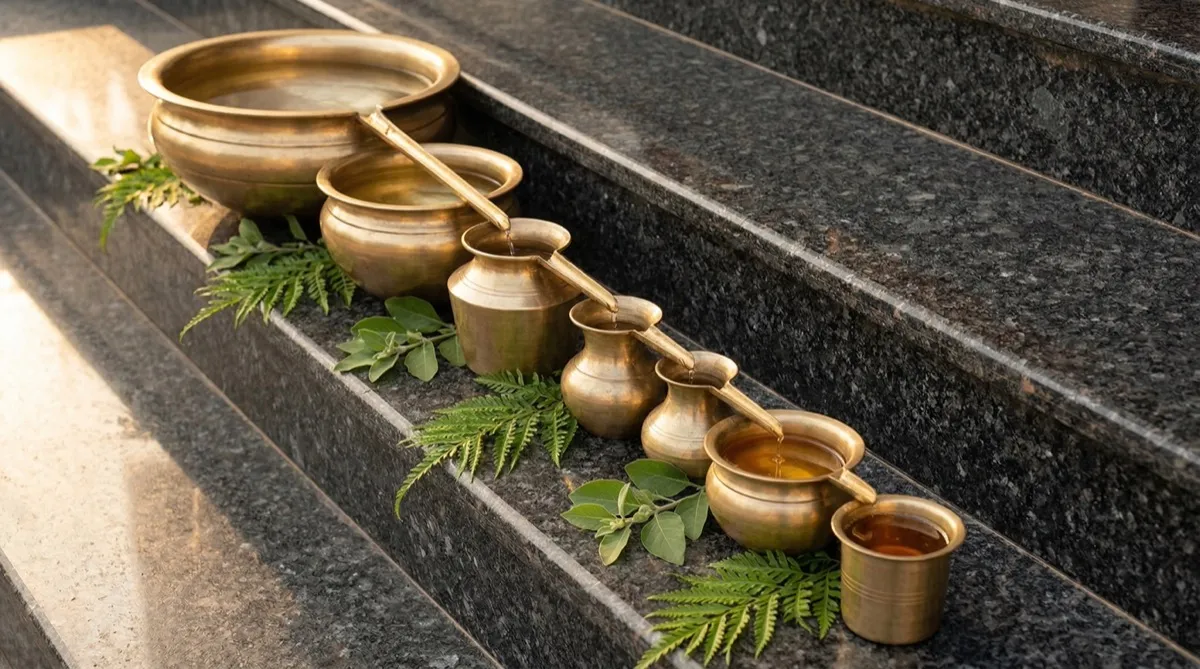
What Rasayana Actually Means — and What It Does Not
After the age of 35, your body starts building tissues from increasingly poor-quality raw material — and no supplement, superfood, or exercise routine can fix that without addressing the source. Ayurveda has a 3,000-year-old system for upgrading tissue quality at the source. They called it Rasayana.
This definition alone reveals something most people miss entirely. Rasayana is not about adding something exotic to your body. It is about ensuring that the most basic product of your digestion — Rasa dhatu — is of such high quality that every tissue built from it downstream (blood, muscle, fat, bone, marrow, reproductive tissue) is properly nourished. It is a quality upgrade at the source.
Charaka Samhita dedicates an entire section to Rasayana (Chikitsasthana, Chapters 1-4). This is not a footnote in the text. It is given the same weight as the treatment of fever, the treatment of metabolic disease, and the treatment of mental disorders. Sushruta Samhita, the other great pillar of classical Ayurveda, devotes Chikitsasthana Chapters 27-28 specifically to Rasayana, approaching it from a surgical-therapeutic perspective and adding detail about tissue regeneration and wound-healing enhancement that Charaka does not emphasise. Together, these two foundational texts establish Rasayana as one of the most extensively documented branches of Ayurvedic science. The ancient physicians considered rejuvenation not a luxury but a medical necessity — especially as the body ages and its capacity to produce high-quality tissues naturally diminishes.
What Rasayana is not: it is not anti-aging cream. It is not a supplement you take for six weeks. It is not a marketing term for expensive herbal capsules. It is a systematic, personalised, constitution-specific approach to rebuilding the body’s deepest tissues and restoring the intelligence that governs their production.
Did You Know?
The Kutipraveshika Rasayana retreat described by Charaka specifies a three-chambered dwelling built to exact specifications — facing east, triple-walled, with controlled light and airflow. The patient would remain inside for months, seeing no one except their physician. This is possibly the world’s oldest documented protocol for controlled clinical isolation — predating modern isolation-based medical therapies by over two millennia.
The Seven Tissues: Understanding Why Rasayana Works at Every Level
To understand why Rasayana is so powerful, you need to understand how Ayurveda views the body’s tissue system. This is one of the most elegant and practically useful frameworks in all of traditional medicine.
Ayurveda describes seven dhatus (tissues) that are produced sequentially from digested food. Each tissue nourishes the next in a precise chain: Rasa (plasma/lymph) → Rakta (blood) → Mamsa (muscle) → Meda (fat/adipose) → Asthi (bone) → Majja (marrow/nerve) → Shukra (reproductive tissue). The final product of this entire chain, when all seven tissues are properly nourished, is called Ojas — the essence of vitality, immunity, and radiant health.
Here is the critical insight: if Rasa dhatu — the first tissue — is of poor quality (because Agni is weak, or diet is wrong, or Ama is present), then every tissue downstream receives substandard raw material. It is like a factory where the incoming steel is impure: every product made from it will be flawed, no matter how good the machinery is. Poor Rasa leads to weak Rakta (anaemia, poor circulation), which leads to depleted Mamsa (muscle weakness), and so on down the chain until Ojas itself — your fundamental vitality — is diminished.
Rasayana works by upgrading the quality at the source. It strengthens Agni so that food is transformed into superior Rasa. It clears the channels so Rasa reaches all tissues without obstruction. And it provides specific nourishment that supports each tissue’s individual metabolic fire (Dhatvagni). The result is not surface-level improvement. It is a deep, systemic rebuilding that manifests as better energy, stronger immunity, clearer skin, sharper mind, and greater resilience.
Consider this: your body replaces roughly 3.8 million cells every second. That is not a number to skim past. Every second, nearly four million new cells are being manufactured from the raw material your digestion provides. If the raw material is poor — because Agni is weak, because Ama is present, because the food itself is devoid of vitality — then four million times a second, your body is building itself from substandard materials. Over a year, that is 120 trillion cells built from whatever you gave your body to work with. Rasayana is not about adding a supplement on top of this process. It is about upgrading the quality of the raw material so that every one of those 120 trillion new cells is built better than the one it replaced.
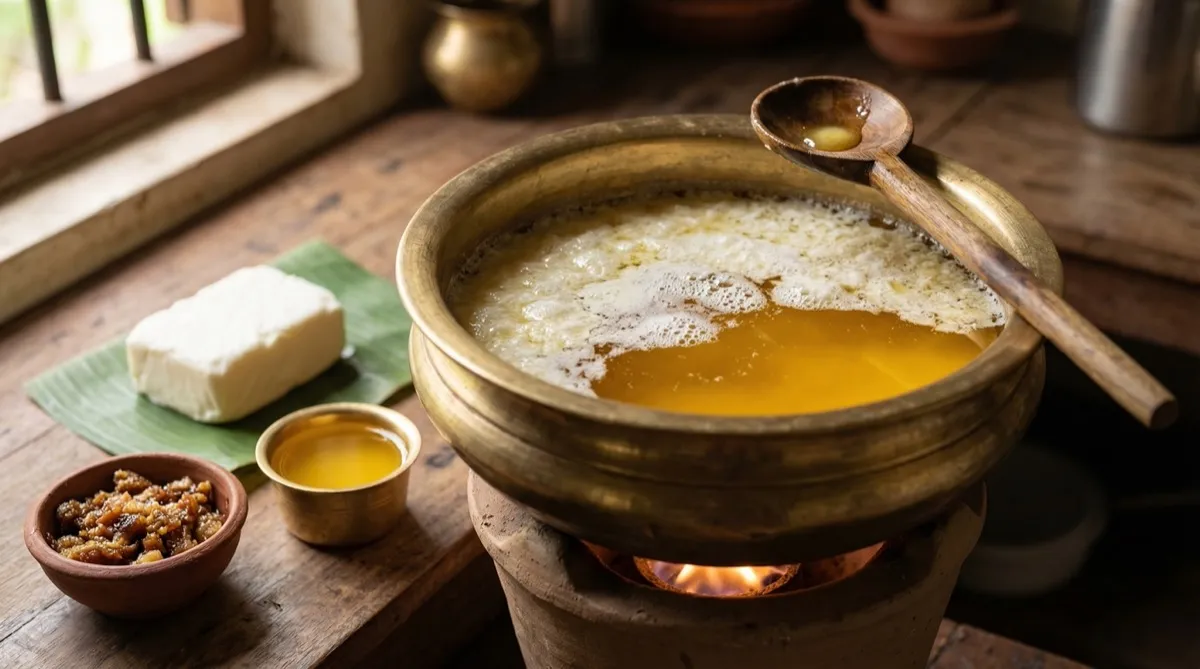
Three Categories of Rasayana — Most People Only Know One
When people hear “Rasayana,” they usually think of classical rejuvenative preparations — the famous herbal jams and formulations. But these represent only one category. Charaka describes three distinct types, and understanding all three changes how you think about rejuvenation entirely.
Aushadha Rasayana (Medicinal Rejuvenation) — This is what most people think of: specific herbs and formulations that directly nourish tissues and enhance Ojas. Classical rejuvenative preparations fall here, along with a wide range of traditional formulations selected based on individual assessment. But here is what most people do not realise: these formulations are not interchangeable. A Vata-pacifying Rasayana is primarily muscle-nourishing. A Pitta-cooling Rasayana supports reproductive tissue. A Majja-targeting Rasayana supports mental function. Using the wrong Rasayana for your constitution can actually create imbalance rather than resolve it.
Ajasrika Rasayana (Dietary Rejuvenation) — This is the category that should get far more attention than it does. Charaka states that certain foods, consumed regularly and in the right manner, function as Rasayana without any medicine at all. These include: milk (properly prepared, warm, from a healthy source), ghee (clarified butter — one of the most celebrated substances in Ayurveda), honey (raw, unheated), Indian gooseberry, and specific preparations of rice and wheat. The key word is “regularly” — these are not superfoods to binge on. They are daily nourishments that, over time, systematically improve tissue quality. This is why traditional Indian families instinctively include ghee in daily cooking and serve warm milk at night. These are not random cultural habits. They are embedded Rasayana practices passed down through generations.
Achara Rasayana (Behavioural Rejuvenation) — This is the most profound and most neglected category. Charaka lists specific behaviours and mental states that function as Rasayana: truthfulness, freedom from anger, non-violence, calmness of mind, regular spiritual practice, compassion, balanced sleep, cleanliness, charitable giving, and respect for teachers and elders (Charaka Samhita, Chikitsasthana 1/4.30-35). This is not moralising. The ancient physicians observed, through thousands of years of clinical practice, that people who maintained these behavioural patterns aged more slowly, fell ill less frequently, and recovered faster. Modern psychoneuroimmunology is now confirming what they observed: chronic anger, dishonesty, and stress literally accelerate cellular aging through cortisol, inflammatory cytokines, and telomere shortening. Ayurveda said it first. Without the lab equipment.
Did You Know?
Charaka lists “speaking the truth” and “freedom from anger” as Rasayana — not as moral advice, but as medical prescriptions with observable physiological effects. In 2009, Elizabeth Blackburn received the Nobel Prize in Physiology or Medicine for discovering how telomeres protect chromosomes — and subsequent research confirmed the mechanism: chronic psychological stress shortens these telomere caps, literally aging your DNA faster. The ancient physicians observed the same outcome through clinical pattern recognition 2,500 years before the microscope existed.
Two Modes of Rasayana Therapy — Kutipraveshika and Vatatapika
Beyond the three categories, the classical texts describe two distinct modes of administering Rasayana therapy. This distinction is almost never discussed outside traditional training, yet it fundamentally determines how Rasayana is delivered, how long it takes, and how deep the results go.
Kutipraveshika Rasayana (indoor/retreat-based) is the more intensive mode. The word “Kuti” means a specially constructed dwelling, and “Praveshika” means entering. The individual enters a controlled environment — Charaka describes a three-chambered dwelling facing east, with specific conditions of light, air, and quietude (Chikitsasthana 1/1.16-23). Inside this space, the body undergoes complete purification followed by intensive Rasayana administration. The isolation removes all external stressors, the controlled diet eliminates Ama-producing inputs, and the absence of physical exertion allows the body to direct its full metabolic energy toward tissue rebuilding. Sushruta Samhita also describes this method in detail (Chikitsasthana, Chapter 27-28), emphasising the importance of the controlled environment for maximising tissue regeneration.
Vatatapika Rasayana (outdoor/ambulatory) is the more practical mode for people who cannot withdraw from their daily responsibilities. “Vata” here means wind and “Atapa” means sunshine — the person remains exposed to the normal elements of daily life while taking Rasayana. This mode is less intensive but more accessible. It can be sustained over longer periods, months or even years, and is what most people in clinical practice actually receive.
The choice between these two modes depends on the individual’s condition, the severity of tissue depletion, their practical circumstances, and the practitioner’s assessment. Kutipraveshika is typically considered for severe depletion, post-illness recovery, or situations where deep rejuvenation is needed. Vatatapika suits ongoing maintenance, prevention, and situations where the person’s depletion is moderate. Both modes require proper Shodhana (purification) beforehand — neither works without that foundation.
The Channels Rasayana Nourishes — Why It Reaches Where Supplements Cannot
Ayurveda describes the body not just as tissues but as an elaborate network of channels called Srotas. These are the pathways through which nutrients, waste, and information flow. Understanding which Srotas Rasayana specifically targets explains why it produces effects that ordinary nutrition cannot match.
Rasavaha Srotas (channels carrying Rasa dhatu) is the primary target. When these channels are clear and well-nourished, the fundamental plasma tissue reaches every corner of the body with high-quality nutrients. Blockage or weakness in Rasavaha Srotas manifests as chronic fatigue, dull skin, poor appetite, and a general sense of depletion even when eating well. Raktavaha Srotas (channels carrying blood tissue) is the second target. Proper Rakta nourishment depends on excellent Rasa, and when Raktavaha Srotas is healthy, it shows as good complexion, clarity of skin, and strong circulation. Mamsavaha Srotas (channels of muscle tissue) determines physical strength and structural integrity. Medovaha Srotas (channels of fat tissue) governs proper fat metabolism — its imbalance is visible as either excessive weight or excessive leanness.
The deeper channels — Asthivaha Srotas (bone), Majjavaha Srotas (marrow and nerve tissue), and Shukravaha Srotas (reproductive tissue) — take the longest to nourish because they sit furthest downstream in the tissue chain. This is why authentic Rasayana is a sustained practice, not a quick intervention. A supplement might briefly influence surface-level markers, but Rasayana aims to nourish the deepest channels through sustained, systematic support over weeks and months. The classical texts note that Shukra dhatu, the last tissue, may take roughly 42 days to form from the food you eat today — approximately six days per dhatu, through all seven tissues. Rasayana respects this timeline rather than promising shortcuts.
Rasayana and the Seasons — Timing That Amplifies Results
One of the least-discussed but most practical aspects of Rasayana is its relationship to seasonal rhythms. Ayurveda is explicit that the body’s capacity to receive and integrate rejuvenation varies dramatically by season — what the texts call Ritu (season) and Bala (strength). Administering the same Rasayana in the wrong season can reduce its effectiveness or create imbalance.
Hemanta and Shishira (early and late winter) are considered the optimal seasons for intensive Rasayana therapy. During these cold months, Agni is naturally at its strongest — the body compresses its heat inward, intensifying digestive and metabolic fire. This strong Agni means the body can process and assimilate Rasayana formulations at peak efficiency. The classical Kutipraveshika Rasayana retreats were traditionally undertaken during winter for exactly this reason. Vasanta (spring) is the classical season for Shodhana (purification) rather than Rasayana. As temperatures rise, accumulated Kapha begins to liquefy and move, making it the ideal time to cleanse before rebuilding. Attempting heavy Rasayana in spring, when the body is naturally trying to purge, works against the body’s own intelligence.
Grishma (summer) is a time when Bala (strength) is naturally low and Agni is dispersed. Heavy Rasayana formulations are generally avoided. Instead, lighter Ajasrika Rasayana — cooling dietary practices, ghee, milk, and sweet seasonal fruits — suit this season. Achara Rasayana practices (behavioural rejuvenation) can be maintained year-round regardless of season. Varsha and Sharad (monsoon and autumn) require particular care. The monsoon weakens Agni further due to atmospheric moisture, making it a poor time for intensive Rasayana but suitable for gentle, Agni-supporting practices. Autumn, as the body regains strength and the residual Pitta from summer begins to clear, opens a second window for moderate Rasayana therapy.
This seasonal awareness is one of the reasons a practitioner-guided Rasayana programme produces results that self-administration often does not. The practitioner times the purification, the Rasayana, and the transitions according to the individual’s constitution and the prevailing season — a level of precision that no generic supplement regimen can replicate.
Did You Know?
Sushruta Samhita describes a mathematical relationship between digestion and tissue formation: it takes approximately 6 days for food to transform through each successive dhatu, meaning the meal you eat today will not fully nourish your deepest tissue (Shukra) for roughly 42 days. This is why Rasayana is never a quick fix — the body’s own manufacturing timeline demands sustained, patient practice. Fast results in rejuvenation are a contradiction in terms.
Why Rasayana Matters More After 35
Ayurveda divides the human lifespan into three broad phases. Childhood and youth (up to roughly 30-35) is Kapha-dominant — a time of growth, building, and accumulation. The middle years (35-60) are Pitta-dominant — a time of transformation, achievement, and metabolic intensity. The later years (60+) are Vata-dominant — a time of natural depletion, lightness, and gradual tissue thinning.
The transition from Kapha phase to Pitta phase — roughly around age 35 — is where most people first notice that their body no longer bounces back the way it used to. Recovery from illness takes longer. Energy dips in the afternoon. Sleep becomes lighter. The skin loses its youthful moisture. Joints start to whisper before they shout. Weight becomes harder to manage despite the same diet.
These are not random signs of “getting older.” They are specific signs that the body’s capacity to produce high-quality Rasa dhatu and nourish downstream tissues is beginning to decline. Agni, while still strong in the Pitta years, becomes more erratic. Ama accumulates more easily. The channels that carry nourishment begin to narrow or clog. This is precisely the point where Rasayana is most needed and most effective.
Starting Rasayana practices in your mid-30s is not vanity. It is preventive medicine of the most practical kind. You are strengthening the tissue production chain before it weakens significantly, rather than trying to rebuild it after it has already declined. A wall is easier to maintain than to reconstruct.
There is something about Achara Rasayana that deserves much more attention: the ancient physicians were saying that your psychological state is not separate from your biology. How you think, how you speak, how you relate to other people — these are not abstract moral categories. They are biological events. Every thought produces a chemical cascade. Every emotion alters your hormonal environment. Chronic anger literally acidifies tissue. Chronic dishonesty creates a low-grade stress response that never fully resolves. The ancients did not have cortisol assays or fMRI machines. They had something arguably more powerful — thousands of years of clinical observation across millions of patients. When they listed truthfulness and compassion as rejuvenative, they were not preaching. They were prescribing.
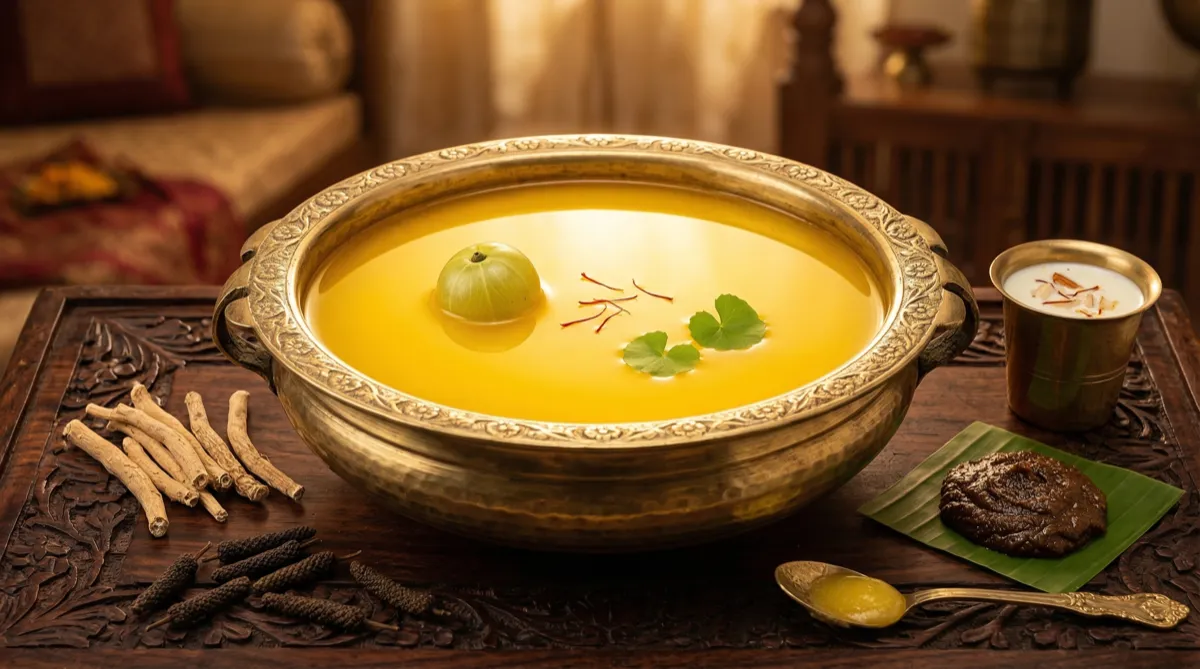
Ojas: The End Product That Determines Everything
If Rasayana is the process, Ojas is the result. Ojas is described in the classical texts as the subtle essence produced when all seven tissues are properly nourished and metabolised. It is, in a sense, the “cream” that rises to the top when the entire digestive-metabolic chain is functioning optimally.
Charaka describes Ojas as that which “maintains life” (Sutrasthana 17.75). A person with strong Ojas has bright eyes, glowing skin, strong immunity, mental clarity, emotional stability, and a natural magnetism that others can sense but cannot easily name. A person with depleted Ojas is perpetually tired, catches infections easily, heals slowly, and feels a pervasive sense of fragility — as if the body’s reserves have been drained.
What depletes Ojas? Chronic stress, irregular eating, excessive screen time, lack of sleep, overwork, suppressed emotions, excessive sexual activity, and habitual consumption of processed food. In other words: modern life. This is not coincidence. The lifestyle that contemporary society normalises is almost perfectly designed to drain Ojas. Rasayana is the systematic antidote.
The closest modern parallel to Ojas is a combination of robust immune function, healthy mitochondrial activity, balanced hormonal output, and psychological resilience. No single blood test measures it, but its presence or absence is unmistakable to an experienced practitioner — and, if you are honest with yourself, to you as well.
Did You Know?
Both Charaka and Sushruta independently document Rasayana — but from entirely different angles. Charaka approaches it as internal medicine (tissue quality, immunity, longevity), while Sushruta, the father of surgery, documents it as post-surgical recovery and wound regeneration. The fact that two physicians from different traditions and possibly different centuries both placed Rasayana at the centre of their work suggests it was considered the single most important branch of Ayurvedic practice for maintaining and restoring the body.
The Prerequisites Most People Skip
Here is something that separates authentic Ayurvedic Rasayana from the supplement industry: Rasayana does not work on a polluted body. Charaka is explicit about this. Before Rasayana can be effective, the body must be properly prepared. Taking a rejuvenative preparation on top of accumulated Ama is like painting over rust — it looks better temporarily but accomplishes nothing structural.
The classical prerequisite is Shodhana — purification. In practice, this means first correcting Agni, clearing accumulated Ama, and ensuring the srotas (channels) are open enough to receive and transport the enhanced nutrition that Rasayana provides. Without this preparation, even the finest Rasayana formulation cannot reach the tissues it is meant to nourish.
This is why Rasayana prescribed by an experienced Ayurvedic practitioner produces results that self-supplementation rarely achieves. The practitioner assesses the current state of your Agni, identifies where Ama is present, determines which channels are compromised, and designs a preparation phase before introducing Rasayana. The sequence matters as much as the substance — a reflection of the traditional approach that values precision and individual attention.
Rasayana You Can Begin Today
While personalised Rasayana requires professional assessment, certain Ajasrika (dietary) and Achara (behavioural) Rasayana practices are safe and beneficial for most people. These are not dramatic interventions. They are small, consistent habits that accumulate into profound changes over months and years.
Morning warm water with a squeeze of lemon — stimulates Agni after the night’s fast. Not ice water. Not coffee first thing. Warm water that gently awakens the digestive system. A teaspoon of ghee with your main meal — ghee is considered one of the greatest Rasayana substances in Ayurveda. It nourishes Rasa dhatu, supports Agni without aggravating Pitta, and carries the properties of other foods deeper into the tissues. Eating your largest meal at midday — when Agni is naturally strongest. This single change improves digestion, reduces Ama formation, and indirectly improves sleep quality. A few minutes of quiet sitting before sleep — not meditation as a performance, but simple stillness that allows Vata to settle and prepares the mind for natural sleep. Truthfulness and freedom from chronic anger — not as moral imperatives, but as Achara Rasayana. Chronic dishonesty creates Vata disturbance. Chronic anger aggravates Pitta and depletes Ojas directly.
None of these require a prescription. All of them, practised consistently, shift the body’s baseline toward better tissue quality. They are not substitutes for personalised Rasayana when it is needed — but they are the foundation on which deeper rejuvenation becomes possible.
Rasayana in Clinical Practice
At Santana Laxmi Ayurvedic Clinic, Rasayana is not treated as a separate “anti-aging programme.” It is woven into the treatment approach for many conditions — because when tissues are depleted and Ojas is low, no condition can be fully resolved without addressing the underlying tissue quality. A person with chronic fatigue, recurring infections, slow wound healing, or persistent low energy may benefit from Rasayana as a core part of their care, not as an add-on. Dr Sri Ramulu’s assessment identifies whether Rasayana is needed, which type is appropriate for your constitution, and how to sequence it with other aspects of care. Learn more about our clinical approach.
Rasayana Specialisations by Body System
Medhya Rasayana (Mind)
Supports cognitive function, memory, and mental clarity.
Associated with Majja Dhatu
Hridya Rasayana (Heart)
Supports cardiac wellness and emotional balance.
Associated with Rasa Dhatu circulation
Chakshushya Rasayana (Eyes)
Supports vision and eye health.
Associated with Alochaka Pitta
Twachya Rasayana (Skin)
Supports skin radiance and tissue nourishment.
Associated with Rasa and Rakta Dhatu
What Current Evidence Says
Several classical Rasayana formulations have attracted significant research attention. Key herbs used in these formulations have been studied in over 20 clinical trials, with systematic reviews in the Journal of Clinical Medicine finding improvements in stress resilience, sleep quality, and physical performance. Indian gooseberry is one of the richest natural sources of vitamin C and has demonstrated antioxidant activity in laboratory studies published by CCRAS.
Classical immunomodulatory Rasayana herbs received particular attention during the COVID-19 pandemic, with the Ministry of Ayush recommending traditional formulations for immune support. Preliminary research published in the Journal of Ethnopharmacology suggests certain Rasayana herbs may enhance macrophage activity and modulate inflammatory responses. Classical Medhya Rasayana (cognitive rejuvenatives) have been studied for cognitive function, with a meta-analysis in the Journal of Psychopharmacology finding improvements in attention and cognitive processing speed.
The Achara Rasayana concept — that behaviour patterns affect biological aging — finds striking support in psychoneuroimmunology research. Studies on telomere length by Elizabeth Blackburn (Nobel Prize in Physiology or Medicine, 2009) demonstrated that chronic psychological stress accelerates cellular aging, while meditation, compassion practices, and stress reduction can slow or partially reverse this process. The ancient Ayurvedic physicians observed the same pattern through clinical experience.
This article is for educational purposes only and does not constitute medical advice. Rasayana formulations should be taken under the guidance of a qualified Ayurvedic practitioner who has assessed your individual constitution and current condition. Self-prescribing concentrated herbal preparations without professional assessment can cause imbalance. Always consult your healthcare provider before starting any new health practice, especially if you are on existing medications, pregnant, or managing a chronic condition.