
Why Aging Is Not a Disease
Modern medicine often frames aging as a problem to be solved — a slow accumulation of dysfunction, a gradual failure of systems. This framing drives an entire industry of anti-aging products, supplements, and interventions that treat the passage of time as something to fight against. Ayurveda takes a fundamentally different position. Aging is not a disease. It is Vriddhaavastha — the natural final stage of life — and it has its own logic, its own physiology, and its own needs.
The classical texts divide the human lifespan into three broad stages. Bala (childhood and youth, roughly up to 30) is dominated by Kapha — a time of growth, building, and accumulation of tissue. Madhya (middle age, roughly 30 to 60) is dominated by Pitta — a time of transformation, metabolic intensity, and achievement. Vriddhaavastha (old age, 60 onward) is dominated by Vata — a time of natural depletion, lightness, dryness, and gradual tissue thinning. Charaka Samhita (Vimanasthana 8.122) describes this progression explicitly: the qualities of Kapha diminish, Pitta subsides, and Vata naturally rises.
This is not pathology. It is biology. Just as a tree does not “fail” when it stops growing taller and begins channelling energy into its roots and seeds, the human body in Vriddhaavastha is not failing — it is transitioning. The seven dhatus (tissues) naturally thin. Agni (digestive fire) gradually weakens. The srotas (channels) become less efficient. And with age, the vital reserve that sustained immunity, emotional steadiness, and the capacity to bounce back from illness — what Ayurveda calls Ojas — naturally thins as well. These changes are expected. The question is not how to prevent them, but how to navigate them wisely so that the elderly person maintains comfort, clarity, and dignity.
The decline of Ojas in aging deserves special attention. Classical Ayurveda distinguishes between Para Ojas (the superior, stable essence seated in the heart, present in minute quantity) and Apara Ojas (the secondary, circulating form distributed throughout the body). In youth, both forms are robust. As Vriddhaavastha progresses, Apara Ojas depletes first — the circulating vitality that supports tissue immunity, emotional resilience, and the body’s capacity to recover from stress. Over time, even Para Ojas gradually diminishes, which the classical texts associate with increasing vulnerability to illness, a loss of lustre (Prabha), declining enthusiasm (Utsaha), and a general sense of fragility. This Ojas framework explains why elderly individuals may not only feel physically weaker but also emotionally more vulnerable — Ojas is described as sustaining both physical and psychological stability. Recognising this depletion as a natural process, rather than a mysterious decline, allows families and practitioners to focus on Ojas-nourishing strategies through diet, rest, warmth, and emotional connection.
This distinction matters enormously in practice. When you frame aging as a disease, every natural change becomes a symptom to suppress. When you frame it as Vriddhaavastha, every natural change becomes a signal to adapt. Ayurveda does not promise to reverse aging. It promises to support the body through aging with intelligence, reducing unnecessary suffering while respecting the body’s natural trajectory.
Did You Know?
Charaka Samhita (Shareerasthana 6.12) states that the human body is composed of roughly 60% water — a figure strikingly close to the 55–65% modern physiology measures. As Vriddhaavastha progresses, this water content decreases significantly. The dryness, tissue thinning, and reduced resilience of aging are not mysterious — they are the body literally losing its relationship with its primary element. This is why Snehana (oleation) and warm fluids are not luxuries for the elderly but biological necessities: they are replacing what time is taking away.
Here is something rarely discussed: the human spine is not merely a structural column. In traditional body-mind understanding, the spine is the central axis around which all physiological and nervous system function organises. As Vata rises in old age, it affects the spine first — leading to the characteristic postural changes, the loss of height, the compression of nerve pathways that produces radiating pain, numbness, and reduced organ function. Many of the symptoms families attribute to “general aging” — digestive slowdown, bladder weakness, impaired circulation to the legs — trace back to Vata accumulation along the spinal column. Classical Ayurveda understood this: Basti therapy targets Vata at its seat in the lower spine precisely because calming Vata there sends ripple effects through the entire body.
The Vata Factor: Why Old Age Belongs to Vata
If you want to understand why elderly people experience the specific cluster of problems they do — joint stiffness, dry skin, constipation, sleep disruption, anxiety, tremors, memory difficulties, weight loss, feeling cold — you need to understand Vata. Every single one of these is a Vata manifestation. This is not coincidence. It is the defining feature of Vriddhaavastha.
Vata dosha has five key qualities: dry (Ruksha), light (Laghu), cold (Sheeta), rough (Khara), and mobile (Chala). As Kapha’s grounding, lubricating, stabilising influence withdraws with age, these Vata qualities become dominant. The skin loses moisture and becomes thin and papery — that is Ruksha. Bones lose density and muscles lose mass — that is Laghu. Circulation weakens and the elderly person feels cold even in warm weather — that is Sheeta. Joint surfaces lose their smooth cartilage cushion — that is Khara. The mind becomes restless, sleep fragments, and tremors appear — that is Chala.
Charaka describes five subtypes of Vata, each governing different functions. In the elderly, the most commonly disturbed are: Prana Vata (governing the mind, senses, and breathing — when disturbed, it causes anxiety, confusion, and breathlessness), Samana Vata (governing digestion — when disturbed, it causes erratic appetite and bloating), Apana Vata (governing elimination — when disturbed, it causes constipation and urinary difficulty), and Vyana Vata (governing circulation — when disturbed, it causes poor peripheral circulation and muscle weakness).
Closely linked to this Vata rise is what the texts call Indriya Daurbalya — the progressive weakening of the Indriyas (sense organs). As Prana Vata becomes increasingly unstable with age, the sense organs it governs lose their acuity. Hearing diminishes first in many individuals, followed by changes in vision — not just acuity but also the ability to adapt between light and dark. Taste perception shifts, which partly explains why elderly people often find food less appealing, compounding the Agni problem. Touch sensitivity changes, and the sense of smell may dull. Charaka does not treat these as separate, unrelated declines. They are all expressions of the same underlying Vata aggravation affecting the sensory pathways. This understanding has a practical consequence: the general Vata-pacifying measures that support joint health and sleep also support sensory function, because the root cause is shared.
Understanding this Vata framework changes everything about how you care for an elderly person. Instead of treating each symptom separately — a laxative for constipation, a sleeping pill for insomnia, an anxiolytic for anxiety, a moisturiser for dry skin — Ayurveda addresses the underlying Vata aggravation that produces all of them simultaneously. Pacify Vata, and the entire cluster of symptoms begins to settle. This is one of the most practically powerful insights Ayurveda offers for geriatric care.
Agni in the Elderly: The Weakening Digestive Fire
If Vata is the dominant dosha of old age, Mandagni (weak digestive fire) is its constant companion. Agni — the metabolic fire responsible for transforming food into nourishment — naturally weakens as the body ages. This is not a failure of the digestive system. It is a predictable consequence of the same Vata increase that affects everything else. Vata’s erratic, mobile quality makes Agni unstable. Some days the appetite is reasonable; other days it vanishes entirely. Some foods are tolerated; others that were eaten for decades suddenly cause discomfort.
Charaka Samhita (Chikitsasthana 15) is explicit: Mandagni in the elderly leads to Ama (toxins) formation even from small quantities of food. This Ama then blocks the already narrowing srotas, further reducing nutrient delivery to the dhatus. It is a vicious cycle — weak Agni produces Ama, Ama blocks channels, blocked channels weaken dhatu nourishment, weakened dhatus further disturb Vata, and disturbed Vata further weakens Agni.
This is why dietary strategy in elderly care is not simply about nutrition. An elderly person may eat perfectly balanced meals and still suffer from malnutrition if their Agni cannot transform the food into usable Rasa dhatu. The classical approach focuses on making food digestible rather than merely nutritious. Warm, well-cooked, slightly oily foods. Smaller portions eaten more frequently. Soups and broths rather than raw salads. Spices that kindle Agni without aggravating Pitta. Avoiding cold food and drink, heavy foods that overwhelm weakened Agni, and eating at irregular times that further destabilise Samana Vata.
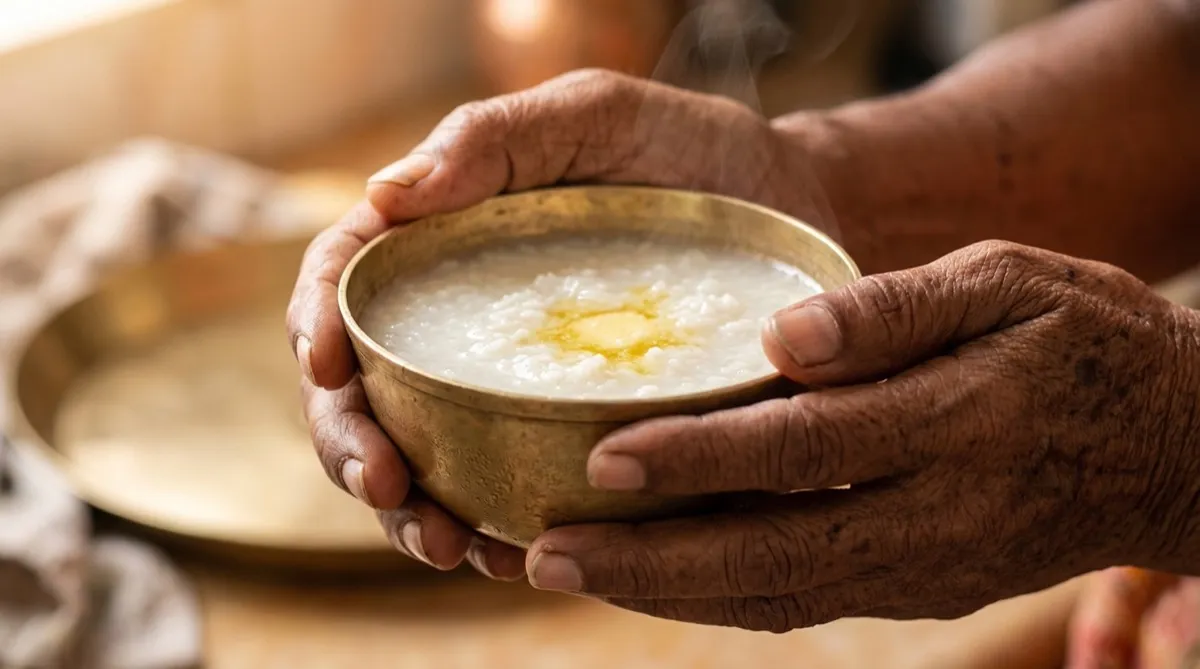
The practical implication is striking: many elderly people are told to eat more, when the real solution is to eat better — food that their Agni can actually process. A bowl of warm rice gruel with ghee and a pinch of digestive spice may nourish an elderly person more effectively than a large plate of raw vegetables and protein supplements, because the gruel is within their Agni’s capacity to transform.
Did You Know?
Sushruta Samhita (Sutrasthana 46.526) records that food is not merely fuel — it is information that instructs every cell in the body. The classical physicians observed that warm, freshly cooked food carried a quality they called Prana (life force), while stale, reheated, or cold food was Prana-depleted. Modern research on the gut microbiome is arriving at a parallel conclusion: fresh, warm, easily digestible food produces a dramatically different microbial and metabolic response than processed or reheated food. For the elderly, whose Agni is already fragile, this distinction between “living food” and “dead food” is not philosophical — it determines whether the body receives nourishment or accumulates Ama.
Consider this: the human body generates its entire blood volume (Rakta Dhatu) roughly every 120 days. Even in old age, the body is constantly rebuilding itself. The question Ayurveda asks is not whether the body can regenerate — it can, even at 80 — but whether the raw materials (properly digested food), the transformation capacity (Agni), and the delivery system (Srotas) are functioning well enough to support that rebuilding. This reframes elderly care entirely: it is not about fighting decline, but about ensuring the body’s natural rebuilding process receives what it needs to continue.
Rasayana: The Science of Rejuvenation in Elderly Care
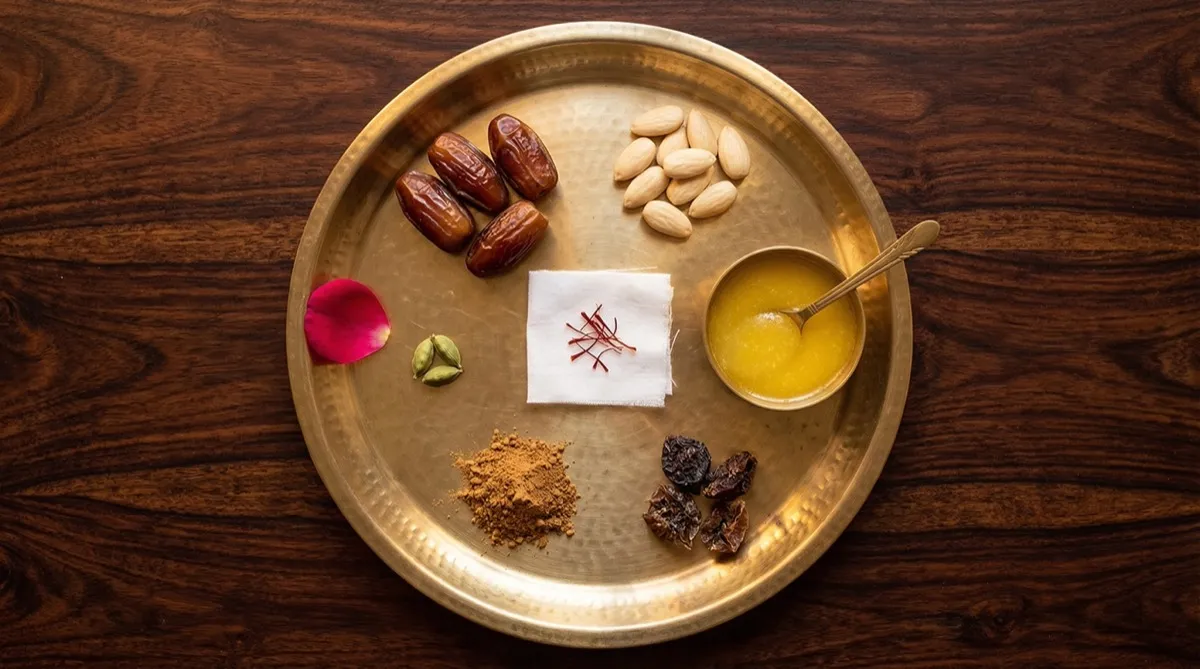
Of all the branches of Ayurveda, Rasayana (rejuvenation science) is most directly relevant to elderly care. But it is essential to understand what Rasayana means in this context. It does not mean reversing aging. It does not mean anti-aging pills or overnight formulations. Rasayana in elderly care means systematically nourishing depleted tissues, rebuilding Ojas (vitality), strengthening whatever Agni remains, and supporting the body’s capacity to maintain function for as long as possible.
Charaka dedicates four entire chapters to Rasayana (Chikitsasthana 1–4) and makes a critical distinction that is often missed: Rasayana is not a single substance. It is a comprehensive approach that includes Aushadha Rasayana (medicinal rejuvenation through specific formulations), Ajasrika Rasayana (dietary rejuvenation through daily foods like ghee, warm milk, and properly prepared grains), and Achara Rasayana (behavioural rejuvenation through truthfulness, compassion, regular routine, and emotional balance).
For the elderly, all three categories are relevant, but Ajasrika and Achara Rasayana often matter more than people realise. An elderly person who eats warm, nourishing food at regular times, maintains gentle daily habits, sleeps well, and lives in an emotionally supportive environment is practising Rasayana daily — even without a single medicinal formulation. The formulations enhance this foundation; they do not replace it.
There is an important caveat here. Charaka is explicit that Rasayana works best on a prepared body — one where Ama has been cleared and channels are open. In elderly patients, aggressive purification is often not appropriate. The practitioner must assess carefully how much preparation the body can tolerate and select Rasayana approaches that are gentle enough for the elderly constitution. This is why personalised assessment matters so profoundly in geriatric Ayurvedic care — what works for a robust 40-year-old is inappropriate for a frail 75-year-old.
Practical Daily Care: Dinacharya for Elders
The Dinacharya (daily routine) described in classical texts needs significant modification for elderly individuals. The standard recommendations — early rising, vigorous exercise, certain seasonal practices — assume a body with strong Kapha and Pitta reserves. An elderly body operating with dominant Vata and weakened Agni needs a gentler, more nurturing version.
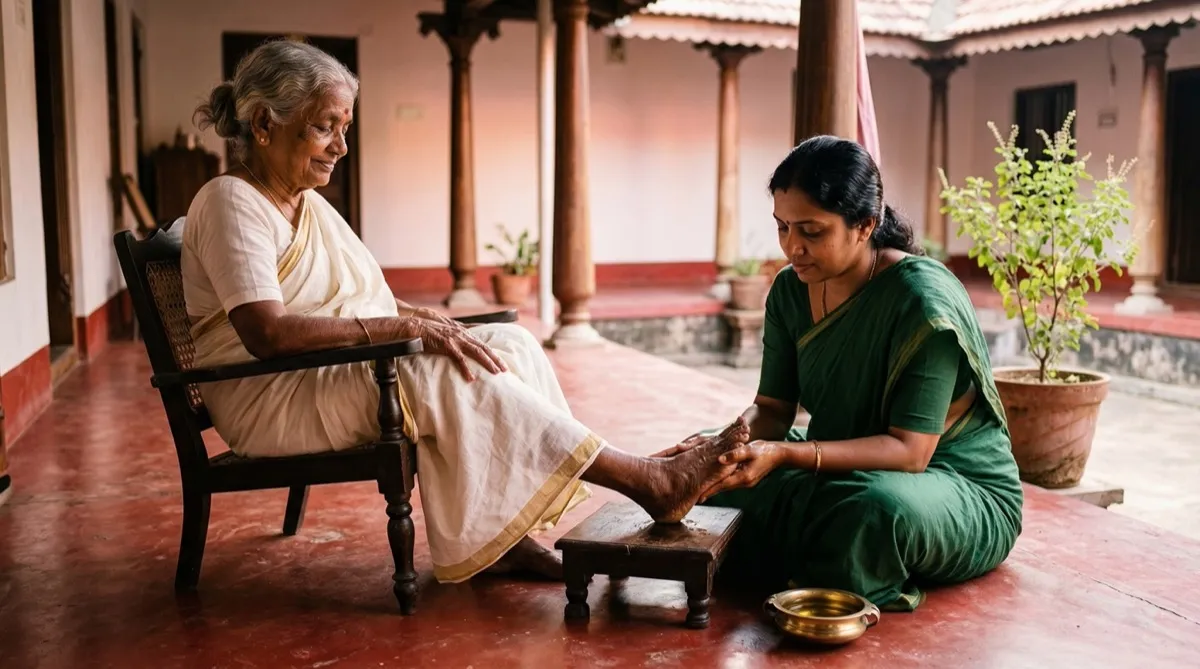
Abhyanga (oil massage) is perhaps the single most important daily practice for the elderly. Charaka specifically recommends regular oil application for Vata management (Sutrasthana 5.81-83). Warm sesame oil, applied gently to the joints, feet, scalp, and body, directly counteracts Vata’s dryness, roughness, and coldness. For elderly people with joint stiffness, morning Abhyanga before bathing can make a remarkable difference in mobility and comfort. It also supports circulation, nourishes the skin, calms the nervous system, and improves sleep quality. Families often underestimate how much this simple daily practice can improve an elderly person’s quality of life.
Warm, cooked food at regular times supports the weakened Agni. The elderly should eat their main meal at midday when Agni is naturally strongest, with lighter meals in the morning and evening. Ghee with food is specifically recommended by the classical texts for its Vata-pacifying and Rasayana properties. Cold food, raw food, leftover food, and heavy food should be minimised. The emphasis is on warm, fresh, easily digestible preparations.
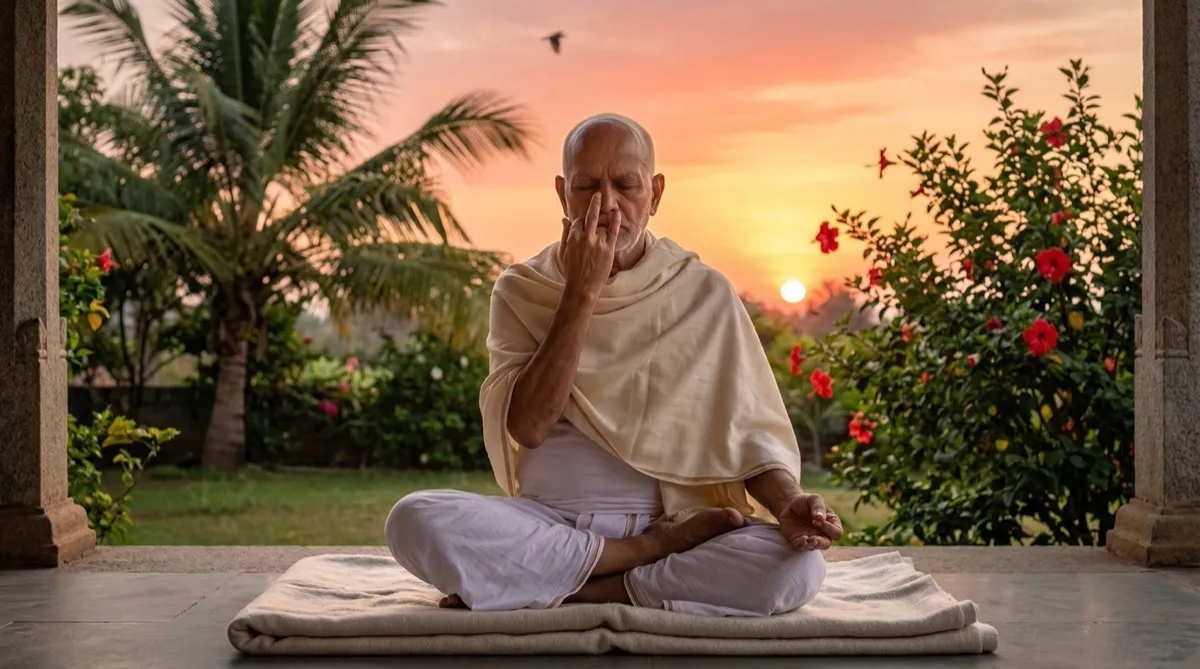
Gentle movement replaces vigorous exercise. Slow walks, gentle stretching, and simple breathing exercises are more appropriate than the vigorous regimens suitable for younger bodies. Charaka warns against excessive exercise (Ativyayama) for those with Vata predominance (Sutrasthana 7.33). The goal is to maintain mobility and circulation without depleting an already depleted system. Exhaustion after exercise is a clear sign that the activity level is too high.
Sleep hygiene becomes critical. Vata disturbance commonly fragments sleep in the elderly — difficulty falling asleep, waking repeatedly at night, early morning waking. Warm milk before bed, foot massage with warm oil, a quiet and warm sleeping environment, and consistent sleep timing all help. The classical texts recommend that elderly people may take a brief daytime rest (unlike younger adults, for whom daytime sleep is generally discouraged) because their nighttime sleep is naturally lighter and shorter.
Family’s Role in Elderly Ayurvedic Care
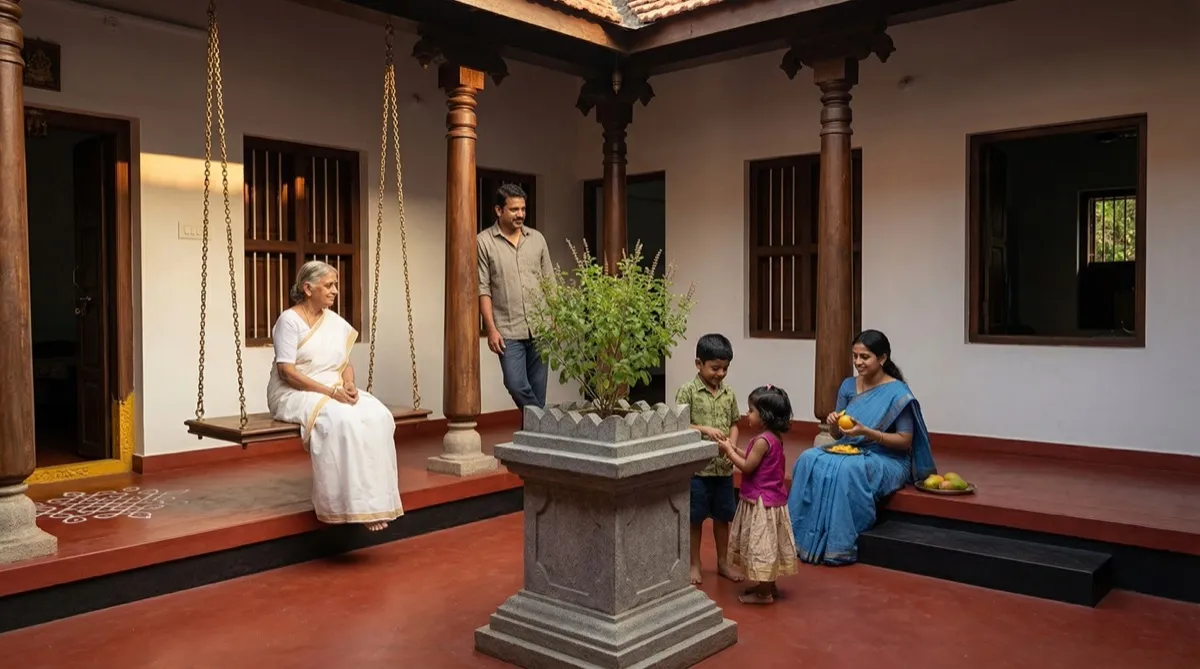
In traditional Indian culture, elderly care is a family responsibility — not a problem to outsource. Ayurveda assumes this context. The classical texts describe elderly care as a family practice, not an institutional one. And families bring something that no clinic can: daily observation, emotional warmth, and continuity of care.
The most important thing a family can do is observe. Families see what practitioners cannot — how the elderly person eats day to day, whether they are sleeping well, whether their mood is shifting, whether they are moving less, whether small changes in behaviour signal a deeper shift. These observations, reported accurately at consultations, allow the practitioner to make more precise adjustments than any periodic assessment alone could achieve.
Dietary support is the second pillar. Ensuring that an elderly family member receives warm, freshly cooked food at regular times is one of the most effective forms of Ayurvedic care — and it requires no prescription. Avoiding the temptation to give elderly parents packaged food, cold leftovers, or restaurant meals out of convenience is itself a health intervention. Many traditional Telugu households already practise this instinctively — warm rice, dal, ghee, and seasonal vegetables served fresh at consistent times. This is not just cultural tradition. It is applied Ayurvedic geriatric nutrition.
Emotional warmth matters more than most people realise. Vata governs the nervous system, and emotional isolation, loneliness, and feeling unvalued directly aggravate Vata — worsening anxiety, sleep disruption, and cognitive decline. An elderly person who feels connected, valued, and emotionally secure has a fundamentally different Vata landscape than one who feels forgotten. Achara Rasayana — the behavioural dimension of rejuvenation — includes the social and emotional environment. Charaka lists “respect for elders” as a Rasayana practice for the person giving it. The implication is bidirectional: being respected is Rasayana for the elderly person receiving it. For families navigating the broader landscape of supporting elderly relatives through Ayurvedic consultations, our guide for family members covers the practical aspects of what to expect and how to participate.
Ayurveda also recognises that caregiving itself is demanding work that can deplete the caregiver’s own balance. A family member who is chronically sleep-deprived, emotionally strained, or neglecting their own meals and routine will gradually develop their own Vata aggravation — anxiety, fatigue, digestive difficulty. The classical principle applies equally: you cannot pour from an empty vessel. Families caring for elderly relatives should also attend to their own Dinacharya, Ahara, and emotional needs, not as a luxury but as a practical requirement for sustainable care.
Did You Know?
Charaka’s Achara Rasayana (Chikitsasthana 1/4.30-35) identifies “respect for elders” (Vriddha Upasevi) as a behaviour that literally functions as rejuvenation therapy — not metaphorically, but physiologically. A 2023 meta-analysis in Nature Human Behaviour confirmed that social isolation increases mortality risk by 26%, comparable to smoking 15 cigarettes a day. Charaka quantified this connection 2,000 years earlier: he placed Achara Rasayana (behavioural rejuvenation through social connection, truthfulness, and emotional warmth) alongside medicinal Rasayana in importance. The ancient physicians observed what modern epidemiology now measures — that loneliness is not just an emotion but a metabolic state that accelerates tissue depletion.
Elderly Care at the Clinic
Many families commonly seek Ayurvedic guidance for elderly relatives dealing with joint stiffness, digestive difficulties, sleep problems, general weakness, or simply the desire to maintain quality of life as they age. At Santana Laxmi Ayurvedic Clinic, Dr Sri Ramulu’s assessment of elderly patients is particularly careful — evaluating not just the presenting concern but the overall state of Vata, the strength of Agni, the condition of the dhatus, and the patient’s daily routine and family support system.
The approach is always gentle and individualised. Formulations for elderly patients tend to be milder, given in forms that are easier to digest — ghritams (medicated ghee), lehyams (medicated jams), and warm preparations rather than strong kashayams that might overwhelm a weakened Agni. Dietary and lifestyle recommendations are practical and family-oriented, because the practitioner understands that the elderly patient’s care happens at home, not in the clinic.
What Current Evidence Says
Research into Ayurvedic approaches to geriatric care is an active area. The Central Council for Research in Ayurvedic Sciences (CCRAS), under the Ministry of Ayush, has conducted studies on Rasayana formulations in elderly populations, with some studies reporting improvements in subjective well-being, sleep quality, and functional capacity. A 2019 review published in the Journal of Ayurveda and Integrative Medicine documented the classical Ayurvedic framework for Jara Chikitsa (geriatric care) and its alignment with contemporary geriatric principles.
Abhyanga (therapeutic oil massage) has received some research attention, with small clinical studies suggesting benefits for joint mobility, pain reduction, and sleep improvement in elderly subjects. The WHO Traditional Medicine Strategy has called for better integration and research into traditional systems of medicine for aging populations. However, large-scale randomised controlled trials specific to Ayurvedic geriatric protocols remain limited, and most evidence comes from smaller studies, clinical experience, and the extensive classical literature.
Modern geriatric medicine increasingly recognises the importance of personalised, multi-modal care — combining diet, lifestyle, social support, and targeted interventions — which closely mirrors the Ayurvedic approach to Vriddhaavastha. The emphasis on maintaining digestive function, preventing sarcopenia (muscle loss), and supporting cognitive health through holistic interventions aligns with principles Ayurveda has articulated for millennia.
This article is for educational purposes only and does not constitute medical advice. Elderly care requires careful, individualised assessment. Always consult your healthcare provider before starting any new health practice for an elderly family member, especially if they are on existing medications or managing chronic conditions. Ayurvedic care should complement, not replace, conventional medical care. Do not discontinue prescribed medications without consulting the treating physician. Seek immediate medical attention for acute or emergency conditions.