
What Ama Actually Is — And What It Is Not
Right now, there is almost certainly something inside your body that should not be there — a sticky, heavy residue that your digestion failed to finish processing. Ayurveda calls it Ama. And it considers Ama, not bacteria, not viruses, not genetics, the root cause of most chronic disease.
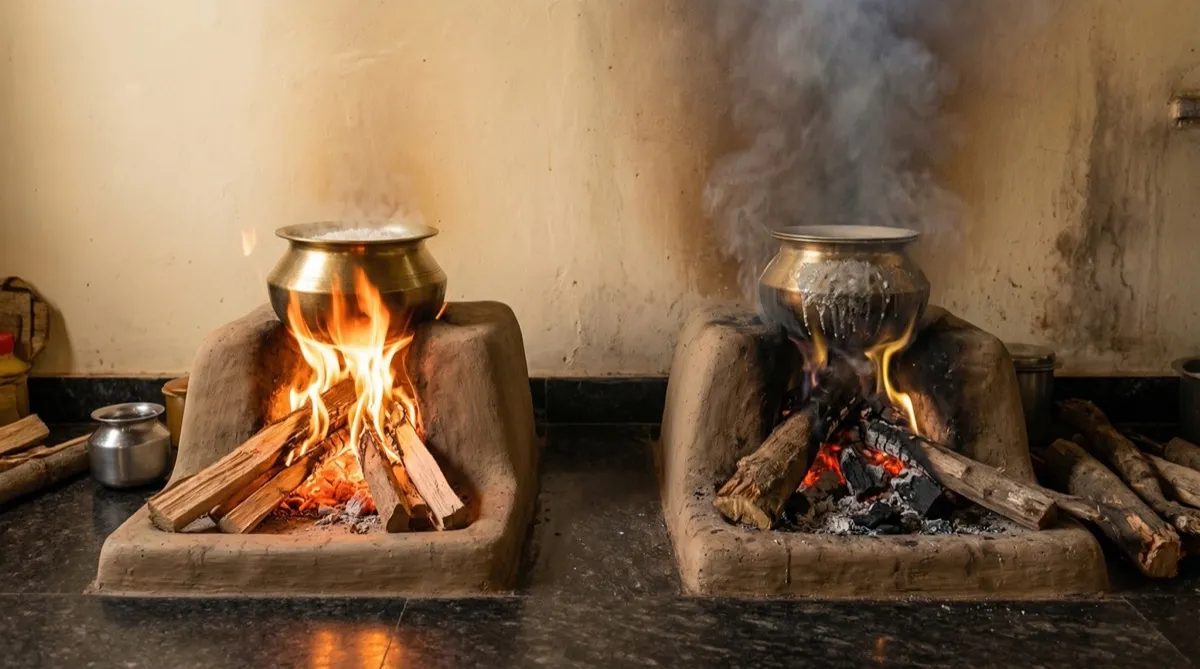
This is the first thing to understand: Ama is not the same as “toxins” in the way modern wellness culture uses that word. It is not about mysterious chemicals lurking in your food or environmental pollutants. Ama is a specific, observable, clinically meaningful substance that forms when your Agni (digestive fire) fails to completely transform what you eat into usable nutrition. Think of it this way: when a fire burns clean, it produces heat, light, and fine ash. When it smoulders, it produces smoke, soot, and a thick residue that coats everything. Your body works the same way.
The Ashtanga Hridaya, one of the three great classical texts of Ayurveda, describes Ama with striking clinical precision: it is heavy (guru), cold (sheeta), wet (kleda), slimy (picchila), turbid (avila), and foul-smelling (durgandhi). These are not metaphors. They are diagnostic descriptors that Ayurvedic practitioners have used for millennia to assess a patient's metabolic state — and they correlate directly with observable symptoms that patients can recognise in their own bodies.
Vagbhata, the author of the Ashtanga Hridaya, stated it plainly in Sutrasthana 13: “The very first dhatu (tissue) — Rasa — when improperly formed due to weak Agni, becomes Ama.” In other words, Ama is not something that invades your body from outside. It is produced by your own digestive process when that process is compromised. The enemy is not external. The problem is internal.
How Ama Forms: The Four Root Causes
Ama does not appear randomly. Classical Ayurvedic texts identify four clear mechanisms through which Ama accumulates, and understanding them gives you direct, practical control over whether your body produces more or less of it.
Mandagni — weak digestive fire. This is the primary cause. When Jatharagni (the main digestive fire) is too weak to completely process food, the partially digested material ferments in the gut instead of being transformed into nutrient-rich Rasa dhatu. The fermented mass becomes Ama. This is why Ayurveda places such enormous emphasis on protecting and strengthening Agni — strong Agni simply does not produce Ama, regardless of what you eat.
Ajeerna — eating before the previous meal is digested. Even if your Agni is reasonably strong, eating again while the previous meal is still being processed overwhelms the digestive system. The new food mixes with the half-digested old food, and the entire mass stagnates. Charaka calls this Adhyashana (eating on top of undigested food) and identifies it as one of the fastest routes to Ama formation. It is also one of the most common habits in modern life, where constant snacking and irregular meal timing are the norm.
Viruddhahara — incompatible food combinations. Ayurveda has detailed rules about which foods should not be eaten together. The classic example is milk with fish, or fruit with meals — combinations where each food requires a fundamentally different digestive environment. When incompatible foods enter the stomach simultaneously, Agni cannot process them efficiently, and the result is Ama. Modern food science acknowledges some of these interactions through the study of enzyme competition and digestive pH requirements.
Emotional suppression and mental disturbance. Here is something many people miss about the Ama concept: it is not purely physical. Charaka explicitly states that eating while emotionally disturbed — angry, grieving, anxious, or deeply stressed — creates Ama regardless of how good the food is or how strong your Agni normally is. The stress response diverts blood and energy away from the digestive organs, and Agni dims. This is why the daily routine (Dinacharya) emphasises eating in a calm, seated, attentive state. The emotional environment of a meal matters as much as the food itself.
Did You Know?
Charaka Samhita describes Ama as having properties exactly opposite to Ojas (vital essence). Ojas is light, warm, clear, sweet-smelling, and life-sustaining. Ama is heavy, cold, turbid, foul-smelling, and disease-causing. In the Ayurvedic framework, your health at any given moment reflects the balance between these two forces — the refined product of perfect digestion versus the residue of incomplete digestion.

Here is a perspective on Ama that changes everything: your body is not a container that passively fills up with waste. It is an extraordinarily intelligent system that is constantly self-cleaning. Every cell in your body has its own waste management programme. The liver alone performs over 500 metabolic functions. The lymphatic system is an entire waste-collection network. Ama accumulates not because the body lacks cleaning mechanisms, but because you are producing waste faster than the system can process it — or because you have weakened the very systems designed to clear it. It is like running a dishwasher while continuously loading dirty plates. The machine works. You are simply overwhelming it. Understanding this shifts the question from “how do I detox?” to the far more useful “how do I stop overwhelming my body’s built-in detoxification?”
The Six Stages of Disease: How Ama Progresses
One of the most sophisticated concepts in all of Ayurveda is Shat Kriya Kala — the six stages through which a disease develops. What makes this framework genuinely eye-opening is that the first four stages are subclinical. They happen before any disease is diagnosable by modern methods. And Ama is central to every stage.
Shat Kriya Kala — The Six Stages of Disease
From subtle accumulation to chronic complications
Dosha begins to build up in its home site. Subtle signs like mild heaviness or slight digestive change.
Accumulated dosha becomes irritated and active. More noticeable symptoms — bloating, acidity, restlessness.
Dosha overflows from its home site and begins spreading through channels (srotas). Symptoms start appearing elsewhere.
Dosha lodges in a weak tissue (dhatu) or organ. This is where disease takes root. Specific symptoms emerge.
Full disease becomes clinically apparent. Named conditions appear with clear signs and symptoms.
Chronic stage with structural changes. Harder to reverse. Complications and secondary conditions develop.
Stage 1 — Sanchaya (Accumulation). Ama begins to accumulate in its site of origin, typically the gastrointestinal tract. At this stage, you might notice mild symptoms: slight heaviness after meals, occasional bloating, a faint coating on the tongue. Most people ignore these signals or reach for an antacid. An Ayurvedic practitioner would recognise this as the earliest warning sign — the ideal moment to intervene, when correction is simplest.
Stage 2 — Prakopa (Aggravation). The Ama continues to build because the root cause (weak Agni, poor eating habits, stress) has not been addressed. The symptoms become more noticeable: persistent bloating, irregular appetite, fatigue after eating, thicker tongue coating, perhaps some acid reflux or irregular bowel movements. The body is sending louder signals now.
Stage 3 — Prasara (Spread). This is the critical turning point. The accumulated Ama overflows from its original site and enters the general circulation via the Srotas (body channels). It is no longer just a digestive problem. The Ama is now mobile, moving through the blood and lymph, looking for a place to settle. You might feel generalised symptoms: body aches, low-grade fatigue, a sense of heaviness that is no longer limited to the stomach, skin that looks dull and congested, or a foggy quality to your thinking.
Stage 4 — Sthana Samshraya (Localisation). The circulating Ama finds a weak point in the body — a tissue or organ that is already compromised, either by constitutional vulnerability (your Prakriti), previous injury, or genetic predisposition — and lodges there. This is the stage where the disease is “choosing” its target. One person's Ama may settle in the joints. Another's in the thyroid. Another's in the reproductive system. The weakness of the tissue determines where Ama takes root. Still, even at this stage, no disease is diagnosable by modern clinical tests.
Stages 5 & 6 — Vyakti and Bheda (Manifestation and Complications). Only in stage 5 does the disease finally produce symptoms clear enough for a clinical diagnosis. By stage 6, the disease has become chronic, with complications affecting related systems. Modern medicine typically encounters patients at stages 5 and 6 — when the disease is fully manifest. Ayurveda's entire diagnostic framework is built to catch Ama at stages 1 through 3, when reversal is straightforward.
A critical clinical distinction: stages 1 through 4 are considered functionally reversible. The dosha is displaced and Ama is accumulating or spreading, but no structural damage has occurred — the tissues themselves remain intact. Correcting diet, restoring Agni, and clearing Ama at these stages can fully resolve the imbalance. Stage 5 (Vyakti) marks a threshold: the disease has manifested with tissue involvement, and while significant improvement is often possible, reversal requires more sustained effort. Stage 6 (Bheda) involves structural changes to the tissue itself — degeneration, fibrosis, or permanent alteration — making full reversal unlikely, though management and stabilisation remain achievable goals.
Did You Know?
The concept of Shat Kriya Kala (six stages of disease) was described by Sushruta over 2,500 years ago. Modern medicine is now developing similar frameworks — studying subclinical inflammation, metabolic syndrome, and pre-disease markers. The idea that disease has a long, detectable pre-clinical phase is not new to Ayurveda; it is foundational.
How to Recognise Ama in Your Own Body
Unlike many medical concepts, Ama is something you can assess yourself. Classical Ayurvedic texts describe several observable signs, and experienced practitioners assess these at the very beginning of every consultation.
The tongue. This is the single most reliable self-assessment tool. Look at your tongue first thing in the morning, before brushing or eating. A thick white, yellowish, or greyish coating — especially toward the back of the tongue — indicates Ama. A clean, pink tongue with minimal coating indicates good Agni and low Ama. The colour of the coating can indicate which dosha is involved: white suggests Kapha-type Ama, yellow suggests Pitta-type, and brownish-grey suggests Vata-type or chronic Ama.
Digestive signs. Persistent bloating, heaviness after meals that lasts more than an hour, foul-smelling gas or stools, a sense of incomplete evacuation, loss of appetite or erratic appetite, and a sweet or sour taste in the mouth between meals. These all indicate that digestion is incomplete and Ama is being produced.
Systemic signs. Morning stiffness in the joints, generalised body aches, mental fog or difficulty concentrating, persistent fatigue that sleep does not resolve, dull or congested skin, and a general sense of heaviness — as though you are carrying extra weight even when you are not. When Ama has spread beyond the digestive system (stage 3 and beyond), these generalised symptoms appear.
The pulse. An experienced Ayurvedic practitioner can detect Ama through Nadi Pariksha (pulse diagnosis). Ama-laden pulse has a distinctive quality — it feels heavy, sluggish, and somewhat slippery or slithery rather than crisp and distinct. This subtle skill takes years to develop but provides remarkably precise clinical information about a patient's metabolic state.
When Ama Becomes Dangerous: Amavisha
Fresh Ama, while problematic, is relatively easy to clear. The real danger comes when Ama sits in the body for a long time without being addressed. Over time, Ama undergoes a transformation — it becomes heated by the body's own metabolic processes and develops a toxic, reactive quality. Classical texts call this Amavisha — literally, “Ama-poison.”
Amavisha is qualitatively different from fresh Ama. Fresh Ama is cold, heavy, and sluggish. Amavisha is hot, sharp, and inflammatory. When Ama combines with Pitta dosha at a tissue site, it creates a condition called Sama Pitta — an inflammatory state that Ayurveda considers the precursor to most chronic inflammatory conditions. When Ama combines with Vata, it creates Sama Vata — marked by erratic pain, variable symptoms, and neurological involvement. When it combines with Kapha, it produces Sama Kapha — characterised by congestion, swelling, and accumulation.
This is one of the most clinically significant ideas in all of Ayurveda: it is not Ama alone or dosha alone that creates disease. It is the combination — Ama locking into a specific dosha at a specific tissue site — that produces the particular disease pattern. Remove the Ama, and the dosha can often self-correct. This is why treatment always begins with Ama, regardless of the diagnosis.
It is worth noting that Ama does not form only in the gut. Ayurveda describes Dhatvagni — the tissue-level metabolic fires that operate within each of the seven Dhatus (tissues). When any Dhatvagni is weakened, that specific tissue produces its own form of incompletely processed material called Dhatugata Ama (tissue-level Ama). This is fundamentally different from the gut-level Ama produced by weak Jatharagni: it is subtler, more localised, and harder to detect. It is also one reason why two patients with the same dietary habits can develop problems in entirely different tissues — the weakness may lie not in the central digestive fire, but in a specific tissue fire.
Ama Pachana: The Classical Approach to Clearing Ama
The Ayurvedic approach to Ama is methodical and sequential. It is not about “detox” in the modern wellness sense of the word. It is a carefully staged clinical process with distinct phases, each of which must be completed before the next begins. Attempting to nourish (Brimhana) or tonify the body while Ama is still present is one of the most common mistakes in Ayurvedic practice.
Nidana Parivarjana — Remove the cause. Before any treatment, identify and remove whatever is producing the Ama. If the cause is dietary (poor food combinations, overeating, irregular timing), correct the diet. If the cause is emotional (chronic stress, suppressed grief), address the emotional root. If the cause is behavioural (late nights, lack of exercise, eating while distracted), change the behaviour. No amount of treatment will help if the cause is still active — you would be mopping the floor with the tap still running.
Langhana — Lightening. The first active treatment step is to lighten the body's load. This typically involves a period of simplified eating — light, warm, easily digestible foods that give Agni a chance to recover without overloading it. Fasting (partial or complete, as appropriate for the individual's constitution and strength) is one form of Langhana. The goal is not weight loss — it is to create space for Agni to rekindle and begin processing the existing Ama backlog.
Ama Pachana — Digesting the Ama. Once Agni starts to recover, specific approaches help it “digest” the accumulated Ama. Classical texts describe two complementary categories here: Deepana (fire-kindling) — approaches that strengthen Agni itself so it burns more efficiently — and Pachana (digestion-promoting) — approaches that help break down and process the existing Ama without necessarily increasing the fire. Deepana rekindles; Pachana clears. In practice, the practitioner often uses both in sequence or combination, monitoring tongue coating, appetite return, and energy levels as indicators that Ama is being cleared. This is the origin of the broader term Ama Pachana (literally, “cooking the Ama”).
Shodhana — Purification. In cases where Ama has spread deeply into the tissues (stages 4 and beyond), simple Pachana is not sufficient. Panchakarma — the five purification procedures — may be recommended. This is a supervised clinical process that physically removes deep-seated Ama from the tissues and channels. It is not a spa treatment — it is a medical procedure that requires proper preparation (Purvakarma), skilled administration, and careful post-treatment recovery (Paschatkarma).
Shamana — Balancing. Only after Ama is cleared and Agni is restored does the practitioner move to the rebalancing phase. This is where constitutional assessment matters most — the specific support for a Vata-predominant person differs significantly from that of a Pitta or Kapha type. Any tonifying or Rasayana (rejuvenation) therapy is introduced only at this stage, when the body's channels are clear enough to actually receive and distribute the nourishment.
There is something even more fundamental that most discussions of Ama miss. Your body does not just digest food. It digests experience. Every sensory input — what you see, hear, read, absorb through screens — must be processed by the mind in a way that parallels how Agni processes food. Unprocessed emotional experiences create their own form of mental Ama — what Ayurveda calls Manovaha Srotas obstruction. This is why you can eat perfectly and still feel heavy, foggy, and unwell if your life is filled with unresolved stress, unfinished conversations, and constant sensory overload. The modern information diet is perhaps the most overlooked source of Ama in contemporary life.

Daily Practices That Prevent Ama
Preventing Ama is far simpler than clearing it once it has accumulated. These daily practices, drawn directly from classical texts, keep Agni strong and Ama at bay.
These practices matter most during seasons when Agni is naturally weak. Ayurveda teaches that Agni is at its lowest during Varsha Ritu (the monsoon season), when humidity and atmospheric pressure dampen the digestive fire. This is when Ama formation risk peaks, and when dietary discipline becomes most important. For a month-by-month guide to how Agni shifts through the year, see the Seasonal Wellness Calendar.
Eat only when genuinely hungry. True hunger is the body's signal that Agni is ready to process food. Eating by the clock, out of boredom, or out of habit creates Ama. Wait for the unmistakable physical sensation of hunger — a lightness in the stomach, a clarity of mind, and an actual desire for food — before eating.
Drink warm water first thing in the morning. A glass of warm water on an empty stomach gently stimulates Agni and helps flush overnight Ama from the digestive tract. This simple practice, done consistently, is one of the most effective Ama-prevention habits in Ayurveda.
Finish dinner early and keep it light. Agni naturally weakens after sunset. Eating a heavy dinner late at night virtually guarantees Ama formation. Aim to finish dinner by 7 PM (or at least three hours before bed), and make it the lightest meal of the day — warm soups, light grains, cooked vegetables.
Move your body daily. Regular physical activity — walking, yoga, or any movement you enjoy — stimulates Agni, opens the Srotas (channels), and helps the body process and eliminate Ama. Dinacharya prescribes morning exercise before breakfast, which kickstarts Agni for the day.
Eat in peace, with attention. Sit down. Put the phone away. Chew thoroughly. These are not trivial suggestions — they directly affect whether your nervous system is in a digestive state (parasympathetic) or a stress state (sympathetic). Agni cannot function properly when the body is in fight-or-flight mode.
Did You Know?
The concept of Ama (metabolic toxins from incomplete digestion) finds a striking parallel in modern research on endotoxemia — where bacterial lipopolysaccharides leak from the gut into the bloodstream due to impaired digestion and gut barrier dysfunction. The mechanism Ayurveda described as “undigested material entering channels where it doesn’t belong” is remarkably close to what researchers now call “leaky gut” and metabolic endotoxemia.
What Current Evidence Says
While Ama does not have a direct one-to-one equivalent in modern medicine, several areas of contemporary research show striking parallels. The study of intestinal permeability (“leaky gut”), where incompletely digested food particles enter the bloodstream and trigger immune responses, mirrors the Ayurvedic description of Ama overflowing from the gut into general circulation.
The emerging science of metabolic endotoxemia — where bacterial lipopolysaccharides from the gut enter the blood and drive systemic inflammation — aligns remarkably with the concept of Amavisha (toxic Ama). Similarly, the role of advanced glycation end-products (AGEs), metabolic waste products that accumulate in tissues and contribute to aging and chronic disease, echoes the Ayurvedic understanding of Ama lodging in specific tissue sites.
Research published through the Central Council for Research in Ayurvedic Sciences (CCRAS) and referenced by the Ministry of Ayush has explored the relationship between Ama and measurable inflammatory markers. While more research is needed, the growing scientific interest in the gut-immune axis, the microbiome, and metabolic inflammation suggests that the Ayurvedic framework of Ama may offer a valuable complementary lens for understanding chronic disease pathogenesis.
This article is for educational purposes only and does not constitute medical advice. If you experience persistent digestive issues, unexplained fatigue, chronic pain, or other concerning symptoms, please consult your physician for proper evaluation. Fasting or dietary changes should be undertaken with appropriate guidance, especially for individuals with diabetes, eating disorders, pregnancy, or other medical conditions. Traditional Ayurvedic approaches should complement — not replace — conventional medical care.