
Why a Seasonal Calendar Matters
You know you should eat differently in summer than in winter. But when exactly should you switch? Which month is your digestion at its weakest? When are you most vulnerable to getting sick? This calendar gives you the month-by-month answer that most seasonal wellness articles leave out.
The problem is that most people know the theory but struggle to apply it. When exactly should you shift from warming to cooling foods? Which months carry the highest risk for Kapha disorders? When is Agni at its weakest? This calendar translates the classical six-season framework into a month-by-month guide you can actually follow. For the deeper theory behind these recommendations, see our complete Ritucharya guide.
The Two Halves of the Year
Before diving into individual months, understand the overarching pattern. Ayurveda divides the year into two halves based on the sun's movement:
Uttarayana (Adana Kala) — January to June: The sun moves northward, intensifying heat. This half is drying, depleting, and progressively weakening. Your body gradually loses strength, and Agni fluctuates. The dominant tastes that naturally increase are tikta (bitter), kashaya (astringent), and katu (pungent).
Dakshinayana (Visarga Kala) — July to December: The sun moves southward. Cooling, nourishing, strengthening. Moisture returns, the earth replenishes, and your body rebuilds. The dominant tastes are amla (sour), lavana (salty), and madhura (sweet). Agni gradually strengthens through this half, peaking in early winter.
This is not abstract philosophy — it has direct consequences for what you eat, how you exercise, and when you are most vulnerable to illness.
Each dosha follows a three-phase cycle through the year called Sanchaya-Prakopa-Prashama — accumulation, aggravation, and pacification. A dosha first builds silently (Sanchaya), then erupts into active disturbance (Prakopa), and finally subsides (Prashama). Understanding this cycle is the key to prevention: if you address a dosha during its Sanchaya phase, you can prevent the Prakopa phase entirely. The seasonal recommendations below are timed precisely around these phases.
At a Glance: The Ayurvedic Year
Months are approximate and vary by region. Ritu Sandhi (seasonal junction) periods are marked — these 15-day transition windows require gradual dietary shifts.
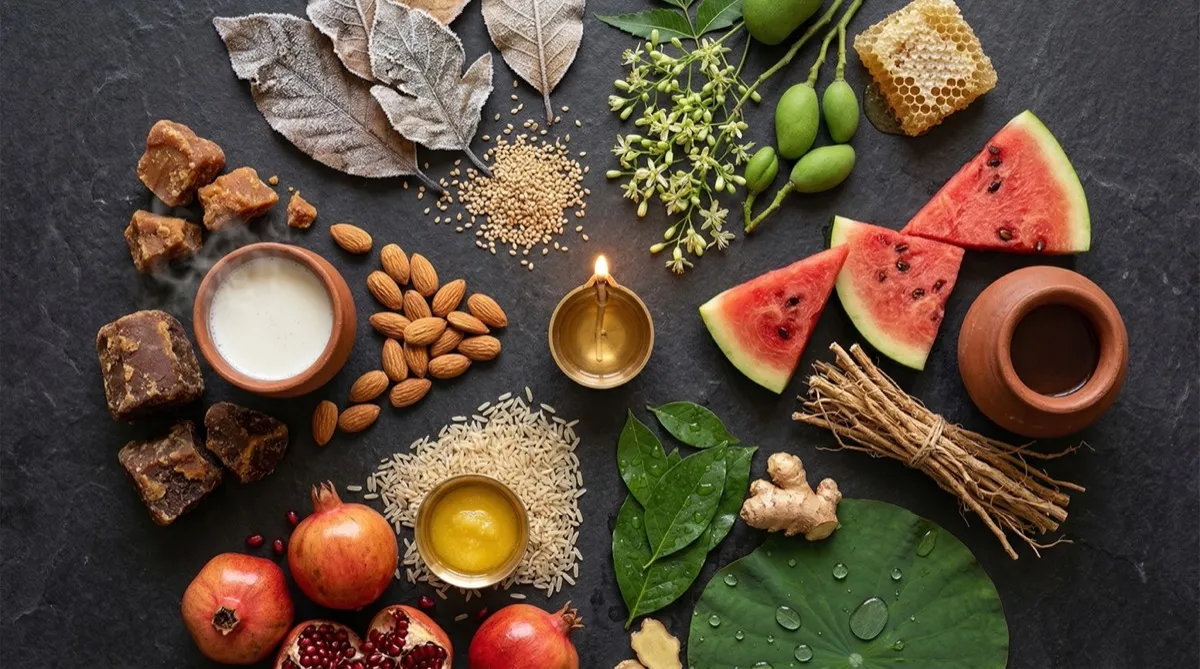
Here is a thought that reframes seasonal wellness entirely: you are not separate from the seasons. You are the seasons. The same five elements that compose the external environment — earth, water, fire, air, and space — compose your body in different proportions. When the external elements shift with the seasons, the internal elements shift in response. Summer does not just happen around you — it happens inside you. The heat outside is the heat inside. The moisture of monsoon is the moisture in your tissues. This is not metaphor. It is the elemental logic that makes Ritucharya work. Seasonal living is not about adapting to an external environment. It is about recognising that the environment and your body are two expressions of the same system.
Hemanta — Early Winter (November – January)
Dosha state: Vata calms down. Kapha begins to accumulate. Pitta is balanced. This is the peak of bodily strength for the entire year.
Agni: At its strongest. The cold weather drives heat inward, concentrating digestive fire in the gut. This is the one time of year your body can comfortably handle heavy, rich, oily foods. Charaka Samhita (Sutra Sthana, Chapter 6) specifically says that failing to eat adequately during Hemanta causes the strong Agni to consume bodily tissues instead. This peak Agni is directly connected to the Ayurvedic concept of Bala (strength). Of the three types of Bala — Sahaja (constitutional, born with), Kalaja (time-dependent, seasonal), and Yuktikrita (acquired through diet and lifestyle) — Kalaja Bala reaches its annual peak during Hemanta. Winter Agni is strongest precisely because Kalaja Bala is highest, and this is why the classical texts encourage building Yuktikrita Bala through nourishing food and exercise during this window, when the body can absorb it most effectively.
Food: Favour warm, nourishing, heavy meals. Ghee, sesame oil, fresh milk, wheat preparations, jaggery, and warming spices are ideal. This is the season for rich traditional foods — Telugu festival foods like til (sesame) laddoos at Sankranti are perfectly aligned with Hemanta requirements. Sweet, sour, and salty tastes dominate.
Lifestyle: Oil massage (Abhyanga) with warm sesame oil is highly recommended. Exercise can be vigorous — this is the season when your body can handle the most physical exertion. Warm baths, warm clothing, and early sleep support the body's natural strength.
Watch for: Undereating. Many people diet during winter, which is counterproductive — your Agni is demanding fuel. Ignoring this leads to tissue depletion (Dhatu Kshaya). Also watch for early Kapha accumulation signs: mild heaviness, sluggishness after meals, slight mucus increase.
Did You Know?
The 2017 Nobel Prize in Physiology or Medicine was awarded to Jeffrey Hall, Michael Rosbash, and Michael Young for their discoveries in circadian biology — the molecular mechanisms governing how organisms adapt to daily and seasonal cycles. Ayurveda’s Ritucharya mapped seasonal biological rhythms thousands of years earlier. Charaka Samhita (Sutra Sthana, Chapter 6) described that Agni peaks in Hemanta (winter) when cold drives metabolic heat inward, and weakens during Varsha (monsoon) when atmospheric moisture disperses it. Modern metabolic research published in journals like Nature and Cell Metabolism confirms that basal metabolic rate increases in cold months and decreases in warm, humid months — following the exact same seasonal pattern the ancient texts described without any of today’s measurement tools.
Shishira — Late Winter (January – March)
Dosha state: Kapha continues accumulating but remains dormant. Vata is low. Agni is still strong, though slightly less than Hemanta's peak.
Agni: Still robust. Continue with nourishing foods, but begin very gently lightening as you approach March. The body is transitioning — this is Ritu Sandhi (seasonal junction) between winter and spring, and it is one of the most vulnerable periods of the year.
Food: Similar to Hemanta — warming, nourishing, with sweet, sour, and salty tastes. Slightly reduce the heaviest foods (deep-fried items, very dense sweets) as you move into late February. Warm soups, stews, and freshly cooked grains remain excellent. Continue with ghee and sesame.
Lifestyle: Continue oil massage and moderate-to-vigorous exercise. Morning routine (Dinacharya) is especially important during this junction period. Keep the body warm. Avoid sleeping during the day — this accelerates Kapha accumulation.
Ritu Sandhi alert (late February – early March): The 15-day transition between Shishira and Vasanta is a critical window. Accumulated Kapha from two months of winter is about to liquefy. People with Kapha-dominant constitutions commonly notice respiratory congestion, heaviness, or allergic symptoms during this exact period. Gradual dietary lightening during this window helps prevent spring Kapha disorders.
Vasanta — Spring (March – May)
Dosha state: Kapha melts and floods the system. This is the season of maximum Kapha aggravation. Pitta begins gentle rise. Vata is balanced.
Agni: Weakening as external heat increases. The liquefied Kapha can directly suppress digestive fire, leading to the sluggish, heavy feeling many people experience in March–April. This is why spring is traditionally the season for cleansing and lightening.
Food: Shift decisively toward light, dry, and warm foods. Bitter, pungent, and astringent tastes are therapeutic now — they directly counter Kapha. Old barley, honey (never heated), green gram (moong dal), and light vegetables are ideal. Reduce sweet, sour, and salty tastes. Avoid heavy, oily, cold foods. The Ugadi tradition of eating Ugadi Pachadi with all six tastes marks the official Ayurvedic new year and the reset from winter to spring eating.
Lifestyle: Increase exercise — brisk walking, active outdoor movement. Dry massage (Udvartana) with powders is preferable to oil massage during this season. Nasya (nasal administration of medicated oils) is traditionally recommended to clear accumulated Kapha from the head and sinuses. Wake early. Avoid daytime sleep entirely.
Watch for: Respiratory congestion, spring allergies, sinus problems, sluggish digestion, skin breakouts, excessive mucus, weight gain. These are all signs of Kapha aggravation and are most commonly reported during March–April. This is when people with chronic Kapha conditions often see flare-ups.
Grishma — Summer (May – July)
Dosha state: Kapha pacifies. Vata begins accumulating due to the drying heat. Pitta rises. This is the peak of the depleting Adana Kala half — bodily strength is at its annual low.
Agni: Weak. The intense external heat disperses digestive fire. This is why most people naturally lose appetite in summer. Do not force heavy meals — respect the body's signal. Eating beyond Agni's capacity creates Ama (toxins).
Food: Sweet, cool, liquid, and light. Buttermilk (Takra), coconut water, rice gruel, sweet fruits, cooling vegetables (cucumber, ash gourd, bottle gourd), and light dal preparations. Ghee in moderate amounts is still appropriate. Avoid pungent, sour, and salty tastes — they increase heat. Avoid fermented foods, heavy non-vegetarian dishes, and excessive spices. Kitchen staples like cumin and coriander in cooling preparations support summer digestion without adding heat.
Lifestyle: Reduce exercise intensity significantly. Gentle walking in cooler hours (early morning, evening) is ideal. Oil massage with coconut oil. Stay in cool, shaded areas. Wear light, loose clothing. Sandalwood paste application is traditionally recommended for cooling. This is the worst season for intense physical training — your body cannot sustain it.
Ritu Sandhi alert (late June – early July): The transition from Grishma to Varsha is dangerous because accumulated Vata from months of drying heat meets the sudden moisture of the monsoon. This junction commonly triggers joint pain flare-ups, digestive disturbance, and viral fevers. Maintain light eating and avoid sudden dietary changes during this window.

Varsha — Monsoon (July – September)
Dosha state: Vata is aggravated — this is its peak disturbance period. Pitta continues accumulating but has not yet erupted. Kapha is mildly provoked by the moisture. This is arguably the most complex season for health maintenance.
Agni: At its weakest for the entire year. The combination of Vata disturbance, atmospheric moisture, and contaminated water creates ideal conditions for digestive problems. Most food-borne and water-borne illnesses peak during monsoon for this exact reason — weak Agni cannot process impurities.
Food: Warm, light, freshly cooked — nothing cold, raw, or leftover. Sour and salty tastes help counter Vata. Old rice, light soups (yusha), moong dal, warm milk with ginger, and moderate amounts of ghee. Honey is recommended (unheated). Strictly avoid raw salads, cold beverages, street food, and heavy-to-digest foods. Water should be boiled and consumed warm.
Lifestyle: Oil massage with warm medicated oils (Tailam) is essential for managing Vata. Avoid getting wet in rain or staying in damp clothing. Fumigate living spaces with traditional herbs. Avoid daytime sleep. Gentle exercise only — the body is at its weakest. Basti (medicated enema therapy) is classically the primary Panchakarma for monsoon Vata management, always administered under practitioner supervision.
Watch for: Joint pain and stiffness (Vata), digestive problems (weak Agni), skin infections (moisture + impurities), fevers, water-borne illness, bloating, and gas. People with existing Vata conditions — arthritis, back pain, nervous system concerns — commonly report their worst symptoms during monsoon.
Sharad — Autumn (September – November)
Dosha state: Pitta erupts. After accumulating through summer and monsoon, Pitta reaches its peak aggravation when the post-monsoon sun returns. Vata calms. Kapha is balanced. Charaka specifically uses the term Pitta Prakopa for this season — the full-blown aggravation phase of Pitta's annual cycle — and calls it “the most dangerous for Pitta disorders.”
Agni: Gradually recovering. Be cautious — Agni is rebuilding but not yet at full strength. Do not overload it with heavy foods too quickly. Moderate portions of easily digestible food allow Agni to recover naturally.
Food: Sweet, bitter, and astringent tastes pacify Pitta. Favour cooling foods — rice, ghee, green gram, sweet fruits, milk, and bitter greens. Avoid pungent, sour, and salty tastes — they aggravate the already erupting Pitta. Avoid curd (yogurt), fermented foods, and excessively spicy meals. The classical texts specifically recommend foods prepared with ghee that has been infused with bitter herbs.
Lifestyle: Cooling practices. Moonlight exposure is classically recommended (called Chandramsa Bhojana). Sandalwood paste, pearl-based preparations, and jasmine are traditionally cooling. Virechana (therapeutic purgation) is the classical Panchakarma for Sharad — it directly addresses accumulated Pitta. Moderate exercise, avoiding intense midday sun, and early sleep help the body through this transition.
Watch for: Acid reflux, skin rashes, inflammatory conditions, burning sensations, loose stools, migraines, and irritability — all signs of Pitta eruption. People with Pitta-dominant constitutions commonly experience their worst symptoms in October–November. This is also when many chronic skin conditions flare up.
Ritu Sandhi alert (late October – early November): The transition from Sharad to Hemanta requires gradually shifting from cooling to warming foods. Do not abruptly switch to heavy winter meals — transition over the 15-day Ritu Sandhi period. Your Agni is still recovering; sudden heavy food can overwhelm it.
Did You Know?
Your gut microbiome is seasonal. Research published in Science (2014) studying the Hadza hunter-gatherers of Tanzania found that their intestinal bacterial populations cycle predictably with the seasons — certain species flourish in the wet season and recede in the dry season, then return the following year. The foods available in each season feed specific bacterial populations, which in turn produce different metabolites that affect immunity, mood, and digestion. When you eat the same food year-round, you flatten this microbial seasonality — effectively running a single operating system when your body evolved to switch between several. Ayurveda’s insistence on seasonal eating may have been protecting this microbial diversity long before we had the tools to measure it.
Ritu Sandhi — The Seasonal Junctions
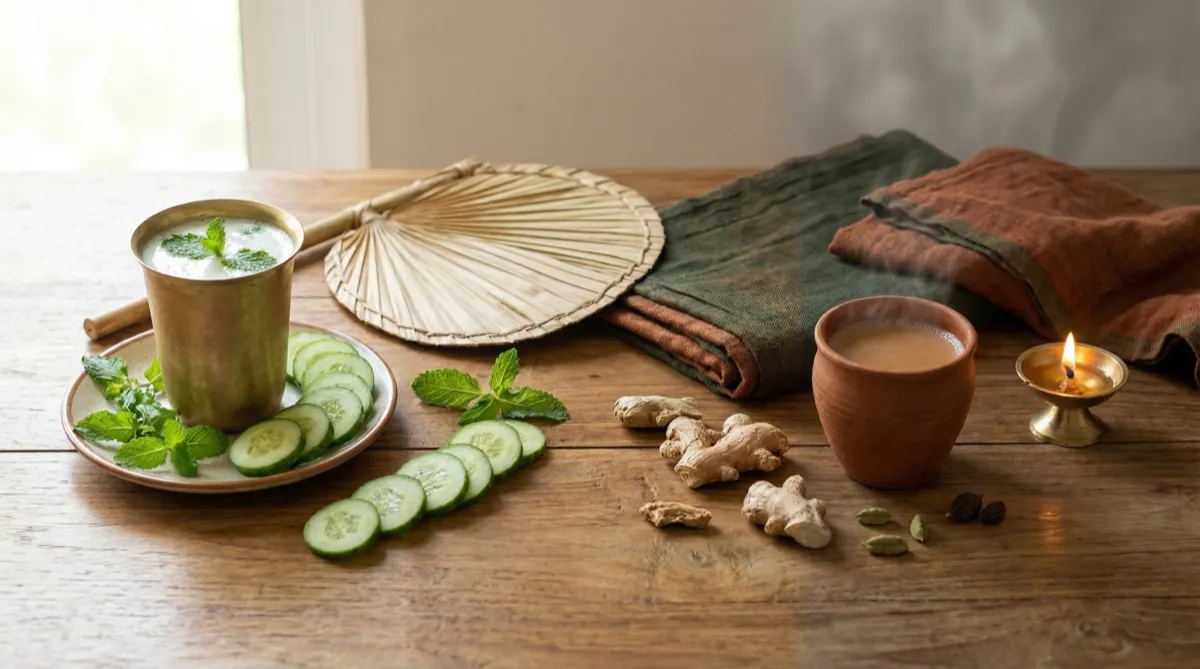
Every seasonal transition includes a Ritu Sandhi — a 15-day window (the last 7 days of the outgoing season plus the first 7 days of the incoming season) where the body is most vulnerable. The classical principle from Ashtanga Hridaya (Sutra Sthana, Chapter 3) is clear: gradually withdraw the previous season's regimen and gradually adopt the next season's regimen over this 15-day window. Never make abrupt changes.
The three most critical Ritu Sandhis for the Indian climate are: Shishira–Vasanta (February–March) when Kapha disorders peak, Grishma–Varsha (June–July) when Vata and digestive problems surge, and Sharad–Hemanta (October–November) when Pitta must be carefully transitioned out. People who fall ill “when the season changes” are experiencing exactly what the texts predicted — Ritu Sandhi vulnerability.
Did You Know?
Charaka Samhita (Sutra Sthana, Chapter 6) identified Ritu Sandhi — the 14-day junction windows between seasons — as the periods when people fall ill most frequently. He prescribed a precise protocol: gradually withdraw the outgoing season’s regimen over seven days while gradually adopting the incoming season’s regimen over the next seven. Modern epidemiological data confirms this ancient observation. Research published in The Lancet and Environmental Health Perspectives documents that hospital admissions, cardiovascular events, respiratory infections, and mortality rates spike measurably during seasonal transitions — particularly the winter-to-spring and summer-to-monsoon junctions. The ancients identified the exact vulnerability window, prescribed a systematic prevention strategy, and got the timing right — all without germ theory, epidemiology, or population health data.
Your Constitution Changes the Calendar
This calendar provides the general framework, but your individual Prakriti (constitution) modifies which months affect you most. A Vata-dominant person needs to be especially careful during monsoon, while a Kapha-dominant person faces their greatest challenge in spring. Pitta-dominant individuals struggle most in autumn. Understanding your Prakriti allows you to anticipate problems before they arrive — not just react after symptoms appear.
A seasonal wellness consultation can help identify your constitution and create a personalised seasonal plan. What this calendar provides is the universal framework — the adjustments that benefit everyone. Individual modifications based on Prakriti, current Vikriti (imbalance), and specific health concerns require professional assessment.
What Current Evidence Says
Modern chronobiology increasingly confirms that human physiology varies with seasonal cycles. Research published by the National Institute of Health (NIH) documents seasonal variations in immune function, metabolic rate, hormonal profiles, and gut microbiome composition. Inflammatory markers fluctuate with seasons, and seasonal patterns in disease incidence — respiratory illness peaking in late winter, digestive problems in monsoon, inflammatory conditions in autumn — align closely with the Ayurvedic Ritucharya framework described in classical texts.
The Central Council for Research in Ayurvedic Sciences (CCRAS) has published studies supporting the correlation between seasonal dietary practices described in Charaka Samhita and measurable health outcomes. While large-scale clinical trials specific to month-by-month Ritucharya adherence are still limited, the foundational concept — that aligning diet and lifestyle with seasonal rhythms supports health — has growing scientific support across nutritional science, immunology, and environmental medicine.
This calendar is educational and provides general guidance based on classical Ayurvedic principles. It is not a substitute for professional medical advice. Specific Panchakarma therapies (Basti, Virechana, Nasya) mentioned here should only be undertaken under qualified practitioner supervision. Always consult your healthcare provider before making significant changes to your diet or lifestyle, especially if you have existing health conditions or are on medication.