
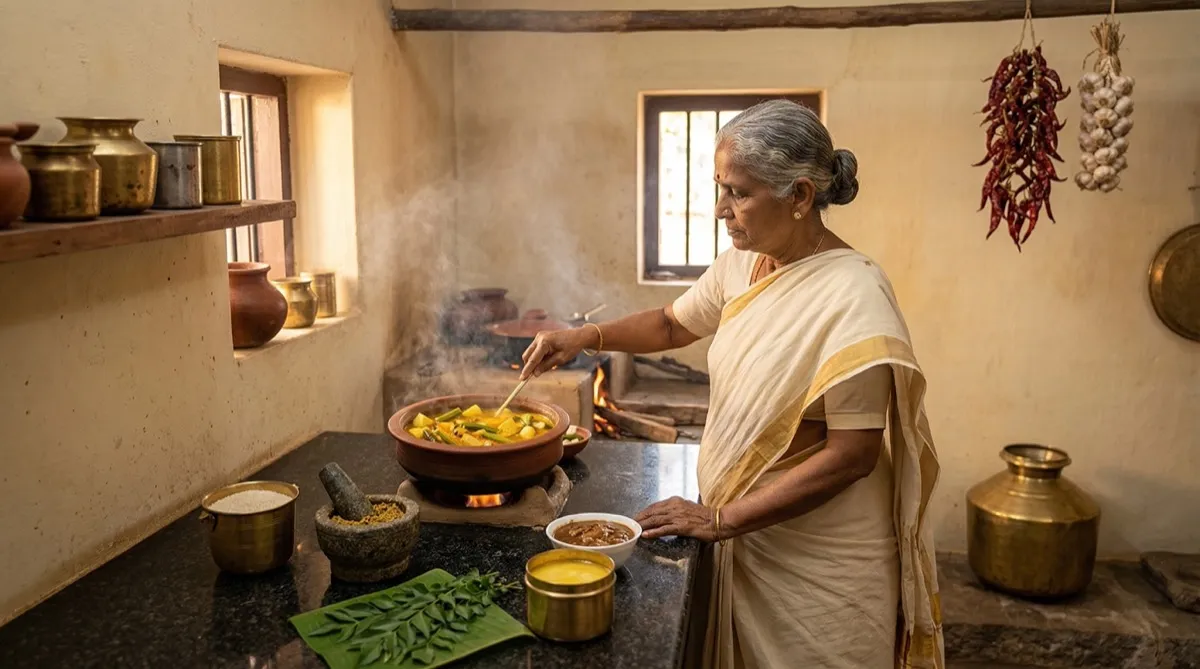
Your Grandmother’s Kitchen Was a Seasonal Calendar
Your grandmother — the one who insisted on gongura pachadi only during certain months, who switched from nuvvulu (sesame) chutney in winter to mamidi thandra in summer, who absolutely refused to serve perugu (curd) at night during the monsoon — was practising a sophisticated form of seasonal medicine. She probably never called it Ritucharya. She may never have heard the term. But every seasonal food rule she followed maps precisely to principles documented in the Charaka Samhita over two thousand years ago.
This is not a coincidence. Telugu food culture did not develop in a vacuum. It grew in a region where Ayurvedic principles were woven into the fabric of daily life for centuries — through temple traditions, family customs, farming calendars, and the practical wisdom of women who managed large joint families through every season. The kitchen was the first pharmacy. The cook was the first doctor. And the seasonal rules were not superstition — they were survival intelligence, refined across generations.
Ayurveda has a formal name for what these families were building: Rtu Satmya — seasonal adaptation. When the same foods are eaten in the same season, year after year, generation after generation, the body develops a deep tolerance and affinity for them. In large joint families, where grandmothers, mothers, and daughters-in-law cooked together across decades, this Satmya was not just personal but collective. The family’s digestive patterns, seasonal cravings, and food rhythms were shaped over lifetimes of repetition. Charaka describes Satmya as being nearly as powerful as Prakriti itself — meaning that what your family has eaten seasonally for generations has become part of your constitutional inheritance.
What is remarkable is how precisely these kitchen traditions align with formal Ayurvedic Ritucharya (seasonal regimen). It is as if the textbook and the kitchen arrived at the same conclusions independently — one through scholarly observation, the other through generations of lived experience. And both agree on a fundamental truth: the same food that nourishes you in January can harm you in July. Your body is not a fixed machine. It is a living system that shifts with the seasons, and the food it needs shifts with it.
What Telugu Kitchens Serve in Each Season — and Why
Shishira and Hemanta (Winter, November to February) — Walk into a Telugu kitchen in deep winter and you will find the heaviest, richest food of the year. Nuvvulu (sesame) appears everywhere — in chutneys, laddus, and as a coating on murukulu. Til chikki. Ariselu fried in ghee. Rich pongali with black pepper and cumin. Your grandmother was not just making comfort food. She was responding to the strongest Agni (digestive fire) of the year. In winter, the cold drives heat inward, stoking the digestive fire to its annual peak. Charaka Samhita (Sutrasthana 6) explicitly advises heavy, unctuous, sweet foods in this season — exactly what sesame, jaggery, and ghee provide. Denying the body this fuel when Agni is roaring can actually aggravate Vata dosha, leading to joint stiffness, dry skin, and restless sleep.
Notice something else about winter Telugu food: it is warm, it is oily, and it is often freshly prepared. Pesarattu with ginger chutney. Hot rasam with black pepper and jeera. Warm milk with turmeric and palm jaggery at night. Every one of these counters the cold, dry qualities of winter that aggravate Vata. Even the tradition of eating pappannam (dal rice) with generous ghee as the first course of a meal follows the Ayurvedic principle of eating sweet and unctuous tastes first to prepare the digestive tract.
Did You Know?
Sesame seeds (nuvvulu) contain the highest natural concentration of lignans — compounds now studied for antioxidant and anti-inflammatory properties. Telugu grandmothers who insist on sesame preparations specifically during winter are unknowingly following a practice that both Charaka recommended for Hemanta and modern nutrition science now validates.
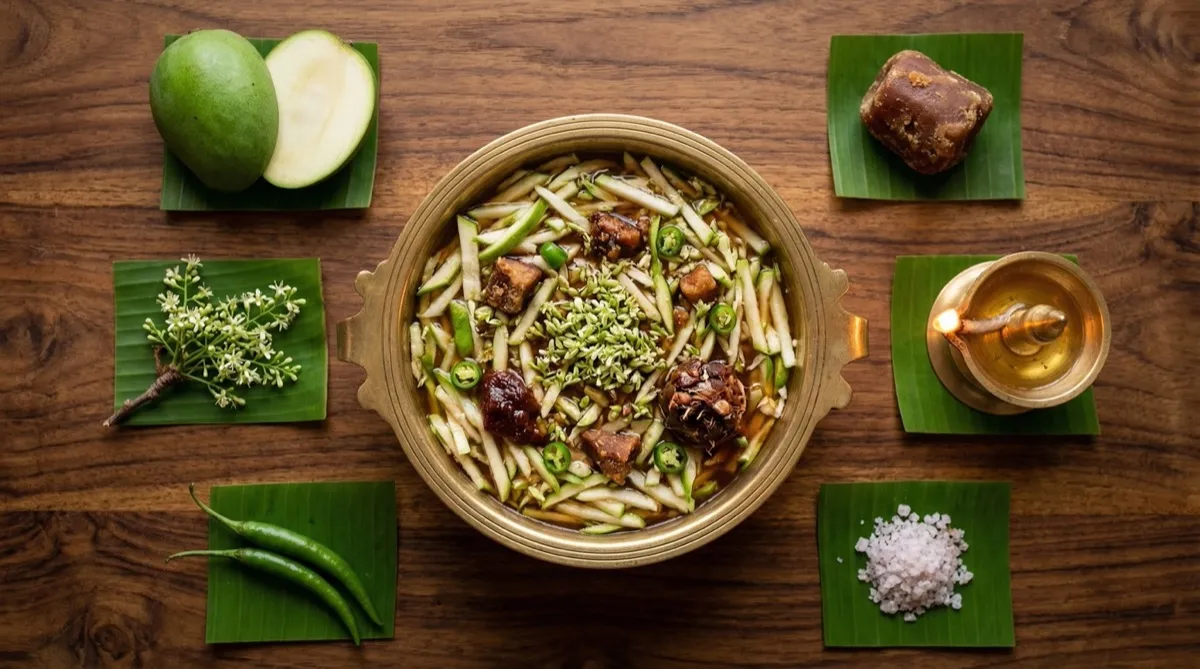
Vasanta (Spring, March to May) — This is when Telugu kitchens undergo a dramatic shift. Ugadi arrives, and with it comes a dish that captures the entire philosophy of seasonal transition in a single bowl: Ugadi Pachadi. Six tastes in one preparation — neem flowers (bitter), raw mango (sour), jaggery (sweet), tamarind (another shade of sour), chilli (pungent), and salt. This is not just festival food. It is a deliberate reset for the palate and the body as winter gives way to spring.
Why does spring demand bitter tastes? Because all that Kapha dosha you accumulated through winter — the heaviness, the slight congestion, the sluggishness — needs clearing out. Bitter and pungent tastes are Kapha’s natural antidotes. And Telugu spring food delivers exactly this: neem flower chutney, raw turmeric preparations, lighter meals with more vegetables and less oil. The tradition of eating mamidikaya pappu (raw mango dal) in spring is not just because mangoes are available — the sour taste stimulates a sluggish digestive fire that weakens as winter transitions to warmer months. Your great-grandmother’s kitchen was performing seasonal detoxification, centuries before the word entered the wellness vocabulary.
Grishma (Peak Summer, May to July) — Telugu summer food is a masterclass in cooling without suppressing digestion. Majjiga (buttermilk) with curry leaves and ginger becomes a daily staple. Watermelon, tender coconut water, cucumber raita. Rice with raw mango dal. Panakam — the jaggery-pepper-cardamom drink served at temples during Rama Navami — is a perfect example of a traditional preparation that cools while maintaining digestive fire. The pepper and cardamom prevent the sweet jaggery from becoming too heavy, while the liquid form keeps the body hydrated. Compare this to drinking ice water, which Ayurveda warns directly suppresses Agni.
Notice what disappears from the Telugu kitchen in summer: sesame preparations, heavy fried foods, excessive spice. In their place come thin rasams, cooling chutneys made with coriander and coconut, and dishes with the sweet taste predominating. Charaka specifically advises sweet, cool, and liquid nourishment in Grishma — the season when the body is at its most depleted and the digestive fire at its weakest. Your body in summer is like soil in a drought. It needs gentle irrigation, not a flood.
Did You Know?
Panakam — the jaggery-pepper-cardamom drink served at Rama Navami — follows a precise Ayurvedic formulation logic. The jaggery provides sweet taste for cooling energy (Sheeta Virya), pepper maintains digestive fire so the sweet does not create Ama, and cardamom opens the channels (Srotas). It is a seasonal medicine disguised as a temple offering.
Varsha (Monsoon, July to September) — This is where Telugu food traditions become genuinely protective. Every family has rules about the monsoon that sound like superstition until you understand the Ayurvedic logic. Do not eat leafy greens during heavy rains (they harbour more bacteria and worms in humid conditions). Do not eat curd at night (it increases Kapha in already damp conditions, promoting congestion). Eat freshly cooked food only (stale food ferments faster in humidity). Always start meals with a piece of fresh ginger and rock salt (to kindle the weakened Agni).
The monsoon is the most dangerous season for digestion. Vata dosha, which accumulated through summer’s dryness, becomes fully aggravated by erratic weather. Meanwhile, Agni drops to its annual weakest. This is exactly why traditional Telugu monsoon food favours sour and salty tastes — pulusu (tamarind-based curries), chintapandu pachadi, warm pepper rasam. Sour taste kindles Agni. Salt grounds Vata. Warm food counteracts the cold dampness. The Telugu tradition of drinking kashayams (herbal decoctions) during the rains is pure Ayurvedic preventive medicine, consumed daily by families who have never read a single classical text.
Here is something worth sitting with: in a large joint Telugu family, three or four generations of women cooked together in the same kitchen, through the same seasons, for decades. The grandmother corrected the daughter-in-law. The daughter-in-law trained the granddaughter. The seasonal knowledge was not written in any textbook — it lived in hands, in timing, in the instinct to reach for nuvvulu in December and put them away in March. This is what modern science calls embodied cognition — knowledge stored not in the mind but in the body’s learned patterns. When the joint family system collapsed, this living transmission broke. We lost not just recipes but an entire intelligence network that had been self-correcting for centuries.
Festival Foods Are Ritucharya in Disguise
Here is what most people miss about Telugu festival food: the timing is not random. Every major festival falls at a seasonal junction, and the traditional food served at that festival directly addresses the dosha imbalance of that transition. This is not over-interpretation — the pattern is too consistent to be accidental.
Sankranti (January) falls at the peak of Hemanta. The traditional foods — ariselu, til laddoo, pongali with ghee, sugarcane — are concentrated sweet and unctuous preparations. This is the season of maximum Agni and maximum Vata accumulation. Sweet taste pacifies Vata. Unctuous quality nourishes tissue. You are eating medicine disguised as festival celebration. The specific combination of sesame and jaggery (til-gur) is mentioned in Ayurvedic texts as one of the most effective winter preparations for building Ojas and nourishing Shukra dhatu.
Ugadi (March/April) arrives precisely when Kapha is spilling over from winter accumulation. The Pachadi’s six tastes — especially the emphasis on neem’s bitter and raw mango’s sour — directly clear Kapha and stimulate spring digestion. Neem flowers are available for only two to three weeks in spring, and nature produces them precisely when the body needs their bitter quality most. This principle — called Ritu Haritaki in classical texts — observes that what nature provides in a season is what the body requires in that season. It is an ecological idea of profound simplicity: the land, the climate, and the human body are not separate systems. They are one system, and the seasonal harvest is nature’s own prescription. Gongura appears in the months when sour taste is needed most. Drumstick leaves flourish when the body needs their lightness. The raw mangoes that flood the market in spring are not just a commercial crop — they are the season’s answer to sluggish digestion and accumulated Kapha.
Vinayaka Chavithi (August/September) comes during the monsoon-to-autumn transition, one of the most critical Ritu Sandhi junctions. The traditional offering of modakam (steamed rice flour dumplings with jaggery and coconut) is a warm, freshly prepared, sweet preparation — exactly what the weakened monsoon Agni needs. Even undrallu (steamed rice balls) are gentle on digestion, unlike fried preparations that would overwhelm the fragile monsoon gut.
Dussehra and Deepavali (October/November) arrive as Sharad (autumn) transitions to Hemanta (early winter). Pitta has just erupted from monsoon accumulation. The traditional sweets — laddu, jilebi, payasam — are sweet-dominant, which is the primary taste for pacifying Pitta. The emphasis shifts from cooling summer foods to warming preparations, marking the body’s transition into the nourishing half of the year. The tradition of eating rich sweets at Deepavali signals the body that winter fuel-building has begun. Sharad is also when Telugu families bring back foods with mild bitter and astringent undertones — fresh fenugreek leaves (menthikura), snake gourd, and preparations with a touch of turmeric — to clear the residual Pitta that autumn sun can still provoke. The classical texts call Sharad “Pitta prakopa kala” — the season when Pitta that quietly accumulated during the monsoon finally flares — and the autumn Telugu kitchen addresses this with a careful balance of sweet coolness and gentle bitterness.
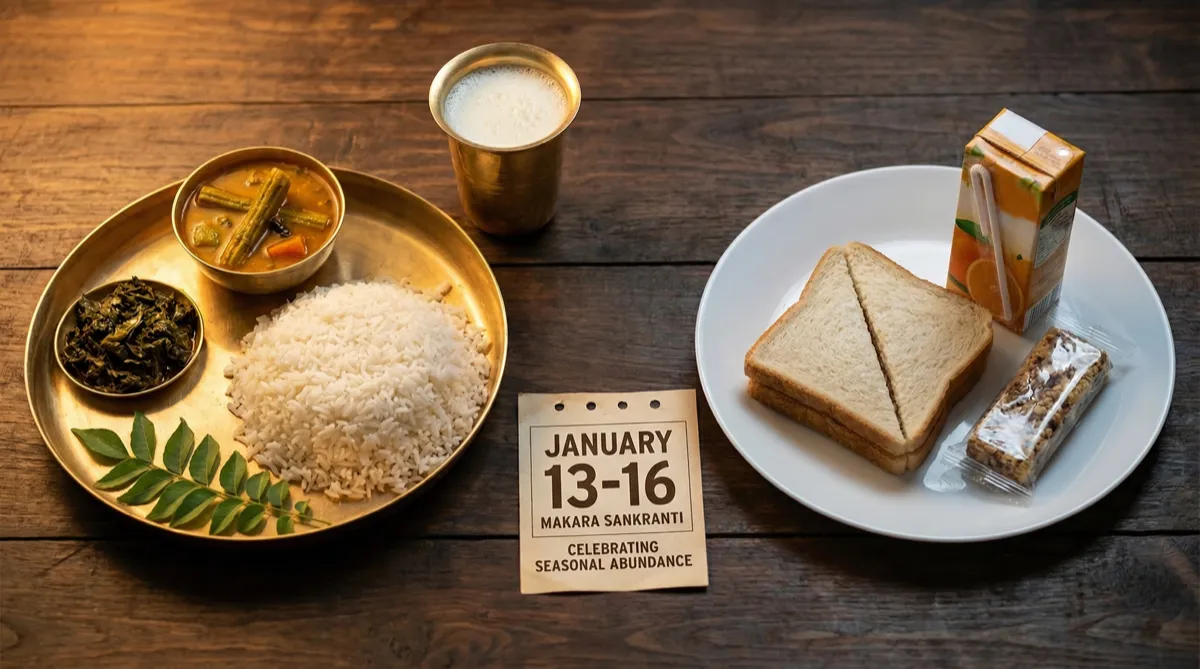
There is a dimension to seasonal eating that goes beyond digestion. The soil in your region changes composition through the year. What grows in that soil in a given month carries the specific minerals and compounds that the local climate demands of your body in that month. When you eat food from your own land in its natural season, you are not just eating nutrients — you are consuming the earth’s response to the very same environmental conditions your body is experiencing. This is a level of precision that no imported superfood, however nutrient-dense, can replicate. It is not just about what you eat. It is about the relationship between what you eat and where you stand on the planet at that moment in the year.
Why Seasonal Eating Collapsed — and What We Lost
Something happened in the last two generations that quietly broke one of the most sophisticated nutritional systems the world has seen. Refrigeration arrived. Supermarkets replaced seasonal bazaars. Packaged food replaced fresh preparation. Air conditioning created artificial climates. And slowly, almost imperceptibly, the seasonal rhythms of the Telugu kitchen flattened into a year-round sameness.
Today, many Telugu families eat the same food in July that they eat in January. Curd rice in every season. The same cooking oil year-round. Mangoes available in December because they are imported or cold-stored. Ice cream after dinner in winter. Leafy greens during heavy monsoon weeks because the supermarket stocks them regardless of season. The seasonal intelligence that protected families for centuries has been quietly abandoned in the name of convenience and availability.
The result? A generation that suffers from chronic low-grade digestive issues that their grandparents rarely experienced. Seasonal allergies that were uncommon two generations ago. A general sense of the body being slightly off — not sick enough for a diagnosis, but never quite thriving. This is what Ayurveda calls Ritu Vaishamya — seasonal disharmony — and it accumulates silently, year after year, creating the conditions for deeper imbalances. It shows up in weakened Agni, disrupted sleep patterns, and what classical texts describe as Dhatvagni mandya — weakened tissue-level metabolism.
The irony is sharp. We abandoned the world’s most tested seasonal diet system in favour of year-round “balanced diets” designed for climates and cultures thousands of miles away. A calorie is not just a calorie when your body processes it differently in different seasons. A food that builds tissue in winter can create toxins in summer. Context is everything, and the season is the most important context of all.
Did You Know?
The Telugu tradition of switching cooking oils by season — sesame (nuvvula nune) in winter, groundnut in the transition months, and coconut or sunflower in summer — directly mirrors Ayurvedic Sneha (oleation) principles. Each oil has a different Virya (thermal potency): sesame is warming, coconut is cooling. Using the wrong oil in the wrong season is like wearing a sweater in July — technically “food,” but working against your body.
The Taste-Season Connection: Shadrasa Meets Telugu Cooking
Ayurveda recognises six tastes — Shadrasa — and each has specific effects on the doshas. Sweet, sour, salty, pungent, bitter, and astringent. The genius of traditional Telugu cooking is that it naturally shifts the dominant tastes with the season, without anyone needing to study Ayurvedic theory. The kitchen itself was the textbook.
Winter emphasises sweet, sour, and salty — the three tastes that build, nourish, and ground. This is why winter food feels richer, heavier, more satisfying. Pongali (sweet and salty), sesame laddus (sweet and unctuous), hot pulusu (sour), and generous salt in every preparation. These three tastes pacify Vata, which naturally rises in cold weather.
Spring pivots to bitter, pungent, and astringent — the three tastes that clear, lighten, and reduce. Neem preparations (bitter), raw turmeric (bitter and pungent), pepper in every drink (pungent), and lighter vegetable preparations that favour astringent tastes. These three tastes clear the Kapha that accumulated through winter. The spring Telugu kitchen becomes a gentle cleansing programme.
Summer centres on sweet and cool — mango varieties, buttermilk, tender coconut, jaggery water. Sweet taste has a cooling energy (Sheeta Virya) that counteracts summer’s depleting heat. The monsoon introduces sour and salty to rekindle weakened Agni. And autumn returns to sweet, with its festival sweets and gentle, Pitta-pacifying preparations. The six tastes rotate through the year like a wheel, and the Telugu kitchen turns it naturally.
Bringing Seasonal Wisdom Back to Your Table
The good news: you do not need to become a scholar of Ayurveda to eat seasonally. You need to do something much simpler — listen to the version of your grandmother who still lives in the back of your memory. Here are practical shifts that families across Telangana and Andhra Pradesh have followed for generations.
In winter: Cook with sesame oil. Add nuvvulu to chutneys and rice preparations. Eat heavier meals at lunch when Agni peaks. Drink warm water, not cold. Add ginger, pepper, and jeera generously. Do not skip meals. Enjoy pongali, ariselu, and other traditional sweets without guilt — this is the season your body is built to receive them.
In spring: Shift to lighter cooking. Add neem preparations when available. Favour raw mango in various forms. Reduce oil and ghee slightly. Eat more bitter and pungent vegetables. This is the best time for any gentle dietary reset. If your family makes Ugadi Pachadi, eat it with awareness — it is not just tradition, it is a seasonal prescription.
In summer: Make majjiga (buttermilk) a daily habit. Switch to coconut oil for cooking where possible. Eat cooling chutneys — coconut, coriander, pudina. Reduce heavy fried items. Drink panakam or jaggery water instead of ice-cold drinks. Eat your lightest dinner of the year. If you feel your appetite dropping, do not force heavy meals — your Agni is naturally lower.
In monsoon: Eat only freshly cooked, warm food. Start meals with fresh ginger and rock salt. Favour sour and salty tastes. Drink warm kashayam or pepper rasam. Avoid raw salads, curd at night, and leftover food. Keep meals simple and well-spiced. This is the season where food safety and digestive support matter most.
Year-round: Pay attention to the fifteen-day Ritu Sandhi windows when seasons change. Eat simpler during transitions. Notice what local markets are selling — what is abundant and affordable is usually what the season demands. Cook with the ingredients your region produces in that month, not what the supermarket imports from elsewhere. And if you want personalised guidance on how these seasonal principles apply to your specific constitution and health concerns, our clinical approach explains how we work, and you can explore specific consultation areas to see how dietary guidance fits into a broader picture of care.
The Kitchen as Medicine — A Tradition Worth Returning To
There is a Telugu saying: “Bhojanamlo manchi aushidham undi” — good medicine is in the food itself. This is not folk wisdom divorced from science. It is the distilled conclusion of a culture that spent centuries observing how the body responds to food in different seasons, in different weather, at different times of day. The Telugu kitchen at its best was never just cooking. It was preventive healthcare, personalised nutrition, and seasonal medicine, all performed without jargon or pretension, by women who understood the body in ways that formal education sometimes misses.
The seasonal diet tradition is not lost. It is dormant. It lives in the memories of older family members, in festival foods that still carry their original logic, in the instincts that tell you something is wrong when you eat ice cream in January or skip meals in winter. Every time you choose sesame in December, buttermilk in May, or warm rasam in August, you are activating a system that was perfected long before any of us were born. The kitchen is still the first pharmacy. The season is still the best doctor. And the wisdom is still there, waiting for you to remember it. If you would like to explore how these principles connect to the broader Ayurvedic framework, our articles on Prakriti (constitution) and Dinacharya (daily routine) offer the larger picture.
What Current Evidence Says
Modern nutrition science increasingly recognises that seasonal variation affects nutrient requirements and metabolic function. Research published in journals like PNAS has documented seasonal changes in over a thousand gene transcripts, suggesting the body’s metabolic profile shifts significantly across the year. Chrono-nutrition, a growing field, studies how the timing of food intake interacts with biological rhythms.
The Ministry of Ayush and the Central Council for Research in Ayurvedic Sciences (CCRAS) have supported research into Ritucharya and its relevance to preventive health. Some studies have explored the relationship between traditional Indian seasonal dietary practices and markers of metabolic and digestive health, though large-scale clinical trials remain limited.
Traditional food cultures worldwide are increasingly studied as models of sustainable, health-supporting dietary patterns. The Mediterranean diet model provides a parallel example of how culturally embedded food practices can align with measurable health outcomes. Traditional Telugu seasonal eating represents a similar system that warrants further scientific exploration.
This article is for educational purposes only and does not constitute medical or dietary advice. Seasonal dietary adjustments can be a valuable part of a healthy lifestyle, but any significant changes to diet should be discussed with your healthcare provider, especially if you have existing health conditions, allergies, or are taking medication. Always consult your physician for medical concerns.