
Ugadi and the Spirit of a New Beginning
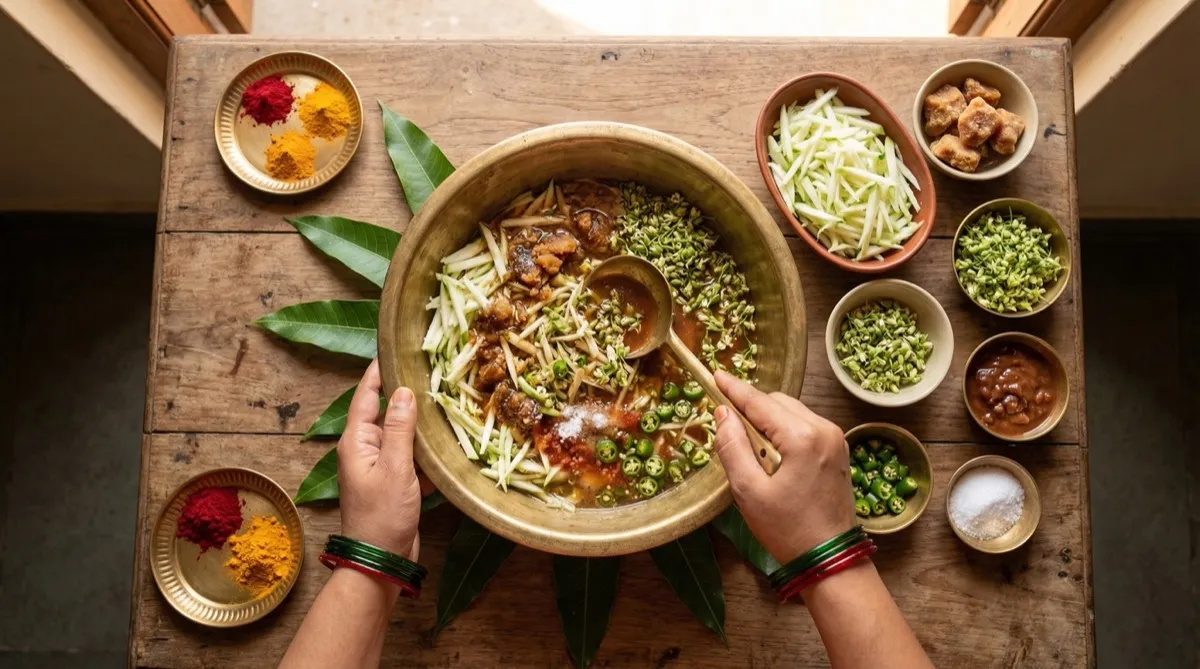
Picture an early spring morning in a Telugu household. The front door is framed with fresh mango-leaf garlands, the floor bears new rangoli patterns, and somewhere in the kitchen, someone is grinding neem flowers with jaggery. The sharp bitterness mixes with the warm sweetness, and the house fills with a smell that every Telugu person recognises instantly — Ugadi is here.
Ugadi marks the Telugu and Kannada New Year, celebrated across Andhra Pradesh, Telangana, and Karnataka in the spring month of Chaitra. It is a day of quiet renewal and hopeful beginnings. But at the heart of the celebration is a single preparation that carries a remarkable idea: Ugadi Pachadi, a mixture of six distinct flavours — sweet, sour, salty, bitter, pungent, and astringent — all consumed together in one spoonful.
Why would you deliberately mix something bitter with something sweet? That question is the doorway into one of Ayurveda’s most elegant ideas — that balance is not about avoiding difficulty, but about holding all of life’s experiences together. In that spirit, this article explores the connection between a beloved festival tradition and a principle that has guided Indian wellness thinking for thousands of years.
The Six Flavours — and What They Really Mean
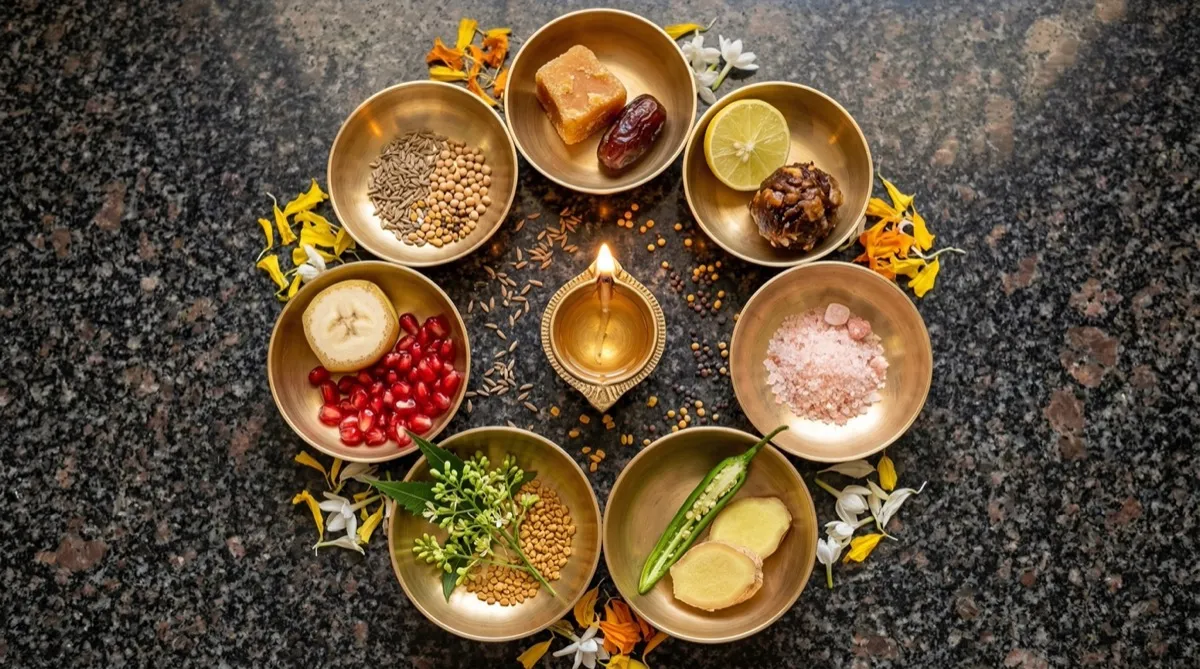
Each ingredient in Ugadi Pachadi represents a flavour of life itself. This is what makes the dish universal — you do not need to know anything about Ayurveda to feel the truth in it:
- Jaggery (Bellam) — the sweetness of joy and contentment. The year begins with something good, a reminder that happiness is always worth savouring.
- Raw mango (Mamidikaya) — the tang of surprise and unexpected turns. Not everything goes as planned, and that is part of what makes life interesting.
- Salt (Uppu) — the savour of zest and engagement. Without interest and flavour, life feels flat.
- Neem flowers (Vepa Puvvu) — the bitterness of hardship and loss. Some seasons are genuinely difficult — and they pass, leaving wisdom behind.
- Pepper or chilli (Miriyalu / Mirapakaya) — the heat of intensity and anger. Challenges and friction are uncomfortable, but they sharpen us.
- Tamarind (Chintapandu) — the dryness of complexity and restraint. Some experiences only make sense with time and reflection.
Some families vary the ingredients — green chilli instead of pepper, different proportions to taste. But the principle is always the same: all six flavours in one bowl, consumed together. Not avoiding the bitter, not chasing only the sweet. The whole of life, accepted in a single spoonful.
But Why These Six? The Ayurvedic Science of Taste
The life metaphors are beautiful, but they are only half the story. In Ayurveda, taste (Rasa) is not just a sensation on the tongue — it is a direct signal of what a food will do inside the body. Charaka Samhita (Sutrasthana, Chapter 26) devotes an entire chapter to the science of the six rasas, explaining how each taste arises from a specific combination of the five great elements (Pancha Mahabhuta) and produces predictable effects on the three doshas. This is not folk wisdom. It is a systematic pharmacological classification that determines how every food and medicine is prescribed. The balance between these six tastes is linked to the doshas — Vata, Pitta, and Kapha — the three energies that shape your individual constitution (Prakriti).
Madhura (Sweet) — composed of Earth and Water elements. Sweet taste is heavy, cooling, and nourishing. It is the most building and grounding of all six rasas, which is why it is recommended at the start of a meal when Agni is strongest. Sweet taste nourishes Rasa dhatu (plasma), Rakta dhatu (blood), Mamsa (muscle), Meda (fat), Asthi (bone), Majja (marrow), and Shukra/Artava (reproductive tissue) — it feeds the entire tissue chain. It pacifies Vata and Pitta (both of which need grounding and cooling) but increases Kapha when consumed in excess. Seasonal relevance: Sweet-tasting foods are most important in summer (Grishma Ritu), when the body is depleted by heat and needs nourishment, and in late winter, when Agni is strongest and can handle heavier foods. In spring, when Kapha is already high, excessive sweet taste worsens congestion and sluggishness.
Amla (Sour) — composed of Earth and Fire elements. Sour taste is heating, moistening, and appetite-stimulating. It kindles Agni more gently than pungent taste and promotes the secretion of digestive juices. Sour taste increases Pitta and Kapha while pacifying Vata (the dryness and lightness of Vata are countered by sour’s moistening and grounding qualities). This is why tamarind-based rasam and raw mango preparations are excellent for Vata-type digestive weakness. Seasonal relevance: Sour taste is most beneficial in winter and the cold months when Agni needs stimulation, but should be reduced in summer and autumn when Pitta is already elevated. The Pachadi’s raw mango component is perfectly timed for the Pitta-Kapha transition of early spring.
Lavana (Salty) — composed of Water and Fire elements. Salt is heating, heavy, and moistening. It softens tissues, promotes secretion, and supports the body’s fluid balance. In moderate amounts, salty taste improves the flavour of food (thereby supporting proper eating habits and digestion) and has a mild laxative effect that supports Vata’s downward movement (Anulomana). Excess salt, however, aggravates both Pitta and Kapha and can lead to water retention, inflammatory conditions, and skin problems. Ayurveda distinguishes between types of salt — Saindhava (rock salt) is considered the best for daily use because it is cooling relative to other salts and does not aggravate Pitta as much. Sea salt is more heating. This nuance is lost in modern nutrition, which treats all sodium as equivalent.
Katu (Pungent) — composed of Fire and Air elements. Pungent taste is the lightest, hottest, and most stimulating of all rasas. It dries moisture, clears channels, kindles Agni powerfully, and is the primary taste for reducing Kapha. Pepper, chilli, ginger, and mustard all carry this rasa. Pungent taste increases both Vata and Pitta while strongly pacifying Kapha. Seasonal relevance: Pungent foods are most essential during spring (Vasanta Ritu) when accumulated Kapha needs clearing, and during monsoon (Varsha Ritu) when dampness and sluggishness dominate. In summer and autumn, excessive pungent taste aggravates Pitta and can cause inflammatory conditions. The Pachadi’s pepper component is spring medicine in miniature.
Tikta (Bitter) — composed of Air and Ether (Space) elements. Bitter is the coldest, lightest, and driest of all tastes. It is the most Kapha-reducing and Pitta-cooling taste, which makes it medicine for the majority of inflammatory and accumulative conditions. Bitter taste purifies the blood (Rakta Shodhana), supports liver function, and is traditionally understood as the primary taste for clearing Ama from the channels. Neem, turmeric, and fenugreek all carry bitter rasa. Because of its Air and Ether composition, excessive bitter taste aggravates Vata — causing dryness, depletion, and anxiety. Seasonal relevance: Bitter taste is most critical during spring, when its lightness and dryness directly counter winter-accumulated Kapha. The neem flowers in the Pachadi are not symbolic — they are spring pharmacology.
Kashaya (Astringent) — composed of Air and Earth elements. Astringent taste creates a characteristic drying, tightening sensation (think of the mouth-puckering feeling of unripe banana or strong tea). It absorbs moisture, firms tissues, and stops excessive discharge. Astringent taste pacifies both Pitta and Kapha while increasing Vata. Tamarind, pomegranate, and turmeric carry significant astringent rasa. Seasonal relevance: Astringent taste supports the body during seasonal transitions — its firming quality helps the tissues adapt as one dosha-season gives way to another. In spring, it works alongside bitter and pungent to clear Kapha without the excessive heat that pungent alone would bring.
Did You Know?
Every taste in Ayurveda is composed of exactly two of the five great elements (Pancha Mahabhuta), and this elemental composition determines everything about what the taste does in the body. Sweet (Earth + Water) builds tissue because it contains the heaviest, most nourishing elements. Bitter (Air + Ether) reduces tissue because it contains the lightest, most depleting elements. This is not metaphor — it is a systematic classification system that allows a practitioner to predict the effect of any food on any dosha, based purely on its taste profile. The six tastes form a complete pharmacological map of all possible food-body interactions.
The practical takeaway is elegant: include all six tastes in your regular meals, adjusted for the season and your own body. Not equal portions of each — but a conscious presence of all six, with emphasis shifting seasonally. This is part of the broader framework of Ritucharya (seasonal living) and Agni (digestive wellness). Ugadi Pachadi is a masterclass in this principle, compressed into a single spoonful.
The Six Tastes (Shadrasa) at a Glance
Sweet
Madhura
Earth + Water
↑Kapha ↓Vata, Pitta
Nourishing, grounding
Sour
Amla
Earth + Fire
↑Pitta, Kapha ↓Vata
Stimulates digestion, moistening
Salty
Lavana
Water + Fire
↑Pitta, Kapha ↓Vata
Softening, hydrating
Pungent
Katu
Fire + Air
↑Vata, Pitta ↓Kapha
Heating, stimulating
Bitter
Tikta
Air + Ether
↑Vata ↓Pitta, Kapha
Cooling, detoxifying
Astringent
Kashaya
Air + Earth
↑Vata ↓Pitta, Kapha
Drying, firming
Did You Know?
The Charaka Samhita describes a specific order for consuming tastes within a meal — sweet (Madhura) first and astringent (Kashaya) last. This sequence is believed to support each stage of digestion progressively. In many traditional families, Ugadi Pachadi is prepared with jaggery settling near the top, so the first sip naturally begins with sweetness — quietly following the same classical principle without most people realising it.
Here is something that connects the Pachadi to your nervous system in a way most people never consider: taste is not passive reception. It is the body’s fastest biochemical signalling system. Within milliseconds of food touching the tongue, taste receptors send electrical signals through cranial nerves VII, IX, and X directly to the brainstem, which immediately adjusts digestive enzyme secretion, stomach acid production, and bile release — all before the food even reaches the stomach. A bitter taste triggers a different enzymatic cascade than a sweet taste. This is why Ayurveda insists that food must be tasted properly (chewed thoroughly, eaten mindfully) — because the act of tasting is itself the first stage of digestion. The Pachadi, with all six tastes in a single spoonful, triggers every digestive pathway simultaneously. It is not just a cultural opener for the new year. It is a metabolic reset for the entire digestive system at the turn of the season.
Why This Matters Beyond Ugadi
Here is the remarkable thing: this single festival dish contains in miniature a principle that Ayurveda applies to all of health — balance. Not too much of any one thing. Not too little of anything. The same thinking that puts all six tastes into one bowl also shapes how Ayurveda approaches digestion, seasonal living, daily routine, and long-term wellness. Ugadi Pachadi is not just a New Year tradition — it is a doorway into an entire way of thinking about food, body, and the seasons. The rest of this site explores that thinking, one idea at a time.

Why Spring? The Seasonal Connection
This is not a coincidence. Ugadi falls at the onset of Vasanta Ritu (spring) — precisely when the body is most vulnerable to seasonal imbalance. The Kapha that accumulated during winter begins to liquefy as temperatures rise, which can weaken digestion and leave you feeling heavy and sluggish. Understanding how Ayurveda works helps explain why this seasonal timing matters so much.
The Charaka Samhita recommends favouring bitter, pungent, and astringent tastes during spring to counterbalance this excess Kapha and rekindle Agni. Look at the Pachadi again: neem flowers (bitter), pepper (pungent), tamarind (astringent) — exactly the tastes Ayurveda would prescribe for this season. The Pachadi also helps clear what Ayurveda calls Ama — metabolic waste that builds up over winter. Bitter and pungent tastes are traditionally understood as Ama-reducing, while also kindling digestive fire.
Many Indian festivals carry within them a quiet alignment with seasonal wellness — dietary customs shaped by generations of observation about what the body needs as seasons change. Ugadi Pachadi is one of the clearest examples of this convergence between cultural practice and Ayurvedic seasonal wisdom.
Did You Know?
Neem flowers (Vepa Puvvu) are available for only a brief two-to-three-week window each spring. Ayurveda considers this timing significant — the principle of Ritu Haritaki holds that what nature produces in a particular season is precisely what the body needs. Neem’s bitter quality arrives exactly when accumulated winter Kapha needs clearing — not a coincidence, but a natural alignment that families have relied on for generations.
What Modern Science Found
Modern research confirms what generations already knew. Neem contains nimbidin, studied for anti-inflammatory properties. Jaggery is rich in iron and trace minerals that refined sugar lacks entirely. Tamarind’s tartaric acid may aid mineral absorption. Families who have been making this dish for centuries did not need a lab to know it worked — modern science is, in many ways, catching up.
Bring It Home — Six Tastes Every Day
The Pachadi’s lesson does not end with the festival. You can carry the six-taste principle into daily meals — especially during spring. Our Diet & Lifestyle guide covers practical ways to bring these principles into everyday cooking:
Try This
- Add a small piece of jaggery (sweet) and a squeeze of lemon (sour) to warm water in the morning.
- Season your dal with a pinch of mustard seeds (pungent), curry leaves (bitter), and a dash of tamarind (astringent).
- During spring, lean into bitter greens, pepper, and warm cooked foods over cold and raw.
- Notice how you feel when all six tastes are present — more satisfied, less likely to crave snacks later.
One Spoonful, One Principle
Next time you taste Ugadi Pachadi, pause for a moment. That bitterness you want to skip? It is doing something. That sweetness you want more of? It is being balanced by five other flavours. The whole of life, the whole of health — in a single spoonful.
That is the principle behind everything on this site — from seasonal living and digestive wellness to daily routines and understanding your constitution. If this one dish made you curious, there is much more to discover.
A Note on Tradition and Evidence
Ayurveda is a traditional wellness system recognised by the WHO and supported by India’s Ministry of Ayush. The six-rasa framework has deep classical roots but has not been extensively validated through modern clinical trials. These concepts are best understood as part of a meaningful traditional wellness perspective, not as a substitute for medical care.
This article is for educational and cultural interest only and does not constitute medical advice. Ugadi Pachadi is a traditional seasonal preparation, not a medicine or health intervention. If you have specific health concerns, allergies, or are taking medication, please consult your physician. Do not delay necessary conventional medical care based on any information in this article.