
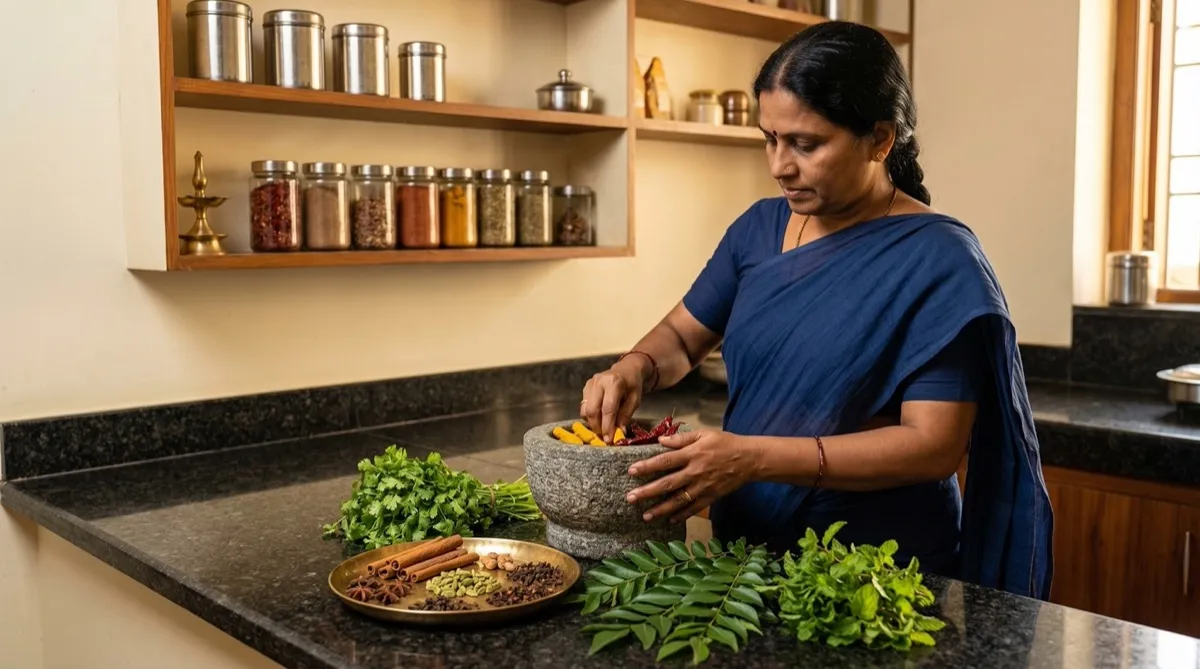
Your Body Is a Different Machine in Different Seasons
The seasonal wisdom passed down in Indian families has a name — and a science behind it. The food you eat in July should be completely different from what you eat in January. Not because of New Year’s resolutions. Because your body is literally a different machine in different seasons. Your digestive fire burns differently. Your skin behaves differently. Even the way your joints feel when you wake up in the morning shifts with the calendar.
Ayurveda noticed this thousands of years ago and built an entire science around it. They called it Ritucharya — from “Ritu” (season) and “Charya” (conduct or regimen). But here is the thing most people miss: Ritucharya is not just “eat what’s in season.” That is the Instagram version. The real framework is far more sophisticated — it tracks how each dosha quietly accumulates over weeks, erupts at a specific season transition, and then naturally calms down if you let it. It is a complete system for preventing disease before it starts.
Think about it. Notice how you crave warm soups in winter but cold buttermilk in summer? That is not random preference — that is your body’s Agni (digestive fire) speaking. Notice how your skin dries out in the cold months and your joints get stiff? That is Vata dosha rising. Notice how you feel sluggish and congested every spring? That is Kapha that accumulated through winter, finally spilling over. If you are new to these concepts, our article on What Is Prakriti? explains how individual constitution shapes your experience of all this, and our Ayurvedic glossary defines all the key terms.
The Hidden Cycle: How Doshas Move Through Seasons
Here is what makes Ritucharya genuinely brilliant. Charaka Samhita (Sutrasthana, Chapter 6), Sushruta Samhita (Sutrasthana, Chapter 6), and Ashtanga Hridaya (Sutrasthana, Chapter 3) all describe a three-stage cycle that every dosha goes through with the changing seasons. First, Sanchaya — quiet accumulation. The dosha builds up silently, like water slowly filling a vessel. You barely notice. Then Prakopa — aggravation. The vessel overflows. Symptoms appear. Finally, Prashamana — natural pacification. If conditions change, the dosha settles on its own.
Take Kapha as an example. During Hemanta and Shishira (the winter months), cold and damp conditions cause Kapha to accumulate in the body. You might not feel anything obviously wrong — maybe just a slight heaviness, a tendency to oversleep, a bit more mucus than usual. Nothing alarming. But when Vasanta (spring) arrives and the warming sun begins to melt this stored Kapha, everything spills over — spring colds, sinus congestion, seasonal allergies, that heavy sluggish feeling. Sound familiar?
The same logic applies to Pitta. It accumulates silently during summer (Grishma), when intense heat stokes the body’s internal fire. Then during the rainy season (Varsha), humidity traps the built-up heat and Pitta becomes fully aggravated. By the time Sharad (autumn) arrives with its clear, warm days, Pitta erupts — acid reflux, skin rashes, inflammatory flare-ups. And Vata? It builds through the drying heat of summer (Grishma), then becomes aggravated in Varsha when the atmosphere is unstable, winds shift, and the ground itself seems restless.
Once you see this pattern, seasonal health stops being mysterious. That autumn acid reflux is not random. Those spring allergies are not bad luck. They are the entirely predictable result of a dosha cycle that Ayurveda mapped out over two thousand years ago. And the beautiful part? If you take the right steps during the accumulation phase, the aggravation phase barely touches you.
Did You Know?
Panchakarma — the five classical purification procedures — was never meant to be done at any random time. Charaka specifies exact seasonal windows: Vamana (therapeutic emesis) in Vasanta to clear liquefied Kapha, Virechana (purgation) in Sharad when Pitta peaks, and Basti (medicated enemas) in Varsha when Vata is most aggravated. Performing these procedures out of season was considered less effective or even counterproductive. Traditional practitioners still follow this calendar today.
Two Great Halves: Adana Kala and Visarga Kala
Before we walk through each of the six seasons, you need to understand the two great halves that frame the entire year. Ayurveda divides the annual cycle into Adana Kala (the “taking away” period, roughly January to June) and Visarga Kala (the “giving back” period, roughly July to December). This is not poetic language. It describes something you can feel in your own body.
During Adana Kala, the sun is in its northern course (Uttarayana). Its intensity increases month by month, and its drying, heating energy literally draws moisture and strength from the earth and from your body. Think of it as the sun slowly turning up a dehydrator. Your strength is at its peak at the start of this period (early winter carries residual nourishment) and progressively declines toward summer. By Grishma (peak summer), the body is at its weakest and most depleted.
Then the reversal begins. Visarga Kala starts with the monsoon, when the moon’s cooling influence dominates and the sun retreats southward (Dakshinayana). Rain nourishes the earth. Cool winds soothe. The body begins to rebuild. Strength gradually returns, reaching its peak in Hemanta (early winter) — which is why winter is traditionally the season when you can eat the most, exercise the hardest, and digest the richest foods.
This is not abstract theory. You can test it against your own experience. Think about how you feel in late June versus December. The difference in your appetite alone tells the story. Charaka explicitly notes that digestive fire is strongest in Hemanta and weakest in Grishma — a claim that lines up neatly with modern observations about seasonal metabolic variation.
The Deeper Mechanism: Dhatu, Ojas, and the Rhythm of Strength
Doshas get all the attention in popular Ayurvedic writing, but the real story of seasonal wellness runs deeper — through the seven-tissue chain called the Dhatus. Each season places different stress on different parts of this chain. Summer’s heat dries out Rasa (the plasma layer that feeds everything downstream) and thins Rakta (blood), while winter’s cold can slow Meda (fat metabolism) and stiffen Asthi (bone tissue). The chain works sequentially — each tissue nourishes the next — so when a season disrupts an early link, every tissue below it feels the effect. When the entire chain runs well, it produces Ojas, the essence of immunity and resilience. Seasonal living, at its core, is about protecting this chain from the specific pressures each season brings. If any of these terms are unfamiliar, our Ayurvedic glossary explains them in plain language.
Here is the connection to seasons that most people miss. During Adana Kala (the sun’s taking-away period), the increasing heat and dryness do not just aggravate doshas — they progressively deplete the Dhatus themselves. Rasa dries up. Rakta thins. Mamsa and Meda lose substance. This is not metaphorical. You can feel it in the progressive loss of weight, moisture, and stamina that builds through spring and peaks in summer. Charaka describes this as declining Bala (strength), and Sushruta Sutrasthana (Chapter 6) elaborates that the body’s Ojas reserve diminishes as the Dhatu chain receives less nourishment.
Then Visarga Kala reverses everything. The monsoon rains bring moisture. Cooling conditions allow Agni to gradually strengthen. The Dhatu chain begins to receive proper nourishment again. Rasa fills out. Each subsequent tissue rebuilds. By Hemanta, the entire chain is running at peak efficiency, Ojas is abundant, and Bala reaches its zenith. This is why Hemanta is traditionally the season for Rasayana (rejuvenation) practices — the body is primed to build and store vitality.
Understanding this Dhatu rhythm explains something important: why certain chronic conditions flare at certain times of year. Joint discomfort tends to worsen in Varsha and early Shishira because Asthi Dhatu (bone tissue) and its surrounding structures are affected by Vata aggravation when the Dhatu chain is still rebuilding. Our article on Ayurvedic approaches to joint comfort explores this connection in more detail. Skin conditions peak in Sharad because Rakta Dhatu is disturbed by aggravated Pitta. Once you see the Dhatu layer, seasonal illness patterns make even more sense.
Why Those Specific Tastes? The Rasa Mechanism
One of the most practical aspects of Ritucharya is the taste prescriptions for each season. But most summaries just list them without explaining why. The mechanism is elegant: each of the six Rasas (tastes) is composed of two of the five Mahabhutas (elements), and those elements either increase or decrease specific doshas.
Sweet taste (Madhura) is composed of Earth and Water elements. It is heavy, cooling, and nourishing — which is exactly why it is recommended in Grishma (summer), when the body is dried out and depleted. Sweet taste directly replenishes Rasa Dhatu and builds Ojas. Sour taste (Amla) contains Earth and Fire — it kindles Agni and promotes moisture retention, making it ideal for Varsha (monsoon) when digestive fire is weak and the body needs grounding.
Bitter taste (Tikta) is composed of Air and Space — light, dry, and cooling. This is precisely why it is prescribed in Vasanta (spring) to scrape away the heavy, wet Kapha that melted with the warming sun. Pungent taste (Katu) contains Fire and Air — it burns through congestion and stimulates metabolism, which is why spring also recommends pungent foods. Astringent taste (Kashaya) has Air and Earth — it dries and tightens, helping to absorb excess moisture in spring and autumn.
The seasonal taste recommendations are not arbitrary traditional rules. They are precise elemental interventions designed to counter the specific imbalances each season creates. When Charaka says to favour sweet, sour, and salty tastes in Hemanta, he is prescribing Earth, Water, and Fire elements to build tissue, retain warmth, and fuel the blazing winter Agni. Every taste recommendation has this kind of logic behind it.
Panchakarma and the Seasonal Calendar
Perhaps the most striking application of Ritucharya is in Panchakarma — the five classical purification procedures described in Charaka Samhita and elaborated in Ashtanga Hridaya (Sutrasthana, Chapter 3). These are not procedures to be performed at convenience. Each one has a specific seasonal window when it is most effective, because the procedure targets the dosha at its moment of peak aggravation.
Vamana (therapeutic emesis) is traditionally indicated in Vasanta (spring). The logic is precise: Kapha that accumulated through winter has now liquefied in the spring warmth and is sitting in the upper body — stomach, chest, sinuses. This is the moment when the body most readily releases it upward. Attempting Vamana in mid-winter, when Kapha is still cold and solid, is considered far less effective.
Virechana (therapeutic purgation) is indicated in Sharad (autumn), when Pitta has reached its peak aggravation after accumulating through the monsoon. The body is ready to release excess heat and bile downward through the intestinal tract. The clear, warm days of Sharad provide the ideal conditions. Basti (medicated enema therapy), the most important procedure for Vata, is indicated in Varsha (monsoon) — exactly when Vata aggravation peaks due to the erratic, destabilising atmosphere.
This seasonal Panchakarma calendar reveals something profound about Ayurvedic thinking: prevention and treatment are not separate categories. The same seasonal awareness that guides your daily food choices also determines the optimal timing for deeper purification. A practitioner trained in this tradition does not simply perform Panchakarma when a patient requests it — the timing itself is considered part of the treatment. If you are planning a visit, our Before & After Your Visit guide can help you prepare.
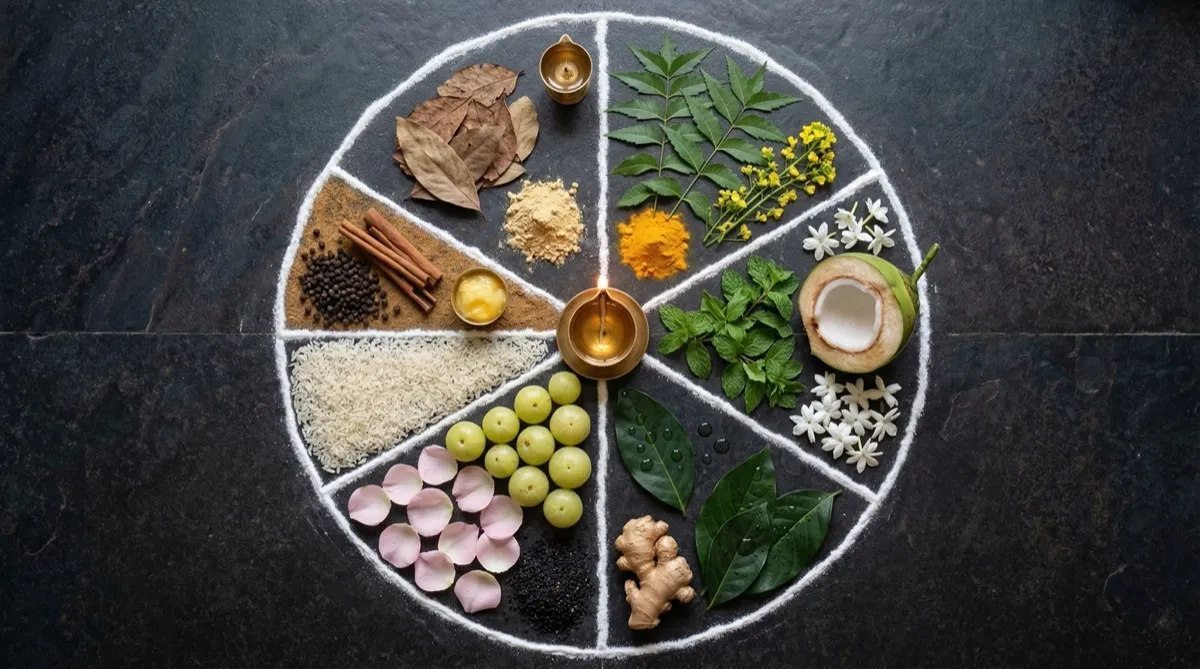
Here is something most seasonal wellness discussions overlook entirely: your body is not a fixed thing. It is a process. Every year, roughly 98% of the atoms in your body are replaced with new ones. Your stomach lining renews every few days. Your skin every few weeks. Your skeleton over a period of years. Yet chronic patterns of discomfort persist — the same allergies every spring, the same digestive trouble every monsoon. Why? Because the body rebuilds itself from the same blueprint. The intelligence governing tissue formation carries forward the same seasonal errors unless the inputs change. Ritucharya is, at its core, about changing the inputs at the right time so the body rebuilds better with each cycle — not just differently, but with more intelligence and less accumulated error.
The Six Ritus: A Walk Through the Year
Ayurveda does not use the four-season model most of us grew up with. It recognises six Ritus, each lasting approximately two months. Each has its own personality, its own dosha dynamics, and its own wisdom. Let us walk through them — not as a textbook list, but as a journey through the year as your body actually experiences it.
Shishira (Late Winter, mid-January to mid-March) — The air is sharp and dry. The landscape is bare. But inside your body, something powerful is happening: your digestive fire is roaring. This is one of the strongest Agni periods of the year. Your body is essentially stoking its internal furnace to fight the cold, which means you can handle heavier, richer foods — ghee, sesame, warm milk, root vegetables, and well-cooked grains. Kapha is accumulating quietly. The classical advice: eat nourishing foods, favour warm and unctuous qualities, and do not fast. Your body needs fuel.
Vasanta (Spring, mid-March to mid-May) — The world is waking up. Flowers bloom. And all that Kapha you stored through winter? It melts. Literally, the classical texts use the metaphor of snow melting in the spring sun. This is why spring brings congestion, heaviness, lethargy, and seasonal allergies for so many people. The wisdom here is beautifully counterintuitive: this is the season to eat lighter, favour bitter, pungent, and astringent tastes, and actually embrace some gentle fasting. Exercise more. Dry massage with herbal powders (Udvartana) instead of heavy oil massage. Honey in warm water. Spring is the season of clearing out.
Grishma (Summer, mid-May to mid-July) — The sun is merciless. Everything dries out. Your energy is at its lowest point of the entire year. This is not the time for intense workouts or heavy meals. The body needs sweet, cool, and liquid nourishment — rice with cooling dals, fresh buttermilk, watermelon, cucumber, coconut water. Sleeping on terraces under the moonlight is classical summer advice. Even the tastes recommended shift: sweet, cold, and unctuous to counter the depleting dryness. Think of your body as a garden in peak heat. It needs gentle watering, not aggressive cultivation. Crucially, this is also when Pitta begins its silent accumulation (Sanchaya) — the intense external heat stokes the body’s internal fire, setting the stage for the Pitta eruptions that come in autumn.
Varsha (Monsoon, mid-July to mid-September) — The rains arrive. Relief from heat — but also the most treacherous season for health. The atmosphere is heavy, humid, and unstable. The earth releases gases. Water sources become contaminated. And Vata dosha, which accumulated through summer’s dryness, now becomes fully aggravated by the erratic weather. Meanwhile, Agni (digestive fire) drops to its weakest. This is why the monsoon is historically the season of epidemics, digestive troubles, and joint pain. The classical prescription is sharp: eat warm, freshly cooked food only. Favour sour, salty, and unctuous tastes. Avoid leafy greens (they harbour more organisms in this season), curd at night (it increases Kapha in an already damp environment), and stale food. A little ginger before meals is worth its weight in gold.
Sharad (Autumn, mid-September to mid-November) — The rains stop. The sky clears. The sun returns with a deceptive warmth. This is when Pitta, which accumulated through summer and was aggravated by the monsoon, suddenly erupts. Acid reflux, skin rashes, burning sensations, inflammatory conditions — autumn is Pitta season. The classical advice is to favour sweet, bitter, and astringent tastes, eat cooling foods even though the weather is pleasant, and avoid direct midday sun. Ghee processed with bitter herbs is considered a hallmark of Sharad wellness. Interestingly, the tradition of eating light, sweet, cool foods during Sharad Purnima (the autumn full moon) is a Ritucharya practice encoded in festival culture.
Hemanta (Early Winter, mid-November to mid-January) — The king of seasons, in Ayurvedic terms. Your body is now at peak strength. Agni blazes. Appetite is enormous. This is when the body naturally wants to build reserves for the year ahead. Rich foods, sesame oil massage, warm baths, vigorous exercise — Hemanta supports all of it. Sweet, sour, and salty tastes dominate. New rice, warm milk, sugarcane products, and well-spiced meats (for those who eat them) are classic Hemanta recommendations. Charaka advises against fasting and light meals in this season — with such strong digestive fire, denying the body fuel can actually aggravate Vata.
Ritu Sandhi: The Dangerous Fifteen Days
Here is a concept most modern wellness advice completely ignores, and it might be the most practically useful idea in all of Ritucharya. Ritu Sandhi means the “junction” of two seasons — the last seven days of the outgoing season and the first seven days of the incoming one. Approximately fifteen days of transition, six times a year.
During Ritu Sandhi, the body is adjusting from one set of environmental conditions to another. The doshas are in flux. Immunity dips. Digestion becomes unpredictable. And this is exactly when most people fall ill. Think about it: when do flu outbreaks cluster? Season changes. When do allergies flare? Season transitions. When do chronic conditions like asthma and arthritis worsen? Right at the junction. Charaka specifically warns against abruptly changing your diet and habits at these junctures. Instead, the transition should be gradual — slowly introducing new-season foods while tapering off old-season ones over the full fifteen-day window. Our Diet & Lifestyle guide offers practical principles for making these seasonal dietary shifts.
This is extraordinarily practical advice. If you do nothing else from this entire article, just paying attention to the two weeks around each season change — eating simpler, sleeping well, reducing exertion, keeping digestion strong — can make a noticeable difference in how many times you fall sick in a year. Pair this with a solid daily routine (Dinacharya) and you have a genuinely powerful preventive framework.
Did You Know?
Research published in PNAS documented seasonal variation in over 1,000 gene transcripts in humans — roughly a quarter of the genome behaves differently in winter versus summer. Genes related to immunity are more active in winter, while inflammatory pathways peak in summer. This means the Ayurvedic observation that the body is a fundamentally different machine in different seasons is not philosophical metaphor — it is measurable at the level of gene expression.
Telugu Festivals as Encoded Ritucharya
One of the most fascinating things about Telugu culture is how many festivals encode precise Ritucharya wisdom without anyone realising it. These are not random cultural practices. They are seasonal health interventions passed down as celebration.
Makara Sankranti (mid-January, Shishira) — The centrepiece foods are sesame (til) and jaggery (bellam). This is not coincidental. Shishira is the season of sharp cold and dryness, when Vata is high and the body needs warming, unctuous nourishment. Sesame is one of the most warming oils in Ayurveda — rich in healthy fats, deeply nourishing to Asthi Dhatu (bone tissue), and a natural Vata pacifier. Jaggery provides sustained warmth and energy. The tradition of eating til-gul (sesame-jaggery sweets) is a Ritucharya practice encoded as a festival custom. Even the Sankranti tradition of oil bath (abhyanga) with sesame oil on the morning of the festival follows classical Shishira wellness advice precisely.
Ugadi (mid-March to mid-April, Vasanta) — The Ugadi Pachadi (a preparation containing neem, jaggery, tamarind, raw mango, salt, and pepper) is one of the most elegant examples of Ritucharya in festival form. It contains all six tastes — but the prominence of neem (bitter) and pepper (pungent) is the key. These are exactly the tastes Charaka prescribes for Vasanta to clear accumulated Kapha. The neem signals the season of internal cleansing. Even the Telugu New Year tradition of beginning with this preparation mirrors the Ayurvedic advice to start spring with lighter, Kapha-clearing foods. Our article on Ugadi and the six tastes explores this connection in more depth.
Bathukamma (September–October, Sharad) — This Telangana festival celebrates wildflowers that bloom specifically in the post-monsoon period. Many of the flowers used — tangedu (Senna auriculata), gunuka (Celosia) — have traditional associations with cooling and Pitta-pacifying properties. The festival falls in Sharad, exactly when Pitta aggravation peaks. The practice of immersing flower arrangements in water bodies is symbolically and practically aligned with the Sharad theme of cooling excess internal heat.

Consider something Ayurveda understood that modern nutrition still struggles with: the act of eating is not just about nutrition. It is the single most intimate transaction between you and the planet. Every meal is a piece of the earth becoming your body. When that piece of earth is in season — grown in the soil you walk on, ripened by the same sun that touches your skin — the transaction is harmonious. When it is shipped from another hemisphere, cold-stored for weeks, and consumed in a climate-controlled room, the transaction is confused. The body receives material it was not designed to process in that season. This is why Ayurveda treats food not merely as fuel but as information — seasonal information that tells your body what time of year it is and how to prepare for what comes next.
The Cost of Living in a Seasonless Bubble
Modern life has done something unprecedented in human history: it has tried to erase the seasons. Air conditioning keeps you at 22 degrees year-round. Refrigeration means you can eat strawberries in November and mangoes in January. Artificial lighting overrides the natural light cycle. Imported foods from the other hemisphere arrive whenever logistics allows. We live, for the first time in our species’ history, in a largely seasonless environment.
And yet the body has not received the memo. Your hormones still cycle with the seasons. Your gut microbiome still shifts. Your immune markers still rise and fall on a seasonal schedule. Your sleep architecture changes with daylight hours. Modern genomics research has confirmed that hundreds of gene transcripts change their expression levels across seasons — your genome itself operates on a seasonal programme. You are not a machine running the same code year-round. You are a biological organism shaped by millions of years of seasonal adaptation.
When you override these rhythms — eating ice cream in January, blasting air conditioning all monsoon, consuming heavy meals in summer when your Agni is weak — you are not just making “unhealthy choices.” You are creating a fundamental mismatch between your body’s internal season and its external inputs. Over months and years, this mismatch accumulates. It shows up as chronic low-grade inflammation, unpredictable digestion, poor sleep, and a general sense of being slightly off — not sick enough for a diagnosis, but never quite thriving either.
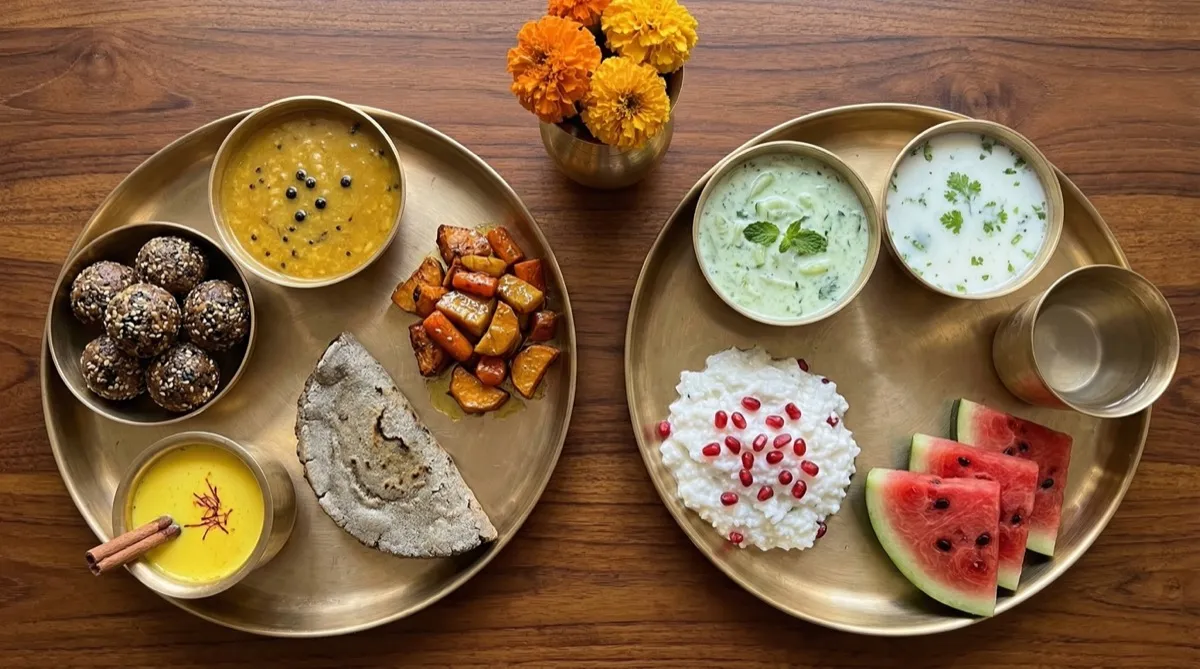
What to Actually Change When the Season Turns
The beauty of Ritucharya is that you do not need to overhaul your life. Small, well-timed adjustments make a significant difference. Here are some practical starting points that generations of families have found useful.
In winter (Hemanta/Shishira): Eat your biggest, richest meal at lunch when digestive fire peaks. Use sesame oil for self-massage (Abhyanga) — it is warming, nourishing, and deeply grounding. Add ginger, black pepper, and cinnamon to your cooking. Favour warm, cooked foods over raw salads. Do not skip meals — your body needs fuel to maintain its internal warmth.
In spring (Vasanta): Shift to lighter meals. Add bitter greens, turmeric, and pepper to your diet. This is the best season for gentle cleansing and fasting. Reduce sweets and dairy, which increase Kapha. Exercise more vigorously — spring is the season your body most rewards movement. Honey in warm water (not hot) is a simple daily support.
In summer (Grishma): Eat cool, sweet, liquid foods. Rice with dal, buttermilk with cumin, fresh seasonal fruits. Avoid excessive salt, sour, and pungent tastes. Reduce exercise intensity. Stay hydrated, but with room-temperature water infused with cooling herbs like coriander or fennel, not ice-cold water that shocks the digestive fire.
In monsoon (Varsha): This is the season to be most careful. Eat only fresh, warm, cooked food. Add a slice of fresh ginger with rock salt before meals to kindle Agni. Avoid curd at night, excess leafy vegetables, and street food. Keep your feet dry. A little honey in warm water helps counter the heavy, damp atmosphere. Boil your drinking water with a pinch of dry ginger.
In autumn (Sharad): Favour cooling, sweet foods even though the weather feels pleasant. Ghee is your best friend this season. Avoid fermented foods, excess sour tastes, and direct midday sun. Take a gentle walk in the moonlight — classical Sharad advice that also happens to be wonderful for your nervous system.
And throughout the year, pay attention to the fifteen-day Ritu Sandhi windows. Eat simpler. Rest more. Do not make sudden dietary shifts. These small acts of seasonal awareness, layered on top of a sound daily routine, compound over time into something remarkably powerful — a body that moves through the year with ease rather than lurching from one seasonal illness to the next. If you want personalised guidance on how these principles apply to your specific constitution, our clinical approach page explains how we work, and you can explore specific consultation areas to see how seasonal wellness fits into a broader picture of care.
Did You Know?
Agni (digestive fire) does not stay constant across seasons — it shifts in a pattern that seems counterintuitive until you understand the mechanism. Agni is strongest in Hemanta (winter) and weakest in Grishma (summer). The reason: in cold weather, the body constricts its peripheral channels and concentrates heat inward toward the digestive core, like a furnace sealed tight. In summer, heat disperses outward to the skin for cooling, leaving the digestive centre relatively weak. This is why heavy winter meals digest easily but the same meal in July sits like a stone.
What Current Evidence Says
The idea that seasonal changes affect human health is well-recognised in modern science. Research has documented seasonal variations in immune function, vitamin D levels, mood, sleep patterns, and metabolic activity. The World Health Organization (WHO) acknowledges traditional medicine systems, including Ayurveda, as part of its Traditional Medicine Strategy.
The Ministry of Ayush in India has supported research into Ritucharya concepts through institutions like the Central Council for Research in Ayurvedic Sciences (CCRAS). Some studies have explored the relationship between seasonal dietary practices and markers of metabolic health, though this research is still developing.
While the broad principle of adapting lifestyle to seasons has general scientific support, the specific Ayurvedic recommendations of Ritucharya have not been extensively validated through large-scale clinical trials. These practices are best understood as part of a traditional wellness framework that complements modern healthcare approaches.
This article is for educational purposes only and does not constitute medical advice. Seasonal wellness practices can be a valuable part of a healthy lifestyle, but any significant changes to diet or routine should be discussed with your healthcare provider, especially if you have existing health conditions or are taking medication. Always consult your physician for medical concerns.