
Your Joints Are Not Just “Wearing Out”
Your joints don’t just “wear out.” That is one of the biggest myths in modern thinking about the body. Ayurveda figured out over 3,000 years ago that joint problems are a whole-body story — and the chapter doesn’t start in your knees.
That morning stiffness that takes ten minutes to walk off? That cracking sound when you climb stairs? The way your knuckles feel tight when it rains? Your body is telling you something very specific. Not “you’re getting old.” Not “your cartilage is gone.” Something far more precise — and far more actionable — than that.
Most people assume joint discomfort is about cartilage damage and inevitable ageing. Ayurveda sees it completely differently. In the classical framework, your joints are called Sandhi — literally the “meeting places” of the body. They are not passive mechanical hinges waiting to grind down. They are dynamic, living spaces where specific forces converge, specific tissues are nourished (or starved), and specific imbalances show up first. Understanding which forces are at play in your joints changes everything about how you care for them. And that understanding starts with one word: Vata.
This is not a modern reinterpretation. The classical texts lay it out with remarkable specificity. Charaka dedicates an entire chapter to Vata disorders affecting the joints (Chikitsa Sthana 28, Vata Vyadhi Chikitsa), describing how Vata migrates to weakened joint spaces and the sequential tissue depletion that follows. Sushruta, in Sharira Sthana 5, classifies joints by their structural type — ball-and-socket, hinge, gliding — and explains how each type is vulnerable to different patterns of imbalance. Madhava Nidana, the classical diagnostic text, devotes Chapter 25 entirely to Amavata — the toxic-joint pattern — detailing its causes, progression, and distinguishing features with a precision that remains clinically relevant today. These are not vague philosophical musings. They are systematic, observation-based frameworks developed over centuries of clinical practice.
Why Joints Are a Vata Story
Think of a door hinge. When it is well-oiled, it swings silently, effortlessly. When the oil dries out, it creaks. Leave it long enough and it grinds, resists, eventually seizes. Your joints work on exactly this principle — and in Ayurveda, the force that dries things out is called Vata.
Vata dosha governs all movement in your body — the blink of your eye, the beat of your heart, the flexion of your knee, the nerve impulse travelling down your spine. Its qualities are dryness, lightness, coldness, roughness, and mobility. These are not abstract philosophical ideas. They are observable, practical descriptions. When Vata increases — through irregular routines, cold and dry weather, excessive physical strain, too little sleep, chronic stress, or simply the natural progression of age — you feel its qualities in your body. Dry skin. Cold hands. Restless mind. And most tellingly: stiff, creaky, uncomfortable joints.
Why joints specifically? Because joints are natural Vata sites. Anywhere in the body where there is space, movement, and the meeting of different structures, Vata concentrates. The joint cavity is essentially a space (Akasha) where movement (Vayu) happens continuously. It is Vata’s home territory. So when Vata goes out of balance anywhere in the system, the joints are among the first places to register the disturbance. This is why a stressful week can show up as a stiff neck, why a few nights of poor sleep can make your knees ache, why travelling — which massively aggravates Vata — leaves you feeling like every joint in your body has rusted overnight.
There is a counterbalancing force, of course. Ayurveda describes a specific type of Kapha called Shleshaka Kapha — the lubricating substance that lives in the joint spaces. Think of it as the oil in that door hinge. Shleshaka Kapha provides cushioning, smoothness, and shock absorption. When it is adequate, you don’t even think about your joints. When Vata rises and begins to deplete this lubrication — like wind drying out a wet surface — the cushioning thins, the smooth glide roughens, and you start noticing your joints for the first time. Usually with a creak. Then a stiffness. Then something more persistent.
Two Completely Different Kinds of Joint Problems
Here is where Ayurveda makes a distinction that most people have never heard, but that changes how you think about joint care entirely. Not all joint discomfort is the same. Classical Ayurvedic texts describe two fundamentally different mechanisms — and the approach for each is practically opposite.
The first is called Sandhigata Vata. This is the degenerative pattern. Vata increases over time, dries out the joint lubrication, and begins to deplete the deeper tissues — specifically Asthi dhatu (bone tissue) and Majja dhatu (the marrow and nervous tissue within bone). The joint space narrows, movement becomes stiff and painful, and cracking sounds develop. This is the pattern most associated with ageing, with the gradual drying-out that Vata brings to later life. It tends to be worse in cold, dry weather, better with warmth and oil, and it responds to nourishing, building, lubricating approaches.
The second is called Amavata — and it is a completely different animal. In this pattern, the problem is not dryness but toxicity. When Agni (digestive fire) is weak, food is not fully processed, and a sticky, heavy metabolic residue called Ama accumulates. Think of Ama as rust in the mechanism. This Ama circulates through the body and has a particular affinity for joint spaces, where it lodges, causes swelling, heat, and inflammatory-type discomfort. The joints feel heavy, swollen, and warm rather than dry and cracking. It tends to be worse in damp weather, worse after heavy meals, and it responds to lightening, cleansing, and Agni-strengthening approaches — the opposite of what works for Sandhigata Vata.
This distinction matters enormously. If your joints are dry, cracking, and stiff (Vata pattern), loading them up with rich, heavy, nourishing treatments is exactly right. But if your joints are swollen, hot, and heavy (Ama pattern), that same rich nourishment can make things worse, because you are feeding the Ama. And vice versa: if your joints are already depleted and dry, aggressive cleansing and lightening can push Vata even higher and increase the discomfort. Getting this assessment right is why individualised care matters so much in the Ayurvedic approach.
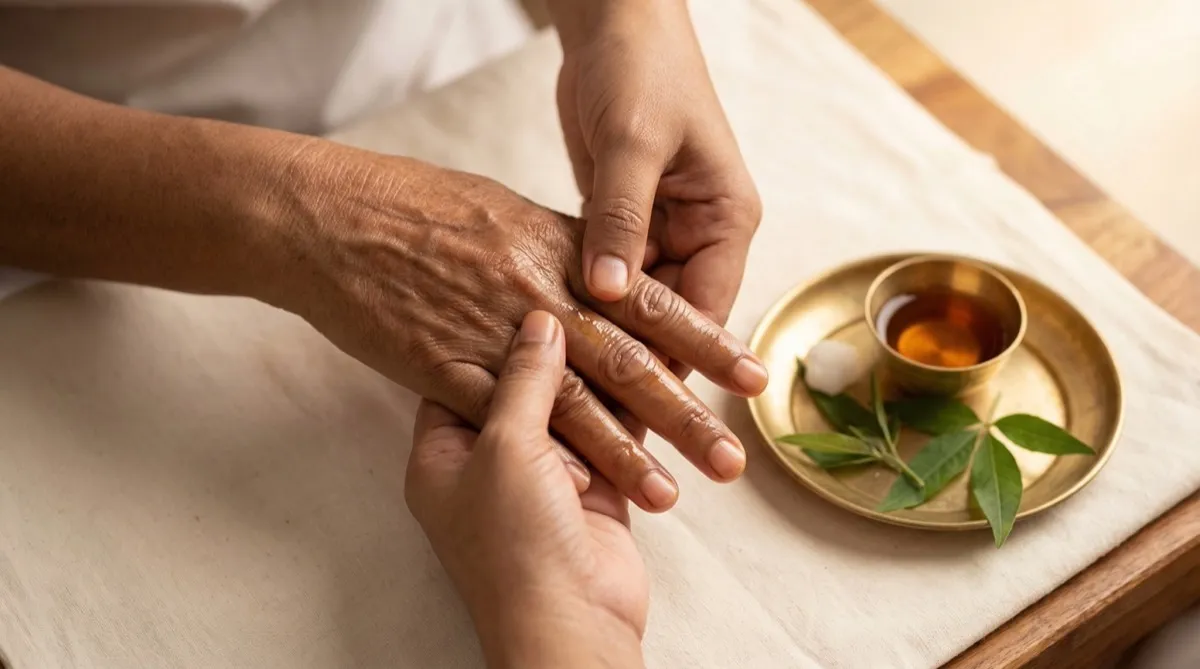
Did You Know?
Madhava Nidana (Chapter 25, circa 700 CE) describes Amavata with such precision — morning stiffness, migratory joint swelling, fatigue, and loss of appetite — that the description maps almost exactly onto the 2010 ACR/EULAR classification criteria for rheumatoid arthritis. Western medicine did not formally separate osteoarthritis from rheumatoid arthritis until Sir Alfred Baring Garrod published his work in 1859. The Ayurvedic diagnostic framework was approximately 1,100 years ahead — and arguably more clinically useful, because it also prescribed opposite treatment approaches for each type.
Here is a perspective that changes how you think about your skeleton: your bones are not static scaffolding. They are living tissue that completely remodels itself every 7–10 years. Every bone in your body today is different from the bone that was there a decade ago. The question Ayurveda asks is whether the conditions for proper bone rebuilding — strong Agni, clear Srotas, adequate Asthi Dhatvagni — are present. When these conditions deteriorate, the body still remodels, but it rebuilds weaker structures. This is why joint degeneration accelerates: it is not that the body stops rebuilding, but that it rebuilds poorly. Restoring the upstream conditions is fundamentally different from simply adding calcium at the end of the chain.
The Asthi-Majja Connection: Why Calcium Supplements Miss the Point
Ayurveda describes seven layers of tissue (Sapta Dhatu) that are nourished in sequence, each one feeding the next. Bone tissue (Asthi dhatu) and the marrow/nervous tissue within it (Majja dhatu) are the fifth and sixth layers — deep in the sequence. This means that for nutrition to reach your bones, it must first successfully nourish five preceding tissue layers. If any stage is weak, the deeper tissues are the first to starve.
This is why Ayurveda suggests that simply taking calcium is an incomplete approach. The real question is not “are you consuming enough calcium?” but “is your body actually transforming what you eat into bone tissue?” That transformation depends on what Ayurveda calls Asthi Dhatvagni — the specific metabolic fire responsible for converting nutrients into bone. If this Agni is weak (which Vata imbalance tends to cause), you can swallow all the calcium in the world and your bones will still feel the deficit. The nutrient goes in, but the tissue does not form properly. The Ayurvedic approach focuses on strengthening the entire chain of tissue nourishment, not just supplementing one mineral at the end of it. This is the logic behind Rasayana (tissue-rebuilding) practices — they work at the level of Agni and Dhatu, not just nutrient supply.
There is another layer to this that makes the picture even more precise. Ayurveda describes specific transport channels — Srotas — responsible for carrying nourishment to each tissue type. For bones and joints, two channels are central: Asthivaha Srotas (the channel nourishing bone tissue) and Majjavaha Srotas (the channel nourishing marrow and nervous tissue within bone). When these channels are functioning well, nutrients reach the joint structures efficiently. But Srotas can be disrupted in two fundamentally different ways. Kshaya (depletion) occurs when the channel carries too little — the tissue starves, dries out, and degenerates. This is the Sandhigata Vata pattern. Sanga (obstruction) occurs when the channel is blocked — typically by Ama — so nutrients cannot reach the tissue even if they are available. This is the Amavata pattern. Understanding which type of Srotodushti (channel disruption) is at play determines the entire direction of care: nourish and build for depletion, clear and lighten for obstruction.
The Dhatu nourishment chain does not end at Majja. The seventh and final product of this sequential transformation is Ojas — described as the essential vitality of the entire body, the refined essence of all seven tissue layers. When the chain from Rasa through Asthi and Majja functions well, Ojas is abundant, and it sustains immunity, resilience, and the structural integrity of every tissue including the joints. When the chain is disrupted — by weak Agni, by Vata depleting the deeper tissues, or by Ama blocking the channels — Ojas diminishes. This is why Ayurveda views joint degeneration not as an isolated local problem but as a sign that the body’s deepest nourishment process has been compromised. Restoring joint health, in this framework, means restoring the conditions for Ojas to form.
Why the Season Your Joints Hurt Tells You Everything
There is a reason your grandmother said “don’t get wet in the rain” and “oil your body before winter.” She was practising Ritucharya — seasonal living — whether she used the word or not. Ayurveda maps joint discomfort to the calendar with remarkable precision.
During cold and dry seasons (Hemanta and Shishira in the Ayurvedic calendar, roughly November through February), Vata naturally rises in everyone. The air is dry, the wind is cold, the environment itself has Vata qualities. This is when the degenerative, Sandhigata Vata pattern tends to flare — joints feel stiff, cracking, worse in the morning, worse after sitting still. The traditional response is intuitive: warm food, warm oil on the body, early bedtime, regularity in routine. Everything that pacifies Vata.
Then comes monsoon season (Varsha), and the pattern shifts. The air is heavy, damp, and cool. Agni tends to weaken in this season. Food digests more slowly. Ama accumulates. This is when the Amavata pattern tends to flare — joints feel swollen, heavy, uncomfortable in a different way. Many people notice that joint discomfort during the rains has a different quality than winter stiffness, and they are right. It is a different mechanism entirely. The monsoon calls for lighter food, digestive spices, avoiding cold and heavy meals, and keeping the body warm and dry.
Summer (Grishma) is generally the easiest season for joints — warmth naturally pacifies Vata, and the heat keeps Agni reasonably strong. But the transition points between seasons are where many people get caught. The body has not yet adjusted, the doshas are shifting, and if your routine does not shift with them, the joints bear the cost. Paying attention to these seasonal rhythms is one of the simplest and most powerful things you can do for long-term joint comfort. It costs nothing. It requires no supplements. Just awareness and adjustment.
The Oil Principle: Why Warm Oil Is Not Just a Massage
Of all the Ayurvedic approaches to joint comfort, Snehana — oleation — is perhaps the most important and the most misunderstood. Most people think of oil massage (Abhyanga) as a relaxation technique. Pleasant, certainly, but fundamentally a luxury. Ayurveda sees it as medicine. In fact, Abhyanga is one of the core practices of Dinacharya (daily routine) — not an occasional indulgence but something the classical texts recommend as a daily discipline, precisely because its effects on Vata accumulate over time.
Snehana works at two levels. Externally, warm oil applied to the skin is traditionally understood to penetrate through the tissue layers, counteracting Vata’s dryness directly where it concentrates — in the joints, the muscles, the connective tissue. Sesame oil is classically preferred because its qualities (warm, heavy, penetrating) are the precise opposite of Vata’s qualities (cold, light, drying). It is not just “moisturising the skin” — Ayurveda describes it as nourishing the deeper tissues (dhatus) that the skin merely covers.
Internally, Snehana means consuming healthy fats — primarily ghee — as part of daily meals. This is exactly opposite to what much modern diet culture recommends. The Ayurvedic reasoning is straightforward: if Vata’s core quality is dryness, and dryness is depleting your joints from the inside, then the antidote is internal lubrication. Ghee, warm milk, soups made with healthy fats, nuts soaked and softened — these are not indulgences. They are Vata medicine. Families who have maintained the tradition of a spoonful of ghee on warm rice, or warm milk before bed, have been doing Snehana without calling it that.
It is worth noting that the classical texts consider Basti — a specialised Panchakarma procedure administered under practitioner guidance — as the single most important intervention for Vata disorders. Charaka calls it Ardha Chikitsa: half of all treatment. The reasoning is that Vata’s primary seat is the lower abdomen (Pakwashaya), and Basti works directly at that site, calming Vata at its source rather than chasing its symptoms at the periphery. For chronic, deep-seated joint concerns driven by longstanding Vata imbalance, classical Ayurveda regards Basti as foundational. This is not something to attempt at home — it is a clinical procedure that requires proper assessment and supervision — but understanding its place in the tradition helps explain why Ayurveda’s approach to joints goes far beyond oil and diet.
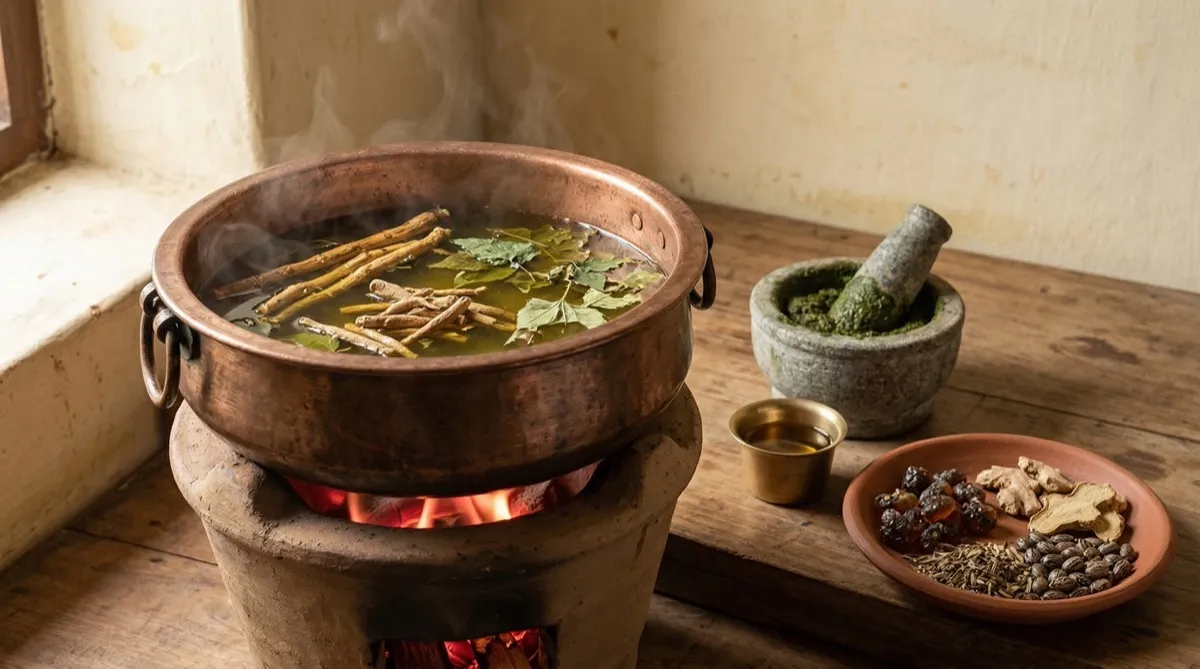
Did You Know?
Charaka Samhita (Sutrasthana 5.81–83) states that Abhyanga with warm sesame oil, practised daily, makes the skin resistant to injury, the body tolerant of exertion, and the joints supple even with ageing. Modern analysis reveals why: sesame oil contains sesamol, sesaminol, and sesamolin — compounds with documented anti-inflammatory and antioxidant properties. But the real surprise is the delivery mechanism. A 2020 study in the Journal of Ayurveda and Integrative Medicine found that transdermal absorption of warm oil occurs within 5–7 minutes and reaches the deeper tissues within 20 minutes. Charaka prescribed 15–20 minutes of oil application — almost exactly the time modern research says is needed for tissue-level penetration.
The Modern Diet Problem Ayurveda Predicted
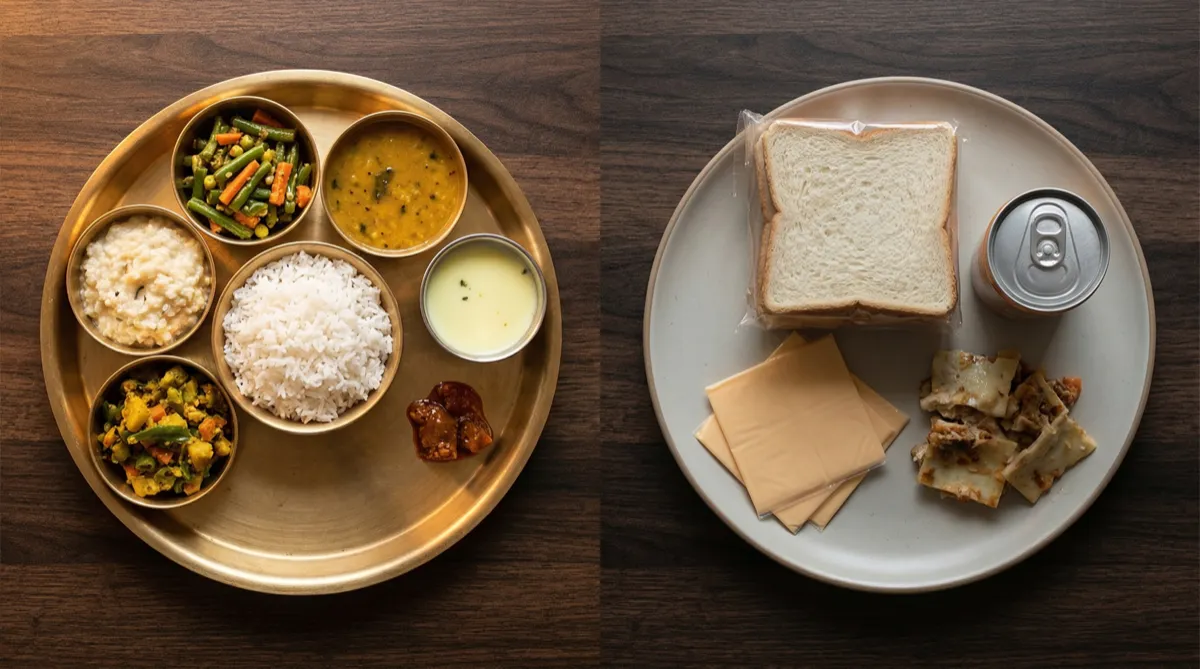
Here is something worth sitting with: the diet that modern wellness culture promotes as “healthy” is, from an Ayurvedic perspective, almost perfectly designed to aggravate Vata and damage joints over time. Cold smoothies for breakfast. Raw salad for lunch. Dry snacks and crackers between meals. Minimal fat. Maximum roughage. Cold water throughout the day.
Every single one of these increases Vata. Cold, dry, rough, light — these are all Vata qualities being pushed into the body meal after meal, day after day. Ayurveda is not surprised when someone eating this way at thirty-five starts noticing joint stiffness at forty-five. The body has been slowly drying out from the inside for a decade.
The Ayurvedic joint-friendly diet looks very different. Warm, cooked meals. Rice with ghee. Soups and stews. Cooked vegetables with mild spices. Foods with natural moisture and substance. Ginger, turmeric, and fenugreek used regularly — not as supplements but as everyday cooking ingredients. Warm water or herbal teas instead of ice water. None of this is exotic or expensive. It is how most Indian families ate two generations ago, before the cold-cereal-and-salad paradigm took over.
Did You Know?
Charaka (Chikitsa Sthana 28) described that joint problems often begin not in the joints but in the gut — when weak Agni produces Ama that migrates to Sandhi (joint spaces). In 2018, Nature Reviews Rheumatology formally recognised the “gut-joint axis” — the finding that intestinal permeability and microbiome dysbiosis directly drive joint inflammation. Specific gut bacteria have now been identified as triggers for rheumatoid arthritis. Charaka mapped this gut-to-joint pathway approximately 2,000 years before the microbiome was discovered, and his prescription — strengthen Agni first, then address the joints — aligns precisely with the emerging research direction.
There is a deeper principle at work here that the classical texts understood intuitively. The human body is roughly 72% water. Every joint space, every synovial capsule, every cartilage surface depends on this water being properly managed — distributed where needed, held in the right tissues, and not allowed to stagnate or deplete. Vata’s fundamental action is to dry and move. When Vata rises unchecked, it does not just affect the joint mechanically — it disrupts the body’s entire fluid intelligence. This is why Ayurveda’s approach to joints always includes hydration strategy (warm water, not cold), internal oleation (ghee, not dry food), and external oleation (oil application) — it is restoring the body’s relationship with the water element that Vata is disturbing.
The Line Between Self-Care and When to See a Practitioner
Not every joint creak needs a doctor and not every stiffness is serious. Ayurveda teaches that early signs of Vata accumulation in the joints — occasional stiffness that eases with movement, mild cracking without discomfort, weather-related changes that come and go — are the body asking for nourishment, not sounding an alarm. This is when lifestyle changes, oil application, dietary adjustment, and seasonal awareness can make the most meaningful difference. This is the window of opportunity.
However, certain signs warrant proper medical evaluation alongside Ayurvedic care: persistent swelling that does not subside, redness and heat around a joint, pain that disrupts sleep consistently, sudden locking or giving-way of a joint, or any rapid change in mobility. These may indicate conditions that benefit from modern diagnostic tools — imaging, blood work, specialist assessment. The Ayurvedic tradition is not opposed to this; classical texts themselves describe when a condition has progressed beyond simple Vata management and requires more intensive intervention. Our clinical approach includes understanding when to recommend patients also seek modern medical evaluation — the two systems can work together, each contributing what it does best.
The most important thing to understand is that joint comfort is not a matter of luck or genetics alone. It is, in large part, a consequence of how you live — what you eat, how you sleep, whether you oil your body, how you respond to seasonal changes, and whether you attend to early signals or ignore them until they become impossible to ignore. Ayurveda offers a remarkably detailed, internally consistent framework for understanding why joints behave the way they do and what, specifically, you can do about it. It is a framework that has been guiding families for millennia — and it begins with listening to what your body is already telling you.
What Current Evidence Says
Modern research recognises the importance of lifestyle factors in joint health. Regular moderate exercise, maintaining a healthy weight, and an anti-inflammatory diet are well-established recommendations. The connection between cold weather and increased joint stiffness, while still being studied, is widely reported by patients and acknowledged by clinicians.
Turmeric and its active compound curcumin have attracted significant research interest. The National Center for Complementary and Integrative Health (NCCIH) notes that some studies suggest curcumin may have anti-inflammatory properties, though more high-quality research is needed. Similarly, massage therapy has been studied for its effects on joint comfort, with some evidence suggesting modest benefits for mobility and pain perception.
It is important to note that arthritis and other joint conditions are medical diagnoses that require proper evaluation by a qualified physician. Ayurvedic lifestyle practices may complement medical care but should not delay or replace diagnosis and treatment from your doctor.
This article is for educational purposes only and does not constitute medical advice. If you experience persistent joint pain, swelling, redness, or reduced mobility, please consult your physician for proper evaluation and diagnosis. Arthritis and other joint conditions require medical assessment. Traditional Ayurvedic approaches to joint comfort should complement — not replace — medical care. Always inform your healthcare provider about any supplements, oils, or herbal preparations you may be using.