
Sleep Is Not a Luxury — It Is a Pillar
Modern wellness culture treats sleep as a performance hack. Get your eight hours, optimise your sleep score, buy a better mattress. Ayurveda takes a fundamentally different position. In Charaka Samhita (Sutrasthana, Chapter 11), sleep — Nidra — is named as one of the Trayopastambha, the three supporting pillars of life. The other two are Ahara (food) and Brahmacharya (regulated living). Remove any one of these pillars and the entire structure of health becomes unstable.
This is not metaphor. Charaka states directly: “Happiness and unhappiness, nourishment and emaciation, strength and debility, sexual prowess and impotence, knowledge and ignorance, life and death — all depend on sleep.” (Charaka Samhita, Sutrasthana 21.36). No other classical medical system in history gave sleep this level of diagnostic importance. Not as a symptom to fix, but as a window into the entire state of the organism.
Sushruta Samhita reinforces this in Sharira Sthana (Chapter 4.33-34), describing sleep as the state in which the mind, exhausted by sensory engagement, withdraws into itself. Vagbhata, writing in Ashtanga Hridaya (Sutrasthana 7.52-67), devotes an entire passage to the consequences of improper sleep — listing weight loss, weakness, infertility, impaired cognition, and reduced lifespan among the results. Three independent classical authorities, separated by centuries, arrived at the same conclusion: sleep is not optional maintenance. It is load-bearing architecture.
The implication is profound: when your sleep is disturbed, it is not an isolated problem to solve with a tablet. It is your body telling you that something fundamental has shifted in its internal balance. The question is not “how do I fall asleep?” but “what has changed in my system that sleep is no longer coming naturally?”
Did You Know?
Charaka did not just call sleep important — he stated that sleep governs the difference between life and death, knowledge and ignorance, strength and debility (Sutrasthana 21.36). He gave no other bodily function this range of influence. Greek medicine treated sleep as recovery from exertion. Chinese medicine classified it under Yin-Yang theory. Only Ayurveda made sleep a structural pillar equal to food itself — meaning a person with perfect diet but poor sleep is, by definition, architecturally unhealthy.
The Six Types of Sleep — Only One Is Healthy
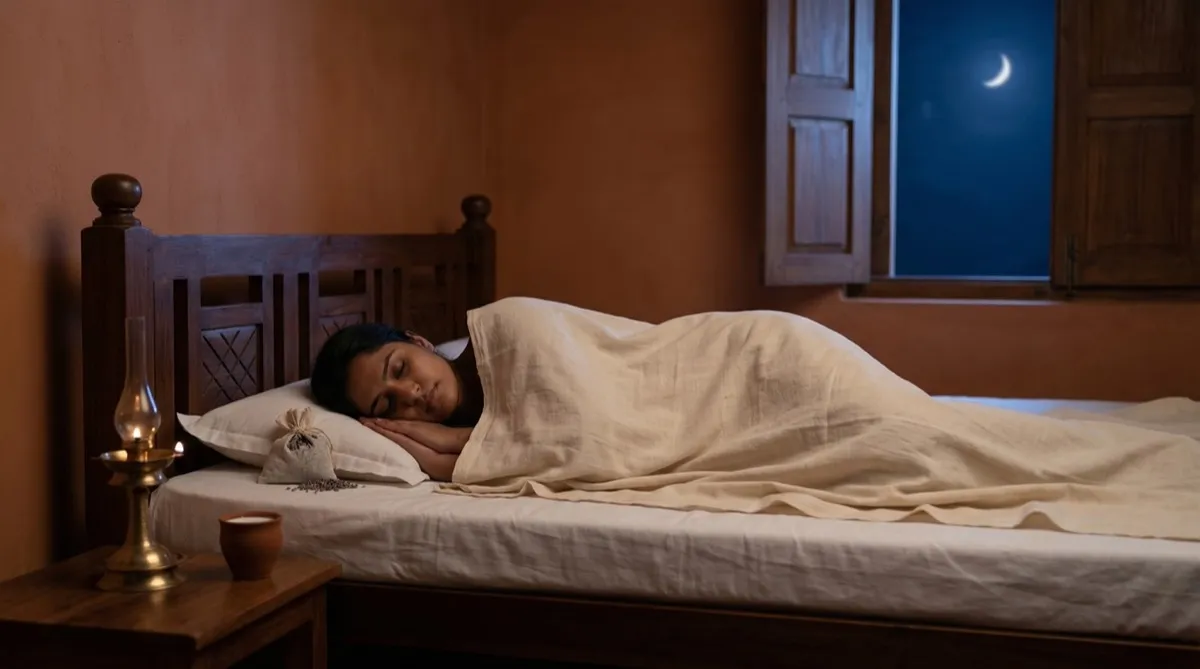
Charaka classifies sleep into six distinct types (Sutrasthana 21.58-59). This classification is one of the most overlooked and genuinely eye-opening aspects of Ayurvedic sleep science. Most people assume that all sleep is the same — you are either sleeping or you are not. Ayurveda says that is like saying all food is the same because it enters the stomach.
The six types are: Tamobhava — sleep caused by Tamas (mental heaviness and dullness). This is the oversleeping that comes with depression, lethargy, or excessive screen consumption. You sleep long hours but wake unrefreshed. Shleshmasamudbhava — sleep caused by Kapha accumulation. Heavy, prolonged sleep with difficulty waking, often accompanied by a foggy, sluggish feeling. Manah-shrama-sambhava — sleep from mental exhaustion. After intense worry, overthinking, or emotional distress, the mind collapses into sleep as a defensive shutdown. Sharira-shrama-sambhava — sleep from physical exhaustion. This is the deep, restorative sleep that comes after honest physical labour. Agantuki — sleep caused by external factors: disease, injury, or substances. Ratrisvabhava-prabhava — natural sleep that comes at night as part of the body’s innate rhythm.
Only the last type — Ratrisvabhava-prabhava, natural nighttime sleep — is considered genuinely healthy. It arrives without effort when night falls, lasts an appropriate duration, and leaves you refreshed. Every other type of sleep is either a compensation mechanism, a symptom of imbalance, or an external imposition. This distinction alone changes how you should think about your sleep. If you are sleeping nine hours but waking exhausted, your sleep type is likely Tamobhava or Shleshmasamudbhava — not healthy rest, but a manifestation of imbalance.
Did You Know?
Charaka classified 6 types of sleep (Nidra) over 2,500 years ago based on their cause — from mental exhaustion to natural rhythm. Modern sleep medicine recognises multiple sleep stages, but still has no equivalent classification system for what causes a person to fall asleep in the first place.
Your Dosha Pattern Determines Your Sleep Pattern
Here is where Ayurveda’s insight becomes genuinely practical. Different doshas create different sleep disturbances, and recognising the pattern is the first step toward addressing the root cause rather than sedating the symptom.
Vata sleep disturbance — the most common type in modern life. Difficulty falling asleep. The mind races. You lie in bed replaying conversations, planning tomorrow, worrying about things you cannot control. When sleep comes, it is light and fragmented. You wake at small sounds. Dreams are vivid, often anxious — flying, falling, running. Vata governs movement, and when it is aggravated, the mind literally cannot stop moving. This is not a melatonin deficiency. It is a Vata imbalance affecting Manovaha srotas — the channels that govern mental activity and consciousness.
Pitta sleep disturbance — the pattern most people do not recognise. You fall asleep fine, often exhausted. But you wake between 10 PM and 2 AM — or more commonly between 2 AM and 4 AM — alert, hot, sometimes with acid reflux or a racing mind full of sharp, problem-solving thoughts. This is not random. In Ayurveda, 10 PM to 2 AM is Pitta time — the period when the body’s internal fire is most active. If Pitta is already aggravated (from stress, anger, competitive intensity, spicy food, or overwork), this natural nightly Pitta surge pushes you past the threshold into wakefulness. You may also notice you feel warm, kick off blankets, or experience vivid, intense dreams — often involving fire, conflict, or competition.
Kapha sleep disturbance — the opposite problem. Excessive sleep. Difficulty waking. A heavy, dull feeling upon rising that persists for hours. Kapha-type sleep disturbance is less about not sleeping and more about sleeping too much without restoration. The sleep is heavy but not refreshing because Kapha is blocking the natural lightness that should accompany waking. This pattern often coexists with weight gain, sluggish digestion, congestion, and a general sense of being “stuck.”
The critical insight: a person with Vata insomnia and a person with Pitta-driven early waking need fundamentally different approaches. A sleeping pill does not distinguish between them. Ayurveda does.
Light, interrupted sleep
- Racing thoughts at bedtime
- Waking at 2–4 AM
- Difficulty falling back asleep
- Vivid, anxious dreams
Hot, intense sleep
- Difficulty winding down
- Waking between midnight–2 AM
- Overheating at night
- Irritability if sleep is broken
Heavy, excessive sleep
- Hard to wake up
- Sleeping 9+ hours but still groggy
- Daytime drowsiness
- Feeling heavy on waking
Prana Vayu and the Sleep-Wake Cycle
Among the five subtypes of Vata, Prana Vayu holds a unique position in the sleep-wake cycle. Prana Vayu governs all upward and inward movement — inhalation, swallowing, sensory perception, and critically, the movement of consciousness itself. It is seated in the head and moves through the chest. When you fall asleep, it is Prana Vayu that facilitates the withdrawal of the senses (Pratyahara) from the external world. When you wake, it is Prana Vayu that re-engages them.
Charaka describes this mechanism in Sutrasthana 12.8: when the sensory organs become fatigued and the mind withdraws from the senses, sleep manifests. This withdrawal is not passive. It is an active function of Prana Vayu directing consciousness inward. This is why breathing patterns are so central to sleep — Prana Vayu governs both. A person whose Prana Vayu is disturbed will simultaneously experience irregular breathing and irregular sleep, because the same force governs both functions.
Sushruta expands on this in Sharira Sthana (Chapter 4), describing how Prana Vayu coordinates with Tarpaka Kapha — the subtype of Kapha that nourishes the brain and sensory organs — to create the conditions for sleep. Tarpaka Kapha provides the cooling, nourishing moisture that allows the brain to rest. When Prana Vayu is aggravated, it dries out Tarpaka Kapha, and the brain becomes overstimulated and unable to settle. This is the precise mechanism behind the “tired but wired” state that so many people experience — exhausted yet unable to sleep. It is not a paradox. It is a Prana Vayu-Tarpaka Kapha imbalance.
Vagbhata in Ashtanga Hridaya (Sutrasthana 11.1) further clarifies that Sadhaka Pitta — the subtype of Pitta governing emotional processing and mental clarity — must also be in balance for healthy sleep. Sadhaka Pitta processes the emotional experiences of the day. When it is overactive, the mind cannot release daytime impressions, and sleep becomes either delayed or fragmented with intense dreams. The classical understanding, therefore, involves a three-way coordination: Prana Vayu withdraws the senses, Tarpaka Kapha cools and nourishes the brain, and Sadhaka Pitta completes emotional processing. Disruption at any point breaks the cycle.
Did You Know?
The “tired but wired” state — where you are physically exhausted but your mind will not stop — has a precise Ayurvedic explanation: aggravated Prana Vayu has dried out Tarpaka Kapha in the brain. The organ that needs moisture and cooling to rest is instead being agitated by excessive neural movement. This is why breath-based practices before sleep are not relaxation techniques — they are direct interventions on Prana Vayu.
The Gut-Sleep Connection: Why Digestion Determines Rest
This is perhaps the most underappreciated connection in sleep science, and one that Ayurveda identified thousands of years before modern research began exploring the gut-brain axis. Charaka states clearly that improper digestion — weakened Agni — directly affects sleep quality through the accumulation of Ama (undigested metabolic waste).
The mechanism is straightforward in Ayurvedic terms: when Agni is weak, food is not fully processed. The residue — Ama — is sticky, heavy, and obstructive. It blocks srotas (channels) throughout the body. When Ama enters Manovaha srotas (the mental channels), it creates a fog that interferes with the natural transition into sleep. When it accumulates in Rasavaha srotas (the plasma channels), it disrupts the nourishment that the brain and nervous system require for healthy sleep-wake cycling.
This is why Ayurvedic practitioners will often ask about your digestion before addressing your sleep. A person who eats heavy food late at night, or eats when not hungry, or combines incompatible foods, is creating conditions that make healthy sleep physiologically difficult. No amount of meditation or sleep hygiene can overcome a gut that is producing Ama every night.
Modern research now confirms what Ayurveda has long observed: gut microbiome composition directly affects melatonin production, serotonin synthesis (90% occurs in the gut), and inflammatory markers that disrupt sleep architecture. The ancient Ayurvedic prescription to eat your largest meal at midday when Agni is strongest, and keep the evening meal light and warm, is not lifestyle advice — it is sleep medicine.
Did You Know?
The Ayurvedic observation that waking between 2–4 AM indicates Pitta disturbance aligns remarkably with cortisol research. The body’s cortisol surge begins around 3 AM, and individuals with Pitta-type constitutions often show exaggerated cortisol responses during this window.
Did You Know?
Stress does not just affect your mind — it physically changes the composition of your gut bacteria within hours. A single episode of acute psychological stress can measurably shift the gut microbiome toward an inflammatory profile. Since 90% of the body’s serotonin (the precursor to melatonin, the sleep hormone) is manufactured in the gut, this means a stressful day literally rewires the chemical factory your body depends on for sleep that same night. Ayurveda’s insistence that emotional state (Manas) and digestive state (Agni) are inseparable — and that both must be addressed for healthy sleep — anticipated this gut-brain-sleep axis by millennia.
Here is something that changes how you think about sleep entirely: sleep is not rest. It is the most active repair state your body enters. During the first 90 minutes of deep sleep, the pituitary gland releases its largest pulse of growth hormone — the signal that triggers tissue repair, muscle recovery, bone density maintenance, and immune cell regeneration. Miss that first deep-sleep window, and the entire night’s repair cascade is compromised. Ayurveda’s Brahma Muhurta timing — the recommendation to sleep early enough that the body completes its deepest rest before 4 AM — was designed around exactly this principle: not for spiritual discipline, but because the body’s most critical repair work happens in the early hours of sleep, and late sleeping pushes that window dangerously close to the cortisol surge that begins around 3 AM.
Sleep, Dhatu Nourishment, and the Production of Ojas
There is a deeper dimension to sleep that even many Ayurvedic discussions overlook: its role in the sequential nourishment of the seven dhatus (tissues) and the ultimate production of Ojas. Understanding this transforms sleep from a rest period into a metabolic event of extraordinary importance.
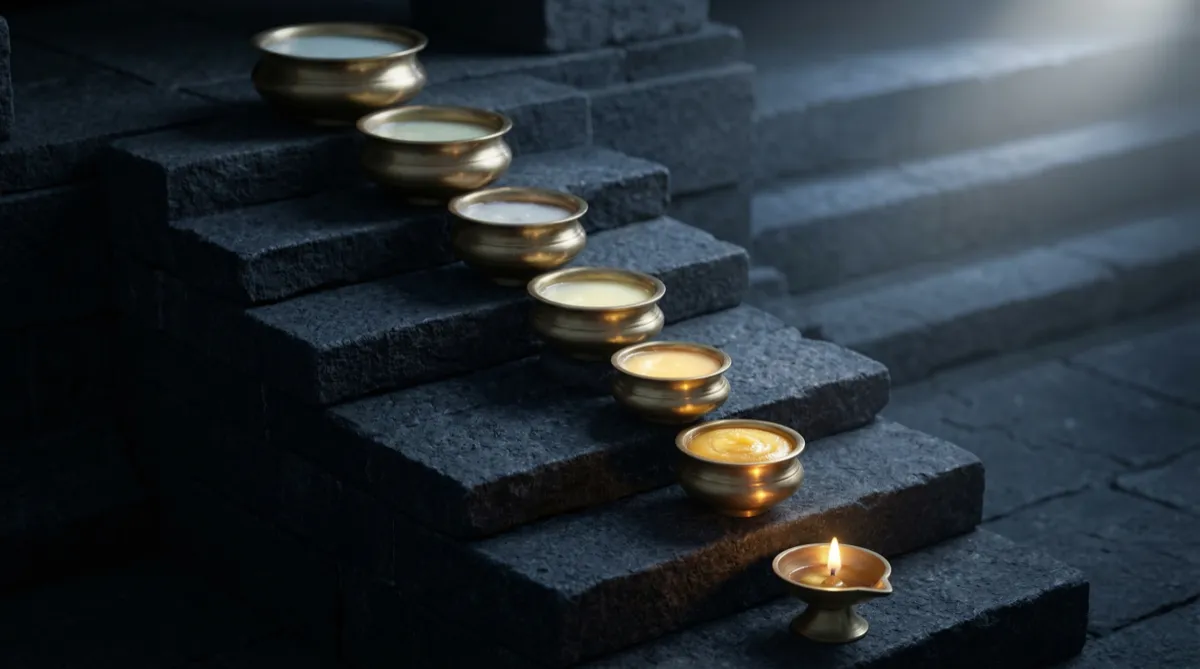
Think of dhatu nourishment as the body’s repair chain — a seven-stage assembly line that rebuilds your tissues from the inside out. It starts with the most basic tissue (Rasa, the plasma layer) and works its way through to the deepest (Shukra, the reproductive tissue), each stage transforming nourishment for the next through its own metabolic fire. During waking hours, the body’s energy is pulled toward movement, digestion, and mental activity, leaving this repair chain running at reduced capacity. Sleep is when the chain finally gets full power. The deeper and later stages — particularly Majja (marrow and nerve tissue) and Shukra — depend almost entirely on uninterrupted sleep to receive adequate nourishment. This is why one poor night leaves you foggy but functional, while weeks of poor sleep erode immunity, nerve function, and vitality at a level that no amount of coffee can compensate for.
Ojas is what your body produces when deep rest allows the full tissue chain to complete its work. Charaka explains in Chikitsasthana (Chapter 15) that this final product — the net result of all seven dhatus being properly nourished in sequence — can only emerge when the body is free from the demands of waking activity. The later dhatu transformations, particularly those involving Majja and Shukra, require the metabolic quiet that only sustained sleep provides. Cut that process short, and the chain never reaches its end. This is why Sushruta (Sutrasthana, Chapter 15) lists sleep deprivation as a direct cause of Ojas depletion (Ojakshaya) — it is not that poor sleep weakens you indirectly; it literally prevents the body from manufacturing its deepest reserve of immunity, clarity, and resilience.
The practical implication is significant: a person who sleeps poorly is not merely tired. Their entire tissue nourishment cascade is incomplete. Rasa dhatu may be poorly formed, leading to dry skin and anxiety. Rakta may be improperly refined, contributing to inflammatory conditions. The later dhatus — Asthi, Majja, Shukra — which require the longest and deepest processing, suffer the most from interrupted or insufficient sleep. And Ojas, the final product that sustains immunity and mental stability, is produced in diminished quantities.
Vagbhata in Ashtanga Hridaya (Sutrasthana 11.4) explicitly connects proper sleep to Bala (strength), Varna (complexion), and Pushti (nourishment of tissues). These are not separate benefits. They are markers of complete dhatu transformation and adequate Ojas production. When a practitioner observes that a sleep-deprived patient has dull skin, low immunity, poor muscle tone, and emotional fragility, they are observing the downstream effects of incomplete dhatu nourishment — all traceable to the disruption of the metabolic processes that should occur during sleep.
Did You Know?
Ojas — the substance Ayurveda identifies as the root of immunity, mental clarity, and emotional stability — is produced primarily during deep sleep as the final extract of seven sequential tissue transformations. This means chronic poor sleep does not just cause tiredness. It systematically depletes the very substance that protects you from disease, emotional instability, and premature ageing. Sushruta listed sleep deprivation as a direct cause of Ojas depletion — a clinical insight that modern immunology research on sleep and T-cell function is only now beginning to validate.
Why Sedation Is Not Sleep
A sleeping pill puts you unconscious. It does not give you sleep. This distinction matters enormously and is something Ayurveda understood long before modern sleep research confirmed it.
Natural sleep follows a precise architecture of stages — light sleep, deep sleep, REM sleep — each serving different functions. Tissue repair happens in deep sleep. Memory consolidation and emotional processing happen in REM. Pharmaceutical sedation disrupts this architecture. You may be unconscious for eight hours, but the body may not have completed the repair and restoration cycles it needs. This is why people on long-term sleep medication often report feeling unrested despite “sleeping” the right number of hours.
The Ayurvedic approach is fundamentally different. Rather than forcing unconsciousness, it asks: what is preventing the body from entering its natural sleep state? If Vata is aggravated, the approach calms Vata — through specific formulations, oil application (Abhyanga), warm food, routine, and grounding practices. If Pitta is the driver, the approach cools Pitta — through cooling herbs, avoiding late-night stimulation, and dietary adjustments. If Ama is obstructing the channels, the approach clears Ama through digestive correction.
The result is not sedation. It is the restoration of your body’s own ability to initiate and sustain natural sleep. This is why the improvement tends to be lasting rather than dependent on a nightly pill.
The Evening Routine: Ratricharya and Sleep Preparation
Classical Ayurveda does not separate “what you do in the evening” from “how you sleep.” The entire period from sunset to sleep is treated as a single physiological transition. The texts describe this with remarkable specificity.
The evening meal should be eaten at least two to three hours before sleep. It should be lighter than the midday meal — warm, easily digestible, and suited to your constitution. Vata types benefit from slightly oily, grounding foods (warm soups, rice with ghee, cooked vegetables). Pitta types benefit from cooling, non-spicy preparations (milk with a pinch of turmeric, sweet fruits, basmati rice). Kapha types benefit from light, warm preparations (clear soups, steamed vegetables, small portions).
After eating, a gentle walk is recommended — not exercise, just movement to support digestion. The period before sleep should be free from intense mental stimulation. The classical texts did not have screens to warn against, but the principle is the same: anything that stimulates Vata (rapid input, worry, planning) or Pitta (competition, anger, intensity) in the pre-sleep hours disrupts the natural downward transition of consciousness.
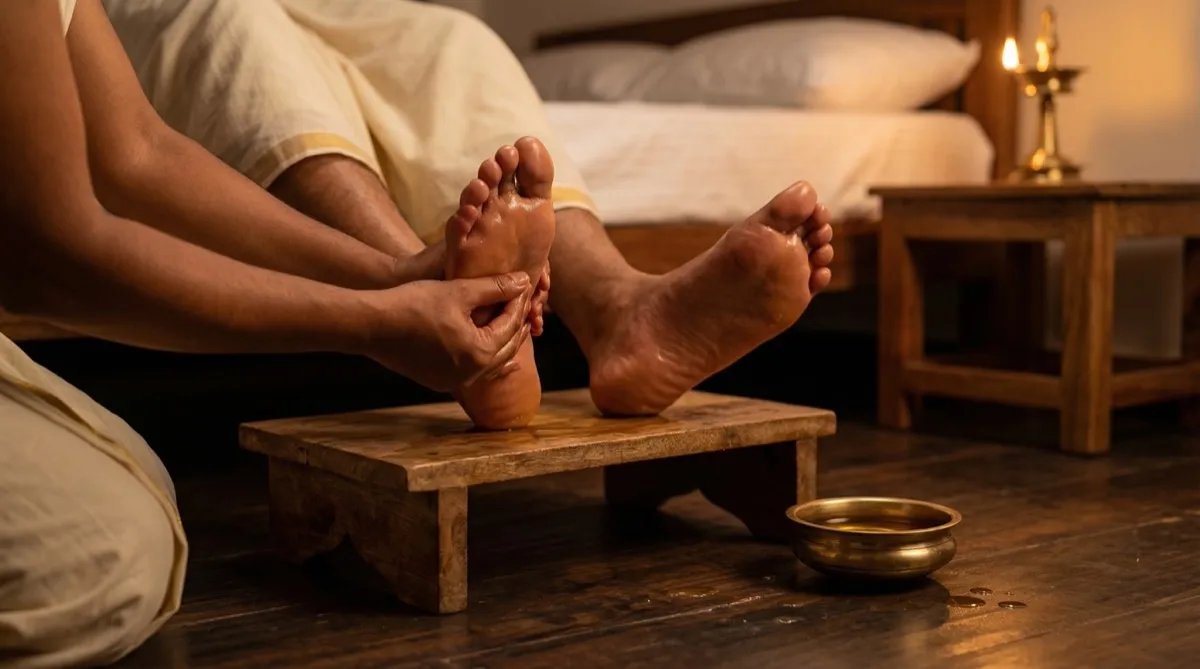
Applying warm oil to the feet (Padabhyanga) is one of the most consistently recommended sleep practices across Ayurvedic texts. It calms Vata, grounds the nervous system, and signals to the body that the active phase of the day is ending. This is not wellness theatre. Practitioners who have used it consistently with patients for decades observe genuinely measurable differences in how quickly and deeply their patients sleep.
Seasonal Sleep: Why Your Sleep Needs Change with Each Ritu
One of the most overlooked aspects of Ayurvedic sleep science is that sleep requirements are not fixed across the year. Classical texts explicitly prescribe different sleep durations and behaviours for different seasons (Ritu). Modern sleep advice gives a flat recommendation — seven to nine hours year-round — while Ayurveda observes that the body’s relationship with sleep shifts as the external environment changes.
Charaka addresses seasonal sleep in Sutrasthana (Chapter 21.44-51), and Vagbhata expands on it in Ashtanga Hridaya (Sutrasthana 7.53-61). The guidelines are specific: Grishma Ritu (summer) is the only season in which daytime sleep (Divaswapna) is explicitly permitted. The reasoning is precise: summer heat and long days cause Adana Kala (the depleting phase), drying out the body and aggravating Vata. Daytime rest compensates for the shorter, lighter nights and prevents further Vata aggravation. Varsha Ritu (monsoon) demands early sleep and early rising. The heavy, damp atmosphere aggravates Vata and Kapha simultaneously. Sleep quality naturally deteriorates in monsoon, and the texts recommend warm, light evening meals and oil application to counteract the seasonal effect. Hemanta and Shishira Ritu (early and late winter) are the seasons when sleep is naturally deepest and longest. The body’s Agni is strongest in winter, tissue nourishment is most active, and the long nights facilitate the complete dhatu transformation cycle. Restricting sleep in winter works against the body’s natural metabolic programme.
Sharad Ritu (autumn) and Vasanta Ritu (spring) both require careful attention. Autumn carries residual Pitta from summer, and Charaka specifically warns against daytime sleep in this season (Sutrasthana 21.44) as it can aggravate Pitta and lead to Kapha accumulation. Spring, when Kapha naturally liquefies and accumulates, also prohibits daytime sleep — sleeping during the day in spring increases heaviness, congestion, and metabolic sluggishness.
The seasonal perspective reveals something fundamental: the person who sleeps eight hours in every season regardless of the body’s changing needs is not following a healthy routine. They are ignoring the signals that the body sends as it adapts to shifting environmental conditions. A practitioner who understands Ritucharya (seasonal regimen) will adjust sleep guidance not just for the individual’s dosha but for the season they are currently in — recognising that the same person may need different sleep patterns in July than in December.
Did You Know?
Summer is the only season Ayurveda permits daytime napping — and the reasoning is metabolic, not about comfort. Summer depletes the body through Adana Kala (the solar extraction phase), drying tissues and aggravating Vata. A daytime nap specifically compensates for this depletion. In every other season, daytime sleep is considered actively harmful. Charaka even specifies that sleeping during the day in autumn or spring can trigger diseases that do not manifest until weeks later — a delayed-effect observation that modern chronobiology is only beginning to explore.
The Classical Approach to Restoring Nidra
When sleep disturbance is brought to an Ayurvedic practitioner, the assessment does not begin with the sleep. It begins with the person. What is their Prakriti? Which dosha is currently aggravated? What is the state of their Agni? Is there Ama present? What are their eating patterns, work rhythms, emotional patterns? How long has the sleep disturbance been present?
From this assessment, a specific approach emerges. It might include classical formulations known to support the nervous system and calm aggravated doshas. It will likely include dietary adjustments — not generic, but targeted to the individual’s constitution and current imbalance. It may include specific lifestyle guidance: when to eat, how to structure the evening, which practices to adopt and which to avoid.
Follow-up is essential. As the dosha imbalance begins to correct, sleep often improves in stages. First, falling asleep becomes easier. Then, the quality deepens. Then, waking becomes more refreshed. The practitioner monitors this progression and adjusts the approach as needed. This is not a one-time prescription. It is a guided restoration of a foundational bodily function.
At Santana Laxmi Ayurvedic Clinic, sleep-related concerns are among the conditions families most commonly bring — especially when they have persisted for years and conventional approaches have offered only temporary relief. Dr Sri Ramulu’s assessment follows this classical methodology, and the guidance is always specific to the individual. Learn more about our consultation areas or explore our sleep and stress consultation area.
What Current Evidence Says
Modern sleep research increasingly validates several Ayurvedic observations. The gut-brain axis and its role in sleep regulation is now a major research area, with studies confirming that gut microbiome composition affects sleep quality (Smith et al., 2019, in PLoS ONE). The concept of chronotypes — individual variation in circadian rhythms — maps loosely onto the dosha-based sleep patterns Ayurveda described centuries ago.
Classical Ayurvedic herbs traditionally used for Vata-related sleep disturbance have been studied in randomised controlled trials. A 2019 systematic review published in the Journal of Ethnopharmacology found significant improvements in sleep quality among participants taking traditional Rasayana formulations. The NCCIH lists several classical Ayurvedic herbs as having “some preliminary evidence” for sleep improvement, while noting that more research is needed.
The Ayurvedic emphasis on meal timing and its effect on sleep also finds support in chrono-nutrition research, which shows that eating late at night disrupts circadian rhythms and melatonin production (Garaulet et al., 2020).
This article is for educational purposes only and does not constitute medical advice. If you are experiencing persistent sleep disturbances, consult a qualified healthcare provider. Ayurvedic consultation can be a meaningful complement to your care, but should not replace medical evaluation — particularly if you experience symptoms like sleep apnoea, severe insomnia, or sleep disturbance associated with mental health conditions. Never stop prescribed medication without consulting your prescribing doctor.