
Agni Is Not What You Think It Is
Every time you eat, your body makes a decision: transform this food into living tissue, or leave it half-processed to become toxic residue. Ayurveda gave this decision-maker a name — Agni — and considered it more important than doshas, herbs, or yoga combined.
Most of us think of digestion as a mechanical process — stomach acid breaks down food, enzymes split proteins, the intestines absorb nutrients. That model is not wrong, but it is dramatically incomplete. Ayurveda recognised thousands of years ago what modern research is only now confirming: that digestion is not just a gut event. It is the body's master intelligence — the force that governs every single transformation happening inside you, from converting your lunch into living tissue, to metabolising emotions, to turning sensory experience into coherent thought. The Charaka Samhita, one of the foundational texts of Ayurveda, puts it bluntly in Chikitsasthana 15.3-4: "Ayuh, varna, bala, swasthya, utsaha, upachaya, prabha, oja, teja, agni, prana — all depend on Agni. When Agni ceases, a person dies." That is not poetic exaggeration. It is a clinical statement about the centrality of transformative capacity to life itself.
Think about that for a moment. Ayurveda does not say "when the heart stops" or "when the brain fails." It says when Agni — the power of transformation — ceases, life ends. This single idea reshapes how you understand health, disease, food, energy, and even aging. And once you truly grasp it, you will never think about your digestion the same way again. This is why digestive wellness sits at the very centre of Ayurvedic practice.
Beyond the Stomach: What Agni Actually Does
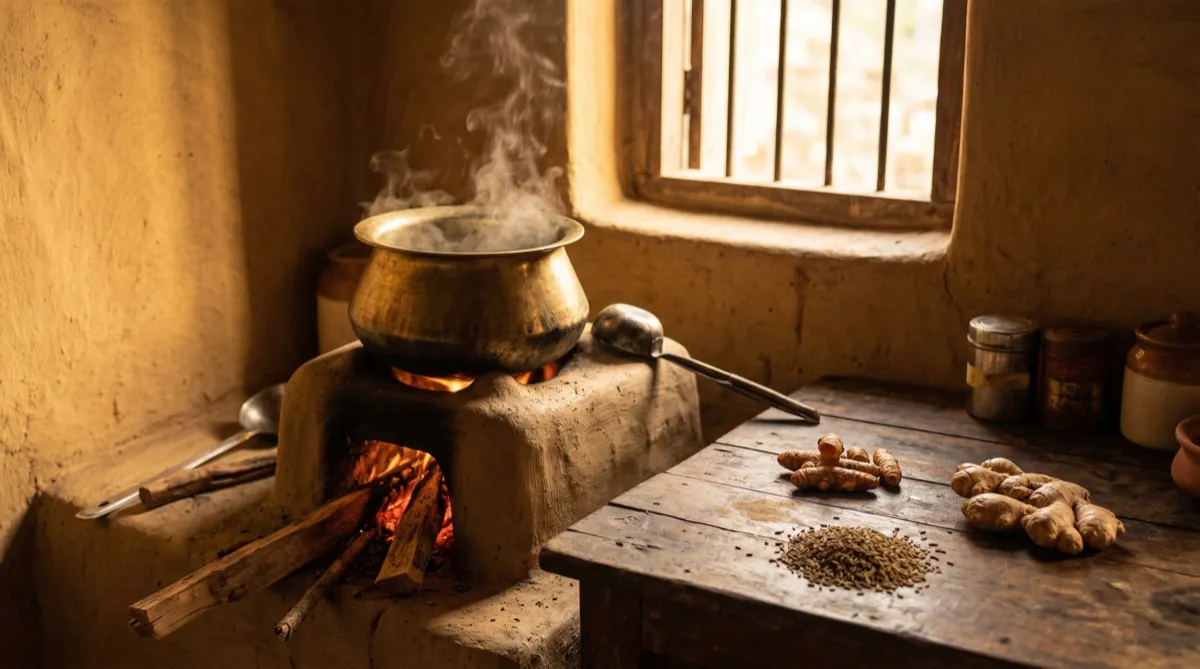
Imagine a campfire. Not a bonfire, not a match flame — a well-tended campfire. Feed it the right amount of dry wood at the right pace and it burns clean, bright, and hot. It transforms solid logs into heat, light, and a fine white ash that blows away in the wind. Now feed it wet logs, too much at once, or smother it with damp leaves. It smokes, sputters, and leaves behind a heavy, sticky, half-burnt residue that chokes the fire further.
Your Agni works exactly like that campfire. When it is strong and balanced, food is transformed completely into nourishment that builds healthy tissues — what Ayurveda calls Dhatus. The waste products are clean and minimal. You feel light after eating, clear-headed, energetic. But when Agni is compromised, the transformation is incomplete. And that is where things get interesting — and where Ayurveda diverges sharply from conventional thinking about digestion.
Because Agni is not one fire. It is thirteen.

The 13 Types of Agni: A Hierarchy That Changes Everything
This is where Ayurveda's model becomes genuinely mind-blowing in its sophistication. Your body does not have a single digestive process. It has a layered hierarchy of transformative fires, each responsible for a different level of processing.
At the top sits Jatharagni — the main digestive fire in your stomach and small intestine. This is the chief. The boss. Every other fire in your body depends on this one functioning well. Jatharagni is the fire you feel when hunger arrives, the fire that breaks down the rice and dal on your plate into something your body can actually use.
Below Jatharagni sit the five Bhutagni — elemental fires. These process the five elemental components (Pancha Mahabhuta) present in digested food: earth, water, fire, air, and space. Each Bhutagni refines the corresponding elemental quality in your food so it becomes compatible with the elemental composition of your own body. This is Ayurveda's explanation for why two people eating the exact same meal can have completely different responses — their Bhutagni process the elemental qualities differently.
To understand this concretely: Parthiva Agni (the earth-element fire) processes the solid, dense, structural qualities in food — think root vegetables, grains, and heavy proteins. Apya Agni (the water-element fire) handles the liquid, cooling, binding qualities. A person whose Parthiva Agni is weak may struggle to fully assimilate heavy, earthy foods even when their overall digestion seems fine, while someone with weak Apya Agni may have difficulty with dairy or juicy fruits. This is why Ayurveda does not prescribe the same diet to everyone — the elemental fires determine which foods your body can actually transform into nourishment.
And below those sit the seven Dhatvagni — think of each one as a specialised furnace in a manufacturing line. Rasagni fires first, refining raw material into plasma and lymph. Raktagni takes that output and forges blood. Mamsagni then builds muscle from what Raktagni provides, and Medagni converts the next share into functional fat tissue. The line continues through Asthyagni, Majjagni, and Shukragni — each furnace receiving material only from the one before it. If any single furnace runs cold, every furnace downstream receives inferior raw material. This is why Ayurveda treats the Dhatvagni not as seven independent fires but as a single production chain where the output quality of each stage determines the input quality of the next.
Here is the critical insight that makes this hierarchy so important: it is a cascade. When Jatharagni is weak, it sends poorly processed material downstream. The Bhutagni then receive substandard input and produce substandard output. The Dhatvagni, in turn, receive that compromised material and build compromised tissues. This is why Ayurveda insists that your constitutional type and your digestive strength are inseparable — weak digestion does not just mean a bloated stomach. It means poorly built muscle, weakened bones, sluggish nerve tissue, and diminished reproductive vitality. Every tissue in your body is only as good as the Agni that built it.
Did You Know?
Charaka classified 28 types of Viruddha Ahara (incompatible food combinations) that weaken Agni — including cooking in the wrong type of vessel, combining foods with opposing potencies, and eating foods out of season. This was essentially a comprehensive food safety and compatibility system documented over 2,000 years ago, long before modern nutritional science began studying adverse food interactions.
The Four States of Agni: Which Fire Are You?
Now that you understand what Agni does, the next question is: what state is your Agni in right now? Ayurveda describes four distinct states, and most people will recognise themselves immediately in one of them.
Sama Agni
Balanced
- Regular, predictable appetite
- Comfortable digestion, no bloating
- Steady energy through the day
- Clear elimination, clean tongue
Vishama Agni
Irregular (Vata)
- Appetite fluctuates day to day
- Gas, bloating, gurgling sounds
- Erratic energy and digestion
- Variable bowel habits
Tikshna Agni
Sharp (Pitta)
- Intense, frequent hunger
- Irritable if meals are delayed
- Burning sensation, acid reflux
- Can eat large quantities
Manda Agni
Sluggish (Kapha)
- Weak appetite, feels full easily
- Heaviness after meals
- Slow metabolism, weight gain
- Sluggish mornings, coated tongue
Sama Agni — the well-tended campfire. This is the gold standard. Appetite arrives like clockwork. You eat, feel satisfied — not stuffed, not still hungry. Food moves through comfortably. You have steady energy through the day without peaks and crashes. Your tongue is clean in the morning. Your mind is clear. Bowel movements are regular and unremarkable. If this sounds like you, your Agni is in excellent shape — and your job is simply to protect it.
Vishama Agni — the wind-blown flickering flame. One day you are ravenous, the next you have zero appetite. Sometimes you digest a heavy meal perfectly; other times a light salad gives you gas and bloating. Your energy is erratic — bursts of productivity followed by sudden fatigue. You might notice gurgling sounds, variable bowel habits, or a sense that your gut has a mind of its own. This irregular pattern is driven by Vata dosha — the principle of air and movement — disturbing the steadiness of your digestive fire. If the wind keeps changing direction, even a good fire cannot burn evenly.
Tikshna Agni — the roaring bonfire. You are always hungry. Miss a meal and you become irritable, shaky, maybe even angry. You can eat large quantities, but you might experience acid reflux, burning sensations, or loose stools. Your metabolism runs hot — you tend to feel warm, you may get inflammatory skin issues, and you probably have a short fuse around mealtimes. This is Pitta dosha pouring excess fire into an already strong Agni, like throwing petrol on a bonfire. The fire is powerful, but it is burning too aggressively, scorching what it should be gently transforming.
Manda Agni — the smouldering wet-log fire. That heavy feeling after lunch? That afternoon energy crash where you could fall asleep at your desk? That persistent sense that food just sits in your stomach? That is Manda Agni. Appetite is dull — you could skip meals and barely notice. When you do eat, food feels heavy for hours. You might gain weight easily, feel sluggish in the morning, and notice a thick white coating on your tongue. Kapha dosha — the principle of earth and water — has dampened your fire like wet logs on a campfire. The fire has not gone out, but it is struggling to burn.
The key insight here is that these are not permanent diagnoses. Your Agni state shifts with the seasons, your stress levels, your eating habits, and your age. A Pitta person with naturally strong Tikshna Agni can develop Manda Agni from chronic overeating. A Vata person can achieve Sama Agni through consistent routine. Understanding your current state is the first step toward changing it.
Here is something worth contemplating: the human body is roughly 72% water, yet what keeps it alive and functional is fire. Not a contradiction — a design. Water is the medium; fire is the intelligence that organises it. Every tradition that has looked deeply at the body has arrived at this same understanding: that life is an interplay between structure (water, earth) and transformation (fire). When transformation weakens, the structure becomes stagnant — like a pond with no current. When transformation is excessive, the structure dries out — like a riverbed in drought. Sama Agni is the state where fire and water are in perfect dialogue, each serving the other. This is not just digestive health. It is the fundamental equation of being alive.
Ama: The Toxic Residue You Can See and Feel
Remember our campfire analogy? When the fire burns clean, it leaves fine white ash. When it smoulders, it leaves sticky, heavy, half-burnt residue. Ayurveda calls this residue Ama — and it is not an abstract philosophical concept. It is something you can observe in your own body right now.
Tomorrow morning, before you brush your teeth, look at your tongue in the mirror. If you see a thick white, yellow, or greyish coating, that is Ama. It is a visible sign that your Agni has been struggling to completely transform what you have been feeding it. Now notice how you feel — is there stiffness in your joints when you first get up? A heaviness in your limbs? A foggy, unclear quality to your thinking? A general sense that your body is not quite clean on the inside? All of these are classical signs of Ama accumulation.
In the Ayurvedic framework, Ama is heavy, cold, sticky, and obstructive. It clogs the Srotas — the body's channels of circulation and transport. When Ama blocks the channels, nutrients cannot reach the tissues and waste cannot be properly eliminated. This creates a vicious cycle: the tissues become malnourished despite eating plenty of food, the organs of elimination — including the liver — become overloaded, and the body's overall vitality (Ojas) declines.
This is why an experienced Ayurvedic practitioner does not start by prescribing tonics and supplements. The first question is always about Agni and Ama. If your channels are clogged with Ama, adding more nutrition is like pouring water into a blocked pipe — it backs up and makes things worse. The clinical approach in Ayurveda always begins with clearing Ama and rekindling Agni before any building or nourishing therapy begins.
Did You Know?
The tongue coating (Ama) that Ayurvedic practitioners have checked every morning for thousands of years is now being studied in modern medicine as a bacterial biofilm — a measurable indicator of gut health and digestive efficiency. What was dismissed as folk practice turned out to be clinically observable.
The Chain Reaction — When Your Digestive Fire Fails, Everything Fails
Once you understand Agni as the body's master transformer, suddenly a whole web of connections lights up that conventional medicine treats as separate problems.
Agni and immunity. Perfect digestion does not just avoid problems — it creates something. When all thirteen Agnis are functioning well, the cascade from food to plasma to blood to muscle and onward through all seven tissues runs to completion. The end product of that completed cascade is Ojas — the body’s deepest reserve of natural resistance. Agni is the creator; Ojas is what it creates. When Agni is weak, the cascade stalls partway through, and the body never accumulates enough of this reserve. This is why people with chronic digestive issues often notice they catch every cold that goes around — it is not a coincidence; their Agni has never been strong enough to build the immunity that sits at the end of the chain.
Agni and sleep. The state of your Agni in the evening directly affects the quality of your sleep. Eat a heavy dinner late at night, and your body diverts energy to digestion when it should be shifting into rest and repair mode. The result is light, disturbed sleep, vivid or anxious dreams, and waking up unrefreshed with that telltale Ama coating on the tongue. Ayurveda considers the evening meal the most important one to get right — not in terms of nutrition, but in terms of respecting your Agni's natural rhythm.
Agni and emotions. Here is something most people never consider: Agni does not just digest food. It digests experience. Suppressed grief, chronic anxiety, unprocessed anger — these are forms of undigested emotional material that dampen Agni just as surely as overeating does. Classical Ayurvedic texts describe how eating while upset, angry, or distracted directly weakens Jatharagni. The connection runs both ways — weak Agni can produce mental Ama that manifests as confusion, indecisiveness, and emotional flatness.
Agni and skin. Your complexion is a mirror of your Agni. Bhrajaka Pitta — the Agni that governs the skin — is a downstream reflection of Jatharagni. When main digestion is strong and Ama-free, the skin glows with a natural lustre that no topical product can replicate. When Agni is weak and Ama accumulates, the skin becomes dull, prone to breakouts, and loses its radiance. This is why Ayurveda often addresses stubborn skin concerns through digestion rather than through external applications alone.

The Biggest Agni Killers in Modern Life
Our ancestors did not need to think much about protecting their Agni. They ate freshly cooked food, at regular times, without screens, and in accordance with seasonal rhythms. Modern life, however, is an Agni assault course. Here are the most common ways we unknowingly damage our digestive fire every single day.
Eating while scrolling. When your attention is on a screen, your nervous system is in a low-grade stress response. The body diverts blood away from the digestive organs and toward the brain and muscles. Agni literally dims. You could be eating the healthiest meal in the world, but if your mind is absorbed in emails or social media, you are digesting it with a fraction of your capacity. Ayurveda was explicit about this centuries ago: eat with full attention, or the food will not be properly transformed.
Cold water with meals. This one is counterintuitive for many people. Imagine pouring a jug of cold water on your campfire mid-burn. That is what ice-cold water does to Jatharagni during a meal. It suppresses the enzymatic activity and contractile rhythm of the stomach at precisely the moment when they need to be at peak performance. Warm or room-temperature water, sipped in small amounts during a meal, supports digestion. A large glass of cold water undermines it.
Irregular meal timing. Your Agni follows a natural rhythm tied to the sun. It is strongest around midday when the sun is at its peak — not a metaphor but a reflection of the circadian biological rhythms that modern chronobiology has confirmed. Eating your main meal at random times — sometimes noon, sometimes 3 PM, sometimes skipping lunch entirely — is like constantly adjusting the damper on a wood stove. The fire never finds its steady state. Consistent daily routine is one of the simplest and most powerful ways to support Agni.
Stress eating and emotional eating. Eating when you are anxious, angry, or upset is one of the fastest ways to create Ama. The stress hormones flooding your system actively suppress digestive secretions, reduce blood flow to the gut, and slow peristalsis. The food sits there, half-processed, fermenting rather than being transformed. If you are emotionally activated, it is genuinely better to skip the meal and eat once you have calmed down than to force food onto a fire that has been temporarily extinguished by stress.
Late-night eating and midnight snacking. After sunset, your Agni naturally starts to wind down — just like the campfire settling into embers as evening comes. Eating a heavy meal at 10 PM or snacking at midnight forces your body to reignite a fire that has been deliberately banked for the night. The result is poor digestion, Ama formation, disturbed sleep, and waking up feeling heavy and unrefreshed. This single habit change — finishing dinner by 7 PM or at least three hours before bed — can produce noticeable improvements in how you feel within days.
Did You Know?
Charaka stated that a person is only as old as their Agni (Chikitsasthana 15). In other words, weak digestive fire ages you faster regardless of your actual age. Modern research on metabolic rate and biological aging is arriving at a strikingly similar conclusion — that metabolic efficiency, not calendar years, determines how fast the body declines.
Rekindling Your Agni: Practices That Work
The beauty of the Agni framework is that it gives you immediate, practical leverage over your health. You do not need expensive supplements or complicated protocols. You need to tend your fire.
Eat your largest meal at midday. This is the single most impactful change most people can make. Your Jatharagni peaks when the sun is highest. Lunch should be your most substantial meal — the one with the most variety, the most volume, and the hardest-to-digest items. Dinner should be lighter, simpler, and earlier. This one shift aligns your eating pattern with your body's natural digestive rhythm, and the effects are often dramatic.
Start meals with ginger. A thin slice of fresh ginger with a pinch of rock salt and a few drops of lemon juice, taken five to ten minutes before a meal, is one of Ayurveda's oldest and most reliable Agni-kindling practices. The pungent, warm quality of ginger directly stimulates Jatharagni. It is simple, inexpensive, and effective — the kind of traditional wisdom that works so well you wonder why everyone does not know about it.
Drink warm water throughout the day. Not hot, not cold — warm. This gently supports Agni without shocking it. A cup of warm water first thing in the morning helps clear overnight Ama from the digestive tract. Small sips of warm water during meals support the digestive process. Cold water at meals, as discussed above, does the opposite.
Eat in peace. No screens, no difficult conversations, no eating at your desk while working. Sit down. Look at your food. Chew thoroughly. This is not wellness-culture fluff — it is a direct, practical way to ensure your nervous system is in the parasympathetic (rest-and-digest) state that Agni requires to function at full capacity. The few minutes you "save" by multitasking during meals cost you hours of compromised energy and foggy thinking later.
Adjust with the seasons. Agni is not static — it shifts with the seasonal cycle. In winter, Agni is naturally stronger (the body compensates for external cold by stoking internal heat), so you can handle heavier, richer foods. In summer, Agni is naturally lighter, and heavy foods overwhelm it. Eating seasonally is not just about which vegetables are available — it is about matching your food to the current state of your digestive fire.
Do not eat until the previous meal is digested. This is perhaps the most commonly violated principle in modern eating culture, where snacking is constant and meals overlap. Ayurveda is clear: adding new fuel before the previous fuel has fully burned creates smoke. Wait until genuine hunger returns — not clock-hunger, not boredom-hunger, but the unmistakable physical signal that your Agni is ready for more. For most people, that means three to six hours between meals, with no snacking in between.
There is one more connection that rarely gets discussed: the relationship between breath and Agni. The word “prana” means both breath and life force. When breathing is shallow, rapid, or irregular — as it is for most people living under chronic low-grade stress — the body interprets this as a survival state. Digestion is deprioritised. Agni dims. This is why traditions worldwide have independently discovered that conscious, slow breathing before and after meals dramatically improves how the body processes food. It is not mystical. It is physiological: slow exhalation activates the vagus nerve, shifts the nervous system into parasympathetic mode, and directly stimulates gastric secretion. The simplest Agni-kindling practice may not involve food at all — it may simply involve taking five slow, deep breaths before you pick up your fork.

Agni is not a metaphor. It is not a quaint ancient idea. It is a precise, practical framework for understanding why you feel the way you feel after eating — and what to do about it. The quality of your tissues, the strength of your immunity, the clarity of your mind, and the vitality of your entire system all trace back to this single fire. Tend it well, and everything downstream improves. Neglect it, and no amount of superfoods, supplements, or exercise can fully compensate. Start paying attention to your Agni today. Your body has been trying to tell you about it all along.
What Current Evidence Says
Modern gastroenterology recognises the importance of digestive health for overall well-being. Research has established connections between gut health and immune function, mental health (the gut-brain axis), metabolic regulation, and nutrient absorption. While the language differs from Ayurvedic terminology, many of the core principles align with contemporary understanding.
Several of the herbs and spices traditionally recommended for supporting Agni — such as ginger, cumin, and fennel — have been studied for their potential digestive benefits. The National Center for Complementary and Integrative Health (NCCIH) notes that ginger, for example, has been studied for its effects on nausea, though more research is needed on many traditional digestive formulations.
The concept of Ama does not have a direct modern equivalent, though the growing research on intestinal permeability, microbiome health, and the effects of incomplete digestion suggests areas of potential overlap. As with other Ayurvedic concepts, these traditional ideas are best understood as part of a holistic framework that complements evidence-based medicine.
This article is for educational purposes only and does not constitute medical advice. If you experience persistent digestive discomfort, changes in appetite, or other digestive symptoms, please consult your physician for proper evaluation. Traditional Ayurvedic approaches to digestive wellness should complement — not replace — medical care. Always inform your healthcare provider about any supplements or herbal preparations you may be using.