
Your Kitchen Is Already an Ayurvedic Pharmacy
Turmeric. Ginger. Cumin. Ghee. Jaggery. You cook with them every day — but do you know that each one has a documented taste, potency, and post-digestive effect in Ayurvedic pharmacology? Your grandmother was not just seasoning food. She was formulating medicine.
The Indian kitchen — particularly the Telugu kitchen — has always been the first line of healthcare. Long before formal consultations, families managed everyday health through food. A cold coming on? Turmeric milk. Indigestion? Cumin-coriander-fennel water. Joint stiffness in winter? Sesame in everything. Sluggish appetite? Ginger with rock salt before meals. These are not folk remedies disconnected from science. They are simplified versions of formulations documented in the Charaka Samhita and Ashtanga Hridaya, refined through centuries of daily use. If you have read our article on seasonal diet in Telugu culture, you have already seen how these staples rotate through the year with the seasons.
But here is the catch. The same ingredient that supports health in one context can create problems in another. Turmeric is wonderful — but not in unlimited quantities for everyone. Ghee is a superfood — but not if your Agni is already weak. Honey is medicinal — but heating it changes its properties entirely. Ayurveda does not deal in universal superfoods. It deals in context, constitution, and balance. This article walks you through the most important kitchen staples from an Ayurvedic perspective — what they actually do, when they help, and when to be mindful.
Nine Kitchen Staples at a Glance
- Taste: Bitter, pungent
- Effect: Heating
- Best season: All year
Not in excess with blood thinners
- Taste: Pungent
- Effect: Heating
- Best season: Winter, monsoon
Reduce in Pitta conditions
- Taste: Sweet
- Effect: Cooling
- Best season: All year, especially winter
Moderate in Kapha conditions
- Taste: Pungent
- Effect: Heating
- Best season: All year, especially monsoon
None significant
- Taste: Astringent, sweet
- Effect: Cooling
- Best season: Summer, Pitta season
None significant
- Taste: Pungent
- Effect: Heating
- Best season: Winter, monsoon
Reduce in Pitta / acidity
- Taste: Sweet, astringent
- Effect: Heating (unique)
- Best season: Spring, monsoon
NEVER heat or cook
- Taste: Sweet, bitter, astringent
- Effect: Heating
- Best season: Winter, early spring
Reduce in Pitta / summer
- Taste: Sweet
- Effect: Heating
- Best season: Winter, monsoon
Moderate in Kapha / diabetes
Turmeric (Haridra): More Than a Golden Latte
Turmeric is arguably the most studied spice on the planet, and for good reason. But the modern wellness world has reduced it to “curcumin supplements” and golden lattes — missing the depth of how Ayurveda actually uses it. In classical texts, Haridra is described as having Tikta (bitter) and Katu (pungent) Rasa, Ushna (hot) Virya, and Katu Vipaka. This combination makes it a powerful Kapha and Ama reducer. It clears channels, supports the liver, purifies blood (Rakta Shodhana), and kindles digestive fire.
In the kitchen, turmeric is used fresh and dried, and the two are not interchangeable. Fresh turmeric (raw root) is lighter, more cooling, and particularly effective in spring preparations — which is why traditional Telugu families use raw turmeric in Ugadi season pickles and chutneys. Dried turmeric powder is warmer, more penetrating, and better suited for cooking and winter use. The classical advice is clear: turmeric cooked in oil or ghee is absorbed far better than turmeric in water alone — a fact that modern bioavailability research has confirmed decades later.
When to be mindful: Turmeric’s heating quality means excess use can aggravate Pitta in people with already-hot constitutions, especially in summer. It has a drying effect, so very Vata-predominant individuals should always take it with ghee or oil to balance the dryness. And the modern habit of taking high-dose curcumin capsules is not the same as using turmeric in food — the whole spice contains dozens of compounds that work together, and isolating one compound at megadoses can create unintended effects.
Did You Know?
Ayurveda has used turmeric with black pepper and ghee for centuries — a combination now validated by pharmacology. Piperine in black pepper increases curcumin bioavailability by 2,000%, and fat from ghee aids absorption of turmeric’s fat-soluble compounds. The traditional haldi doodh (turmeric milk) with a pinch of pepper was pharmacy-grade formulation disguised as a bedtime drink.
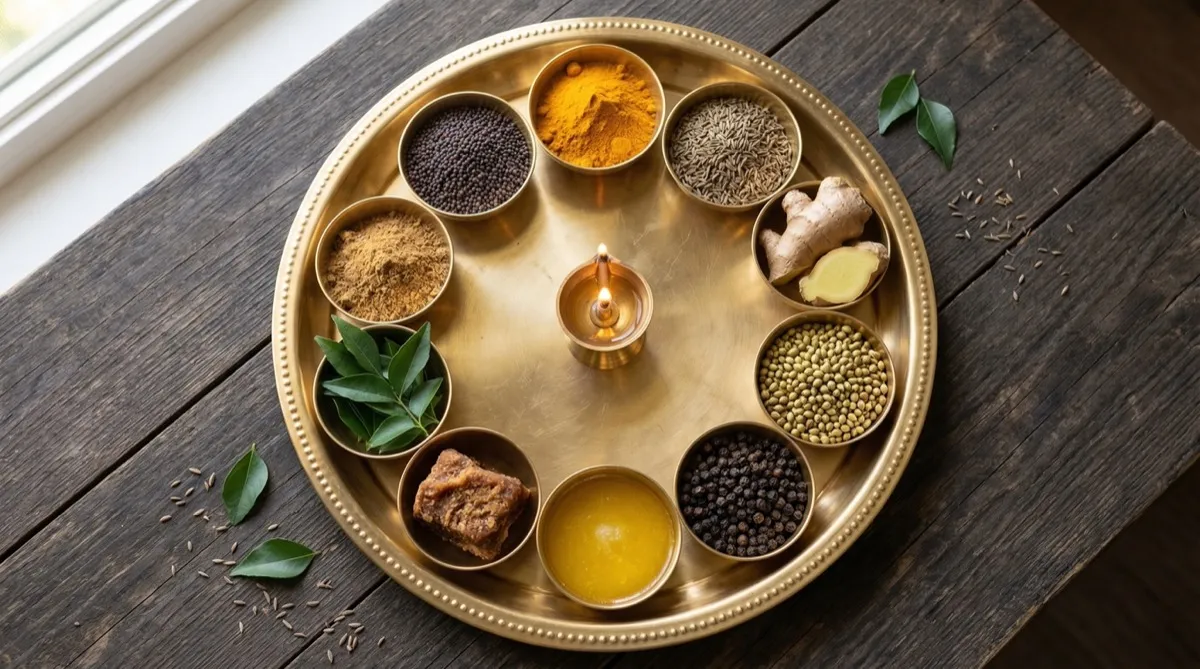
Here is something that changes how you think about your spice rack: the volatile oils in whole spices are not flavour molecules. They are concentrated antimicrobial defence systems that the plant evolved to protect its seeds from bacterial, fungal, and parasitic attack. When you add cumin to dal or pepper to rasam, you are not just seasoning food — you are deploying the plant’s own immune system inside your digestive tract. Research from Cornell University documented that the antimicrobial potency of common Indian spices correlates almost perfectly with the ambient temperature of the regions where they are most heavily used. Hotter climates (where food spoils faster) use more antimicrobial spices. This is not cultural preference — it is evolutionary food safety, refined over millennia. Ayurveda’s classification of spices as Agni Deepana (fire-kindling) captures this reality: these substances do not just improve digestion through heat; they actively transform the microbial environment of the gut.
Ginger (Shunthi and Ardraka): The Universal Medicine
Charaka calls ginger “Vishwabheshaja” — the universal medicine. It is one of the rare ingredients that appears in almost every category of Ayurvedic formulation. Fresh ginger (Ardraka) and dried ginger (Shunthi) have different properties. Fresh ginger is heavier, more moistening, and better for acute conditions — nausea, fresh cold, appetite stimulation. Dried ginger is lighter, more penetrating, and better for chronic digestive weakness and deep-seated Ama.
The most practical Ayurvedic use of ginger is devastatingly simple: a thin slice of fresh ginger with a pinch of rock salt and a squeeze of lemon, eaten fifteen minutes before meals. This kindles Agni, prepares the digestive tract, and clears the tongue of Ama coating. Generations of Indian families have done this without knowing the pharmacology — they just know it works. In Telugu households, the tradition of serving allam pachadi (ginger chutney) with pesarattu or adding generous ginger to rasam serves exactly the same purpose.
When to be mindful: Ginger is Ushna Virya (heating), which makes it less suitable for Pitta-aggravated conditions like acid reflux, bleeding disorders, or inflammatory skin conditions. During pregnancy, fresh ginger in small culinary amounts is generally fine, but large therapeutic doses should only be used under practitioner guidance. In summer, reduce ginger use and favour cooling digestives like coriander instead.
Ghee (Ghrita): The Most Misunderstood Fat
No ingredient in Ayurvedic pharmacology has been as dramatically misunderstood by modern nutrition as ghee. For decades, it was demonised as a saturated fat that clogs arteries. Now the pendulum has swung the other way and it is marketed as a miracle superfood. Neither extreme is accurate. What Ayurveda says about ghee is far more nuanced and far more useful.
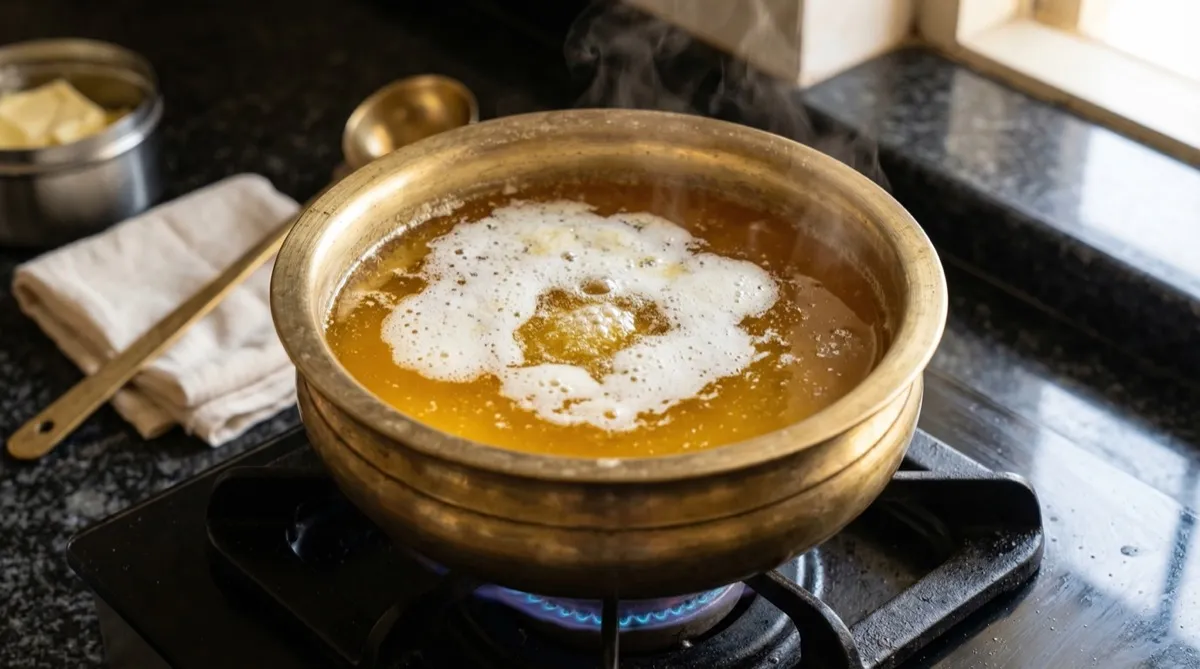
Ghee is classified as Madhura (sweet) Rasa, Sheeta (cooling) Virya — which surprises many people who assume all fats are heating. This cooling quality makes ghee uniquely suitable for Pitta conditions and for use in warmer months. It is Snigdha (unctuous), which nourishes tissues, lubricates joints, and counters the drying quality of Vata. Classical texts describe ghee as Agni Deepana — it kindles digestive fire without aggravating Pitta. This paradoxical quality (cooling yet digestive-fire-enhancing) is why Charaka calls ghee “Shreshtham” (the best, the most excellent) among all fats — a classification recorded in Charaka Samhita, Sutra Sthana, Chapter 27 (Annapana Vidhi Adhyaya). It is not a casual opinion. It is a formal pharmacological ranking in one of the most important chapters on food and drink in all of Ayurvedic literature.
But ghee is also context-dependent. It is best in moderate quantities, taken with warm food. Eating ghee when Agni is weak (you will know because you feel heavy after meals, or food sits like a stone in your stomach) adds fuel to a fire that is not burning — creating more Ama, not less. People with Kapha-predominant constitutions or Meda dhatu excess need to use ghee more sparingly than Vata-dominant individuals who thrive on it. And the quality matters enormously. Traditionally prepared ghee from whole milk, slowly clarified on low heat, is a fundamentally different product from commercially processed versions. If you want to understand the Rasayana (rejuvenating) properties of ghee, our article on rejuvenation science covers this in detail.
Did You Know?
Charaka Samhita describes ghee as “Samskarasya Anuvartanam” — meaning ghee takes on the properties of whatever it is processed with. This is why medicated ghees (Ghrita preparations) are one of the most important categories of Ayurvedic medicine. Ghee processed with mind-supporting herbs supports cognitive function, ghee with digestive formulations supports the eyes, ghee with bitter herbs supports the liver. The ghee acts as both medicine and carrier — a concept modern pharmacology calls a “drug delivery vehicle.”
The Spice Trio: Cumin, Coriander, and Fennel
If you could only keep three spices in your kitchen for digestive health, an Ayurvedic practitioner would likely tell you: cumin (Jeeraka), coriander (Dhanyaka), and fennel (Shatapushpa). These three are so foundational that they form a classical combination — often brewed as a simple tea (CCF tea: cumin-coriander-fennel) that is gentle enough for daily use by almost any constitution.
Cumin (Jeeraka) is Agni Deepana (fire-kindling) and Pachana (digestion-promoting). It is one of the few spices that stimulates digestion without significantly increasing Pitta. This is why cumin is added to buttermilk, dal, and rice dishes — it ensures the food is digested properly. Roasted cumin with rock salt is a classical first-aid remedy for bloating and gas. Cumin water (jeera water) is one of the simplest and most effective daily digestive supports.
Coriander (Dhanyaka) is the cooling complement to cumin. It has Sheeta (cooling) Virya, making it the go-to digestive spice for Pitta conditions and hot weather. Where cumin kindles fire, coriander regulates it — ensuring it burns steadily without flaring. Coriander is also Mutrala (diuretic), supporting kidney function and fluid balance. Fresh coriander leaves, coriander seed tea, and coriander in chutneys all serve this purpose. In summer, coriander water infused overnight is one of the best cooling daily drinks.
Fennel (Shatapushpa) completes the trio as a gentle carminative — it reduces gas and bloating while soothing the digestive tract. It has a sweet post-digestive effect (Madhura Vipaka), making it calming rather than stimulating. Fennel is particularly useful after meals — which is why many Indian restaurants offer fennel seeds (saunf) as a mouth freshener. The tradition is not just about fresh breath. It is post-meal digestive support, encoded as a cultural habit.
Black Pepper and Long Pepper: The Bioenhancers
Black pepper (Maricha) and long pepper (Pippali) are two of the three ingredients in Trikatu — the famous Ayurvedic “three pungents” formula (the third is dried ginger). Together, they form one of the most potent Agni-kindling combinations in the classical repertoire. But their role goes beyond just boosting digestion.
Both peppers act as Yogavahi — bioenhancers that increase the absorption and efficacy of other substances. When you add pepper to turmeric milk, it is not just for flavour. The piperine in black pepper dramatically increases the absorption of curcumin and many other nutrients. When Trikatu is taken with honey, it enhances the honey’s Kapha-clearing properties. This bioenhancing quality is why pepper appears in so many Ayurvedic compound formulations — not as the primary medicine, but as the agent that helps the medicine reach its target.
In the kitchen, black pepper is almost universally useful in winter and monsoon cooking, when Agni tends to be sluggish and Kapha accumulates. Hot rasam with generous pepper, pepper in buttermilk, pepper in kashayam — these are standard Telugu seasonal food practices. When to be mindful: pepper is strongly heating. People with Pitta-dominant constitutions, gastritis, or inflammatory conditions should use it sparingly. In summer, reduce pepper and increase cooling spices like coriander and fennel.
Honey (Madhu): The Rules Most People Break
Honey occupies a unique place in Ayurvedic pharmacology. It is classified as Kashaya (astringent) and Madhura (sweet) in Rasa, with Ushna (heating) Virya for processed honey and a unique Yogavahi (bio-enhancing) property. Charaka considers honey one of the most valuable substances in the entire materia medica — but with strict rules that most people unknowingly violate.
The most important rule: never heat honey. This is not a vague suggestion in Ayurveda. It is one of the most explicitly stated prohibitions in the classical texts. Charaka describes heated honey as producing Ama — a toxic, heavy residue that the body struggles to process. This means adding honey to boiling water, cooking with honey, or baking with honey all violate the classical principle. The right way: add honey to warm (not hot) water or milk after it has cooled enough to touch comfortably. Honey in warm water with a squeeze of lemon on an empty morning stomach is a classical Kapha-clearing practice — but the water should be warm, not hot.
The second rule: never combine honey and ghee in equal quantities. This specific combination is listed as Viruddha Ahara (incompatible food) in Charaka Samhita. Unequal proportions are fine — a little honey with more ghee, or more honey with a little ghee — but equal parts is classically contraindicated. These rules may sound arbitrary, but they reflect two thousand years of clinical observation about how these substances interact during digestion.
Did You Know?
Modern research has found that heating honey above 60°C produces hydroxymethylfurfural (HMF) — a compound associated with cellular damage. This temperature threshold aligns remarkably with Ayurveda’s two-thousand-year-old prohibition against heating honey. The classical texts could not identify HMF, but two millennia of observational medicine arrived at the same practical conclusion.
Sesame (Tila): The Winter Powerhouse
If there is one ingredient that defines winter cooking in Telugu households, it is sesame. Til chikki, nuvvula podi (sesame powder with rice), sesame oil in pickles, nuvvula undalu (sesame laddus) during Sankranti — sesame is everywhere when the cold arrives. This is not coincidence. It is Ritucharya in action.
Sesame (Tila) has a complex Rasa profile: Madhura (sweet), Tikta (bitter), and Kashaya (astringent), with Ushna (heating) Virya and Madhura Vipaka (sweet post-digestive effect). This makes it one of the most nourishing and warming foods in the Ayurvedic kitchen. It is Balya (strength-building), Tvachya (skin-nourishing), Keshya (hair-supporting), and Vata-Shamana (Vata-calming). The Charaka Samhita lists Tila among the best substances for building Bala (strength) and nourishing Asthi dhatu (bone tissue). In Hemanta and Shishira Ritucharya (early and late winter), sesame is specifically recommended because its heating quality and tissue-nourishing properties directly counter the cold, dry, Vata-aggravating nature of winter.
Sesame oil (Tila Taila) deserves special mention. It is the default base oil in Ayurvedic practice — used more than any other oil for massage (Abhyanga), cooking, and as a carrier for medicated preparations. Its penetrating quality allows it to reach deep tissues, and its warming nature makes it ideal for Vata conditions. In Telugu households, gingelly oil (nuvvula nune) has been the traditional cooking oil for generations, long before refined oils entered the market.
When to be mindful: sesame is heating, so it should be reduced during summer and Pitta-dominant seasons. People with Pitta-aggravated conditions — acid reflux, inflammatory skin issues, excessive internal heat — should use sesame more sparingly. In moderation during cooler months, however, it is one of the most beneficial foods available. The traditional practice of eating sesame-based sweets during Makar Sankranti is a perfect example of seasonal food wisdom encoded in festival culture.
Jaggery (Guda): The Sweetener That Does More Than Sweeten
Every Telugu meal traditionally ends with a small piece of jaggery. It is offered after meals, stirred into warm milk at night, mixed into festival sweets, and used in payasam instead of refined sugar. This is not just about taste. Jaggery plays a specific digestive role that refined sugar cannot replicate.
In Ayurvedic pharmacology, Guda (jaggery) is Madhura (sweet) in Rasa, Ushna (heating) in Virya, and Madhura in Vipaka. Unlike refined sugar, which is simply sweet and offers nothing beyond calories, jaggery retains minerals from the sugarcane and has specific Karma (actions) described in classical texts. Old jaggery (Purana Guda) is considered lighter and better for digestion than fresh jaggery. It is Agni Deepana (kindles digestive fire), Anulomana (helps the downward movement of Vata), and Shukrala (supports reproductive tissues). The tradition of eating a small piece of jaggery after meals is rooted in the understanding that its mild heating quality supports post-meal digestion, particularly when the main meal has been heavy or Kapha-producing.
But jaggery is also context-dependent, like every other kitchen staple. Its sweet taste and nourishing quality mean it can increase Kapha when consumed in excess — leading to heaviness, congestion, and sluggish digestion. People managing blood sugar need to be aware that jaggery, while less processed than white sugar, still raises blood glucose significantly. The Ayurvedic guidance is moderation: a small piece after meals, not handfuls throughout the day. Palm jaggery (Tala Guda) is considered lighter than sugarcane jaggery and is often preferred in warmer months. In traditional Telugu cooking, different types of jaggery appear in different seasons — sugarcane jaggery in winter for warmth, palm jaggery in summer for a lighter sweetness.
Did You Know?
Charaka Samhita describes twelve types of sugar preparations, with old jaggery (Purana Guda) ranked as the lightest and most digestible. Fresh jaggery, by contrast, is considered heavier and more Kapha-producing. The simple practice of ageing jaggery before use — something many traditional households still follow — was a pharmacological decision, not a storage accident.
Viruddha Ahara: Incompatible Food Combinations
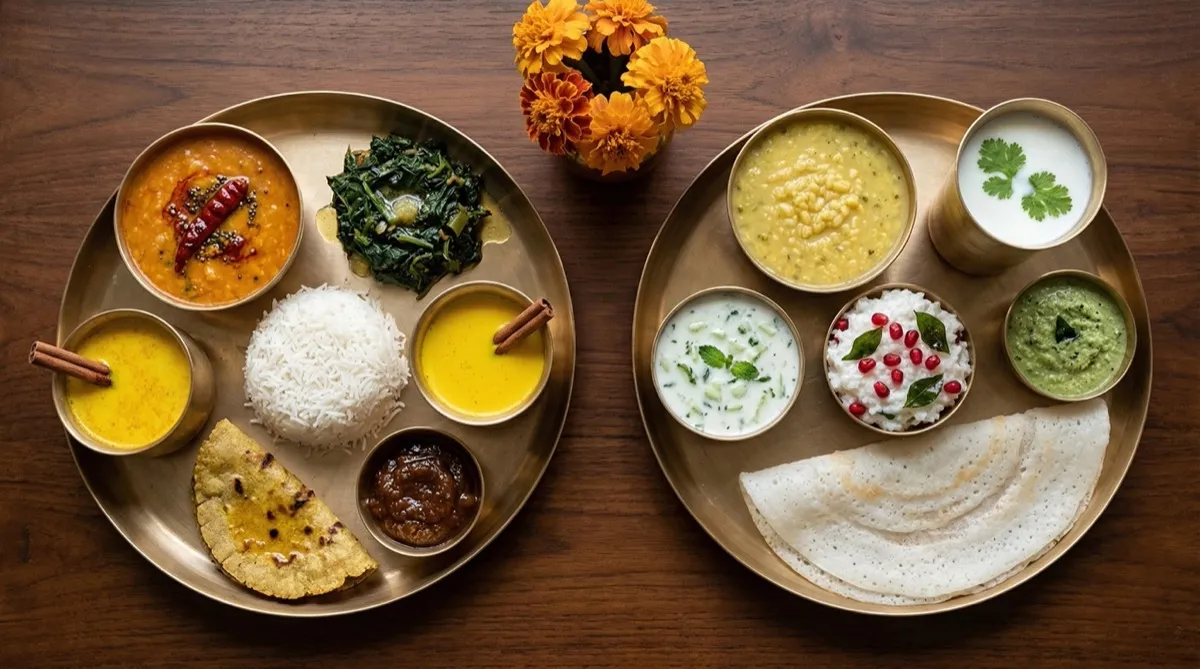
The honey-and-ghee rule mentioned earlier is just one example of a broader Ayurvedic concept: Viruddha Ahara, or incompatible food combinations. Charaka Samhita devotes significant attention to this topic, listing combinations that individually are wholesome but together create problems during digestion. These are not arbitrary taboos. They are observations refined over centuries about how certain foods interact when consumed together.
Milk and fish: This is one of the most frequently cited incompatibles in classical Ayurveda. Milk is cooling and sweet; fish is heating and typically salty or pungent. Combining them is described as creating a conflict in digestive processing that can lead to skin-related and channel-blocking issues. This is why traditional Indian cooking almost never combines dairy and seafood in the same dish — a food rule that many families follow without knowing its Ayurvedic origin.
Fruit with meals: Fruits are generally fast-digesting, while cooked grains, lentils, and vegetables take longer. Eating fruit immediately with or after a heavy meal means the fruit sits in the stomach longer than it should, fermenting rather than digesting cleanly. Ayurveda recommends eating fruit separately — ideally thirty minutes before a meal or as a standalone snack — rather than as dessert immediately following food. This is particularly relevant for people with weak Agni.
Hot drinks with honey: As covered in the honey section, heating honey is one of the most explicitly stated prohibitions. But the broader principle applies: any substance whose properties fundamentally change with heat should not be subjected to heat processing. The classical rule is that honey should only be added to liquids that are warm enough to touch comfortably — never boiling, never in cooking.
These Viruddha Ahara principles are not about creating fear around food. They are about understanding that digestion is a process with its own logic, and certain combinations work against that logic. Most traditional Indian cooking already avoids these combinations instinctively — the rules are built into the cuisine itself.
Did You Know?
Charaka described a pharmacological property called Yogavahi — the ability of certain substances to enhance the potency and absorption of whatever they are combined with, without losing their own properties. Black pepper and ghee are the two most important Yogavahi substances in Ayurveda. Modern pharmacology discovered the same principle independently: piperine (from black pepper) increases curcumin absorption by 2,000% (a 2017 study confirmed this figure). And lipid-based carriers like ghee are now standard in drug delivery science for fat-soluble compounds. The ancient concept of Yogavahi is, in modern terms, a bioavailability enhancement system — described two thousand years before the word “bioavailability” existed.
Here is an insight that connects your kitchen to your gut in a way you have probably never considered: your tongue is not just a taste organ — it is the beginning of your digestive tract, and it communicates directly with your stomach. The moment a flavour hits taste receptors on the tongue, signals travel via the vagus nerve to the stomach, pancreas, and liver, telling them what type of food is incoming and what enzymes to prepare. A bitter taste triggers bile release. A sour taste triggers acid production. A sweet taste signals insulin preparation. This is why Ayurveda insists on tasting food properly, chewing slowly, and including all six tastes in a meal — each taste literally primes a different part of the digestive system. The modern habit of eating quickly or eating while distracted short-circuits this entire preparatory cascade.
Putting It All Together: Your Daily Kitchen Pharmacy
You do not need to memorise pharmacological properties to use these staples wisely. Here are simple, practical applications that families have used for generations — each one grounded in classical Ayurvedic logic.
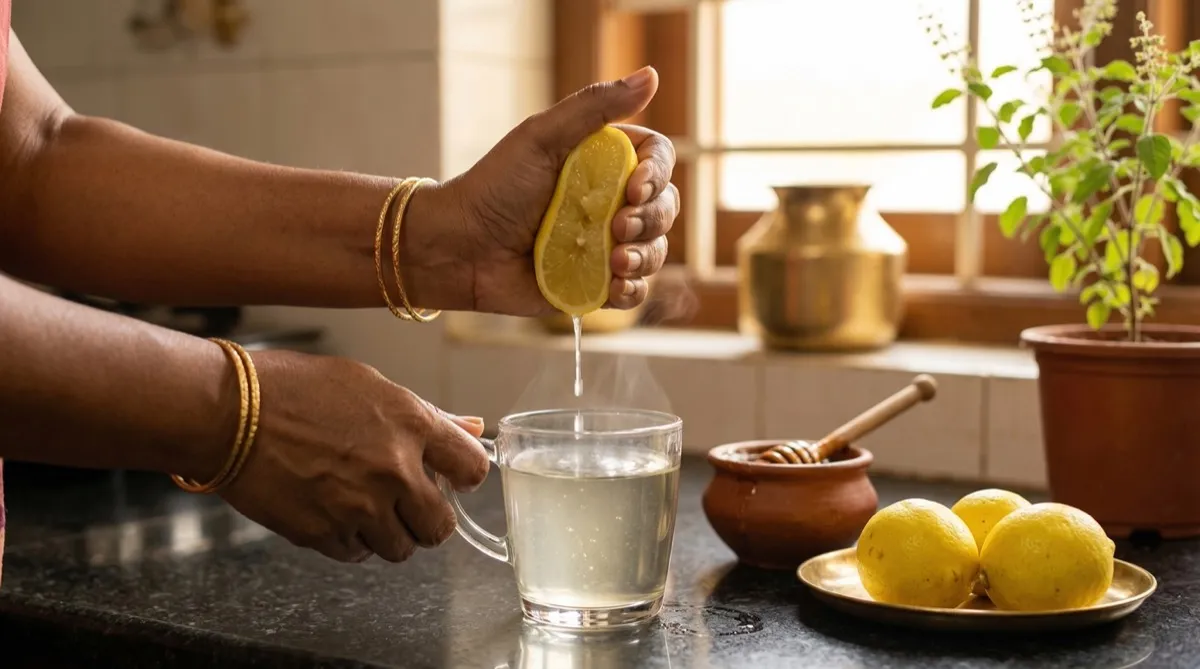
Morning: Warm water with lemon and honey (honey added after cooling). This clears overnight Kapha, stimulates Agni, and prepares the digestive tract for breakfast. In winter, add a pinch of dried ginger. In summer, skip the ginger and use room-temperature water with coriander instead.
Before meals: A thin slice of fresh ginger with rock salt and lemon, fifteen minutes before lunch (the main meal). This is one of the most effective simple practices in all of Ayurveda for maintaining strong Agni. If fresh ginger is too strong, try cumin-coriander-fennel tea instead.
During cooking: Season with the season. Ginger, pepper, and cumin dominate winter and monsoon cooking. Coriander, fennel, and turmeric suit year-round use. Sesame appears in winter. Coconut in summer. Always cook turmeric in oil or ghee, not dry. Add a pinch of black pepper whenever you use turmeric.
After meals: A small piece of jaggery, or a few fennel seeds, or a cup of warm water. These aid post-meal digestion. Avoid ice-cold water immediately after eating — it suppresses Agni at the exact moment it needs to be working hardest.
At night: Warm milk with a pinch of turmeric and nutmeg supports restful sleep. In winter, add palm jaggery and cardamom. In summer, let the milk cool to room temperature and add a thread of saffron instead. These small adjustments, applied consistently, build a foundation of digestive health that supports everything else — from joint comfort to women’s wellness to liver function. If you want personalised guidance on which kitchen staples best suit your constitution and current needs, our clinical approach page explains how we tailor recommendations, and you can explore specific consultation areas to see how dietary guidance fits into a broader picture of care.
What Current Evidence Says
Many traditional kitchen spices have been extensively studied in modern pharmacology. Curcumin (from turmeric), gingerols (from ginger), and piperine (from black pepper) have documented anti-inflammatory, antioxidant, and digestive properties in peer-reviewed research. The WHO recognises several of these ingredients in its monographs on medicinal plants.
Research published in journals like the British Journal of Nutrition, Phytotherapy Research, and Food Chemistry has validated specific traditional uses — such as ginger for nausea, turmeric for inflammatory markers, and fennel for digestive comfort. The bioavailability-enhancing effect of piperine on curcumin has been documented in multiple clinical studies.
However, culinary use of spices differs significantly from therapeutic supplementation. The amounts used in daily cooking are generally safe for most people, but concentrated extracts and supplements can interact with medications and may not be suitable for all conditions. These kitchen staples are best understood as supportive daily practices within a broader wellness framework, not as replacements for medical care.
This article is for educational purposes only and does not constitute medical or dietary advice. While kitchen spices in normal culinary amounts are generally safe, therapeutic or supplemental doses may interact with medications and affect certain health conditions. Consult your healthcare provider before making significant changes to your diet, especially if you are pregnant, breastfeeding, or taking medication. Always seek professional medical attention for health concerns.