
Why Women’s Health Is a Separate Branch — Not an Afterthought
Modern medicine only started including women in clinical drug trials in the 1990s. Ayurveda made women’s health one of its eight foundational branches over 2,000 years ago — not as an afterthought, but because it recognised that a woman’s physiology is not a variation on a man’s. It has its own logic, its own rhythms, and its own needs.
Ayurveda took a different path. Stree Roga (women’s health) is one of the eight primary branches of classical Ayurveda — Ashtanga Ayurveda — listed alongside surgery, toxicology, and internal medicine. It is not a sub-specialty. It is a foundational pillar. Charaka Samhita (Chikitsa Sthana, Chapter 30) classifies 20 types of Yonivyapad (gynaecological conditions), each linked to specific dosha disturbances. The Kashyapa Samhita, one of the oldest Ayurvedic texts, dedicates extensive sections specifically to women’s health, including the Revati Kalpa (Khila Sthana), which addresses conditions affecting women and children with remarkable depth and specificity.
Why did the ancient physicians give women’s health this status? Because they recognised something that modern research is only now confirming: a woman’s physiology is not simply a variation on a man’s. It has unique tissue transformations, unique metabolic rhythms, and unique vulnerabilities that require their own framework of understanding.
Did You Know?
Kashyapa Samhita dedicated an entire section (Revati Kalpa) specifically to women’s and children’s health — making Ayurveda one of the only ancient medical systems to treat women’s health as a foundational branch, not a subspecialty.
Artava Dhatu: The Tissue That Changes Everything
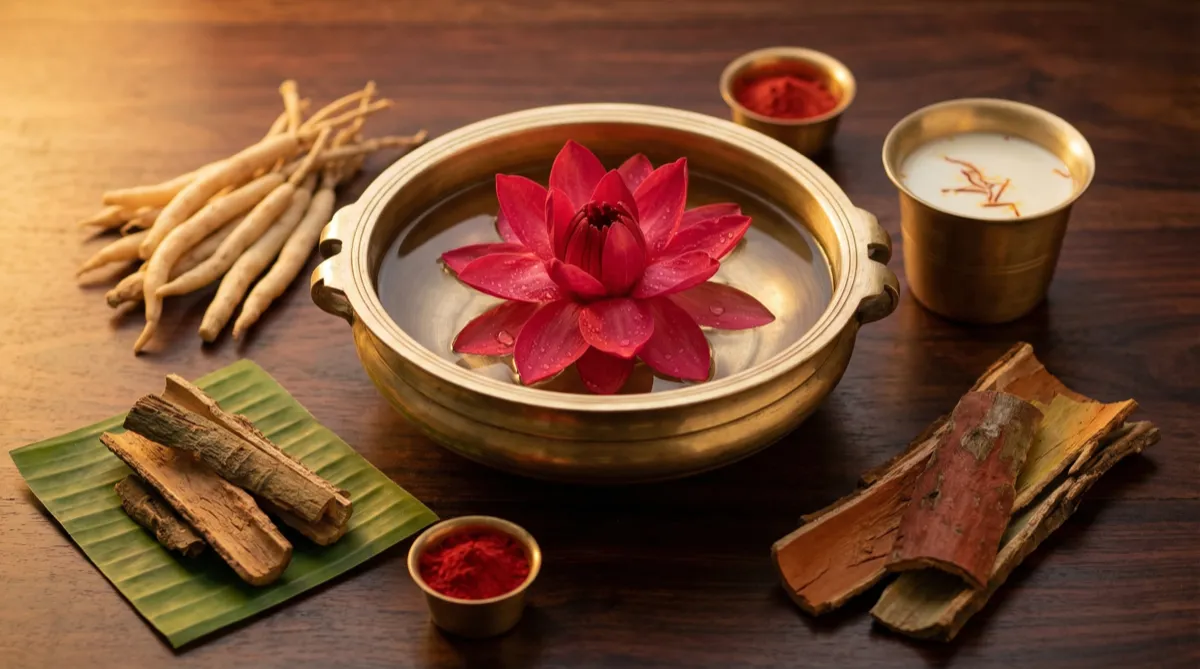
Think of your body’s tissue system as a garden with seven layers of soil. Each layer must be rich and well-nourished before the one beneath it can thrive. In Ayurveda, this is the seven-tissue hierarchy — the Sapta Dhatus — where nourishment from digested food filters downward through Rasa (the plasma layer that feeds everything), through Rakta (blood), through Meda (the metabolic-fat layer), and onward through the deeper tissues until it reaches the very last layer: the reproductive tissue. In women, this deepest layer is called Artava — and because it sits at the bottom of the entire garden, its health depends on every layer above it being fertile and well-tended. This single structural difference reshapes the entire Ayurvedic understanding of women’s health.
Here is the critical insight that most people miss: Artava is the last tissue in a seven-stage chain. This means its quality depends entirely on the quality of every tissue that precedes it. If Rasa dhatu is weak (poor diet, weak digestion, chronic dehydration), Rakta will be substandard. If Rakta is compromised, Mamsa suffers. And so on, tissue by tissue, until Artava — the reproductive tissue — receives whatever remains after six upstream tissues have taken their share.
This is why Ayurveda insists you cannot address reproductive health in isolation. A woman with irregular periods, difficulty conceiving, or menopausal disturbances is not simply having a “reproductive problem.” She is showing the downstream consequences of imbalances that may have started with digestion (Rasa), blood quality (Rakta), or metabolic function (Meda). Treating the reproductive system alone — whether with hormonal pills or isolated herbal remedies — is like repainting the seventh floor of a building whose foundation is cracking.
This is why experienced Ayurvedic practitioners often begin women’s wellness consultations by assessing Agni (digestive fire), Rasa dhatu (nutrition status), and Rakta dhatu (blood quality) before even discussing the menstrual cycle. The cycle is a symptom display, not the root cause.
When the tissue chain is healthy and each dhatu receives what it needs, the body produces something beyond structure — a subtle vitality that the classical texts call Ojas. In women, this vitality is intimately linked to the rhythms of the menstrual cycle, pregnancy, and menopause. Each menstrual period draws on the body’s reserves for its natural cleansing work. The postpartum period redirects enormous dhatu resources toward sustaining new life. And menopause restructures the entire metabolic rhythm from the ground up. During each of these transitions, Ojas bears the cost. This is why Ayurveda places such emphasis on rest, warmth, and nourishment at precisely these times — not as indulgence, but as protection for the body’s deepest hormonal and immunological resilience.
Here is a fact that reframes how you think about women\u2019s health entirely: a woman\u2019s skeleton replaces itself roughly every ten years. But the rate of bone remodelling is not constant — it is governed by the same hormonal rhythms that govern the menstrual cycle. Oestrogen does not just regulate reproduction; it is one of the primary signals that tells osteoblasts (bone-building cells) to keep working. When oestrogen declines at menopause, bone loss accelerates to 2–3% per year for the first five to seven years. Ayurveda\u2019s classification of menopause as a Vata-dominant transition — where dryness, lightness, and porosity increase throughout the body — is describing exactly this phenomenon at the tissue level. The Asthi dhatu (bone tissue) becomes Vata-aggravated because the hormonal signal that was protecting it has shifted. This is why Ayurveda\u2019s post-menopausal emphasis on warm, nourishing, unctuous foods and Vata-pacifying routines is not comfort advice — it is bone medicine.
The Menstrual Cycle as a Diagnostic Window
Modern medicine often treats the menstrual cycle as something to manage, regulate, or suppress. Ayurveda views it as one of the most valuable diagnostic tools available — a monthly report card on the state of a woman’s internal health.
Charaka and Sushruta describe Artava in its healthy state: it should appear at regular intervals (approximately monthly), last for the right duration (typically 3-5 days), be of moderate quantity, and be free from excessive pain, clots, or unusual odour. When these parameters shift, the nature of the shift tells a practitioner exactly what is happening at the dhatu level.
A woman’s Prakriti (constitutional type) also shapes what her cycle looks like in both health and imbalance. A Vata-predominant woman tends toward scanty, irregular flow with darker colour and more cramping. A Pitta-predominant woman tends toward heavier, bright-red flow with warmth and sometimes irritability. A Kapha-predominant woman tends toward heavier, more mucoid and pale flow with longer duration but less pain. Recognising these constitutional patterns helps distinguish between a natural tendency and a genuine imbalance requiring attention.
Artava Kshaya (scanty or absent periods) typically indicates Vata aggravation or dhatu depletion. The tissues are not producing enough Artava because there is not enough nourishment arriving upstream. This is commonly seen in women who over-exercise, under-eat, experience chronic stress, or have constitutionally high Vata. The modern impulse to “fix” this with hormonal pills forces the appearance of a cycle without addressing the depletion underneath — like forcing a dry well to produce water by installing a better pump.
Artava Atipravritti (excessive or prolonged periods) typically indicates Pitta aggravation in Rakta dhatu or Kapha accumulation creating congestion. Pitta-type excess presents as heavy bleeding with a bright red colour, often with burning sensations. Kapha-type excess tends toward heavier, more mucoid flow with a dull, sluggish quality. The Ayurvedic approach addresses the underlying dosha disturbance rather than simply reducing bleeding through medication.
Painful periods (Kashta Artava) are not considered normal in Ayurveda — despite how commonly women are told they are. Charaka attributes menstrual pain primarily to Apana Vayu obstruction — the downward-moving aspect of Vata that governs menstruation, urination, and elimination is being blocked, usually by accumulated Ama or displaced Kapha in the pelvic channels (Artavavaha srotas). When Apana Vayu cannot flow freely downward, it creates spasm, cramping, and pain. Painkillers relieve the symptom. Clearing the channel and restoring Apana Vayu resolves the pattern.
Did You Know?
The Ayurvedic observation that menstrual pain is NOT normal (it indicates Apana Vayu obstruction) directly contradicts the modern tendency to normalise dysmenorrhoea. Charaka considered pain-free menstruation the baseline, not the exception.
Did You Know?
The uterus has its own microbiome. For decades, the uterus was assumed to be a sterile organ. Research published in 2015 in Nature Communications revealed that the uterine cavity hosts a distinct microbial community that directly influences implantation success, menstrual health, and susceptibility to conditions like endometriosis. An imbalanced uterine microbiome is now linked to recurrent implantation failure in IVF. Ayurveda’s concept of Ama (metabolic waste) accumulating in Artavavaha srotas (the reproductive channels) and disrupting reproductive function describes, in classical language, what modern reproductive immunology is now measuring with DNA sequencing.
Three Transitions That Reshape the Doshas
A woman’s life is marked by three major physiological transitions. Each shifts the dosha balance in predictable ways, and understanding these shifts is key to supporting wellness at every stage.
Rajodharma (Menarche) — The onset of menstruation marks a profound shift from the Kapha-dominant phase of childhood into the reproductive years. Pitta begins to rise as Rakta dhatu becomes more active and Artava production commences. This transition period is when constitutional tendencies often first reveal themselves clearly. A young woman who develops acne, excessive heat, or heavy periods at menarche is showing early Pitta aggravation in Rakta. One who develops irregular cycles, anxiety, or weight loss is showing Vata disturbance in the tissue chain. These early signals, if read correctly, can guide preventive care for decades. If ignored or suppressed with medication, the underlying pattern deepens.
Garbhini (Fertility and Pregnancy) — The Ayurvedic perspective on fertility is startlingly clear: conception requires four things — healthy Shukra/Artava (reproductive tissue), a healthy uterus (Kshetra), proper nourishment (Rasa), and the right timing (Ritu). If any of these is compromised, difficulty arises. This is why the classical texts describe a pre-conception protocol (Garbhadhana Vidhi) that begins months before conception — purifying the body, strengthening Agni, nourishing all seven dhatus, and stabilising the doshas. It is not a fertility treatment. It is creating the conditions where fertility is the natural outcome. During pregnancy itself, Kashyapa Samhita (Khila Sthana) prescribes month-by-month dietary and lifestyle guidance (Masanumasika Pathya) specific to each stage of foetal development — recognising that the mother’s Agni, dosha balance, and emotional state directly shape the child’s constitution. Sushruta Samhita (Sharira Sthana, Chapters 2–3) provides detailed descriptions of embryological development and the factors that influence the health of both mother and child.
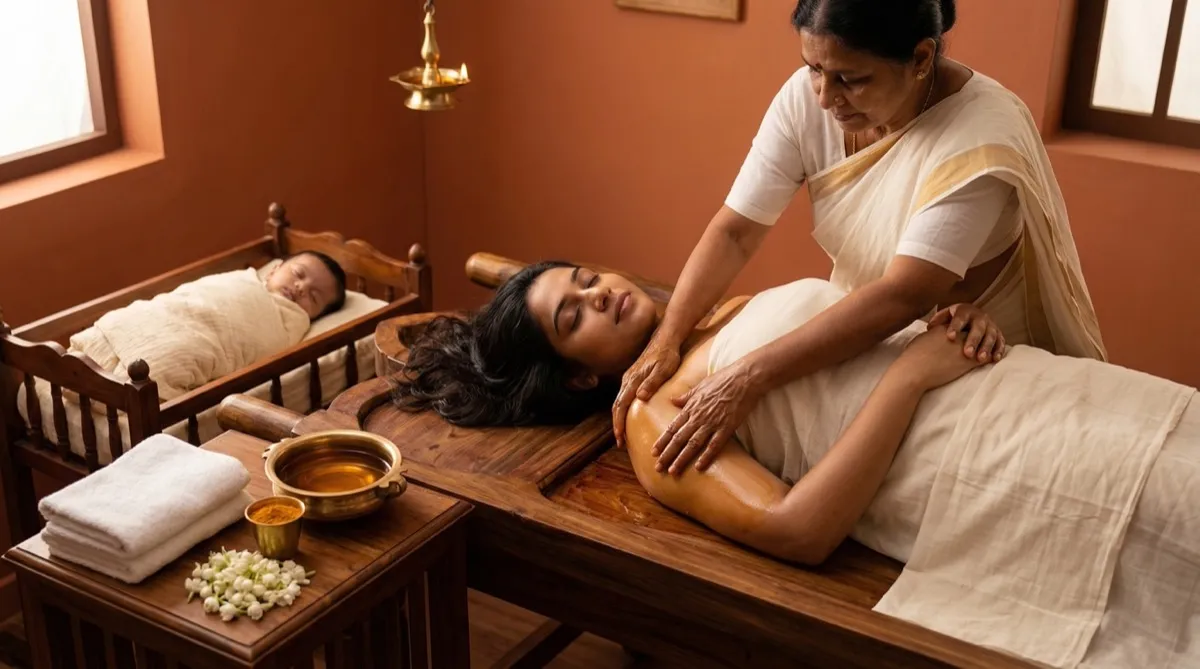
After delivery, the classical texts prescribe Sutika Paricharya — a structured 42-day postpartum protocol specifically designed to restore the mother’s depleted body. Delivery massively aggravates Vata: the body has emptied a large space, tissues have been stretched and expended, and blood loss has weakened Rasa and Rakta dhatu. This is why the postpartum period emphasises warm, unctuous, easily digestible foods, abhyanga (oil massage), rest, and gradual reintroduction of activity. Rushing back to normal routines before Vata is pacified and the dhatus have been replenished is, in the Ayurvedic view, one of the most common causes of long-term health problems in women — from persistent back pain to weakened immunity to difficulty with subsequent conception.
Rajonivritti (Menopause) — This transition is perhaps the most misunderstood. In Ayurveda, menopause is not a disease or a deficiency. It is a natural transition from the Pitta-dominant reproductive years into the Vata-dominant phase of life. Artava production naturally decreases, and the energy that was directed toward reproductive function becomes available for other purposes — traditionally understood as a shift toward spiritual and intellectual pursuits. The symptoms that modern medicine attributes to “oestrogen deficiency” — hot flashes, insomnia, anxiety, dryness, joint stiffness — Ayurveda reads as Vata aggravation combined with residual Pitta that has lost its natural outlet through menstruation. The approach is not to replace hormones but to pacify the rising Vata, cool residual Pitta, and support the body through this transition with appropriate nourishment, routines, and if needed, specific formulations.
Did You Know?
Ayurveda described a month-by-month prenatal care protocol (Masanumasika Pathya) over 2,000 years ago — prescribing specific foods and behaviours for each month of pregnancy. Modern prenatal nutrition is only now formalising trimester-specific dietary guidance that Ayurveda detailed millennia earlier.
Ayurvedic Care Across a Woman’s Life Stages
The Ayurvedic Perspective on Modern Concerns
PCOS (Polycystic Ovarian concerns) — Ayurveda views this condition through the lens of Kapha accumulation blocking Artavavaha srotas (the reproductive channels). Excess Kapha — driven by sedentary lifestyle, heavy and sweet foods, and weak Meda Dhatvagni (fat tissue metabolism) — creates Ama that accumulates in the pelvic region, obstructing normal Artava production and flow. The cysts themselves are Kapha-Ama formations. This is why the Ayurvedic approach emphasises restoring Agni, clearing Ama from the channels, and reducing Kapha — through dietary modification, specific movement, and formulations — rather than simply inducing ovulation artificially. The channel must be cleared for the function to restore naturally.
Thyroid imbalances — From the Ayurvedic perspective, thyroid function relates to Dhatvagni — the metabolic fire within each tissue. When Dhatvagni becomes sluggish (hypothyroid pattern), tissues are not properly transformed, Ama accumulates, and Kapha increases. When Dhatvagni becomes excessively active (hyperthyroid pattern), tissues are consumed too rapidly and Vata increases with depletion. The classical approach addresses Dhatvagni correction alongside the overall Agni, rather than simply supplementing or suppressing the thyroid gland in isolation. This is a fundamentally different orientation: correct the fire, and the tissue finds its balance.
In both conditions, the Ayurvedic emphasis is on restoring natural function rather than overriding it with external substances. This does not mean rejecting modern medical support where needed — it means understanding why the imbalance arose and addressing it at its root while managing symptoms appropriately.
Why Suppression Differs from Restoration
This is perhaps the most important distinction in women’s health, and one that Ayurveda makes with uncomfortable clarity: suppressing a symptom and restoring a function are not the same thing. They are opposite approaches with opposite long-term consequences.
Taking painkillers for dysmenorrhoea (menstrual pain) reduces pain but does nothing about the Apana Vayu obstruction causing it. The pain returns every month, often requiring increasingly stronger medication. Taking hormonal pills to “regulate” an irregular cycle creates the appearance of regularity without addressing the dhatu depletion or channel blockage behind the irregularity. When the pills are stopped, the original pattern returns — often worse, because the underlying cause has been progressing unaddressed while the symptoms were masked.
Ayurveda’s approach is to ask why. Why is Apana Vayu obstructed? Usually Ama in the channels, Vata disturbance from lifestyle, or Kapha congestion. Clear these, and the pain resolves not because it has been numbed but because the mechanism causing it has been corrected. Why are cycles irregular? Usually weak Agni failing to nourish the dhatu chain adequately, or dosha aggravation disrupting the natural rhythm. Correct these, and regularity returns as a natural consequence of restored function.
This does not mean Ayurveda opposes modern medication in acute situations. Severe pain warrants relief. Dangerous bleeding requires intervention. But the long-term strategy should be restoration of natural function, not permanent dependence on symptom suppression. These are complementary, not competing, approaches when used wisely.
Ahara, Vihara, and Sadvritta: The Three Pillars of Women’s Daily Wellness
Ahara (Diet) — The Ayurvedic dietary framework for women emphasises nourishing Rasa and Rakta dhatu as a priority. These are the upstream tissues that determine everything downstream. Iron-rich foods, warm and cooked meals, adequate healthy fats (especially ghee), seasonal fruits, and foods that are sweet and nourishing by nature support these tissues. Conversely, excessive raw, cold, dry, or processed foods weaken Agni and deplete Rasa — a pattern particularly damaging during menstruation when the body’s Agni naturally dips. The classical texts specifically advise lighter, warm, easily digestible food during menstruation — not as restriction but as support for a body already working hard.
Vihara (Lifestyle) — Regular routines matter more for women than most realise. The menstrual cycle is itself a rhythm, and it functions best when supported by other rhythms: regular sleep-wake times, consistent meal times, and seasonal adjustments (Ritucharya). During menstruation, Ayurveda traditionally advises reduced physical exertion — not because menstruation is limiting, but because Apana Vayu is naturally active during this time and intense activity can disturb its downward flow. Light movement like gentle walking is encouraged; intense exercise, heavy lifting, and excessive travel are traditionally avoided during the first two to three days. This is practical physiology, not cultural restriction.
Sadvritta (Behavioural Conduct) — Charaka describes Sadvritta as behaviours that maintain mental and emotional balance: truthfulness, calmness, compassion, and avoidance of excessive mental stimulation. For women, this is particularly relevant because Manovaha srotas (the mental channels) and Artavavaha srotas (the reproductive channels) are closely connected in the Ayurvedic model. Chronic stress, unresolved emotional patterns, and constant mental overload directly affect reproductive health through this channel connection. This is not mysticism — modern psychoneuroendocrinology confirms that chronic psychological stress disrupts the hypothalamic-pituitary-ovarian axis, affecting menstrual regularity, fertility, and menopausal symptoms.
Classical Herbs in Women’s Wellness
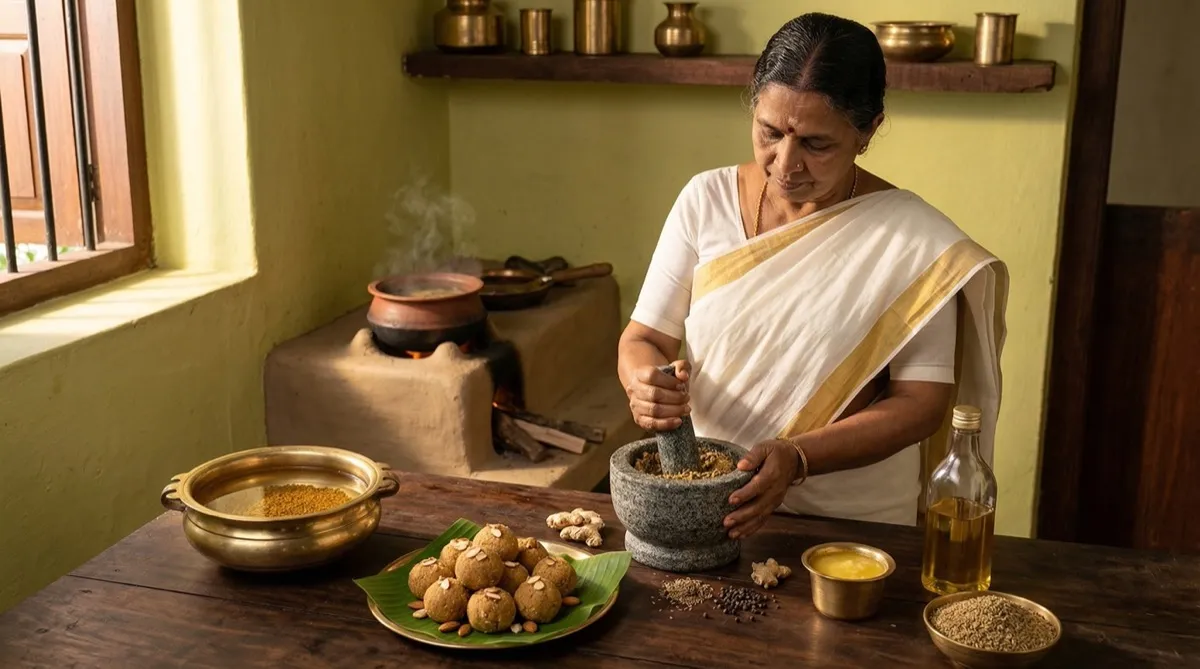
Ayurveda has a rich tradition of herbs specifically studied for women’s wellness over millennia. These are not supplements to self-prescribe. They are powerful substances that work differently depending on constitution, dosha state, and the specific condition being addressed. A few deserve mention for the reasoning behind their use.
Nourishing and cooling formulations — Classical texts describe sweet and cooling herbs that primarily nourish Rasa and Artava dhatu. These pacify both Vata and Pitta, making them suitable for conditions involving dryness, depletion, or excessive heat. Charaka Samhita references such formulations extensively in sections on Stanya (lactation) and Artava (reproductive health).
Astringent and cooling formulations — Classical texts describe herbs with a particular affinity for uterine tissue, traditionally used in conditions involving excessive or painful menstruation. Charaka Chikitsasthana references these in the context of Asrigdara (abnormal uterine bleeding). Their action is astringent and cooling — they tone uterine tissue without suppressing natural function.
Kapha-Pitta pacifying formulations — Classical texts describe herbs with specific action on the reproductive and circulatory systems. These are important components in formulations for Artava Dushti (disorders of the reproductive tissue) and Shweta Pradara (leucorrhoea). Their binding and astringent qualities help when there is excessive or abnormal discharge, indicating Kapha accumulation in the reproductive channels.
The crucial point is not which herb does what — it is that the right herb, in the right formulation, for the right constitution, at the right time, works fundamentally differently from a generic supplement. This is why Ayurvedic women’s wellness requires individual assessment, not one-size-fits-all prescriptions.
Women’s Wellness in Clinical Practice
At Santana Laxmi Ayurvedic Clinic, women’s wellness consultations begin with understanding the whole person — not just the symptom. Dr Sri Ramulu’s assessment evaluates Prakriti (constitution), Vikriti (current imbalance), Agni strength, dhatu status, and srotas condition before considering specific interventions. This ensures that any formulation prescribed addresses the root pattern, not just the surface presentation. Women seeking guidance for menstrual irregularity, menopausal transitions, general vitality, or wellness across life stages can learn more about our consultation areas or explore our women’s health consultation area.
What Current Evidence Says
Classical herbs used in women’s wellness formulations have been studied in several clinical trials for reproductive health. A 2018 review in Biomedicine & Pharmacotherapy found evidence supporting the use of traditional formulations as galactagogues (supporting lactation) and for hormonal modulation. Research published in the Journal of Ethnopharmacology has documented adaptogenic and phytoestrogenic properties in key classical herbs.
Classical herbs traditionally used for menstrual health have been studied by CCRAS (Central Council for Research in Ayurvedic Sciences), with clinical trials showing improvements in menstrual regularity and reduction in excessive bleeding. A review in the Journal of Ayurveda and Integrative Medicine confirmed traditional applications with pharmacological evidence.
The mind-body connection in women’s reproductive health is well-established in modern research. A 2019 meta-analysis in Human Reproduction Update found that psychological stress is significantly associated with reduced fertility outcomes. Research on the hypothalamic-pituitary-ovarian axis confirms that chronic stress disrupts hormonal signalling in ways that parallel the Ayurvedic understanding of Manovaha-Artavavaha srotas connection.
This article is for educational purposes only and does not constitute medical advice. Women’s health conditions require proper clinical evaluation. Herbal formulations mentioned in this article should only be taken under the guidance of a qualified practitioner who has assessed your individual constitution, current condition, and health history. Do not self-prescribe herbal preparations during pregnancy. Always consult your healthcare provider before starting any new health practice, especially if you are on hormonal medication, pregnant, or managing a chronic condition.