
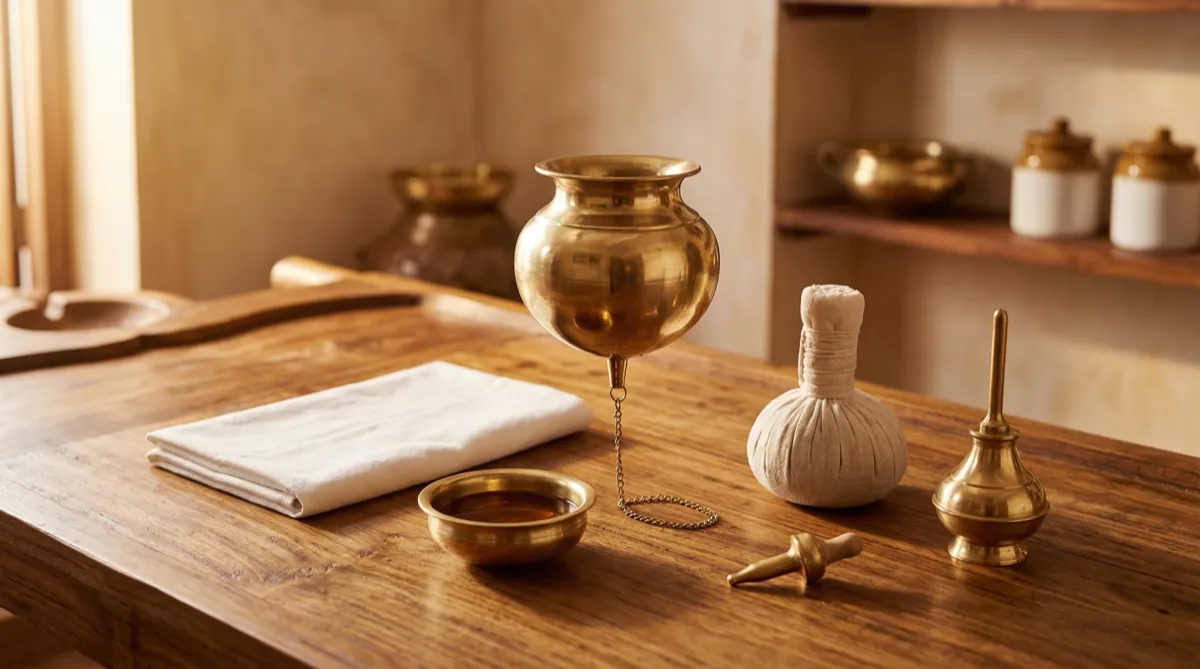
What Panchakarma Actually Means
The word Panchakarma is straightforward Sanskrit: Pancha means five, Karma means actions. Five purification actions. Not five spa treatments, not five wellness therapies — five specific clinical procedures designed to expel accumulated doshas from the body through its nearest natural routes.
The five actions are Vamana (therapeutic emesis), Virechana (therapeutic purgation), Basti (medicated enema), Nasya (nasal administration), and Raktamokshana (bloodletting). Each targets a specific dosha and uses a specific route of elimination. Together, they form the most powerful purification system in Ayurvedic medicine.
Understanding Panchakarma requires understanding a fundamental distinction in Ayurveda: Shodhana versus Shamana. Shamana means palliation — calming the doshas, managing symptoms, bringing temporary relief through diet, lifestyle, and gentle formulations. Shodhana means purification — physically removing the doshas from the body. Shamana manages. Shodhana removes. Most Ayurvedic guidance people encounter is Shamana. Panchakarma is Shodhana at its most systematic.
Why does this distinction matter? Because some conditions cannot be resolved through palliation alone. When doshas have accumulated over years or decades, when they have relocated from their natural sites and lodged deeply in tissues and channels, palliative measures can only suppress them temporarily. They return. Charaka Samhita, in its Siddhi Sthana, is explicit about this: doshas that are palliated can be aggravated again by provocative factors, but doshas that are properly eliminated through Shodhana do not recur easily. The metaphor used is that of a tree — palliation trims the branches, but purification removes the roots. Vagbhata reinforces this principle in Ashtanga Hridaya (Sutra Sthana 18–19), where he systematically describes the indications, contraindications, and proper sequence of Shodhana procedures — synthesising the teachings of both Charaka and Sushruta into a practical clinical framework that practitioners have followed for over a thousand years.
Did You Know?
Charaka called Basti (medicated enema) “Ardha Chikitsa” — literally half of all treatment. Why? Because Basti addresses Vata, and Vata is the driver behind 80 of the 140 diseases classified in Ayurvedic pathology (Charaka Samhita, Sutra Sthana 20). No other medical tradition in history has ever elevated a single procedure to this status. Modern gastroenterology is only now exploring the gut-nervous system axis that Ayurveda mapped over two millennia ago.
The 3-Phase Panchakarma Process
- Snehana (oleation / oil therapy)
- Swedana (fomentation / steam)
- Loosens & mobilises toxins
- Vamana, Virechana, Basti
- Nasya, Raktamokshana
- Core purification of doshas
- Samsarjana Krama (graduated diet)
- Lifestyle guidelines
- Rasayana (rejuvenation)
Purva Karma — Why Preparation Is Everything
Perhaps the single most important thing to understand about Panchakarma is this: you cannot simply perform the five actions on an unprepared body. The doshas that need to be expelled are not sitting conveniently in the stomach or intestines waiting to be flushed out. They are lodged in tissues, embedded in channels, stuck in places that no purgative or emetic can directly reach. They must first be mobilised — drawn back into the digestive tract — before they can be expelled.
This is the purpose of Purva Karma, the preparatory phase. It consists of two main procedures: Snehana (oleation) and Swedana (sudation). Without these, Panchakarma is not merely less effective — it can be harmful. Attempting to purge a body whose doshas have not been mobilised is like trying to remove dried paint from fabric without first soaking it. You damage the fabric without removing the stain.
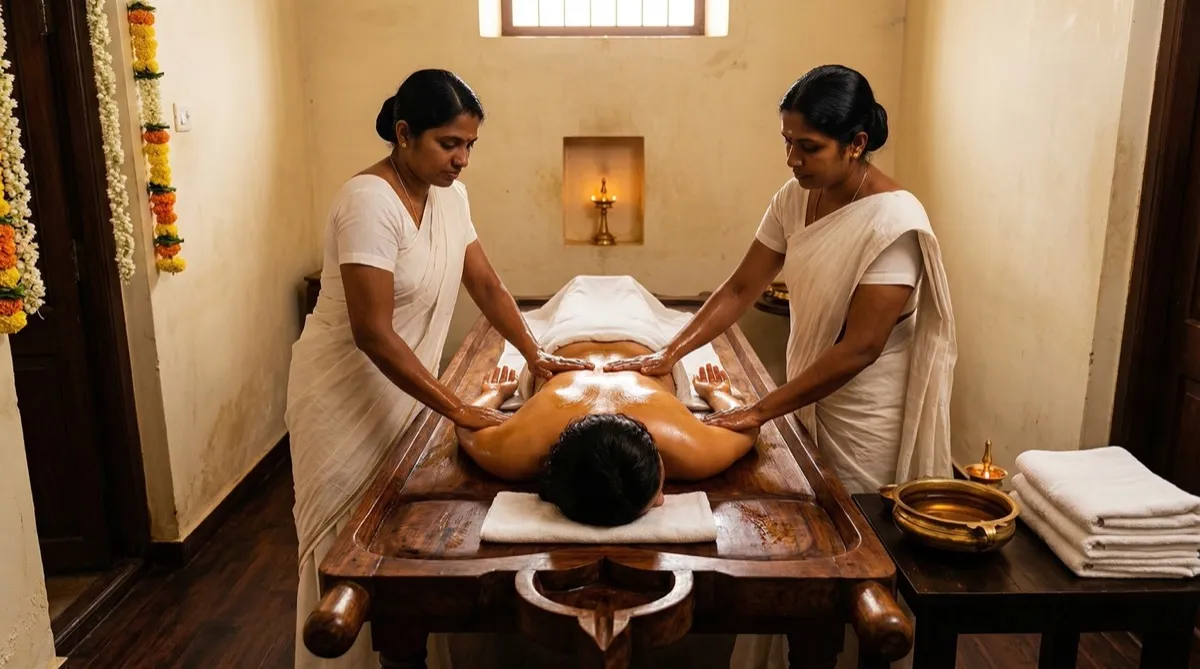
Snehana involves both internal and external oleation. Internal Snehana means the progressive ingestion of medicated ghee or oil over several days, in carefully calibrated increasing doses. The lipid medium penetrates tissues, loosens lodged doshas, and draws them toward the gastrointestinal tract. External Snehana involves full-body oil application — Abhyanga — which works from the outside in, softening tissues and facilitating dosha movement. The classical texts describe specific signs that indicate oleation is complete: oily skin, soft stools, aversion to further ghee. These signs are assessed by the practitioner daily.
Swedana follows Snehana. It is therapeutic sweating — applied through steam, warm poultices, or other methods. The heat dilates the body’s channels (srotas), making it easier for the loosened doshas to flow toward the gastrointestinal tract. Think of it as opening the roads after the cargo has been loaded. Snehana loads the doshas onto the transport medium; Swedana opens the pathways for transport.
The cooking analogy is often used in classical teaching: raw rice cannot be separated from the husk easily. You must first soak it (Snehana) and then apply heat (Swedana). Only then does the husk separate cleanly. Similarly, doshas embedded in tissues cannot be cleanly expelled without first being loosened through oleation and then mobilised through sudation. The preparation phase typically takes five to seven days, sometimes longer, depending on the individual’s constitution and the depth of dosha accumulation.
Here is something worth pausing on. The human body replaces nearly every cell over a seven-to-ten-year cycle — stomach lining every few days, red blood cells every four months, even the skeleton rebuilds roughly every decade. Yet diseases that have been present for years persist in a body that is materially brand new. Why? Because the intelligence that organises these cells carries forward the same patterns. The blueprint is vitiated, not just the bricks. Panchakarma works at the level of that blueprint — it does not merely flush out waste but resets the metabolic intelligence of the channels and tissues so that when new cells are built, they are built according to a corrected plan. This is what Charaka means when he says Shodhana removes the root: it is not removing a physical substance so much as resetting an informational pattern.
The Five Actions Explained
Vamana (therapeutic emesis) is the primary Karma for Kapha dosha. It involves controlled, medicated vomiting to expel excess Kapha from its primary seat in the stomach and respiratory tract. Classical indications include chronic respiratory congestion, skin conditions driven by Kapha, persistent sluggish digestion, and conditions where Kapha has accumulated beyond what palliative measures can address. Vamana is performed in the morning, when Kapha is naturally predominant. The number of bouts and the volume of expelled material are carefully observed — they indicate whether the purification is optimal (Samyak Yoga), insufficient (Ayoga), or excessive (Atiyoga).
Virechana (therapeutic purgation) addresses Pitta dosha primarily. It uses medicated purgatives to cleanse the small intestine, liver, and gallbladder — the primary sites of Pitta. Classical indications include chronic skin conditions with heat and inflammation, digestive disorders involving excess acid or bile, and conditions where Pitta has accumulated in the blood and liver. Virechana is generally considered easier to tolerate than Vamana and is the most commonly administered of the five Karmas in contemporary practice.
Basti (medicated enema) is considered the most important of all five Karmas — Charaka calls it Ardha Chikitsa, meaning “half of all treatment.” It addresses Vata dosha, which is the primary driver of most diseases according to Ayurvedic pathology. Basti is administered in two forms: Niruha Basti (decoction-based, cleansing) and Anuvasana Basti (oil-based, nourishing). They are typically alternated in a specific sequence over several days. The colon is Vata’s primary seat, and medicated substances administered through the rectal route have a direct effect on Vata. Classical indications span an enormous range because Vata imbalance underlies so many conditions — musculoskeletal concerns, neurological patterns, reproductive health, digestive irregularity, and chronic discomfort.
Basti is not a single procedure but a structured protocol administered over multiple sessions. Classical texts describe three standard sequences: Karma Basti (a full course of 30 sessions), Kala Basti (a moderate course of 16 sessions), and Yoga Basti (a short course of 8 sessions). Each sequence alternates Niruha and Anuvasana Basti in a specific ratio and order. The choice of sequence depends on the severity of the Vata imbalance, the patient’s strength, and the practitioner’s clinical assessment.
Nasya (nasal administration) addresses conditions above the clavicle — the head, sinuses, eyes, ears, and brain. Medicated oils or powders are administered through the nostrils. The nasal passage is described in classical texts as the gateway to the head (Shirasya Dwaram). Nasya is indicated for chronic sinus congestion, recurring headaches, certain neurological patterns, and conditions affecting the sense organs. It is also used as a daily health practice (Pratimarsha Nasya) in milder forms, distinct from the therapeutic Panchakarma application.
Raktamokshana (bloodletting) is the most specialised and least commonly performed of the five Karmas. It involves the controlled removal of small quantities of blood to address conditions where vitiated doshas have entered Rakta dhatu (blood tissue). Classical indications include certain skin conditions, localised inflammatory states, and conditions where Pitta has deeply vitiated the blood. Sushruta Samhita describes Raktamokshana in extensive detail, including multiple methods suited to different conditions and constitutions. It is a procedure that requires particular expertise and is only performed when specifically indicated.
Sushruta describes four classical methods of Raktamokshana, each suited to different dosha conditions. Jalaukavacharana (leech application) is preferred for Pitta-vitiated blood conditions because leeches extract blood gently without generating heat. Siravyadha (venepuncture) is used for deeper, more widespread blood vitiation. Pracchana (scarification through small surface incisions) addresses localised conditions where vitiated blood is close to the skin. Shringa (horn cupping, using a hollow horn to create suction) is indicated for Vata-predominant blood conditions. The method selected depends entirely on the dosha involvement, the location of the condition, and the patient’s constitution.
Did You Know?
Sushruta described Raktamokshana (therapeutic bloodletting) with specific instruments, precise indications, and dose controls over 2,500 years ago (Sushruta Samhita, Sharira Sthana 8). While medieval European bloodletting was crude, indiscriminate, and often fatal, Sushruta’s approach was targeted to specific conditions, controlled in volume, and matched to the patient’s constitution. The difference between a system and a superstition — separated by two thousand years and an ocean.
Classical texts prescribe specific seasons for each Karma, a practice known as Ritucharya-based Panchakarma. Vamana is recommended in Vasanta Ritu (spring) because Kapha, which accumulated during winter, naturally liquefies in spring warmth and is easiest to expel upward at that time. Virechana is prescribed for Sharad Ritu (autumn) because Pitta, which intensified during the summer heat, becomes aggravated when the season shifts and is best purged downward before it causes disease. Basti is indicated in Varsha Ritu (monsoon) because Vata naturally increases during the cool, dry, irregular energy of the rainy season, and Basti directly pacifies Vata through the colon. This is not arbitrary scheduling — it is preventive medicine aligned with the body’s own seasonal dosha rhythms, detailed by Vagbhata in Ashtanga Hridaya (Sutra Sthana 3) and by Charaka in the Sutra Sthana chapters on Ritucharya.
Paschat Karma — The Most Neglected Phase
If Purva Karma is underestimated, Paschat Karma — the post-purification protocol — is outright neglected. And this neglect can undo everything the purification achieved. After Panchakarma, the body is in an extraordinarily sensitive state. The doshas have been expelled. The digestive fire, which was deliberately managed during preparation, is now at its weakest. The tissues have been cleansed but are also depleted. The channels are open and receptive.
The classical texts use a vivid analogy: the body after Panchakarma is like freshly dyed cloth. The colour has been set, but it is fragile. Rough handling — in this case, heavy food, excessive activity, strong sensory stimulation — will ruin the work that has been done. Another analogy used is that of a freshly cleaned vessel: whatever you put into it first will be absorbed deeply. This is why the post-purification period is both a vulnerability and an opportunity.
Samsarjana Krama is the graduated dietary protocol that follows Panchakarma. It begins with the lightest possible food — thin rice gruel (Peya) — and progressively advances through thicker gruel (Vilepi), light dal soup (Akrita Yusha, then Krita Yusha), and finally normal food. The duration depends on the intensity of the purification: a strong purification (Pravara Shuddhi) requires a longer dietary graduation than a mild one (Avara Shuddhi). Typically, this phase spans seven to fourteen days.
Rushing back to normal food after Panchakarma is one of the most common and damaging mistakes. The weakened Agni cannot handle heavy, complex food. Introducing it prematurely produces Ama — the very metabolic waste that the entire Panchakarma process was designed to remove. The patient ends up worse than before: a weakened digestive system now burdened with fresh Ama, and open channels that absorb the Ama more deeply than before. This is why supervised post-care is not optional. It is integral to the treatment. Our Diet & Lifestyle guide covers the dietary principles that support recovery.
Beyond diet, Paschat Karma includes behavioural guidelines: avoiding excessive exercise, sexual activity, sun exposure, cold wind, emotional stress, and travel during the recovery period. The body is rebuilding its strength, and it needs rest, routine, and gentle nourishment to do so properly. This phase also represents the ideal time for Rasayana (rejuvenation) — because the cleansed, open channels can absorb rejuvenative substances far more effectively than channels clogged with Ama.
Did You Know?
Samsarjana Krama — the graduated re-feeding protocol after Panchakarma — is one of the earliest documented post-procedure dietary recovery systems in medical history. Charaka laid out a precise sequence: thin gruel, then thicker gruel, then light soup, then normal food (Charaka Samhita, Siddhi Sthana 1). Modern post-surgical nutrition guidelines follow the same principle of graduated reintroduction — but Charaka documented it over 2,000 years earlier.
Who Needs Panchakarma and Who Does Not
Panchakarma is powerful precisely because it is not gentle. It is a medical intervention that places significant demands on the body. Not everyone is suitable for it, and performing it on someone who is not suitable can cause serious harm.
Panchakarma may be appropriate for individuals with chronic dosha accumulation that has not responded to palliative measures, for seasonal purification in otherwise healthy individuals (Ritucharya-based Panchakarma), as preparation before Rasayana (rejuvenation) therapy, and for deep-seated patterns involving multiple tissues and channels. The practitioner assesses the individual’s strength (Bala), digestive capacity (Agni), dosha state (Vikriti), and constitution (Prakriti) before determining whether Panchakarma is indicated, which of the five Karmas to employ, and at what intensity.
Ayurveda describes disease progression through six stages known as Shat Kriya Kala: Sanchaya (accumulation), Prakopa (aggravation), Prasara (spread), Sthana Samshraya (localisation), Vyakti (manifestation), and Bheda (complications). Panchakarma is most effective during the first three stages — when doshas are accumulating, getting aggravated, or beginning to spread, but before they have localised in tissues and produced full-blown symptoms. At these early stages, the doshas can be expelled relatively easily because they have not yet deeply embedded in dhatus. Once disease reaches Vyakti or Bheda, treatment becomes more complex and Panchakarma alone may not suffice. This is why classical Ayurveda emphasises seasonal preventive Panchakarma — to catch and expel dosha imbalances before they progress beyond the reversible stages.
Panchakarma is contraindicated in several situations. Pregnancy is an absolute contraindication. Extreme weakness or emaciation rules out Panchakarma because the body lacks the strength to withstand the purification process. Very young children and very elderly individuals are generally excluded because their tissues cannot tolerate the stress. Acute fever indicates active infection where the body’s energy must be directed toward fighting the pathogen, not toward purification. Certain cardiac conditions make the physiological stress of purification dangerous.
The commercial wellness industry has obscured this reality. Panchakarma packages marketed as relaxation retreats, weekend cleanses, or luxury spa experiences bear little resemblance to the clinical procedure described in classical texts. Real Panchakarma requires thorough pre-assessment, careful preparation, supervised administration, and monitored post-care. It is not something you book online between a massage and a facial. Approaching it casually is not merely ineffective — it is irresponsible.
Consider this: 70% of the human immune system resides in the gut — a fact that modern immunology established in the late 20th century. Ayurveda stated something functionally identical thousands of years earlier: Agni (digestive fire) is the root of immunity and vitality. When the classical texts say “all disease begins with Mandagni (weakened digestive fire),” they are describing what contemporary science maps as impaired gut-associated lymphoid tissue, disrupted microbiome, and compromised intestinal barrier function. Panchakarma’s entire logic — clear the gut, restore the fire, rebuild from the centre outward — is built on this principle. The gut is not just where food is processed. It is where the body’s entire defensive intelligence is organised.
What a Consultation Involves
Any discussion of Panchakarma begins with a thorough assessment — not with a treatment menu. The first question is not “which Panchakarma do you want?” but “does your condition actually require Panchakarma, or would Shamana (palliative) approaches be more appropriate?” Many conditions that patients believe require Panchakarma can be effectively managed through dietary guidance, lifestyle modification, and carefully selected formulations. Panchakarma is reserved for situations where these gentler approaches are insufficient. Learn more about our clinical approach.
When Panchakarma is determined to be appropriate, the assessment becomes more specific. Which Karmas are indicated? In what sequence? At what intensity? Should all five be performed, or only selected ones? The assessment considers the individual’s constitution, current dosha state, strength, age, season, digestive capacity, and the specific nature of the condition being addressed. A Kapha-predominant accumulation in the respiratory system calls for Vamana. A Pitta-driven condition affecting the liver and skin calls for Virechana. Chronic Vata imbalance calls for Basti. The selection is clinical, not commercial. If you are considering a consultation, our First Consultation guide explains what to expect.
There is also an important relationship between Panchakarma and Rasayana (rejuvenation). Classical texts are clear that Rasayana is most effective when administered after proper Shodhana. The analogy is dyeing cloth: you must wash the cloth before dyeing it, or the dye will not hold. Similarly, administering Rasayana formulations to a body still burdened with Ama is wasteful — the rejuvenative substances cannot be properly absorbed and assimilated. This is why the sequence matters: purification first, then rejuvenation.
What Current Evidence Says
The World Health Organization’s Traditional Medicine Strategy (2014–2023, extended to 2025) recognises traditional medicine systems including Ayurveda and encourages member states to integrate them into health systems where appropriate, with emphasis on safety, quality, and evidence-based practice.
The Central Council for Research in Ayurvedic Sciences (CCRAS), under India’s Ministry of Ayush, has conducted clinical research on Panchakarma procedures. Studies have examined Virechana and Basti for various conditions, with results published in peer-reviewed journals. While these studies show promise, larger multi-centre trials with standardised protocols are needed to establish robust evidence.
Published clinical studies have examined specific Panchakarma procedures — particularly Basti and Virechana — for musculoskeletal, digestive, and metabolic conditions. Preliminary findings suggest measurable changes in inflammatory markers and metabolic parameters following supervised Panchakarma protocols. However, the evidence base remains in early stages, and definitive conclusions about efficacy for specific conditions await larger, well-designed trials.
This article is for educational purposes only and does not constitute medical advice. Panchakarma is a medical intervention that must be administered only by qualified Ayurvedic practitioners after thorough individual assessment. Do not attempt any Panchakarma procedure without professional supervision. Do not discontinue prescribed medication based on this article. If you are pregnant, nursing, or have any serious health condition, consult your healthcare provider before considering any Ayurvedic purification procedure. Always inform both your medical doctor and your Ayurvedic practitioner about all treatments you are receiving.