
The Question Nobody Asks Before Starting
Most people walk into an Ayurvedic consultation with a modern medicine mindset. Take something. Feel better. Move on. It is the model we have all been trained in — a symptom appears, you take a pill, the symptom disappears, and you call that “fixed.” So when families begin Ayurvedic care, the most common question is: “How long until I feel better?”
It is a fair question. But it reveals a fundamental misunderstanding about what Ayurvedic care is actually doing. Because Ayurveda is not trying to make your symptom disappear. It is trying to understand why the symptom appeared in the first place — which dosha is imbalanced, which dhatu (tissue layer) is affected, where the Ama (metabolic waste) has lodged, how your Agni (digestive fire) is functioning — and then systematically address the root, layer by layer. This takes time. Not because Ayurveda is slow, but because real healing is not instant.
Think of it this way. If your house has been slowly developing a crack in the foundation for ten years, you would not expect a painter to fix it in an afternoon. The painter can cover the visible crack in hours. But the foundation work? That requires understanding what caused the crack, stabilising the structure, and then rebuilding properly. Ayurveda works at the foundation level. And this article explains exactly what that journey looks like — what happens in the first weeks, the first months, and over years of care — so you know what to expect and why patience is not just a virtue here, but the actual mechanism of healing. If you are new to Ayurvedic consultations, our guide for first-time visitors covers the basics of what happens in an initial assessment.

The human body replaces itself almost entirely over roughly seven years. Your stomach lining regenerates every three to five days. Your skin replaces itself every two to three weeks. Your red blood cells last about four months. Your skeleton completely rebuilds over seven to ten years. You are, in the most literal biological sense, not the same body you were a decade ago. Ayurveda’s insistence on long-term care is built on this reality: if the body is constantly rebuilding itself, then the quality of what you build with — the food you eat, the air you breathe, the rhythms you keep — determines the quality of the body you will inhabit next year. Short-term interventions address the body you have now. Long-term care shapes the body you are becoming.
Your Treatment Journey at a Glance
- Understanding your condition and first formulation
- Body begins responding to initial support
- Small changes in digestion or sleep may appear
- Formulations adjusted based on your response
- Doshas start rebalancing at deeper levels
- Follow-ups every 2–4 weeks
- Significant shifts in chronic patterns
- Lifestyle changes becoming habits
- Less frequent adjustments needed
- Seasonal adjustments and preventive care
- Rasayana (rejuvenation) support
- Visits become periodic check-ins
The First Few Weeks: Assessment and Preparation
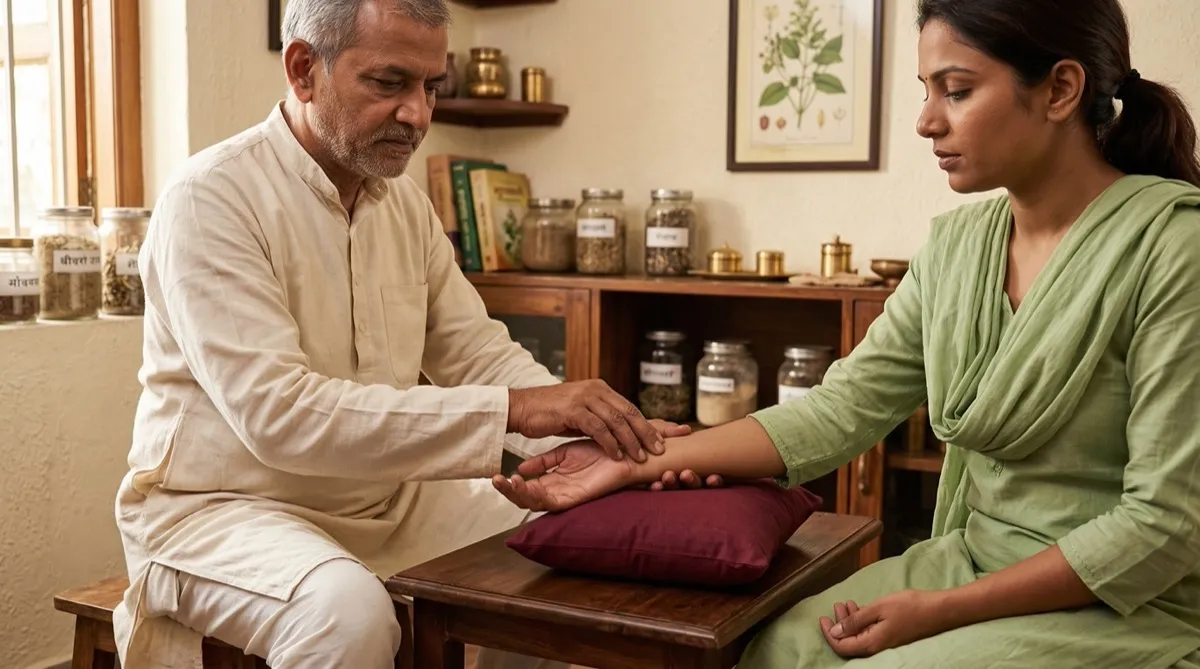
The first phase of Ayurvedic care is not treatment at all. It is assessment. A thorough Ayurvedic practitioner spends the initial consultation understanding your Prakriti (innate constitution), your current Vikriti (state of imbalance), the strength of your Agni, the presence and location of Ama, which srotas (channels) are blocked, and how your daily habits, diet, sleep, and emotional patterns contribute to the current picture. Charaka Samhita (Vimanasthana 8) outlines a detailed tenfold examination framework — Dashavidha Pariksha — that a practitioner uses to assess the complete picture before formulating any approach. This is not a five-minute process. It often takes the full first consultation and sometimes extends into the early follow-ups.
During these initial weeks, you may be given preliminary formulations — often lighter preparations designed to test your digestive response and begin clearing surface-level Ama. The practitioner is observing how your body responds. Do you tolerate the formulation well? Does your digestion shift? How is your energy? This feedback loop is critical because Ayurvedic formulations are adjusted based on individual response, not prescribed uniformly. What works beautifully for one person may need modification for another, even if the presenting complaint is identical.
Some people notice small improvements in this phase — better sleep, slightly improved digestion, a subtle lift in energy. Others notice very little. Both are normal. The practitioner is laying groundwork, not aiming for dramatic shifts yet. The most important thing you can do in the first weeks is follow the dietary and lifestyle guidance consistently and report honestly at follow-ups. Every observation you share — even things that seem unrelated — helps the practitioner refine the approach.
Did You Know?
Charaka Samhita (Sutrasthana 16) describes an elaborate pre-treatment protocol called Purva Karma — preparatory steps that must happen before the main treatment can begin. Ashtanga Hridaya (Sutrasthana 14) reinforces this with a vivid analogy: administering powerful formulations to an unprepared body is like pouring water on unploughed land — it runs off without nourishing. The body must first be prepared through digestive kindling and channel opening before it can absorb and utilise deeper-acting formulations. This is why experienced practitioners do not rush the early phase.
Months One Through Three: The Real Work Begins
This is where long-term Ayurvedic care diverges most sharply from the quick-fix model. Between the first and third month, the practitioner typically moves from preliminary support to more targeted formulations. Kashayams (decoctions), churnas (powders), and tailams (medicated oils) may be adjusted, combined, or changed entirely based on how you have responded in the first phase.
This is why Ayurveda measures treatment timelines in weeks and months, not days. The body nourishes its seven dhatus (tissues) in a strict sequence, from Rasa at the surface down to Shukra at the deepest level. Each layer must receive and process its share before passing nourishment to the next. When a formulation begins working, improvements appear first in Rasa — better skin hydration, steadier energy, improved digestion. But for that same formulation to reach Asthi (bone) or Majja (nerve tissue), the nourishment must pass through five preceding layers first. Classical texts estimate the full cycle at roughly 30 days. This is not slowness — it is depth. A formulation that changes your blood markers in a week has only reached the second dhatu. The real work, the kind that addresses joint conditions, nerve concerns, or reproductive health, requires the patience to let nourishment travel the full chain.
Classical Ayurveda actually contains two competing theories about how dhatu nourishment works — and the difference matters for understanding treatment timelines. The first is Kshira-Dadhi Nyaya (the milk-to-curd principle), described in Charaka Samhita (Chikitsasthana 15). Just as milk must fully transform into curd before it can become butter, Rasa dhatu must be completely nourished and transformed before Rakta dhatu can receive its share. This is strict sequential processing — each layer must finish before the next begins. The second theory is Khale Kapota Nyaya (the pigeon-from-grain principle), found in Sushruta Samhita and later commentaries. Like pigeons selectively picking grains from a threshing floor, each dhatu extracts what it needs directly from the nutrient pool, without waiting for the previous layer to finish. Under this model, deeper tissues can begin receiving nourishment earlier, though they still take longer because they require more refined nutrients.
In practice, most experienced practitioners observe something that combines both models. Sequential nourishment clearly occurs — surface-level improvements reliably appear before deep-tissue changes. But the timeline is not as rigidly linear as pure Kshira-Dadhi Nyaya would predict, which suggests some degree of selective nourishment also operates. This dual-model understanding explains why two people with the same condition may respond at different rates: their Agni strength, channel integrity, and constitutional factors determine which nourishment pathway predominates. Ashtanga Hridaya (Sutrasthana 11) discusses this dhatu formation process in detail, noting that the quality of Agni at each tissue level determines how efficiently transformation occurs.
This is why joint conditions, nerve-related concerns, or reproductive health issues take months rather than weeks to respond. It is not that the formulation is ineffective. It is that the effect has to travel through several tissue layers before reaching the affected dhatu. Charaka describes specific time periods for dhatu nourishment in Chikitsasthana 15 — roughly one to several weeks per layer, depending on the strength of Agni and the quality of the formulation. Impatience here is the single biggest reason people abandon Ayurvedic care too early, right when the deeper work is finally beginning.
During this phase, you may experience something that seems counterintuitive: old symptoms briefly resurfacing. A skin condition that had been suppressed may flare mildly. Digestion may shift temporarily. You might feel unusually tired for a few days. Classical Ayurveda has a name for this — it is part of the Ama mobilisation process, closely tied to a concept called Srotoshodhana (channel cleansing). Charaka Samhita (Vimanasthana 5) describes how the srotas — the body’s micro-channels that carry nutrients, waste, and doshic influence — become blocked by accumulated Ama over time. As formulations begin clearing these channels, stored metabolic waste mobilises and moves through the body for elimination. This processing can temporarily create discomfort. Experienced practitioners expect this and manage it with formulation adjustments. Srotoshodhana is not a side effect of care — it is one of the primary mechanisms through which Ayurvedic formulations work at the deeper tissue level.
Did You Know?
The seven dhatu tissue chain means that a formulation targeting joint health (Asthi dhatu, layer 5) must first nourish and pass through Rasa, Rakta, Mamsa, and Meda. Charaka estimates this sequential nourishment takes meaningful time — which is why joint or bone-related improvements in Ayurvedic care typically become noticeable after 8–12 weeks, not overnight. The improvement is real; it is just building from the inside out.
Months Three Through Six: Stabilisation and Deepening
By the third month, if the care has been consistent and the practitioner skilled, most people notice meaningful changes. Not just symptom improvement — though that often comes — but broader shifts. Digestion works more predictably. Sleep quality improves. Energy has a different character — steadier, less dependent on caffeine or willpower. Skin clarity, emotional stability, seasonal resilience — these secondary benefits often surprise people because they did not come seeking help for them.
This is the hallmark of Ayurvedic care done well. Because the approach addresses root imbalances rather than surface symptoms, improvements tend to ripple outward. When Agni strengthens, digestion improves, which means better nutrient absorption, which means better dhatu nourishment, which means better sleep, which means better recovery, which means better immunity. One correction cascades into many. This is fundamentally different from taking a painkiller for joint discomfort, a sleeping pill for insomnia, and an antacid for digestion — three separate interventions that do not connect to each other.
The practitioner typically stabilises the formulation during this phase. Adjustments become smaller and less frequent. The focus shifts from active correction to consolidation — making sure the gains hold. Dietary and lifestyle recommendations become more refined and personalised. This is also when many people begin to understand their own body’s patterns with a clarity they never had before. You start noticing which foods disturb your digestion, which seasonal shifts affect you, and what your body is trying to tell you when minor symptoms appear. This self-awareness is one of the most valuable long-term outcomes of Ayurvedic care.
Beyond Six Months: Maintenance and Prevention
Here is where long-term Ayurvedic care reveals its deepest value. Once the primary imbalance has been addressed and stabilised, the focus shifts to something modern medicine barely attempts: prevention. Not annual blood tests and hoping for the best. Active, personalised, seasonal prevention — adjusting formulations for seasonal transitions, refining diet for changing life stages, and supporting the body’s natural rejuvenation (Rasayana) processes.
Many families who have been under Ayurvedic care for years describe a shift in their relationship with health. Instead of reacting to problems, they learn to prevent them. They notice the early signs of dosha accumulation — the slight heaviness before Kapha aggravation, the mild acidity before Pitta erupts, the restless sleep before Vata takes hold — and take simple corrective steps before anything develops into a full condition. This is what Charaka meant when he described the ideal approach to health as Swasthya Rakshana (protection of health) rather than Vikara Prashamana (treatment of disease).
Follow-up frequency naturally decreases over time. Where the first six months might involve consultations every few weeks, long-term care often settles into seasonal check-ins — adjusting formulations for summer, winter, monsoon transitions. Some families visit only when they feel something shifting. Others maintain a regular seasonal rhythm. The practitioner-patient relationship deepens into something more like a partnership, where the practitioner understands your constitution so thoroughly that adjustments become precise and minimal.
This is the model that has sustained families for generations at clinics like ours. Families where the grandmother first visited, then brought her children, and now the grandchildren come. Not because something is always wrong, but because consistent Ayurvedic guidance — rooted in a tradition carried forward through gurus — has become part of how the family maintains health. It is a fundamentally different paradigm — healthcare as an ongoing relationship rather than a series of disconnected emergency visits.
Did You Know?
Charaka Samhita (Vimanasthana 8) uses a striking metaphor to explain why formulations must change over the course of treatment. He compares the practitioner to an archer who must continuously adjust aim as the target moves. Just as an archer cannot fix a single trajectory and expect to hit a moving target, a practitioner cannot fix a single formulation and expect it to address an imbalance that shifts as the body responds. This “moving target” principle — where each stage of recovery reveals new information that demands a new response — is one of the most sophisticated aspects of classical Ayurvedic reasoning, and it is the reason experienced practitioners treat long-term care as an ongoing dialogue with the body rather than a fixed prescription.

Your gut contains roughly 100 million neurons — more than your spinal cord. Scientists now call it the “second brain” (the enteric nervous system), and it communicates with your brain through the vagus nerve in both directions. When Ayurveda says that digestion affects your mental state, it is not being poetic. Your gut literally thinks. It produces over 90% of your body’s serotonin — the neurotransmitter most associated with mood stability. This is why Ayurvedic practitioners assess Agni (digestive fire) first in almost every consultation: because the state of your digestion is, measurably, the state of your neurochemistry. Fix the gut, and the mind often follows. The ancients knew this. Modern neurogastroenterology is confirming it one study at a time.
Why Formulations Change — and Why That Is a Good Sign
One of the most common concerns families raise during long-term care is: “The practitioner keeps changing my medicine. Does that mean the first one did not work?” Almost always, it means the opposite. Formulation changes in Ayurveda typically signal progress.
Here is the logic. A formulation given in the first month is addressing the most superficial layer of imbalance — clearing Ama, kindling Agni, beginning to correct the dominant dosha disturbance. Once that layer responds, the practitioner looks deeper. The next formulation targets a subtler imbalance that was hidden beneath the first. This is like peeling an onion. Each layer reveals the next. A skilled practitioner reads the signs — pulse changes, digestion shifts, symptom evolution — and adjusts the formulation to match the current state. Our clinical approach page describes this assessment process in detail.
This is why Ayurvedic formulations are traditionally prepared individually or selected from a vast classical repertoire of over seven hundred compound formulations. A one-size-fits-all approach cannot navigate the shifting terrain of an individual’s healing process. The practitioner needs to be responsive — adjusting potency, changing herb combinations, modifying dosage forms from kashayam to churna or vice versa — based on how the body is responding at each stage.
If your formulation has not changed in many months, it could mean one of two things: either you are in a stable maintenance phase where the current support is exactly right, or the practitioner may need to reassess. A completely static prescription over a long period when you are still experiencing symptoms warrants an honest conversation about whether the approach needs refinement.
What You Can Do to Support the Process
Long-term Ayurvedic care is a partnership. The practitioner provides the clinical expertise, the formulations, and the guidance. But the patient provides something equally important: consistency. The most beautifully selected kashayam in the world will underperform if you take it irregularly, ignore the dietary recommendations, and skip follow-ups.
Follow the dietary guidance. When a practitioner says to avoid curd at night or to eat warm food during monsoon, it is not generic wellness advice. It is specific to your current treatment plan. Dietary recommendations in Ayurveda are not separate from the medicine — they are part of it. Charaka places Ahara (diet) alongside Aushadha (medicine) as equally important therapeutic tools. If you want to understand why specific seasonal dietary adjustments matter, our article on seasonal diet in Telugu culture explores this in depth.
Maintain your daily routine. Regular sleep timing, consistent meal schedules, adequate hydration, and some daily movement create the stable foundation on which Ayurvedic formulations work best. The formulation is the seed. Your daily habits are the soil. Neither works optimally without the other.
Report honestly at follow-ups. Do not tell the practitioner what you think they want to hear. Report what actually happened. If you did not take the medicine consistently, say so. If you noticed something unusual — even something seemingly unrelated — mention it. The more accurate information the practitioner has, the more precise the next adjustment will be.
Do not compare timelines. Your neighbour’s three-month recovery from a similar complaint does not predict yours. Different constitutions, different imbalance depths, different lifestyle factors, different compliance levels — all affect pace. Trust the process, stay consistent, and let the results speak over time. If you have concerns about whether Ayurveda is right for your specific situation, our urgent care guide clarifies where Ayurveda excels and where modern medicine should be the first response.

The Long Game Is the Only Real Game
Families who have maintained long-term Ayurvedic relationships often describe a shift not just in specific symptoms, but in their broader relationship with health. The classical term for this state is Swasthya — literally “being established in oneself.” It describes a condition where the body’s self-regulating mechanisms function well, seasonal transitions are navigated without disruption, and minor imbalances are caught early before they develop into conditions. This is what Charaka Samhita (Sutrasthana 30) describes as the natural outcome of sustained, attentive care.
Modern medicine and Ayurveda address different aspects of health, and they function on different timescales. Modern medicine excels at acute intervention — emergencies, infections, surgeries, diagnostics. Ayurveda’s strength lies in the chronic, slowly-developing territory — the digestive patterns, the joint stiffness, the sleep irregularities, the seasonal vulnerabilities — where sustained, individualised care over months and years tends to produce the most meaningful shifts. The two systems are not in opposition; they address different dimensions of the same body. Understanding what long-term Ayurvedic care involves — and what it does not — is the first step toward deciding whether it aligns with what you are seeking. You can explore the full range of consultation areas where families commonly seek this kind of guidance.
What Current Evidence Says
Research into long-term outcomes of traditional medicine is growing. The WHO Traditional Medicine Strategy 2014–2023 (extended to 2025) explicitly calls for integration of traditional systems into national health frameworks and better research into their long-term effects. In India, the Ministry of Ayush has funded multi-centre studies exploring Ayurvedic management of chronic conditions through institutions like CCRAS.
Some observational studies have documented that sustained Ayurvedic care for conditions like osteoarthritis, chronic digestive disorders, and certain skin conditions shows progressive improvement over time, with some outcomes comparable to conventional long-term management. However, rigorous long-term randomised controlled trials remain limited, and most evidence is from smaller studies or case series.
The concept of individualised, multi-modal care — combining dietary change, lifestyle modification, herbal formulations, and practitioner follow-up — aligns with emerging evidence in personalised medicine and lifestyle medicine approaches. The idea that chronic conditions benefit from sustained, multi-factorial interventions rather than single-drug approaches is gaining broader scientific recognition.
This article is for educational purposes only and does not constitute medical advice. Ayurvedic care should complement, not replace, conventional medical care for serious health conditions. Always inform both your Ayurvedic practitioner and your physician about all treatments you are receiving. Do not discontinue prescribed medications without consulting your doctor. Seek immediate medical attention for acute or emergency conditions.