
What Are the Dhatus?
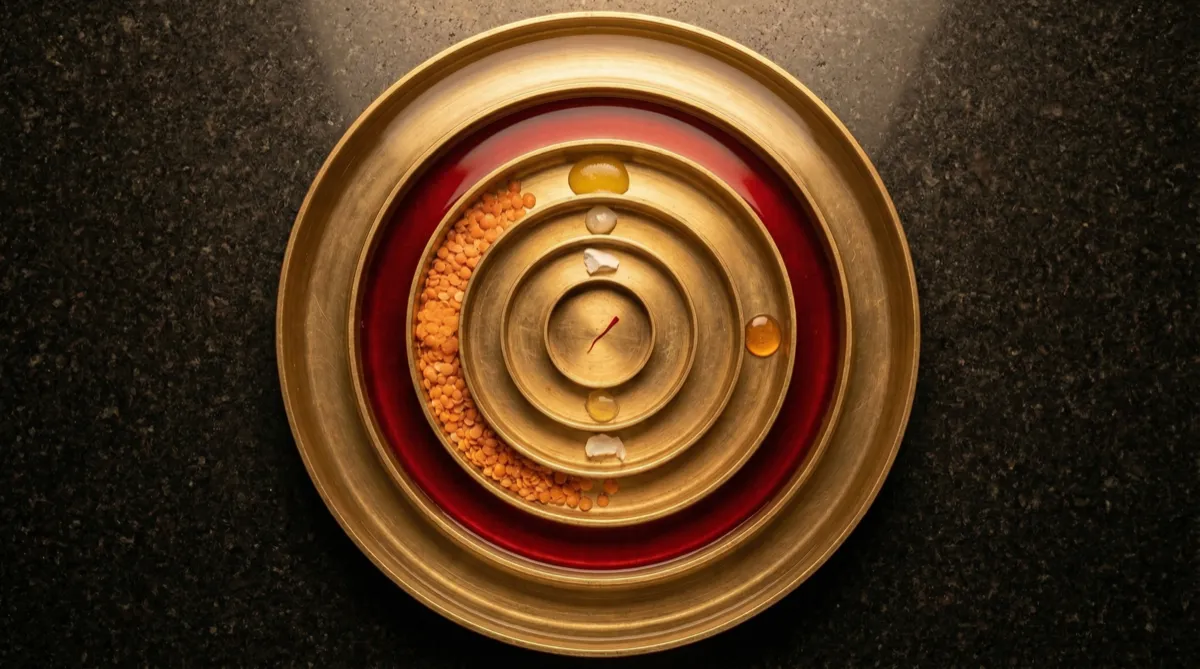
Here is something that might reframe how you think about your own body: the dinner you ate last night is not finished with you. According to a framework documented over 2,000 years ago, that meal will spend the next five weeks being transformed — layer by layer, tissue by tissue — from simple plasma into the substance that governs your immunity, your emotional resilience, and your capacity to create life. The word Dhatu comes from the Sanskrit root “dha,” meaning “that which sustains.” These are not abstract categories. They are the seven living tissues that give your body its form, strength, and capacity to function — and they are being rebuilt from your food right now, as you read this. Sushruta Samhita (Sutra Sthana 14.20) describes the Dhatus as the pillars upon which the entire body stands. Charaka (Sutra Sthana 28.4) adds that the Dhatus are what the doshas ACT upon — without healthy tissue substrate, balancing Vata, Pitta, and Kapha is like tuning an engine that has no fuel in the tank. The load-bearing walls must be intact before you worry about the paint.
The seven Dhatus, in their order of formation, are: Rasa (plasma and lymph), Rakta (blood), Mamsa (muscle tissue), Meda (fat and adipose tissue), Asthi (bone), Majja (marrow and nervous tissue), and Shukra or Artava (reproductive tissue — Shukra in males, Artava in females). Each Dhatu is composed of specific combinations of the Panchamahabhutas (five elements) — Rasa is predominantly Water, Rakta is Fire and Water, Asthi is predominantly Earth and Air. This sequence is not arbitrary. It represents the actual order in which the body converts digested food into progressively more refined and specialised tissues. Each Dhatu produces the next through a tissue-level digestive process governed by its own metabolic fire, called Dhatvagni.
Think of this sequence like a company payroll that pays employees in strict order of seniority. The most senior person (Rasa) gets paid first from whatever money is available. What remains goes to the next in line (Rakta), and so on. In good months, everyone down to the most junior employee (Shukra) receives their full share. But in a lean month, the juniors get shortchanged first — even though the seniors may not notice any difference. Food enters the body, is digested by the central Agni (digestive fire), and produces a nutritive essence called Ahara Rasa. This essence first nourishes Rasa Dhatu — the most basic, most fluid tissue. Whatever Rasa Dhatu does not absorb passes to Rakta Dhatu for further refinement. What Rakta does not use feeds Mamsa, and so on down the chain until the final, most refined product — Shukra/Artava — is formed. Each transformation requires its own time, its own Agni, and produces its own by-products. This sequential nourishment model is one of the most clinically powerful concepts in Ayurveda, because it explains patterns of disease that are otherwise puzzling.
Each Dhatu has a specific function beyond its structural role, and the classical texts name these functions with surgical precision. Rasa provides nourishment and satisfaction (Prinana) — which is why chronic emotional emptiness is often a Rasa problem, not a psychological one. Rakta provides vitality and the visible glow of health (Jivana) — the reason your face looks dull during illness, not just tired. Mamsa provides covering, protection, and physical strength (Lepana). Meda provides lubrication and insulation (Snehana) — the reason crash dieting produces cracking joints and dry skin. Asthi provides the structural framework (Dharana). Majja fills the bone spaces and nourishes nervous tissue (Purana) — which is why Ayurveda links bone health and cognitive clarity, a connection modern research on the bone-brain axis is only now confirming. Shukra/Artava provides the capacity for reproduction and the generation of Ojas (Garbhotpadana). When any of these functions is impaired, the clinical picture is specific and recognisable — not vague or theoretical, but immediately observable in your skin, your energy, your hair, your mood.
Did You Know?
Your body replaces roughly 330 billion cells every single day — about 1% of all your cells. Most of the lining of your small intestine (a Rasa-related tissue) is replaced every 3–5 days. Red blood cells (Rakta) last about 120 days. Bone cells (Asthi) take 7–10 years for a full turnover cycle. This means you are quite literally not the same physical person you were a decade ago — every atom has been swapped out. The Ayurvedic Dhatu model, which describes tissues being continuously rebuilt from food through sequential nourishment, was not a philosophical position about impermanence. It was a precise observation about biological reality: your body is a process, not a thing. The quality of that process — determined by the quality of your food, digestion, and lifestyle — determines the quality of the body you are continuously rebuilding.
The Dhatu Nourishment Chain
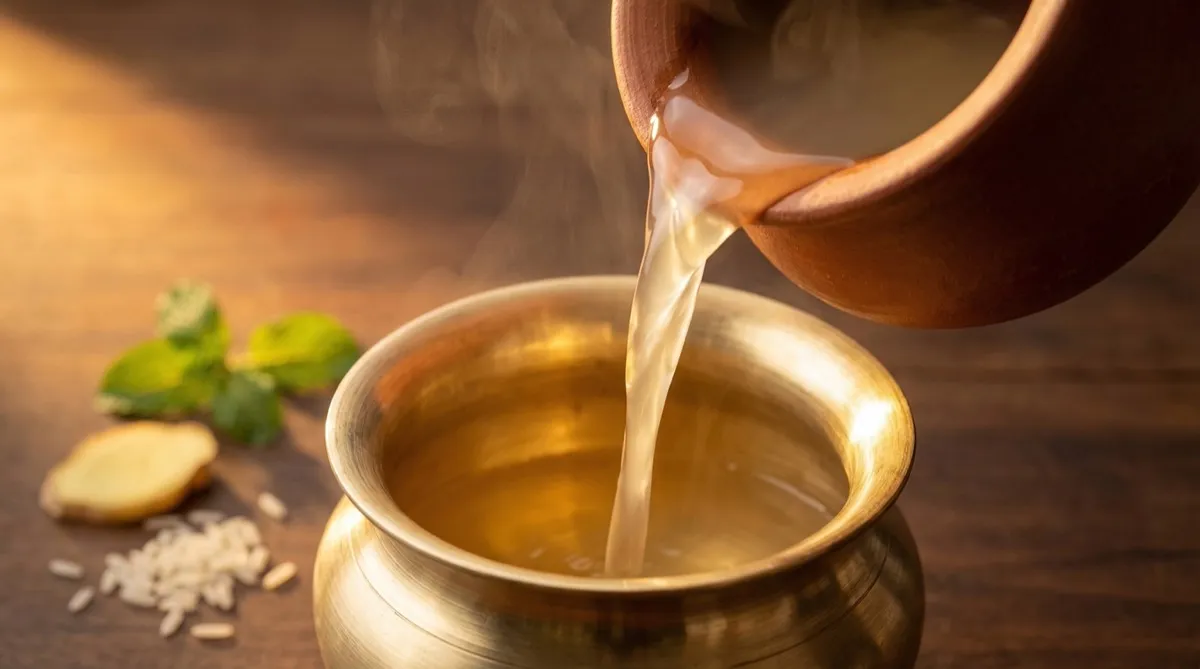
Imagine a mountain spring. Water cascades from pool to pool, and at each level, something different grows — moss in the first pool, fish in the second, lotus in the third. Each pool receives only what the pool above it did not absorb. Now replace water with the nutritive essence of your food, and the seven pools with seven tissues. That is the Dhatu nourishment chain. It begins with digestion: your central Agni (the digestive fire seated in the stomach and small intestine) breaks food down into two products — Sara (the nutritive essence) and Kitta (the waste). The Sara becomes Ahara Rasa, the raw material that enters your bloodstream and begins a five-week journey through all seven tissue layers. Without strong Agni, every pool downstream runs dry from the start.
From Ahara Rasa, Rasa Dhatu forms first. The Rasa Dhatvagni (the metabolic fire specific to Rasa tissue) processes this nutritive fluid and extracts what it needs. The remainder — the portion that Rasa Dhatu cannot use — becomes the raw material for Rakta Dhatu. Rakta Dhatvagni then processes this material, takes what it needs for blood formation, and passes the rest to Mamsa. Mamsa to Meda. Meda to Asthi. Asthi to Majja. Majja to Shukra. At each stage, the tissue becomes more refined, more concentrated, and takes longer to produce.
This sequential process has a profound clinical implication: the time it takes for food to nourish all seven Dhatus is significant. Charaka Samhita (Chikitsa Sthana 15.16–17) describes this process as taking approximately 35 days for a single meal to complete its journey through the entire Dhatu chain — roughly five days per Dhatu. Some commentators, following Vagbhata (Ashtanga Hridaya Sharira Sthana 3.62), interpret this as the cumulative effect of daily nourishment gradually reaching deeper tissues over weeks. Either way, the practical consequence is the same — nutritional changes do not produce instant results at the tissue level. This is why someone who starts eating well notices better skin and energy within a week (Rasa), but their hair may take three months to improve (Asthi) and reproductive vitality even longer (Shukra). Patience is not merely a virtue in Ayurvedic nutrition — it is a physiological reality.
The chain also explains something that puzzles many people: why poor digestion seems to affect hair, nails, and reproductive health before it affects more “basic” tissues like blood or muscle. The answer lies in the sequence. When Agni is weak or when nutritional input is inadequate, the tissues at the END of the chain are starved first. Rasa Dhatu, being first, gets whatever nutrition is available. Rakta gets whatever Rasa does not need. By the time the nutritive essence reaches Asthi, Majja, and Shukra, there may be very little left. This is also why Ama (metabolic toxins from incomplete digestion) is so damaging to tissue health — it clogs the channels through which nutrients travel between Dhatus, starving the deeper tissues even when dietary input seems adequate. Hair loss (an Asthi by-product), brittle nails (Asthi again), and reproductive difficulties (Shukra/Artava) are often the earliest warning signs of deep nutritional or digestive imbalance — even when the person appears outwardly healthy.
Upadhatus and Malas: The Body’s Diagnostic Dashboard
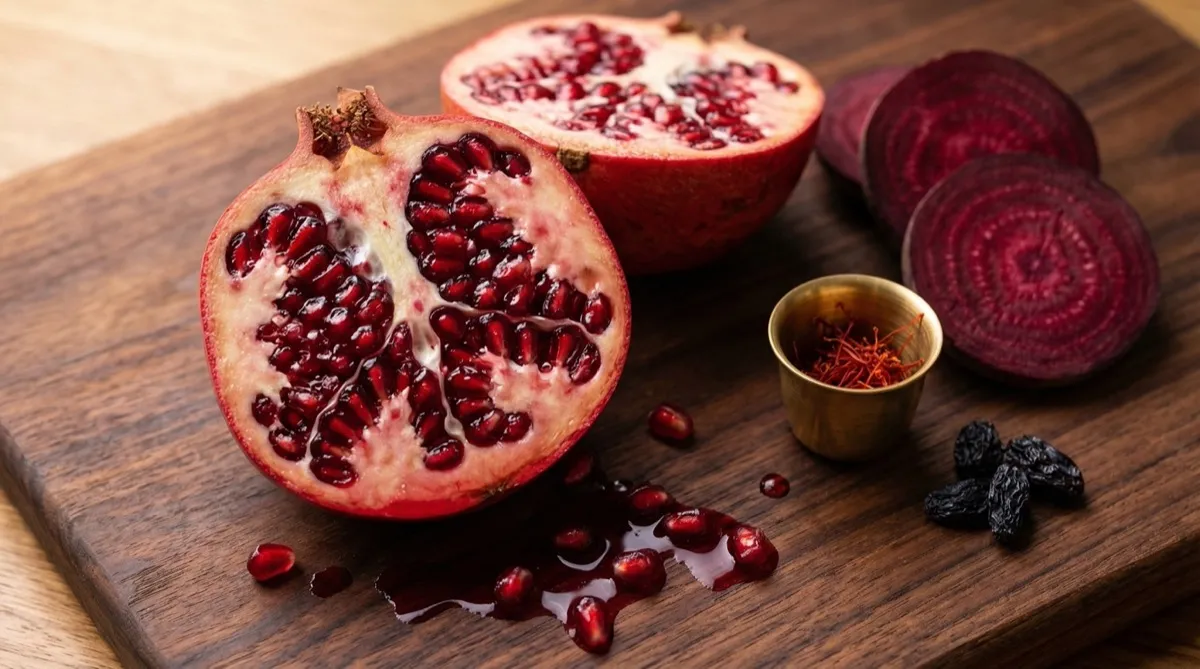
Here is where the Dhatu model becomes genuinely extraordinary — and where a modern biologist might do a double take. At each stage of the nourishment chain, two additional categories of substance are produced: Upadhatus (secondary tissues) and Dhatu Malas (tissue-level waste products). These are not incidental leftovers. They are the body’s diagnostic dashboard — visible, external signals of what is happening in tissues you cannot see or touch. A skilled practitioner reads these the way a soil scientist reads the weeds growing in a field: the surface tells you everything about what is happening underground.
Each Dhatu produces specific Upadhatus. Rasa Dhatu produces Stanya (breast milk) and Artava (menstrual fluid) — which is why the quality and regularity of menstruation and lactation are considered direct indicators of Rasa health. Rakta Dhatu produces Sira (blood vessels) and Kandara (tendons). Mamsa Dhatu produces Vasa (muscle fat or subcutaneous fat) and the six layers of skin — which is why skin quality is a direct reflection of Mamsa and Rakta health. Meda Dhatu produces Snayu (sinews and ligaments). Asthi Dhatu produces Danta (teeth) and Kesha (hair), along with nails — which is why hair quality and dental health are classical indicators of bone tissue health. This is one of Ayurveda’s most surprising insights: your hair is not just a cosmetic feature. It is a by-product of bone metabolism, and its quality tells you something about the health of tissues you cannot see. Majja Dhatu produces Akshi Tarpaka (eye secretions and the lubricating substances of the eyes). And Shukra Dhatu produces Ojas — the most refined substance in the body, the essence of all seven Dhatus combined.
The Dhatu Malas are equally informative. Each Dhatu produces waste that the body must process and eliminate. Rasa produces Kapha (mucus). Rakta produces Pitta (bile). Mamsa produces waste products that appear in the ears, nose, and other orifices. Meda produces Sweda (sweat). Asthi Malas include body hair and the oily secretions of the skin. Majja produces the oily secretions of the eyes and skin. These waste products, when normal in quantity and quality, indicate healthy Dhatu metabolism. When excessive, deficient, or abnormal, they point directly to which Dhatu is disturbed.
This framework gives the practitioner an extraordinary diagnostic tool. A patient presenting with dry, brittle hair and weak nails is showing Asthi Dhatu disturbance — regardless of what their chief complaint might be. A patient with excessive sweating points to Meda Dhatu involvement. Poor skin quality suggests Mamsa or Rakta issues. The quality of menstruation reveals Rasa Dhatu health. These are not metaphorical associations. They are specific, predictable, observable consequences of the Dhatu nourishment model — and they have been validated by clinical observation over thousands of years of Ayurvedic practice.
Here is something that should change how you think about emotional health: the classical texts do not treat emotions as purely psychological events. Rasa Dhatu — the very first tissue, formed directly from digested food — is described as governing not just plasma and lymph but also Prinana: the feeling of being nourished, content, and emotionally satisfied. When Rasa Dhatu is depleted, the person does not just get dehydrated or develop dry skin. They feel a persistent, inexplicable sense of emotional emptiness — a hollowness that no amount of external comfort seems to fill. This is not a metaphor for sadness. It is a tissue-level deficiency producing an emotional symptom. The implication is profound: some of what we experience as emotional distress may actually be a nutritional problem at the level of the first tissue. The body does not separate physical nourishment from emotional nourishment — they are the same process, happening in the same tissue, governed by the same Agni.
Did You Know?
In 2022, researchers at the Weizmann Institute of Science published a study in Nature showing that fat tissue (Meda Dhatu) is not just passive energy storage — it is an active endocrine organ that sends over 600 different signalling molecules to the brain, liver, muscles, and immune system. Fat tissue literally talks to every other tissue in your body. Ayurveda classified Meda as the fourth Dhatu in the nourishment sequence and described its function as Snehana (lubrication) — but also noted that when Meda becomes excessive, it blocks the Srotas (channels) that nourish the tissues downstream from it: bone, marrow, and reproductive tissue. This is why Charaka linked obesity not just to heaviness but to bone weakness, cognitive dullness, and reproductive difficulty. Modern endocrinology now confirms all three connections. Excess fat tissue produces inflammatory cytokines that impair bone remodelling, disrupt neural function, and suppress reproductive hormones. The fourth tissue in a 2,000-year-old sequential model turns out to be a master regulator of exactly the downstream tissues Ayurveda predicted it would affect.
Dhatu Imbalance: Kshaya and Vriddhi
Consider two people who both feel constantly exhausted. One is thin, anxious, and cannot sleep. The other is overweight, sluggish, and sleeps too much. Both would tell their doctor the same thing: “I have no energy.” But the Dhatu model reveals completely different stories. The first person’s tissues are depleted (Kshaya) — they are running on empty. The second person’s tissues are congested with excess (Vriddhi) — they are clogged. Charaka Samhita (Sutra Sthana 17.62) states that each Dhatu can exist in one of three states: normal (Sama), depleted (Kshaya), or excess (Vriddhi). Identifying which state, in which tissue, is the central diagnostic question.
Dhatu Kshaya (depletion) is often the more clinically urgent condition, and Charaka Samhita (Sutra Sthana 17.64–76) lists the signs of each Dhatu’s depletion with remarkable specificity. Rasa Kshaya manifests as dehydration, dry skin, intolerance to noise, fatigue, and a pervasive sense of emptiness or dissatisfaction. Rakta Kshaya presents as pallor, cold extremities, desire for sour and cold foods, and collapse or dullness of blood vessels. Mamsa Kshaya shows as wasting, weakness, joint pain (from loss of muscular support), and fatigue during even mild physical activity. Meda Kshaya manifests as extreme thinness, cracking joints, fatigue, and an enlarged spleen. Asthi Kshaya produces brittle bones, hair fall, loose teeth, and pain in bones and joints. Majja Kshaya presents as a feeling of emptiness in the bones, weakness, dizziness, and visual disturbances. Shukra Kshaya manifests as reproductive difficulties, weakness, dryness, and emotional depletion. When depletion is chronic and long-standing, it often involves multiple Dhatus simultaneously, requiring sustained, layered support rather than a single intervention.
Dhatu Vriddhi (excess) produces its own distinct set of symptoms. Rasa Vriddhi leads to excessive salivation, nausea, heaviness, and a feeling of satiation without reason. Rakta Vriddhi manifests as skin conditions, redness, burning sensations, and inflammatory presentations. Mamsa Vriddhi shows as abnormal growths, heaviness in muscles, and tumour-like formations. Meda Vriddhi is what modern medicine recognises as obesity — accompanied by breathlessness, excessive thirst, lethargy, and metabolic sluggishness. Asthi Vriddhi produces bony outgrowths and dental overgrowths. Majja Vriddhi manifests as heaviness in the eyes and limbs. Shukra Vriddhi can present as excessive sexual drive or the formation of stones in reproductive tissues.
The clinical art lies in identifying WHICH Dhatu is imbalanced and at WHAT level. This is why two patients who present with the same symptom — say, chronic fatigue — may need entirely different approaches. One patient’s fatigue may stem from Rasa Kshaya (depleted plasma, poor nourishment reaching tissues). Another’s may come from Meda Vriddhi (excess fat tissue creating metabolic heaviness). A third may have Majja Kshaya (depleted nervous tissue). The symptom is the same. The Dhatu involvement is different. The approach must match the actual Dhatu imbalance, not merely the surface symptom. This is like three people whose cars all make the same rattling noise — one has a loose exhaust, another has worn brake pads, and the third has a failing engine mount. The sound is identical, but the fix for each is completely different. This level of specificity is what distinguishes Ayurvedic assessment, and why a personalised assessment of tissue metabolism matters more than matching a symptom to a remedy.
How Doshas Affect Dhatus
The doshas and Dhatus do not exist in separate compartments. They interact constantly, and the nature of this interaction determines the specific character of disease. When a dosha becomes aggravated, it does not simply float around causing generic symptoms. It lodges in specific Dhatus, and the resulting condition carries the characteristics of BOTH the dosha and the Dhatu involved. This dosha-Dhatu interaction model is one of the most clinically precise tools in Ayurvedic pathology. Understanding your Prakriti (constitutional type) helps predict which Dhatu-dosha combinations you are most vulnerable to.
Vata, with its dry, light, cold, and mobile qualities, tends to deplete Dhatus. Charaka Samhita (Sutra Sthana 28.15–18) describes Vata as having a particular affinity for Rasa Dhatu (causing dehydration and poor nourishment), Asthi Dhatu (causing bone loss, joint deterioration, and cracking), Majja Dhatu (causing nervous system depletion, anxiety, and insomnia), and Shukra Dhatu (causing reproductive tissue dryness and depletion). There is a specific, inverse relationship between Vata and Asthi described in the texts — as Vata increases, Asthi decreases, and vice versa. This is unique among dosha-Dhatu relationships and explains why Vata-predominant individuals are most prone to bone and joint concerns as they age. When Vata lodges in Asthi Dhatu, the result is what we recognise as degenerative joint conditions — dryness, cracking, pain that worsens with cold and movement. When Vata disturbs Majja, the presentation is neurological — tremors, numbness, tingling, cognitive fog. The tissue determines the location and type of symptoms; the dosha determines their character.
Pitta, with its hot, sharp, liquid, and slightly oily qualities, tends to inflame and burn Dhatus. It has a particular affinity for Rakta Dhatu (causing inflammatory blood conditions, skin rashes, and bleeding disorders), Mamsa Dhatu (causing muscle inflammation, abscesses, and tissue breakdown), and Meda Dhatu (causing metabolic inflammation). When Pitta lodges in Rakta, the classical texts describe this as Raktapitta — a condition characterised by bleeding tendencies, skin inflammation, and heat-related symptoms. When Pitta enters Mamsa, the result is inflammatory muscle conditions, skin infections, and tissue ulceration. The sharp, penetrating quality of Pitta literally “digests” the tissue it invades.
Kapha, with its heavy, cold, oily, and stable qualities, tends to accumulate in and congest Dhatus. It has a particular affinity for Rasa Dhatu (causing fluid retention, lymphatic congestion, and heaviness), Meda Dhatu (causing excessive fat accumulation and metabolic sluggishness), and Mamsa Dhatu (causing benign growths and tissue heaviness). When Kapha lodges in Meda, the result is the progressive weight gain and metabolic sluggishness that Ayurveda calls Medoroga — a condition that modern medicine classifies as obesity and metabolic syndrome. The heaviness of Kapha added to the already heavy quality of Meda creates a compounding effect that is difficult to reverse without addressing both the dosha and the Dhatu simultaneously.
Rasayana: Rebuilding the Dhatus
If Dhatu depletion is the problem, Rasayana is the classical solution. The word Rasayana literally means “the path of Rasa” — it refers to therapies and approaches that optimise the flow of nutrition through the entire Dhatu chain. This is not simply “taking supplements.” True Rasayana, as described in Charaka Samhita (Chikitsa Sthana, Chapters 1–4), works by strengthening the Dhatvagnis (tissue-level digestive fires), clearing the Srotas (channels) of obstruction, and providing the raw materials each Dhatu needs in a form it can actually absorb.
Here is why this matters practically: many people eat well but still show signs of Dhatu depletion. They have good dietary input but poor tissue output. The problem is not what enters the mouth but what reaches the seventh Dhatu. If any Dhatvagni along the chain is weak, or if Ama (metabolic residue) is blocking the channels, the nutrition stalls at a certain level. The tissues downstream go hungry. This is why Ayurveda insists that Rasayana must be preceded by proper cleansing — rebuilding tissue on a clogged foundation is like pouring clean water into a pipe blocked with sediment. Some gets through, but most backs up.
What Current Evidence Says
Modern tissue biology has independently arrived at several conclusions that map onto the Dhatu model with striking precision. In 2007, Gerard Karsenty at Columbia discovered that osteocalcin, a hormone secreted by bone cells (Asthi), directly regulates testosterone production in the testes (Shukra), insulin sensitivity in the pancreas, and memory formation in the brain (Majja). This bone-reproductive-brain axis was a major revelation in endocrinology. It is also an exact match for the Asthi → Majja → Shukra sequence described in Charaka Samhita over two millennia earlier. The Dhatu model did not just list tissues — it predicted the direction of metabolic communication between them.
Nutritional biochemistry confirms that nutrients reach different tissues at different rates, following a pattern consistent with the Dhatu sequence. Water-soluble nutrients enter the bloodstream within hours (paralleling rapid Rasa nourishment). Fat-soluble vitamins take days to weeks to integrate into adipose and bone tissue (paralleling Meda and Asthi). Research on collagen supplementation shows measurable effects on skin within 4–8 weeks but requires 3–6 months to affect bone density — a timeline remarkably consistent with the Ayurvedic model of deeper Dhatus requiring longer nourishment periods. And the phenomenon of hypothalamic amenorrhea — where women under nutritional stress lose their menstrual cycle — is exactly what the Dhatu chain predicts: reproductive tissue (Shukra/Artava), being last in the nourishment sequence, is the first to be sacrificed when the body runs short.
The discovery of fascia as a body-wide connective tissue communication network (published in journals including Scientific Reports and the Journal of Bodywork and Movement Therapies) parallels the Ayurvedic concept of Srotas — the channels through which Dhatus receive nourishment. Fascia transports nutrients, metabolic waste, and signalling molecules between tissue compartments, functioning as exactly the kind of inter-tissue relay system that the Srotas model describes. Meanwhile, the emerging field of osteoimmunology — studying how bone marrow (Majja) governs immune function — maps directly onto the Majja-to-Ojas pathway: the classical claim that marrow nourishment produces the body’s deepest immune capacity.
Did You Know?
In 2012, scientists at Columbia University discovered that osteocalcin — a hormone produced by bone tissue — directly regulates brain function, male fertility, and energy metabolism. Bone was not just structural scaffolding; it was an endocrine organ communicating with the brain, the gonads, and the pancreas. This was treated as a paradigm-shifting discovery. But open Charaka Samhita (Chikitsa Sthana 15.16–17), written over two millennia earlier, and you find Asthi Dhatu (bone) positioned as the direct precursor to Majja (marrow and nervous tissue) and Shukra (reproductive tissue) in the nourishment chain — bone feeding the brain and reproductive system in exact sequence. The 35-day Dhatu cycle described in the same passage means your body is running a continuous five-week production pipeline where yesterday’s bone metabolism becomes next week’s nervous tissue nourishment and next month’s reproductive vitality. Modern endocrinology took until 2012 to map what this framework had been describing for 2,000 years: bone is not dead scaffolding. It is a living relay station that controls what happens in your brain, your fertility, and your immunity.
This article is for educational purposes only and does not constitute medical advice. The Dhatu model is a traditional Ayurvedic framework for understanding body tissues and should not be used as a substitute for modern medical diagnosis or treatment. If you have concerns about tissue health, bone density, blood conditions, reproductive health, or any other medical issue, consult a qualified healthcare provider. Ayurvedic consultation can complement your care but should not replace medical evaluation. Never stop prescribed medication without consulting your prescribing doctor.