
Hair as a Mirror of Internal Health
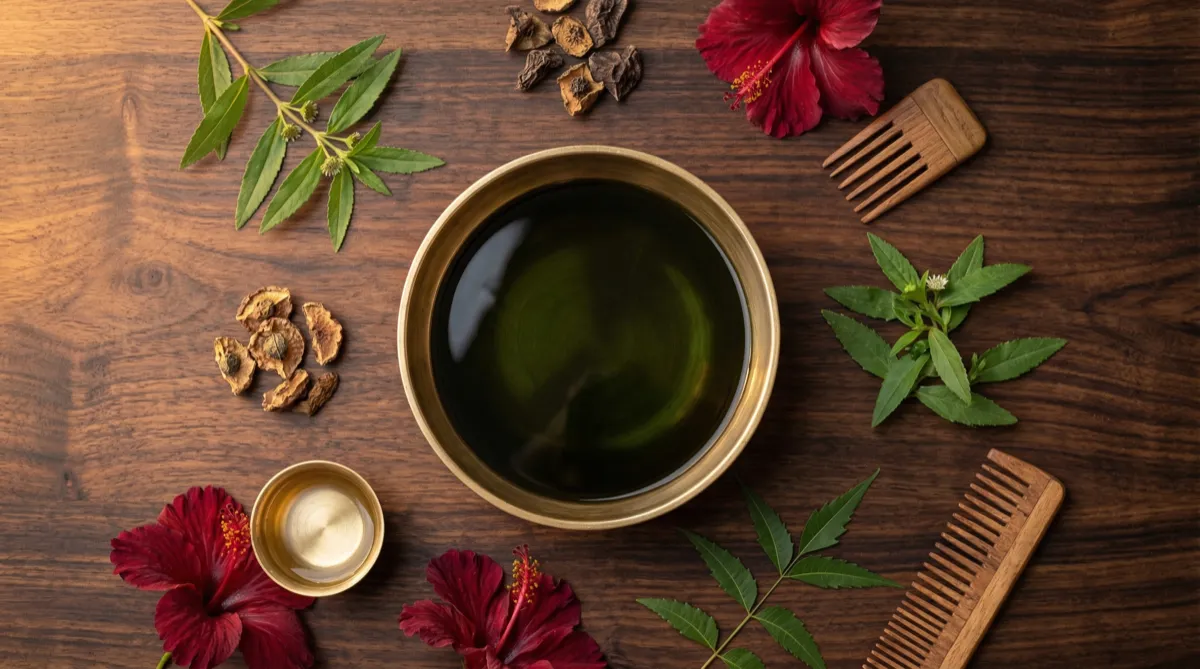
You have tried the expensive shampoo. The biotin supplements. The castor oil ritual every Sunday night. Maybe even PRP injections. And yet every morning, the shower drain tells the same story. Here is something most hair-loss advice will never tell you: according to Ayurveda, your hair is not really about your hair. In the classical texts, Kesha (hair) is classified as a Mala — a metabolic byproduct — of Asthi Dhatu (bone tissue). Sushruta makes this explicit in Sharira Sthana (Chapter 6): the quality of hair directly reflects the quality of bone tissue metabolism happening deep inside your body. Strong, thick, lustrous hair tells a practitioner that Asthi Dhatu is well-nourished. Thin, brittle, prematurely greying hair tells them that something in the tissue nourishment chain has gone wrong — often months or years before any bone or joint symptoms appear. Your hair is not failing you. It is sending you a message from your bones.
Think about that for a moment. If hair is a byproduct of bone tissue metabolism, then treating hair problems at the scalp level is like turning up the volume on a car radio to drown out engine noise. The engine is still failing. You can apply the finest oils and the most expensive serums, but if Asthi Dhatu is undernourished, the hair follicle is not receiving what it needs to produce healthy hair. The factory is underfunded — no amount of polishing the output changes that reality. This is why so many people cycle through external hair treatments with temporary improvements that never last. Modern dermatology is beginning to acknowledge this too: a 2017 review in the Journal of Clinical and Aesthetic Dermatology found that nutritional and metabolic assessment should be standard in evaluating chronic hair loss, because the scalp is often the last place to look for the actual cause.
The classical references go remarkably deep. Sushruta Samhita (Nidana Sthana, Chapter 13) describes Khalitya (hair fall) and Palitya (premature greying) as conditions rooted in systemic dosha imbalance, not localised scalp problems. Charaka Samhita (Chikitsa Sthana 26.132) connects hair quality to Bhrajaka Pitta — the subdosha of Pitta that governs skin and scalp — and to the quality of Rasa Dhatu, the first tissue in the chain, which carries nutrients to every other tissue. Vagbhata, in Ashtanga Hridaya (Uttara Sthana 23), devotes an entire chapter to hair and scalp conditions, treating them as windows into deeper metabolic disturbance. When a classical Ayurvedic practitioner examines a person with chronic hair fall, they are not primarily thinking about the scalp. They are thinking about digestive strength, tissue nourishment, dosha balance, and the integrity of the entire metabolic chain that eventually produces hair as its endpoint.
The Dosha Connection to Hair Problems
Here is where Ayurveda does something that no shampoo bottle or dermatologist’s office typically does: it asks which kind of hair problem you have, because the answer changes everything. Two people can both experience “hair fall” and need completely opposite approaches. This is one of the areas where Ayurveda’s constitutional framework offers real clinical precision that generic hair advice cannot match. Charaka Samhita (Vimana Sthana 6.12-17) describes how the same symptom manifests differently depending on which dosha is driving it — and each pattern has its own logic, its own triggers, and its own resolution pathway.
Vata imbalance produces dry, brittle hair that splits and breaks easily. Picture a plant in drought — the leaves do not fall all at once; they become dry, dull, and crumble gradually. That is Vata-type hair. The scalp becomes dry, sometimes flaky with fine, powdery dryness rather than oily flakes. Hair feels rough to the touch and tangles easily. Hair fall in Vata patterns tends to be diffuse — thinning all over rather than in specific areas. The person typically also shows other Vata signs: dry skin, constipation, anxiety, irregular sleep, and joint cracking. Consider the 28-year-old software engineer working late nights with irregular meals, living on coffee and cold sandwiches, sleeping at different times every night — that person is building a textbook Vata hair problem. Vata-type hair problems worsen in autumn and early winter (Vata season), with cold dry weather, travel, irregular routines, and excessive mental activity. The fundamental issue is dryness and depletion — the tissues are not receiving adequate nourishment, moisture, or stability.
Pitta imbalance is the dosha of premature greying, receding hairlines, and crown thinning — and it is the most aggressive of the three. Think of a forest fire moving through dry brush: it is fast, visible, and once it starts, it escalates. The scalp tends to be hot, sometimes inflamed or sensitive, with redness that may not be visible but can be felt as warmth or irritation. Pitta-type hair loss can show noticeable thinning over months rather than years. The person often shows other Pitta signs: acidity, loose stools, skin sensitivity, irritability, and a tendency to overheat. The ambitious 32-year-old who works intensely, eats spicy food, skips lunch for meetings, and carries chronic low-grade frustration — that is Pitta consuming hair from the root. Charaka (Chikitsa Sthana 26.132-136) describes how excess Ushna (heat) in Rakta and Pitta damages the hair root at its foundation. The melanocytes that produce hair colour are particularly vulnerable to this thermal damage, which is why premature greying is Pitta’s signature calling card.
Kapha imbalance is the slowest and most deceptive. The hair may actually look thick initially, but underneath, the scalp is congested — like a garden with rich soil but waterlogged drainage. Nothing new can grow properly. Kapha produces an oily, heavy scalp with thick, sticky dandruff. Hair becomes limp, heavy, and lacks volume. The hair loss is gradual but steady — a slow reduction in density over years, often accompanied by the feeling that hair is perpetually greasy even shortly after washing. The person often shows other Kapha signs: sluggish digestion, weight gain, lethargy, sinus congestion, and a general sense of heaviness. Kapha-type hair problems worsen in late winter and spring (Kapha season), with excessive dairy, sugar, cold food, sedentary lifestyle, and daytime sleeping. The fundamental issue is congestion and stagnation — the channels (Srotas) that nourish the hair root are clogged with excess Kapha, preventing nutrients from reaching the follicle despite adequate supply in the body.
In practice, most people present with mixed patterns — Vata-Pitta being particularly common in modern urban life, where the dryness and depletion of Vata combines with the heat and inflammation of Pitta to produce rapid thinning with premature greying. This is the modern epidemic pattern: the person who is simultaneously stressed (Vata), overheated from ambition and screen time (Pitta), and eating irregularly. Understanding the dominant dosha pattern determines whether the approach emphasises nourishment and moisture (Vata), cooling and soothing (Pitta), or cleansing and stimulating (Kapha). Generic hair advice that ignores this distinction is why so many people try everything and nothing works. Gender-specific factors add another layer — hormonal transitions in women (post-pregnancy, perimenopause) and the androgenic patterns common in men each involve distinct doshic imbalances that require tailored approaches rather than one-size-fits-all solutions.
Did You Know?
Your hair and your bones share the same mineral signature. Ayurveda classified hair as a byproduct of Asthi Dhatu (bone tissue) over 2,500 years ago — and modern biochemistry has confirmed that hair keratin requires the same calcium, zinc, and mineral metabolism pathways that bones do. A 2013 study in the journal Biological Trace Element Research found that hair mineral analysis can reflect systemic mineral status with surprising accuracy. Sushruta (Sharira Sthana 6.19) stated that Asthi Mala — bone waste products, namely hair and nails — deteriorate when bone tissue is depleted. This is not metaphor. It is the same biochemical reality that modern osteoporosis research is rediscovering: people with low bone density frequently show concurrent hair thinning, because both tissues depend on the same metabolic foundation.
Agni, Ama, and the Tissue Nourishment Chain
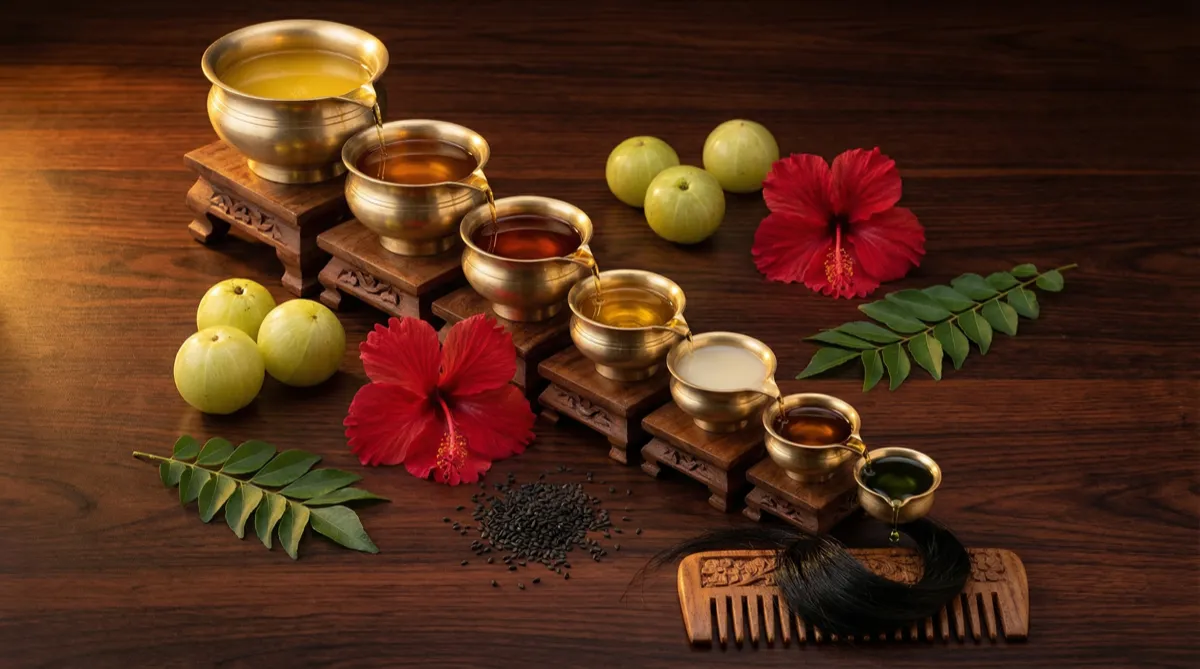
Imagine your body has a seven-stage water filtration system. Food enters at the top, and each stage refines the nutrients further, producing one tissue before passing the remainder to the next. Hair is produced at stage five. If the system is working well, plenty of nourishment flows all the way down. But if there is a blockage or weakness at stage one, two, or three — everything downstream runs dry. This is not just a metaphor. Charaka Samhita (Chikitsa Sthana 15.15-17) describes the seven Dhatus nourished in sequence: Rasa (plasma) → Rakta (blood) → Mamsa (muscle) → Meda (fat) → Asthi (bone) → Majja (marrow/nerve) → Shukra (reproductive tissue). Hair is produced as Mala of Asthi Dhatu, the fifth tissue. For hair to be healthy, nourishment must successfully pass through four preceding tissues first. If Agni (digestive fire) is weak at any level, the nourishment simply never arrives.
This sequential model explains something that baffles many people: why hair problems so often accompany other health issues that seem entirely unrelated. A person with chronic digestive weakness (Mandagni) will eventually show hair thinning — because the raw material for the entire tissue chain is inadequately processed at the very first stage. A person with anaemia or poor blood quality shows hair changes — because Rakta Dhatu, the second tissue, is compromised and everything downstream starves. A person with bone density concerns shows hair changes — because Asthi Dhatu itself is undernourished and cannot produce quality waste products. Modern medicine sees these as separate problems requiring separate specialists. Ayurveda sees them as different symptoms of the same upstream failure. The hair is the canary in the coal mine of your tissue nourishment chain. By the time hair problems become visible, the nourishment deficit has been building for months or years at deeper tissue levels.
Ama — the toxic residue of incomplete digestion — makes this situation worse by actively blocking the channels (Srotas) through which nutrients flow between tissues. Think of it as sediment clogging the pipes. Even if you eat excellent food, if Ama is present in the channels, the nutrients cannot reach their destination. This explains one of the most frustrating experiences people have: eating a balanced diet, taking supplements, and still losing hair. The supply is adequate but the delivery system is compromised. Charaka describes Ama in the Asthivaha Srotas (the channels feeding bone tissue) as a direct cause of both hair deterioration and bone weakness (Vimana Sthana 5.7-8). Ama in the scalp channels suffocates hair follicles, reducing their capacity to produce healthy hair regardless of what is applied externally.
The practical takeaway is clear: any serious approach to chronic hair problems must address Agni first. Without strong digestive fire, nothing you eat — no matter how nutrient-rich — will be properly converted into the tissue nourishment that eventually reaches hair. This is why Ayurvedic practitioners addressing hair concerns almost always begin with digestion, not the scalp. It sounds counterintuitive — you came in about your hair, and the practitioner wants to talk about your breakfast. But once you understand the seven-tissue cascade, it makes perfect sense. Fix the factory before worrying about the output.
Did You Know?
The average human hair follicle cycles between growth (Anagen), rest (Catagen), and shedding (Telogen) phases — and Ayurveda described this cycle thousands of years before modern science. Sushruta (Chikitsa Sthana 1.28-30) described how hair grows in phases governed by the interplay of Kapha (growth and structure), Pitta (metabolic transformation), and Vata (movement and shedding). Modern trichology did not formally identify the hair growth cycle until the 1920s, when researchers like Frederic Dry mapped the same three phases that Ayurveda had already attributed to three distinct biological forces. The parallel is striking: Kapha dominates anagen (growth), Pitta drives catagen (transition), and Vata governs telogen (shedding and release).
Scalp Care in Ayurveda: Shiro Abhyanga
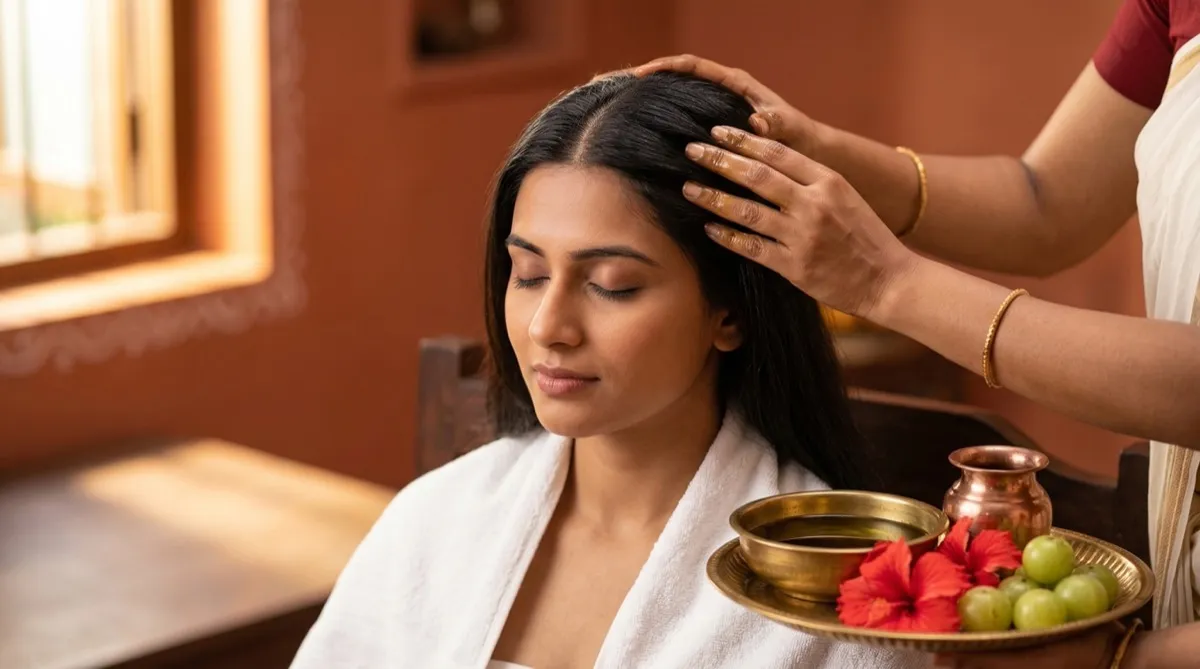
Your grandmother was right about oil. But probably not for the reasons she told you. Shiro Abhyanga (head oil massage) is listed as one of the essential Dinacharya (daily routine) practices in Ashtanga Hridaya (Sutra Sthana 2.24-25), where Vagbhata makes a remarkably specific claim: “Shirshabhyangat Kesha na Khalitya Palityam upajayate” — regular head oiling prevents hair fall and premature greying. He also lists prevention of headaches and promotion of sound sleep. This is not vague wellness advice. It is a precise clinical observation recorded in a systematic medical text, and the key word is “regular” — not occasional, not when you remember, not the night before washing. Consistent, daily or near-daily application is what the text prescribes.
The choice of oil matters and depends on the dosha pattern. For Pitta-type hair problems (greying, hot scalp, inflammation), coconut oil is traditionally preferred for its cooling properties — it directly counteracts the excess heat that damages hair follicles and melanocytes. For Vata-type hair problems (dryness, brittleness, diffuse thinning), sesame oil is the classical choice — it is warming, deeply penetrating, and heavy enough to counteract Vata’s dry, light qualities. For Kapha-type hair problems (oily scalp, congestion, sluggish growth), lighter applications with stimulating preparations are preferred. These oils are mentioned here as food-grade topical applications in the Dinacharya tradition, not as medicinal preparations — specific therapeutic oils are determined only through individual assessment by a practitioner.
The technique of application is as important as the oil itself. Warm oil — not hot, but comfortably warm — is gently massaged into the scalp using the fingertips in circular motions, starting from the crown and working outward. The massage stimulates blood flow to the scalp, nourishes the hair roots directly, and calms the nervous system through the dense network of nerve endings in the scalp. Vagbhata specifically notes that head massage calms Prana Vata, which governs sensory perception and mental activity — this is why many people find scalp oiling profoundly relaxing, often inducing deep sleep when done at night.
Overnight oiling works significantly better than quick pre-wash applications. The scalp has time to absorb the oil, the hair shaft is conditioned along its full length, and the calming effect on the nervous system operates through the entire night. The modern habit of applying oil for thirty minutes before shampooing misses most of the benefit. Classical texts describe leaving oil on overnight as the standard practice, with washing the following morning. This is one of those cases where the traditional method is both simpler and more effective than the modern shortcut, but it requires the willingness to sleep with oiled hair — a small inconvenience for a practice that has sustained hair health across generations.
Here is something that connects hair health to a much deeper principle of how the body works: the scalp has one of the highest concentrations of nerve endings of any surface area on the body — roughly 100,000 nerve fibres per square centimetre. In the yogic tradition, the crown of the head (Sahasrara) is considered the point where the body’s energy system meets the external world. When classical texts insist that head oiling calms the mind and promotes sleep, they are not making a vague wellness claim. They are describing the direct stimulation of a dense peripheral nerve network that feeds back into the central nervous system. Modern neuroscience calls this the trigeminovascular system — a nerve network connecting the scalp to the brainstem that plays a role in migraine, sleep regulation, and stress response. The ancients mapped the function correctly; the anatomy caught up later.
Did You Know?
A single strand of human hair is stronger than a copper wire of the same thickness. Hair can stretch up to 30% of its length when wet without breaking. Yet this remarkably strong material is made entirely from keratin — a protein that your body builds using the same amino acids required for bone matrix and nail growth. Ayurveda’s classification of hair and nails as Asthi Mala (bone byproducts) is not a coincidence — it reflects the genuine biochemical relationship between these tissues. When modern forensic scientists analyse a hair strand, they can detect nutritional status, heavy metal exposure, and even chronic stress markers going back months. Your hair is literally a historical record of your body’s internal environment — precisely what Ayurveda meant when it called hair a mirror of Dhatu health.
Diet and Lifestyle for Hair Health
Here is an uncomfortable truth: you cannot out-supplement a poor diet, and you cannot out-diet a broken routine. Because hair is a byproduct of Asthi Dhatu, foods that nourish bone tissue directly support hair health. Charaka Samhita (Sutra Sthana 5.12) and Sushruta both list milk, ghee, and sesame among the primary Asthi Dhatu nourishers — they provide the calcium, fat-soluble vitamins, and oleating quality that bone tissue requires. Modern nutritional science agrees: a 2019 review in Dermatologic Clinics confirmed that calcium, zinc, iron, and fat-soluble vitamins A, D, E, and K are all essential for the hair growth cycle, and deficiency in any one of them can independently cause hair loss. The Ayurvedic approach is simpler: instead of taking six different supplements, eat the foods that naturally contain all of these in bioavailable form. Our diet and lifestyle guide covers these Ayurvedic dietary principles in more practical detail.
What you avoid matters as much as what you eat. Excess spicy and sour food aggravates Pitta, and Pitta aggravation is the primary driver of premature greying and aggressive hair thinning. The person who eats heavily spiced food daily, drinks excessive coffee, and includes large amounts of sour foods (citrus, fermented items, vinegar-based preparations) is systematically feeding the dosha most destructive to hair. This does not mean eliminating these tastes entirely — all six tastes have their place in a balanced diet. It means recognising that a Pitta-aggravating diet will eventually show its effects in the hair, among other places. Reducing excess heat-generating food is one of the most effective dietary interventions for hair health, particularly for premature greying that runs in families with Pitta-predominant constitutions.
Sleep is a critical and often overlooked factor — and this is where modern research has produced a genuinely startling finding. During deep sleep, Tarpaka Kapha — the subdosha that nourishes the brain, nervous system, and by extension the scalp — does its most important work. A 2020 study published in the International Journal of Trichology found that participants sleeping less than six hours per night had significantly higher rates of hair loss compared to those sleeping seven or more hours, independent of other factors. Charaka (Sutra Sthana 21.36-40) describes Nidra (sleep) as one of the three pillars of life and states explicitly that sleep deprivation causes tissue depletion in descending order — with hair and skin deteriorating first. The person who sleeps five hours a night and wonders why their hair is falling is not connecting the dots that Ayurveda connected over two thousand years ago. For deeper understanding, see our article on stress and emotional wellness, which details the Tarpaka Kapha connection.
Stress is perhaps the single most common modern cause of hair fall, and Ayurveda explains the mechanism with remarkable precision. Stress aggravates Vata directly, and Vata aggravation disrupts the entire tissue nourishment cascade. The condition modern medicine calls telogen effluvium — diffuse hair shedding triggered by physical or emotional stress — is precisely what Ayurveda predicts when Vata is acutely aggravated. A landmark 2021 study in Nature identified the exact molecular pathway: stress hormone cortisol inhibits a signalling molecule called GAS6 in dermal papilla cells, which effectively tells hair follicle stem cells to stop regenerating. Ayurveda described this same outcome through its own framework — Vata, when aggravated by stress, withdraws Prana (life force) from peripheral tissues, and hair follicles, already last in line for nourishment, are the first to be abandoned. The body is essentially performing triage during stress, redirecting resources to survival functions. Hair is non-essential. It gets cut off first.
Iron-rich foods deserve special mention. Iron deficiency is one of the most common nutritional causes of hair fall worldwide, and Ayurveda recognised this connection through the framework of Rakta Dhatu (blood tissue). When Rakta is depleted or poor quality, every downstream tissue suffers. Green leafy vegetables, pomegranate, dates, jaggery, and black sesame are traditionally emphasised for blood building. The connection between gut health and hair is equally important — a compromised gut cannot absorb iron and other minerals effectively regardless of intake, which circles back to the central Ayurvedic principle: strong Agni is the foundation of all tissue health, including hair.
What Current Evidence Says
Nutritional deficiency studies consistently confirm the hair-nutrition link that Ayurveda has emphasised for millennia. A 2019 review published in Dermatology and Therapy found that deficiencies in iron, zinc, biotin, protein, and essential fatty acids are all associated with hair loss. The Ayurvedic framework of sequential tissue nourishment — where deficiency at any level affects all downstream tissues — is entirely consistent with these findings. The review noted that correcting nutritional deficiencies often improves hair outcomes without any scalp-specific intervention, supporting the Ayurvedic position that hair health begins in the gut.
Scalp massage has been studied in randomised controlled trials with encouraging results. A 2016 study published in ePlasty found that standardised scalp massage over 24 weeks resulted in increased hair thickness, with stretching forces during massage potentially activating dermal papilla cells and promoting hair growth signalling pathways. A 2019 survey study in Dermatology and Therapy reported that participants who practised daily scalp massage experienced self-reported improvements in hair density and thickness. While these studies are small, they provide initial evidence for what the Shiro Abhyanga tradition has maintained for thousands of years — that regular, systematic scalp manipulation supports hair health.
The stress-hair loss connection is well established in modern research. Telogen effluvium — diffuse hair shedding triggered by stress — has been documented extensively, with studies showing that psychological stress can push hair follicles prematurely from the growth phase into the resting and shedding phases. A 2021 study in Nature demonstrated specific molecular mechanisms by which stress hormones (corticosterone in mice, cortisol in humans) inhibit hair follicle stem cell activity. This parallels the Ayurvedic model where Vata aggravation (the doshic expression of stress) disrupts tissue nourishment and diverts resources away from non-essential functions like hair production. The emerging gut-skin-hair axis research further supports the Ayurvedic observation that digestive health, emotional state, and hair quality are interconnected through shared physiological pathways.
This article is for educational purposes only and does not constitute medical advice. Hair loss can have multiple causes, including medical conditions such as thyroid disorders, autoimmune conditions (alopecia areata), hormonal imbalances, and medication side effects. If you are experiencing sudden or severe hair loss, consult a qualified healthcare provider for proper evaluation. Ayurvedic consultation can be a meaningful complement to your care, but should not replace medical investigation of unexplained hair changes. Never stop prescribed medication without consulting your prescribing doctor.