
Why Skin Conditions Persist Despite External Treatment
Your skin condition keeps coming back because you keep treating the messenger instead of reading the message. Every cream, ointment, and steroid you have tried addresses the surface. Ayurveda says the surface is never the source.
Ayurveda’s answer is that the skin is not generating these conditions independently. The skin is the outermost expression of what is happening inside the body. Specifically, it is an expression of Rakta dhatu — the blood tissue. In the Ayurvedic tissue chain of seven dhatus, skin is classified as an Upadhatu (secondary tissue) of Rakta. When Rakta is healthy — properly formed, free of metabolic waste, and nourished by strong Agni — the skin reflects that health with clarity, resilience, and natural lustre. When Rakta becomes vitiated by accumulated Ama, excessive Pitta heat, or dosha disturbance, the skin becomes the messenger of that internal disruption.
Bhrajaka Pitta — The Fire That Lives in Your Skin
The concept of Bhrajaka Pitta is central here. Bhrajaka Pitta is the specific sub-type of Pitta that resides in the skin. Its function is to maintain skin complexion, temperature regulation, lustre, and the capacity to absorb and process what is applied externally. When Bhrajaka Pitta is balanced, the skin has a natural glow, wounds heal well, and the skin responds appropriately to oils, sunlight, and environmental changes. When Bhrajaka Pitta is disturbed — either through internal dosha imbalance, dietary factors, or accumulated toxins in Rakta — the skin becomes reactive. It may flush, break out, become hypersensitive, or develop chronic conditions that resist external treatment.
This is why Ayurveda insists on an inside-out approach. External applications may soothe symptoms temporarily, but unless the quality of Rakta dhatu is addressed and Bhrajaka Pitta is rebalanced from within, the skin will continue to express the internal disturbance. The surface is not the source. It is the messenger. And treating the messenger without reading the message is why so many skin conditions persist despite years of topical management.
The Srotas Framework — How Skin Conditions Travel Through the Body
To understand why skin conditions emerge where they do, and why they persist so stubbornly, Ayurveda turns to the concept of Srotas — the channel systems through which all nutrients, wastes, and dosha influences flow. The skin is not an isolated organ. It is the downstream endpoint of several interconnected channel systems, and understanding which Srotas are involved changes how the condition is read and addressed.
Rasavaha Srotas — the channels carrying Rasa dhatu (plasma and lymph) — is where skin conditions often originate. Rasa is the first dhatu formed after digestion. When Agni is weak, the Rasa produced is of poor quality, loaded with Ama. Since Rasa circulates everywhere, carrying nutrients to every tissue, vitiated Rasa delivers that Ama body-wide. The skin, being richly supplied with lymphatic and capillary networks, receives this contaminated Rasa directly. Charaka Samhita (Vimana Sthana 5) identifies the signs of Rasavaha Srotas disturbance: loss of appetite, nausea, heaviness, drowsiness, fever, and skin pallor. When patients present with chronic skin dullness, generalised itching without a clear local cause, or a tendency to develop rashes after eating, Rasavaha Srotas involvement is the first consideration.
Raktavaha Srotas — Where Chronic Skin Conditions Take Root
Raktavaha Srotas — the channels carrying Rakta dhatu (blood tissue) — is where most established skin conditions are seated. Charaka identifies the liver and spleen as the Moola (root) of Raktavaha Srotas. When these organs are overtaxed by Pitta-aggravating foods, alcohol, excessive spicy or fermented intake, or chronic anger and frustration, the Raktavaha channels become disturbed. The signs are unmistakable: skin conditions with redness, burning, inflammation, bleeding, darkening, and non-healing lesions. Charaka states (Sutra Sthana 24) that Raktavaha Srotas disturbance is characterised by Kushtha (skin disease), Visarpa (spreading eruptions), Pidika (pustules), and Raktapitta (bleeding disorders). This is why an Ayurvedic approach to chronic skin conditions almost always includes attention to liver function and blood tissue quality — the root of Raktavaha Srotas must be addressed for lasting change.
The clinical significance of the Srotas framework is that it reveals the pathway of disease progression. A skin condition does not appear suddenly from nowhere. It follows a traceable path: dosha aggravation disturbs Agni, weakened Agni produces Ama, Ama enters Rasavaha Srotas and then Raktavaha Srotas, and finally manifests through the skin as the body attempts to expel what it cannot process internally. Understanding which Srotas is primarily involved tells the practitioner where in this chain to intervene — and why topical treatment alone, which addresses only the endpoint, rarely produces lasting resolution.
The Ayurvedic Reasoning Chain — From Dosha to Skin
What distinguishes the Ayurvedic approach from a purely symptomatic one is its insistence on tracing every skin condition back through a specific reasoning chain. The chain runs: Dosha aggravation leads to Dhatu vitiation, which manifests through Srotas disturbance, which finally produces visible skin changes. Each step in this chain has diagnostic markers and intervention points. Missing any step produces an incomplete picture and a less effective approach.
Consider someone presenting with red, inflamed, burning skin eruptions. The surface symptom is inflammation. But the Ayurvedic reasoning proceeds backward: the burning and redness indicate Pitta dosha aggravation. Pitta’s primary site of accumulation is the small intestine and liver. Aggravated Pitta increases the heat quality in Rakta dhatu, producing what the texts call Rakta Dushti (blood vitiation). This vitiated blood flows through Raktavaha Srotas, and when it reaches the skin — where Bhrajaka Pitta resides — it produces inflammation, redness, and pustular eruptions. The full chain: Pitta aggravation (often dietary or emotional) → Rakta dhatu vitiation → Raktavaha Srotas disturbance → skin inflammation. Each link in this chain is addressable.
When the Chain Runs Through Vata — Dryness From the Inside Out
Now consider someone with dry, cracking, painful skin. The reasoning shifts: dryness and roughness indicate Vata dosha aggravation. Vata depletes moisture from all tissues sequentially through the dhatu chain. When Vata aggravation reaches Rasa dhatu (which nourishes skin moisture) and Rakta dhatu (which maintains skin colour and vitality), both become depleted. The Rasavaha and Raktavaha Srotas carry insufficient nourishment to the skin, which dries, cracks, and loses its resilience. The chain: Vata aggravation (stress, irregular routine, dry diet) → Rasa and Rakta depletion → Srotas under-nourishment → dry, cracking skin. The approach addresses each level.
This reasoning chain explains why two patients with identical-looking skin conditions may receive entirely different guidance. The surface presentation may match, but if one person’s chain runs through Pitta-Rakta-Raktavaha and another’s runs through Vata-Rasa-Rasavaha, the intervention logic differs at every level. This is why Ayurveda resists protocol-based approaches to skin conditions and insists on individual assessment. The chain must be read correctly before it can be addressed correctly.
Did You Know?
Charaka Samhita describes 13 major Srotas (channel systems) in the body, each with a specific Moola (root organ), Marga (pathway), and Mukha (opening). Skin conditions can involve up to four different Srotas simultaneously — Rasavaha, Raktavaha, Medovaha (fat channels), and Swedavaha (sweat channels) — which is why chronic skin conditions are considered among the most complex to address in classical Ayurveda, often requiring simultaneous multi-level intervention that topical treatment alone cannot achieve.
Here is something that connects skin health to a dimension most people never consider. The skin is the body’s largest organ — roughly 1.7 square metres in an adult — and it replaces itself entirely every 27 to 30 days. That means every month, you are wearing an entirely new skin. Yet chronic skin conditions persist for years in this constantly renewing organ. Why? Because the skin is not generating itself from nothing. It is being built, cell by cell, from the quality of blood tissue (Rakta dhatu) flowing through it. If the blood carries Ama and metabolic waste, every new skin cell is built with contaminated raw material. The building site is clean every month, but the supply truck keeps delivering the same impure bricks. This is why Ayurveda insists on addressing Rakta quality from within — the skin can only be as healthy as the blood that feeds it.
The Seven Layers of Skin — Sushruta’s Anatomical Map
Sushruta Samhita (Sharira Sthana 4) provides a remarkably detailed anatomical description of the skin as a seven-layered structure — Sapta Twak. This is not metaphorical. Sushruta describes each layer’s thickness (measured in units of a rice grain — Vrihi), its specific function, and the diseases that manifest when each layer is affected. Modern histology identifies distinct skin layers too — epidermis, dermis, and hypodermis with their sublayers — but Sushruta’s classification is clinically oriented, mapping each layer to specific conditions rather than just cellular composition.
The first layer, Avabhasini, is the outermost. Sushruta states it is extremely thin and reflects the person’s complexion and aura. Conditions affecting only this layer include minor discolouration and Padmakantaka (goosebumps-like eruptions). The second layer, Lohita, is where Tilakalaka (moles), Nyachha (birthmarks), and Vyanga (dark patches or melasma) are seated. The third, Shweta, is the site of conditions like Charmadala (contact dermatitis) and certain Kushtha types. The fourth layer, Tamra, is described as the seat of Kilasa and other spreading, pigment-altering conditions.
The Deeper Layers — Where Serious Conditions Reside
The deeper layers are where more serious conditions reside. The fifth layer, Vedini, is so named because it is the seat of sensation — pain, touch, and temperature perception are centred here. Kushtha affecting this layer is associated with significant pain and sensory disturbance. The sixth layer, Rohini, is the healing layer — wounds and deep ulcers that penetrate to this level take much longer to heal and often leave significant scarring. The seventh and deepest layer, Mamsadhara, holds the entire skin structure in place; conditions affecting this layer include deep abscesses (Vidradhi), Fistula (Bhagandara), and Arbuda (tumours).
The clinical relevance of this layered understanding is profound. A superficial skin condition affecting only the first or second layer has a fundamentally different prognosis and approach than one that has penetrated to the fourth or fifth layer. Classical texts explicitly state that conditions penetrating deeper layers are more difficult to address, require longer timelines, and involve deeper dhatu and dosha disturbances. This is why Ayurvedic assessment of skin conditions pays careful attention to the depth of involvement — not just the surface appearance, but how deep the condition has reached — because depth determines both the approach and the realistic timeline for improvement.
Kushtha — The Classical Taxonomy of Skin Conditions
Charaka Samhita, in Chikitsa Sthana Chapter 7 (the dedicated chapter on Kushtha), provides what may be the most systematic classification of skin conditions in any traditional medical system. The text classifies all Kushtha into two major categories: 7 Mahakushtha (major skin conditions) and 11 Kshudrakushtha (minor skin conditions) — 18 types in total. This is not an arbitrary grouping. The classification is based on the specific combination of doshas involved, the depth of tissue penetration, and the prognosis.
The 7 Mahakushtha represent the more severe, deep-seated conditions. They are: Kapala, Audumbara, Mandala, Rishyajihva, Pundarika, Sidhma, and Kakanaka. Each has a specific dosha combination, a characteristic appearance, and a defined level of tissue involvement. Charaka describes Kapala Kushtha as rough, dark, and thin like a broken earthen pot, with all three doshas involved but Vata predominant. Mandala Kushtha presents as circular, raised, whitish-red patches that are stable and defined — Kapha and Pitta predominant. The point is not the names themselves but the diagnostic precision: each Mahakushtha tells the practitioner exactly which doshas are driving the condition, how deep it has penetrated, and what course it is likely to follow.
The 11 Minor Types — Eczema, Psoriasis, and Their Classical Counterparts
The 11 Kshudrakushtha are considered relatively more manageable, though still significant. They include: Ekakushtha, Charmakushtha, Kitibha, Vipadika, Alasaka, Dadru, Charmadala, Pama, Visphota, Shataru, and Vicharchika. Some of these map recognisably to conditions modern dermatology identifies separately. Kitibha Kushtha, described as rough, dark, and hard patches resembling a scar, is often correlated with psoriasis presentations. Vicharchika, with its intense itching, oozing, and darkening, corresponds to what modern medicine calls eczema. Dadru, presenting as circular, itching, raised patches, maps to dermatophyte infections. But the Ayurvedic classification goes beyond surface appearance to include the dosha signature and the treatment logic, which means that even two cases of Kitibha may require different approaches if the underlying dosha pattern differs.
Charaka makes an important statement about the Nidana (causes) of all 18 Kushtha types. The causative factors are fundamentally the same across all types: Viruddha Ahara (incompatible foods), suppression of natural urges, excessive exercise after heavy meals, Panchakarma performed improperly, and the combined vitiation of all three doshas along with Rakta and skin. What determines which specific Kushtha manifests is the proportional involvement of each dosha and the specific Dhatus and Srotas affected. This means the root causes are shared, but the expression is individual — a central principle of Ayurvedic dermatology that continues to guide clinical practice.
The Three Dosha Patterns of Skin Conditions
Just as every person has a unique constitutional balance, every skin condition carries a specific dosha signature. Ayurveda does not see eczema as one disease, psoriasis as another, and acne as a third. It sees patterns of dosha involvement that cut across modern diagnostic categories. Two people with the same dermatological diagnosis may have fundamentally different dosha imbalances driving their condition — and therefore require fundamentally different approaches.
Vata-pattern skin conditions are characterised by dryness, roughness, cracking, and flaking. The skin may feel thin, tight, and uncomfortable. Fissures develop, particularly on the heels, palms, and around joints. There is often a pricking or tearing pain. The condition worsens in cold, dry, windy weather. Sleep disturbance and anxiety frequently accompany Vata skin conditions because Vata is simultaneously aggravated across multiple systems. In the classical literature, conditions described under the broad category of Kushtha that present with dryness, roughness, and pain are typically Vata-predominant. The nails may become brittle, and the scalp tends toward dry dandruff — fine, white flakes without much oiliness.
Pitta and Kapha Skin — Heat, Oil, and Stubborn Itching
Pitta-pattern skin conditions are defined by inflammation, redness, burning, and heat. The skin may be swollen, tender to touch, and prone to pustules. There is often a burning or stinging quality. Pitta skin conditions flare with heat exposure, sun, spicy food, alcohol, and emotional frustration. Yauvan Pidika — the classical term for inflamed eruptions, particularly in youth — is a Pitta-predominant presentation. The blood is overheated, Bhrajaka Pitta is aggravated, and the skin becomes a site of inflammatory expression. These conditions often leave marks or hyperpigmentation because Pitta’s heat affects melanin production. The scalp may show redness, irritation, and premature greying or thinning.
Kapha-pattern skin conditions present with oiliness, oozing, itching, and heaviness. The skin may feel thick, swollen, or waterlogged. There may be whitish or pale discolouration. Itching is often the dominant symptom — persistent, maddening itching that worsens with scratching. Vicharchika, described in classical texts as a condition involving intense itching with discharge, eruptions, and darkening of the skin, is a Kapha-predominant presentation often complicated by Vata involvement. Kapha skin conditions worsen in damp, cold weather and with heavy, oily, sweet dietary patterns. They tend to be chronic and stubborn because Kapha by nature is stable, heavy, and resistant to change. The scalp produces excess sebum, leading to oily dandruff — thick, yellowish, sticky flakes.
In practice, most chronic skin conditions involve more than one dosha. A condition may begin as Pitta inflammation and evolve into a Vata-Pitta presentation with both redness and dryness. Or a Kapha-Vata pattern may present with both oozing and cracking at different sites or different phases. The practitioner must read the current dosha picture accurately, because the approach for a Pitta-predominant presentation differs significantly from one that has shifted to a Vata-predominant phase — even if the dermatological diagnosis remains unchanged throughout.
Vata Skin
Dry, thin, cool
- Prone to roughness, fine lines, and dullness
- Flaky scalp and brittle hair
- Worsens in cold, dry weather
Pitta Skin
Warm, sensitive, fair/reddish
- Prone to inflammation, rashes, and acne
- Oily scalp, premature greying
- Worsens in heat and sun exposure
Kapha Skin
Thick, oily, cool
- Prone to congestion, cystic acne, excess oil
- Thick hair, dandruff
- Worsens in damp, cold weather
Did You Know?
Charaka Samhita (Chikitsa 7) states that all 18 types of Kushtha share one root cause: the simultaneous vitiation of all three doshas plus Rakta and the skin tissue. The difference between mild Kshudrakushtha and severe Mahakushtha is not a different disease — it is the same process at different depths. This means Ayurveda recognised 2,000 years ago what modern dermatology is still debating: that conditions like eczema, psoriasis, and dermatitis may share common immunological origins and differ primarily in depth and dosha proportionality, not in fundamental mechanism.
Hair Fall and Scalp Health — The Asthi Dhatu Connection
Hair fall is one of the most distressing concerns people bring to an Ayurvedic practitioner, and Ayurveda’s understanding of it is both specific and counterintuitive. The hair, in Ayurvedic physiology, is not primarily connected to the skin or the blood. It is classified as a Mala (metabolic by-product) of Asthi dhatu — bone tissue. This means the health, thickness, and longevity of hair directly reflects the quality and nourishment of the skeletal system.
This connection explains patterns that modern dermatology documents but does not always explain. Why do women with osteoporosis frequently experience hair thinning? Why does chronic calcium deficiency correlate with brittle hair? Why do conditions that deplete bone minerals often coincide with hair loss? In Ayurvedic terms, hair and bone share the same metabolic source. When Asthi dhatu is well nourished — when Asthi Dhatvagni (the tissue-level metabolic fire of bone) functions properly — the hair grows strong, thick, and retains its colour. When Asthi dhatu is depleted, the hair suffers as a downstream consequence.
Khalitya and Palitya — The Classical Mechanics of Hair Loss and Greying
The classical terms are precise. Khalitya refers to hair fall — the loss of hair from the scalp. Sushruta describes it as a condition where aggravated Pitta, along with Vata, enters the Romakoopa (hair follicles), weakens the hair root, and causes the hair to fall. Simultaneously, Kapha along with Rakta obstructs the follicle, preventing new hair from growing. This dual mechanism — weakening of existing hair and obstruction of new growth — explains why hair fall often progresses if only one aspect is addressed.
Palitya refers to premature greying. It is understood as a consequence of excess Pitta heat at the hair root, which depletes the natural pigment. The classical texts connect premature greying to excessive anger, sun exposure, and Pitta-aggravating dietary patterns — observations that align with what modern trichology is beginning to document about oxidative stress and melanocyte damage.
Vata plays a particularly important role in hair health. Excessive Vata — from stress, irregular routines, inadequate sleep, excessive travel, or a diet that aggravates Vata — dries the scalp, depletes the nourishing oils that maintain hair strength, and disrupts the blood supply to the follicles. Many people experiencing sudden or accelerated hair fall can trace it to a period of intense stress, sleep deprivation, or major life disruption — all of which are Vata-aggravating in Ayurvedic terms. Addressing the scalp alone, without correcting the underlying Vata aggravation and nourishing Asthi dhatu, produces only temporary results.
Agni, Ama, and the Gut-Skin Connection
Modern dermatology is increasingly recognising what Ayurveda has stated for millennia: the gut and the skin are deeply connected. Researchers now speak of the “gut-skin axis” — the bidirectional relationship between intestinal health and skin conditions. Ayurveda mapped this connection in precise mechanistic terms thousands of years ago.
The mechanism follows a clear chain. Mandagni — weak or irregular digestive fire — fails to fully process food. The incompletely digested material produces Ama, a toxic, sticky metabolic residue. This Ama enters Rasa dhatu (plasma) and from there contaminates Rakta dhatu (blood). When Rakta becomes loaded with Ama, the condition is called Rakta Dushti — vitiation of the blood tissue. Since the skin is a direct expression of Rakta, vitiated blood manifests as skin conditions. The sequence is clear: Mandagni → Ama → Rakta Dushti → skin manifestation.
Viruddha Ahara — The Foods That Quietly Poison the Blood
Charaka Samhita describes this connection explicitly in the chapters on Kushtha. Impaired Agni and the accumulation of Ama are listed among the primary Nidanas (causative factors) for skin disease. The text identifies specific dietary and behavioural causes that damage Agni and lead to Rakta Dushti: consuming incompatible food combinations, eating before the previous meal is digested, suppressing natural urges, excessive consumption of sour, salty, and pungent foods, and prolonged emotional disturbance. These causes weaken Agni, generate Ama, contaminate the blood, and eventually express through the skin.
The concept of Viruddha Ahara — incompatible food combinations — deserves particular attention in the context of skin health. Charaka specifically identifies combinations that are inherently difficult for Agni to process and that have a special affinity for vitiating Rakta: fish with milk, fruit with meals, honey heated above a certain temperature, sour substances with milk, and several others documented in classical texts. These combinations do not necessarily cause acute illness. Instead, they produce a slow, chronic Ama accumulation that gradually vitiates Rakta over months and years. Many people with persistent skin conditions discover, upon careful dietary inquiry, that they regularly consume combinations classified as Viruddha Ahara.
This is why an Ayurvedic approach to skin conditions always addresses digestion first. It is not a roundabout strategy. It is addressing the source of the chain. If Agni remains weak and Ama continues to be produced, any improvement achieved through external applications or even internal formulations will be temporary, because Rakta dhatu is being continuously re-contaminated from within. Correcting Agni stops the production of new Ama at its source.
Did You Know?
Charaka Samhita lists Viruddha Ahara (incompatible food combinations) as a primary cause of Kushtha — and provides over 18 specific categories of food incompatibility. One example: fish with milk. Modern immunology research has found that certain food protein combinations can trigger cross-reactive immune responses and intestinal permeability changes that manifest as skin inflammation. What Charaka mapped through clinical observation of dietary patterns, molecular immunology is now beginning to explain through IgE cross-reactivity and tight-junction disruption.
What a Consultation Involves
An Ayurvedic consultation for skin or scalp concerns is more comprehensive than most people expect. It begins well before the skin itself is discussed, because the practitioner needs to understand the terrain — the constitutional background, the digestive capacity, and the lifestyle factors that have created the conditions for the skin to express disturbance.
Prakriti assessment establishes the constitutional baseline. A person with a Pitta-predominant constitution has an inherent tendency toward heat-related skin conditions. A Vata-predominant person is constitutionally prone to dryness and cracking. A Kapha-predominant person may tend toward oily, congested skin. Knowing the Prakriti tells the practitioner what the body is naturally inclined toward, and helps distinguish between constitutional tendencies and acquired imbalances that need correction.
The Dietary Detective Work Most People Never Expect
Dietary inquiry goes into detail that may seem unrelated to the skin but is not. What is eaten, when, how frequently, in what combinations. The practitioner looks specifically for Viruddha Ahara (incompatible food combinations), eating patterns that weaken Agni (late-night eating, eating when not hungry, excessive cold or raw food), and dietary habits that directly aggravate Rakta (excess sour, salty, fermented, or fried food). Many chronic skin conditions have a significant dietary component that becomes visible only through this kind of systematic inquiry.
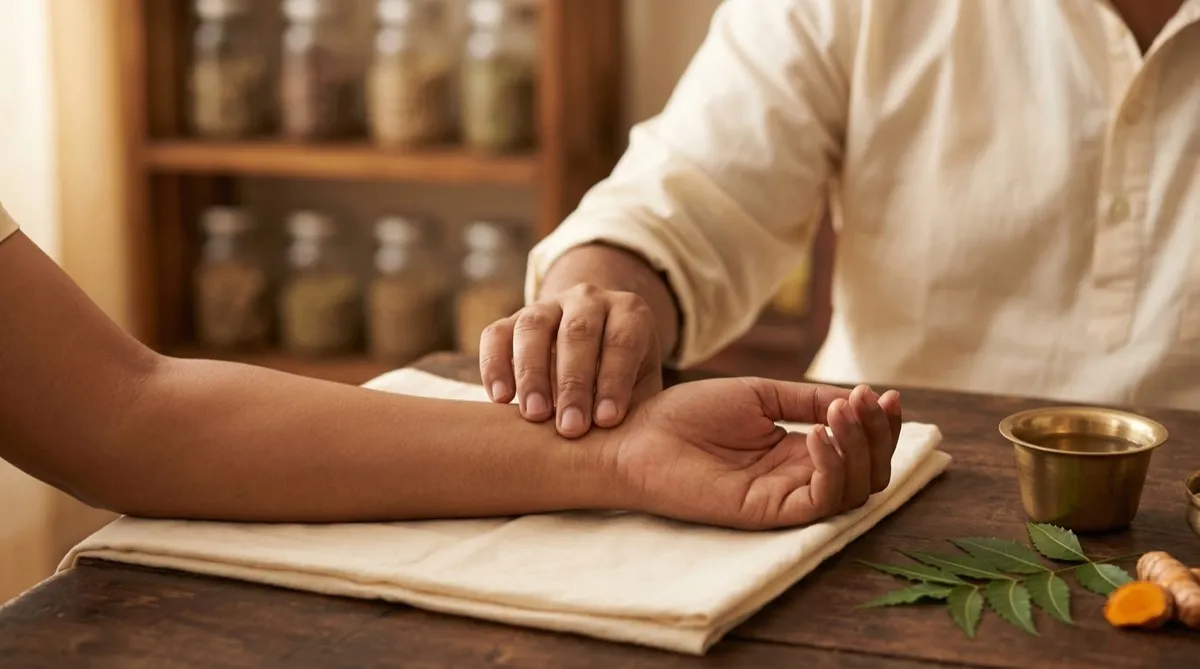
Pulse and tongue assessment provide direct information about the current state of Agni, the level of Ama in the system, and which doshas are aggravated. Nadi Pariksha (pulse assessment) in experienced hands can indicate Rakta Dushti and the degree of Pitta involvement. The tongue reveals digestive capacity, Ama coating, and organ-level involvement. These traditional assessment methods offer a functional picture that complements any dermatological findings the person may bring.
The Phased Approach and Realistic Timelines
Based on the assessment, guidance typically involves formulations from categories appropriate to the individual pattern — kashayam, churnam, tailam, lehyam, or ghritam — selected specifically for that person’s constitution, dosha picture, and the nature of the condition. External applications may also be recommended, but always as complements to internal correction, never as the sole approach. Dietary modifications are invariably part of the plan, because without correcting the dietary causes of Ama and Rakta Dushti, formulations alone have limited lasting impact.
The timeline for skin and scalp conditions requires honest conversation. Chronic conditions that have been present for years do not resolve in weeks. The approach typically works in phases: Agni correction and Ama reduction first, followed by Rakta purification, followed by sustained dosha balancing. Visible changes may begin within weeks for some conditions, but full stabilisation often takes several months. Hair-related concerns generally take longer because hair growth cycles operate on a timeline of months, and changes in Asthi dhatu nourishment take time to express through new growth. To learn more about our approach, visit the skin and scalp consultation page.
When to Work With Both Systems
Ayurvedic guidance for skin and scalp conditions works alongside dermatological care, not instead of it. There are situations where dermatological evaluation is not optional — it is necessary, and an ethical Ayurvedic practitioner will recognise them.
Dermatologist referral is the priority when a skin lesion changes shape, colour, or size unexpectedly and requires biopsy to rule out serious conditions. Any non-healing ulcer, rapidly spreading rash, or condition with systemic symptoms — fever, joint pain, significant weight loss — needs dermatological or medical assessment first. These situations require diagnostic tools that only a clinical setting can provide.
Where the Inside-Out Approach Adds Value Alongside Dermatology
Severe bacterial or fungal infections require antimicrobial treatment. Autoimmune skin conditions — where the immune system attacks the body’s own tissues — require proper diagnosis, monitoring, and often immunomodulatory therapy that only a dermatologist can manage. In these cases, addressing the acute condition medically while simultaneously working on the underlying dosha and dhatu imbalances through Ayurvedic guidance is the responsible approach.
Where Ayurvedic guidance adds particular value is in chronic, recurring conditions that dermatological treatment manages but does not resolve. When someone has been on steroid creams for years, or when a condition keeps returning after each course of treatment, the inside-out approach — addressing Agni, Ama, Rakta dhatu quality, and constitutional dosha balance — can work alongside dermatological care to address the systemic patterns that external treatment alone does not reach. The dermatologist provides diagnostic clarity and acute management. The Ayurvedic approach addresses the terrain that keeps producing the condition.
Did You Know?
Sushruta described the skin as having exactly seven layers, each with a specific thickness measured in Vrihi (rice grain units) and each associated with specific conditions. Modern histology identifies the stratum corneum, stratum lucidum, stratum granulosum, stratum spinosum, stratum basale, dermis, and hypodermis — also seven distinct functional layers. The correspondence is striking: Sushruta’s first layer (Avabhasini) handles complexion like the stratum corneum handles light reflection; his sixth layer (Rohini) is the healing layer, corresponding to the dermal layer where wound repair occurs. He mapped this without microscopy, using only clinical observation of wound depth and healing patterns.
What Current Evidence Says
The Central Council for Research in Ayurvedic Sciences (CCRAS), under the Ministry of Ayush, has conducted clinical studies on Ayurvedic approaches to various skin conditions including Kushtha and Vicharchika. Published findings document improvements in symptom scores using classical formulations, though the council acknowledges the need for larger, multicentre trials with standardised outcome measures to strengthen the evidence base.
The WHO Traditional Medicine Strategy 2014–2023 recognised traditional medicine systems including Ayurveda as significant healthcare resources, particularly for chronic conditions. The strategy emphasised evidence-based integration of traditional practices alongside conventional care, noting that traditional medicine often addresses aspects of health and wellbeing that conventional approaches may not fully cover.
The NCCIH (National Center for Complementary and Integrative Health) notes that some traditional approaches used for skin conditions show preliminary promise in research settings, while emphasising that the evidence remains insufficient for definitive efficacy claims. The gut-skin axis — a concept central to the Ayurvedic understanding of skin health — is increasingly validated by modern microbiome research, though the specific Ayurvedic mechanisms and interventions require further rigorous study.
This article is for educational purposes only and does not constitute medical advice. Skin and scalp conditions can have various underlying causes, including conditions that require dermatological evaluation and diagnosis. Do not self-prescribe herbal preparations, discontinue prescribed medication, or delay medical evaluation based on this article. Any Ayurvedic formulations should only be taken under the guidance of a qualified practitioner who has assessed your individual constitution, current condition, and health history. If you notice any skin lesion that changes rapidly, does not heal, or is accompanied by systemic symptoms, seek medical attention promptly. Always inform both your dermatologist and your Ayurvedic practitioner about all treatments you are receiving.