

Manas in Ayurveda: The Mind Is Not Separate from the Body
Modern medicine draws a line between physical and mental health. You see a doctor for your body and a therapist for your mind, as though these are two independent systems that happen to share the same address. Ayurveda never made this division. In the classical texts, Manas — the mind — is not a separate domain. It is one of the seats of disease, equal in clinical importance to any organ or tissue. Charaka Samhita (Sharira Sthana, Chapter 1) describes the mind and body as inseparable — two aspects of a single living system that cannot be understood or treated in isolation.
This inseparability has practical consequences. A disturbance in the mind always manifests in the body. A disturbance in the body always affects the mind. Chronic anxiety does not just make you feel worried — it dries out tissues, disrupts digestion, and weakens immunity through specific doshic pathways. Chronic indigestion does not just cause physical discomfort — it clouds thinking, destabilises mood, and reduces emotional resilience through the accumulation of Ama in mental channels. Ayurveda saw these connections not as interesting correlations but as direct cause-and-effect relationships operating through identifiable physiological mechanisms.
The framework for understanding mental health rests on three fundamental qualities of the mind, called the Triguna: Sattva, Rajas, and Tamas. Sattva represents clarity, balance, awareness, and the capacity for calm discernment. Rajas represents activity, agitation, restlessness, and the drive that becomes anxiety when unchecked. Tamas represents inertia, heaviness, dullness, and the stagnation that becomes depression when it predominates. Every person has all three qualities, but their relative proportion determines mental and emotional tendencies.
Stress, in Ayurvedic terms, is a state of Rajasic predominance — the mind moving too fast, too reactively, unable to settle. Depression is Tamasic predominance — the mind too heavy, too withdrawn, unable to engage. The balanced state — Sattva — is not the absence of stress or sadness, but the capacity to experience life’s full range of emotions without being destabilised by them. This is not philosophical abstraction. It is a clinical framework that determines how a practitioner assesses and addresses mental health concerns.
The channels through which these mental processes flow are called Manovaha Srotas — the channels that carry thought, emotion, and consciousness. Just as Annavaha Srotas carry food and Raktavaha Srotas carry blood, Manovaha Srotas carry the substance of mental life. When these channels are clear, thinking is sharp, emotions flow and resolve naturally, and the mind recovers quickly from stress. When they are blocked — by Ama, by doshic aggravation, by chronic overstimulation — the result is exactly what we recognise as mental health disturbance: persistent anxiety, emotional numbness, inability to focus, mood swings, and the feeling that the mind is no longer under your own direction.
Prana Vata and Sadhaka Pitta: The Doshas That Govern Your Inner World
If Manovaha Srotas are the channels, then the forces flowing through them are the subdoshas — and two in particular determine the quality of your emotional life more than any other factor. Understanding these two subdoshas transforms how you think about stress, anxiety, and emotional resilience.
Prana Vata is a subdosha of Vata seated in the head, moving through the chest. It governs sensory perception, mental processing, and emotional response. Every thought you have, every sensory input you receive, every emotional reaction you experience — all are functions of Prana Vata. When Prana Vata is balanced, you perceive clearly, think coherently, respond proportionally to situations, and can be present in the moment. When Prana Vata is disturbed, the picture changes dramatically: racing thoughts, scattered attention, anxiety that seems to have no specific cause, an inability to be present, hypersensitivity to stimuli, and the constant feeling of being overwhelmed even by ordinary demands.
Sadhaka Pitta is a subdosha of Pitta seated in the heart. Its name comes from Sadhana — meaning fulfilment, accomplishment, or the capacity to process and complete. Sadhaka Pitta governs emotional processing, intelligence, courage, and contentment. It is what allows you to experience an emotion, process it fully, and move forward without carrying its residue. When Sadhaka Pitta is balanced, you have emotional clarity, intellectual sharpness, natural courage in facing difficulties, and a baseline sense of contentment that does not depend on external circumstances. When Sadhaka Pitta is disturbed, the presentation is unmistakable: irritability that seems disproportionate, anger that flares quickly, perfectionism that becomes paralysing, emotional intensity that exhausts both you and the people around you, and eventually burnout — the state where Sadhaka Pitta has consumed itself through its own excess.
There is a third player that completes the picture: Tarpaka Kapha. This subdosha of Kapha nourishes the brain and nervous system, providing the stability, moisture, and insulation that the nervous system needs to function without becoming overstimulated. Think of Tarpaka Kapha as the shock absorber of your emotional life. When it is adequate, you can handle stress, absorb emotional impact, and recover. When Tarpaka Kapha is depleted — typically by chronic Vata or Pitta aggravation drying it out — emotional resilience drops precipitously. Things that would not have bothered you begin to feel unbearable. The nervous system becomes raw, reactive, and fragile.
Did You Know?
The concept of Prana Vata governing both breath and thought is why Pranayama (breathing practices) directly affects emotional state — not as a relaxation technique, but as a direct intervention on the subdosha that connects breathing to thinking. When you slow your breath, you are not just calming down. You are directly regulating the force that governs sensory processing, mental activity, and emotional response. This is why Pranayama has measurable effects on anxiety, focus, and emotional regulation — it is working on the same physiological force that produces all three.

Here is a fact that rewires how you think about emotions: your gut produces approximately 90% of the serotonin in your body — the molecule most associated with feelings of happiness and emotional stability. Your intestines contain roughly 500 million neurons — more than your spinal cord. The yogic and Ayurvedic traditions never considered the abdomen just a food-processing unit. They mapped it as Manipura — the seat of personal power, confidence, and emotional fire. When Ayurveda says that disturbed Agni (digestive fire) causes mental fog, anxiety, and emotional dullness, it is not speaking metaphorically. The enteric nervous system in your gut is literally a second brain, and its health directly determines your emotional baseline. Every time you eat under stress, skip a meal, or consume food that disrupts your gut, you are altering the chemistry of your emotional experience.
Why Modern Stress Is an Ayurvedic Emergency
Modern life, viewed through the Ayurvedic lens, is a near-perfect storm for Vata aggravation. Constant digital stimulation. Irregular eating and sleeping schedules. Processed and cold food consumed hastily. Excessive screen time that overloads Prana Vata without respite. Reduced physical activity. Artificial lighting that disrupts circadian rhythms. Social media that creates a state of perpetual comparison and low-grade emotional activation. Each of these individually aggravates Vata. Together, they create a degree of Vata disturbance that would have been almost impossible in any previous era of human life.
Vata controls the entire nervous system. When it is aggravated, the first casualties are always the same: anxiety, insomnia, restlessness, scattered thinking, and a pervasive sense of being unsettled. These are not personality traits or character weaknesses. They are the predictable symptoms of a specific doshic imbalance that modern life systematically creates. The epidemic of anxiety disorders in developed nations is, from an Ayurvedic perspective, entirely predictable — it is what happens when an entire civilisation lives in a way that maximally aggravates the dosha governing the nervous system.
But it does not stop at Vata. Chronic stress also aggravates Pitta. The competitive pressures of modern work, the constant performance evaluation, the information overload that demands continuous processing — these all feed Sadhaka Pitta until it runs hot. The result is the progression that millions of working adults experience: initial anxiety (Vata) evolving into irritability and anger (Pitta) and eventually reaching burnout and emotional shutdown (Pitta exhaustion leading to Tamas). This three-stage progression — anxiety, anger, collapse — maps precisely onto what Ayurveda would predict when Vata aggravation triggers secondary Pitta aggravation that eventually depletes Ojas.
Ojas — the finest product of digestion and tissue nourishment, the substance that sustains immunity, mental stability, and emotional resilience — is depleted by chronic stress through multiple pathways. Poor sleep (common in stress) prevents the tissue nourishment cascade from completing. Weak Agni (common when eating under stress) reduces the raw material from which Ojas is produced. Excessive sensory and emotional expenditure (the hallmark of modern life) consumes Ojas faster than it can be replenished. The result is what Ayurveda calls Ojakshaya — Ojas depletion — manifesting as lowered immunity, emotional numbness, chronic fatigue, and the feeling of being empty or burnt out.
The Ayurvedic understanding explains something that conventional stress management often cannot: why stress affects different people so differently. A Vata-predominant person exposed to chronic stress develops anxiety, insomnia, and weight loss. A Pitta-predominant person develops irritability, inflammatory conditions, and acid reflux. A Kapha-predominant person develops emotional withdrawal, weight gain, and depression. Same stress, different manifestations — because the stress is interacting with a different constitutional baseline. This is why generic stress advice (“meditate more, exercise more”) works for some people and fails others. The approach must match the Prakriti.
Did You Know?
Charaka Samhita describes 80 Vata disorders (Nanatmaja Vata Vikara) — more than any other dosha. Of these, over 40 involve the mind or nervous system: anxiety, fear, insomnia, tremors, confusion, delirium. No other dosha comes close. This is why Vata management is the single most important factor in mental health from an Ayurvedic perspective — and why modern life, which maximally aggravates Vata, has produced an epidemic of precisely these conditions.
There is another dimension to the mind-body connection that rarely appears in stress articles: sound. The human body is roughly 70% water, and water responds to vibration at a molecular level. The Vedic tradition used specific mantras and sound frequencies not as religious ritual but as precise vibrational interventions on the nervous system. Modern cymatics — the study of how sound shapes matter — shows that different frequencies create distinctly different geometric patterns in water. When traditional practices prescribe specific sounds or chanting for mental calm, they are working with the physics of how vibration affects a body that is mostly water. Your nervous system does not just hear sound — it is shaped by it.
Sattvic Ahara: Why What You Eat Changes How You Think
Ayurveda makes a claim that sounds radical to modern ears but is increasingly supported by gut-brain axis research: the food you eat directly affects the quality of your thoughts and emotions. This is not a loose metaphorical connection. The classical texts describe specific mechanisms through which food influences mental state through its effect on the three Gunas — Sattva, Rajas, and Tamas.
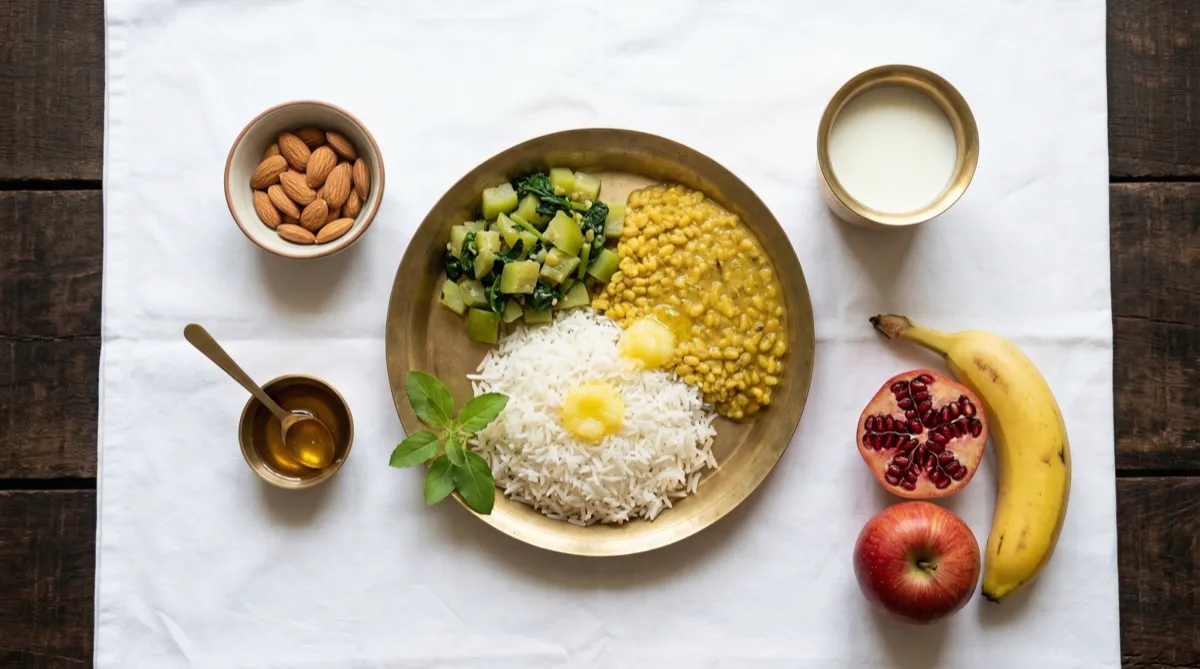
Sattvic foods promote mental clarity, emotional balance, and the capacity for calm awareness. These are foods that are fresh, seasonal, warm, properly cooked, and eaten mindfully — fresh vegetables, whole grains, milk, ghee, ripe fruits, and foods prepared with care and attention. The emphasis is not on specific ingredients but on qualities: freshness, digestibility, warmth, and the circumstances of eating. A simple meal of rice, dal, and vegetables, eaten warm and in a calm state, is profoundly Sattvic. The same ingredients, reheated from yesterday and eaten while scrolling through your phone, lose their Sattvic quality.
Rajasic foods increase mental agitation, restlessness, and emotional reactivity. These include overly spicy foods, excessive caffeine, heavily stimulating preparations, food eaten too quickly or in too large a quantity, and anything consumed in a state of hurry or emotional disturbance. The connection is direct: Rajasic food aggravates Rajas in the mind, increasing the very quality that manifests as stress, anxiety, and an inability to be still. The person who drinks five cups of coffee, eats spicy takeaway food, and then wonders why they cannot relax in the evening is experiencing a Rajasic food-mind loop that Ayurveda described thousands of years ago.
Tamasic foods promote mental dullness, lethargy, and emotional heaviness. Stale food, processed food, reheated leftovers, food that has lost its vitality, excessive amounts of heavy or fried preparations — these increase Tamas in the mind, leading to the sluggish, unmotivated, foggy state that many people experience but attribute to tiredness or personality. Charaka is explicit: the food you eat becomes the substance of your mind. If you feed the mind Tamasic material, it produces Tamasic thinking.
Specific guidance for emotional wellness includes: warm milk with a small amount of spice (nutmeg, cardamom) at night to calm Vata and promote Sattva; regular use of ghee in cooking, which nourishes Sadhaka Pitta and supports emotional processing; fresh seasonal fruits eaten between meals; and most importantly — never eating while stressed, rushed, or emotionally disturbed. The state in which you eat is as important as what you eat. This is not dietary restriction. It is choosing food that supports mental clarity rather than undermining it.
Did You Know?
The Ayurvedic principle that “the state in which you eat matters as much as what you eat” has a modern parallel: studies show that eating while distracted increases caloric intake by 10–25% and reduces nutrient absorption. Stress hormones active during rushed eating literally suppress digestive enzyme production. Charaka called this Mithya Ahara Vidhi (improper eating conduct) — a specific cause of disease, not merely a lifestyle suggestion.
Dinacharya and Lifestyle: The Foundation of Emotional Resilience
Of all the factors that contribute to emotional resilience, daily routine — Dinacharya — is the one most consistently emphasised across all classical Ayurvedic texts. The reason is simple and profound: Vata is the dosha most disturbed by irregularity, and Vata governs the entire nervous system. A person living without routine is, by definition, aggravating the dosha that controls their capacity to handle stress. Regular routine is not a lifestyle preference. For the nervous system, it is medicine.
The key practices are not complicated, but they are non-negotiable in their consistency. Consistent wake and sleep times — even on weekends — create a stable circadian foundation that Vata can organise around. Morning Abhyanga (self-massage with warm oil) is one of the most powerful anti-Vata practices available. Oil is heavy, warm, and stable — the exact opposite of Vata’s qualities. Applied to the skin (the seat of Vata), it directly counteracts the dry, cold, mobile qualities that drive anxiety and overstimulation. Pranayama in the morning regulates Prana Vata at the start of the day, setting a calm baseline that makes the nervous system less reactive to whatever follows. Gentle exercise — walking, yoga, swimming — moves Vata in a controlled, grounding way rather than the scattered movement that comes from sedentary days punctuated by intense bursts.
The evening routine is equally important. A warm, easily digestible meal eaten early — ideally before 7 PM — supports Agni and prevents the Ama formation that clouds mental channels. Oil applied to the soles of the feet before bed (Padabhyanga) calms Vata through the nerve-rich soles and signals the nervous system that the active phase of the day is ending. Reduced screen time in the final hour before sleep protects Prana Vata from the overstimulation that modern devices deliver directly to the senses.
The cumulative effect of Dinacharya is not merely “feeling better.” It is a systematic reduction of the doshic aggravation that drives emotional instability. A person following a consistent daily routine has lower baseline Vata, better-nourished Tarpaka Kapha, and more efficient Sadhaka Pitta processing. Their nervous system is not starting each day from a state of depletion. It is starting from a state of stability — and that stability is the foundation upon which genuine emotional resilience is built. For a detailed guide to building a daily routine, see our article on Dinacharya.
What Current Evidence Says
The gut-brain axis — a major focus of contemporary neuroscience — validates the Ayurvedic observation that food directly affects mental state. Research published in the Annals of General Psychiatry (2020) demonstrates that dietary patterns influence anxiety and depression through microbiome-mediated neurotransmitter production, including serotonin (90% of which is produced in the gut). The Ayurvedic emphasis on Sattvic food supporting mental clarity is consistent with this growing body of evidence.
Studies on meditation and Pranayama consistently show measurable reductions in cortisol, the primary stress hormone. A 2022 systematic review in the International Journal of Yoga found that regular Pranayama practice significantly reduced both state and trait anxiety, with effects comparable to some first-line pharmacological interventions. The NCCIH (National Center for Complementary and Integrative Health) under NIH lists yoga and meditation among evidence-based practices for stress management.
Classical Ayurvedic herbs traditionally used for Manas (mind) support have been studied for anxiolytic properties. Systematic reviews in the Journal of Clinical Medicine and Phytomedicine have identified several traditional Rasayana preparations with measurable effects on cortisol levels, anxiety scores, and sleep quality. While the NCCIH notes that more large-scale research is needed, the direction of evidence is consistent with traditional Ayurvedic observations about the nervous system-supporting properties of these classical formulation categories.
This article is for educational purposes only and does not constitute medical advice. If you are experiencing persistent stress, anxiety, or emotional difficulties, consult a qualified healthcare provider. Ayurvedic consultation can be a meaningful complement to your care, but should not replace medical or psychological evaluation — particularly for conditions such as clinical depression, anxiety disorders, PTSD, or any situation involving thoughts of self-harm. Never stop prescribed medication without consulting your prescribing doctor.