
Why Men’s Health Deserves Its Own Framework
Your energy, your stamina, your mental clarity, your sexual health, and how fast you age — Ayurveda traces all of them to a single tissue that sits at the very end of a seven-stage metabolic chain. If that chain breaks anywhere, the last tissue suffers first. Most men have no idea this is happening.
Vajikarana encompasses the full spectrum of male vitality: the capacity for sustained physical effort, the clarity and stability of the mind, emotional resilience, reproductive quality, and the ability to age with strength rather than decline. Charaka describes it in Chikitsa Sthana (Chapter 2) as essential for progeny, happiness, and the maintenance of Ojas — the subtle essence of all tissues that sustains immunity, strength, and life itself. The chapter does not read like a narrow specialty. It reads like a comprehensive framework for what it means for a man to be well.
Vagbhata’s Ashtanga Hridaya also addresses Vajikarana in its Uttarasthana, reinforcing that this was not a concern of one school alone but a consistent priority across the major classical traditions.
Why does this matter today? Because modern men’s health operates largely in crisis mode. A man visits a doctor when something has already failed — when energy is depleted, when prostate symptoms have become disruptive, when sexual function has declined, or when stress has tipped into anxiety or depression. The idea of actively maintaining vitality before problems appear is foreign to most conventional frameworks. Vajikarana operates on precisely this principle: sustain the upstream conditions that produce vitality, and the downstream expressions of health take care of themselves.
Shukra Dhatu — The Seventh Tissue and Why It Matters
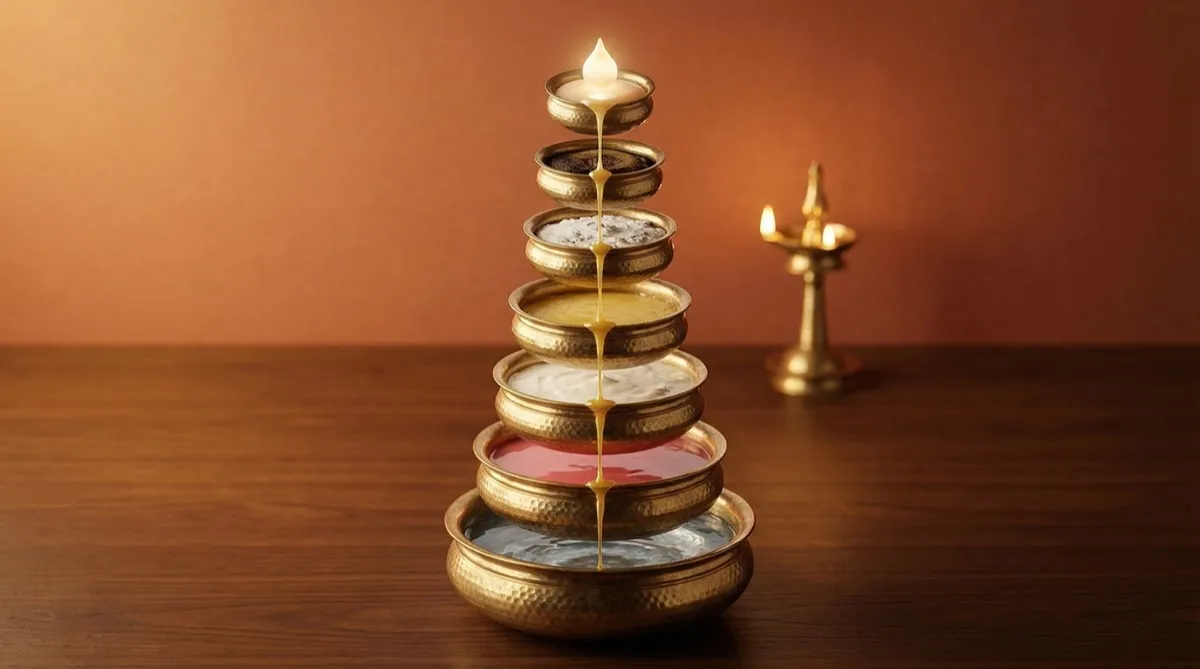
Think of the body’s tissue system as a seven-story building. The ground floor is Rasa (plasma), and above it rise Rakta, Mamsa, Meda, Asthi, and Majja in sequence. Shukra — the reproductive tissue — sits on the seventh floor. You cannot build the top floor without solid foundations below. Each level is constructed from the one beneath it through a tissue-specific metabolic fire (Dhatvagni), and the entire construction cycle from ground floor to seventh takes roughly 30 days according to classical texts. For men’s health, this architecture is critical: Shukra’s position at the very top means it is the most dependent tissue in the body. Every weakness in every floor below it — poor digestion reducing Rasa quality, sluggish metabolism thinning Rakta, inadequate nutrition depleting Mamsa — compounds upward until Shukra receives whatever is left. Which, if the lower floors are struggling, may not be much.
Shukra’s position at the end of this chain is not incidental. It means that Shukra is the last tissue to receive nourishment and the first to suffer when anything upstream goes wrong. Think of it as the last field in an irrigation system. If the water supply is strong and the channels are clear, that last field flourishes. If the supply is reduced at any point — whether at the source, through a blocked canal, or through excess drainage along the way — the last field dries up first, even while the upstream fields still appear green.
This is why Ayurveda considers the quality of Shukra dhatu a barometer of overall health. A man with depleted Shukra is not merely experiencing a reproductive issue. He is showing the end-stage expression of inadequate nourishment across the entire tissue chain. Low energy, poor muscle recovery, brittle bones, dry or ageing skin, and diminished immunity can all trace back to the same upstream problem: the seven-tissue chain is not being adequately nourished, and the last tissue in line — Shukra — reveals it most visibly.
This understanding has a practical consequence that changes how men should think about vitality. Attempting to enhance Shukra directly — through isolated supplements or stimulants — without addressing the health of the six upstream tissues is like trying to fill the last field by dumping water directly into it while the irrigation system remains broken. The water does not stay. The approach must begin upstream: ensure Rasa is well-formed through proper digestion, ensure Rakta is clean and well-nourished, support Mamsa and Meda through appropriate diet and activity, maintain Asthi and Majja through adequate minerals and rest. When the entire chain is healthy, Shukra is naturally abundant.
The channel system responsible for carrying Shukra is called Shukravaha Srotas. Classical texts note that the health of this channel depends entirely on the upstream dhatu chain being well-nourished — if Rasa, Rakta, or any intermediate tissue is compromised, the channels carrying Shukra cannot function properly regardless of what is done at the Shukra level alone.
Did You Know?
Charaka Samhita (Chikitsa Sthana 2/1.17) describes the seven-dhatu transformation cycle as taking approximately 30 days from ingested food to the formation of Shukra dhatu. Modern reproductive biology confirms that the sperm maturation cycle (spermatogenesis) takes 64–74 days — and that the quality of sperm is directly influenced by diet and lifestyle choices made 2–3 months earlier. The concept of a lengthy, sequential, diet-dependent tissue transformation process was not just philosophically elegant — it was physiologically prescient. This is why Vajikarana protocols are prescribed for months, not days: Charaka understood that reproductive tissue quality reflects what the body was fed and how it lived weeks to months ago, not yesterday.
There is a dimension to men’s vitality that the classical texts understood with remarkable clarity: the body does not distinguish between physical exertion, mental exertion, and emotional exertion. All three draw from the same reserve. In Ayurvedic terms, all three consume Ojas. A man who works 14-hour days at a desk is not sparing his body because he is not doing physical labour — the mental intensity, the screen exposure, and the stress hormones are depleting his tissue chain just as effectively as if he were running marathons. This is why many modern professionals with sedentary jobs experience the same Shukra depletion, fatigue, and vitality loss as men who are physically overworked. The body does not care whether the drain is physical or mental — it tracks the total demand on Ojas.
Fatigue, Low Energy, and the Ojas Connection
Chronic fatigue is perhaps the most common complaint among men today, and also the most poorly understood. The modern response is predictable: caffeine, energy drinks, pre-workout supplements, and when those fail, blood tests that often come back “normal.” The man is tired but not clinically deficient in anything measurable. He is told to sleep more and manage stress — advice that is correct but incomplete.
Ayurveda frames this differently. Persistent fatigue that exists despite adequate sleep (or that persists because adequate sleep never happens) points to Ojas Kshaya — depletion of Ojas. The pathway is specific: when Agni (digestive and metabolic fire) is weakened by irregular meals, excess processed food, late nights, chronic stress, and overstimulation, the quality of digestion suffers. Food is converted to Rasa dhatu less efficiently. Each subsequent tissue in the chain receives less nourishment. At the end of the chain, Shukra receives the least, and Ojas — the subtle product of the entire process — diminishes.
The Agni-to-Ojas pathway explains why energy drinks and caffeine worsen the problem over time. Caffeine stimulates Agni artificially — like fanning a fire that has no fuel. The short-term effect is alertness; the long-term effect is further depletion. The fire burns hotter but produces nothing of substance because there is no well-prepared fuel (properly digested food at proper intervals) to sustain it. The body borrows energy from tissue reserves. Over months and years, this creates the paradox of the “wired but tired” man — stimulated but depleted, alert but brittle.
Screen exposure compounds this. Ayurveda classifies the eyes as a primary seat of Alochaka Pitta, and excessive screen time aggravates Pitta and Vata simultaneously — creating heat, dryness, and nervous system overstimulation. Late-night screen use disrupts the body’s natural transition into the Kapha phase (roughly 6 PM to 10 PM) when the body is designed to slow down, digest, and prepare for sleep. Missing this window means Pitta re-activates after 10 PM, creating a second wind that feels productive but is actually draining. The man stays up late, sleeps poorly, wakes depleted, reaches for caffeine, and the cycle deepens.
The Ayurvedic approach to fatigue does not begin with a stimulant or even a Rasayana (rejuvenative). It begins with restoring Agni and protecting the conditions under which Ojas is naturally produced: regular meals, adequate sleep within the right window, reduced overstimulation, and time for the body to complete its seven-tissue cycle without constant interruption.
Did You Know?
The 10 PM–2 AM window is described in Ayurvedic Dinacharya as the Pitta phase of night — when the body’s internal metabolic fire is strongest and tissue repair happens most intensively. Modern chronobiology has confirmed this: growth hormone (essential for tissue repair and Shukra-equivalent regeneration) peaks during deep sleep between 10 PM and midnight. A man who habitually misses this window — staying up past 10 PM on screens, catching a “second wind” of Pitta energy — is not just losing sleep. He is losing the body’s primary tissue-rebuilding window. Charaka’s prescription of early sleep was not moralistic advice — it was precision endocrinology, described in terms of dosha rather than hormones.
Prostate and Urinary Concerns — Apana Vata
Prostate and urinary concerns become increasingly common as men age, yet they rarely receive attention until symptoms are significant. Difficulty initiating urination, weak stream, frequent night-time urination, or a sense of incomplete emptying are often dismissed as “just ageing.” Ayurveda does not accept this framing. It sees these symptoms as signals of dysfunction in a specific subdosha — Apana Vata — and in a specific region of the body.
Apana Vata governs all downward movement in the body: urination, defecation, ejaculation, and the movement of flatus. Its seat is the pelvic region — the lower abdomen, bladder, colon, and reproductive organs. When Apana Vata functions normally, these processes happen smoothly and at appropriate times. When Apana Vata is disturbed — aggravated, obstructed, or displaced — the results manifest as exactly the urinary and reproductive complaints that bring men to clinics.
Classical Ayurvedic texts describe conditions that map closely to modern urinary concerns. Mutraghata refers to obstruction of urine flow — difficulty initiating, weak stream, retention. Mutrakrichra refers to painful or strained urination. Both are understood as disorders of Apana Vata, often complicated by Kapha accumulation in the urinary channels (Mutravaha Srotas). The prostate, though not named in classical texts in modern anatomical terms, sits precisely in the region Ayurveda identifies as the seat of Apana Vata — and enlargement of this gland creates exactly the Apana Vata obstruction the texts describe.
Modern lifestyle aggravates Apana Vata in ways that the classical texts could not have anticipated but that their principles perfectly explain. Prolonged sitting compresses the pelvic region, reducing circulation and creating stagnation in Apana Vata’s domain. Vegadharana — the suppression of natural urges — is identified in Charaka Samhita as a direct cause of Vata aggravation. When a man repeatedly suppresses the urge to urinate (during long meetings, long drives, absorbed screen time), he is directly disturbing Apana Vata. When he suppresses the urge for bowel movement, the effect on the same region is compounded. Over years, this chronic suppression and stagnation creates the conditions for the urinary difficulties that seem to appear “suddenly” in middle age but have been building for decades.
The Ayurvedic approach to prostate and urinary support centres on restoring Apana Vata function: addressing seated lifestyle patterns, honouring natural urges, supporting pelvic circulation, and ensuring that the channels of elimination remain open and functional. This is not a replacement for urological evaluation — it is a complementary perspective that addresses the functional environment in which prostate and urinary health either thrives or deteriorates.
Sexual Wellness Through the Ayurvedic Lens
Sexual wellness is the area where men most often seek Ayurvedic guidance, but it is also the area most distorted by oversimplification. The internet is saturated with lists of “Ayurvedic herbs for men” and “natural aphrodisiacs.” This framing misses the entire point of the Ayurvedic approach, which is built on a fundamentally different logic than the stimulant model.
The stimulant model — whether pharmaceutical or herbal — operates by increasing arousal or blood flow at the moment of need. It addresses the symptom at the point of expression. The Ayurvedic model asks a different question: why is the body not producing adequate sexual vitality on its own? The answer, as we have seen, almost always traces back to the dhatu chain. Shukra Kshaya (depletion of reproductive tissue) is the end-stage expression of a process that may involve weak Agni, poor Rasa formation, depleted Rakta, insufficient Meda or Majja, or some combination of these upstream failures.
This is why isolated aphrodisiacs — whether herbal or otherwise — produce inconsistent results. They attempt to stimulate Shukra without addressing the reason Shukra is depleted. It is the equivalent of demanding output from an assembly line while starving the supply chain. Even if the final station is temporarily stimulated into activity, it cannot sustain production without raw materials from upstream.
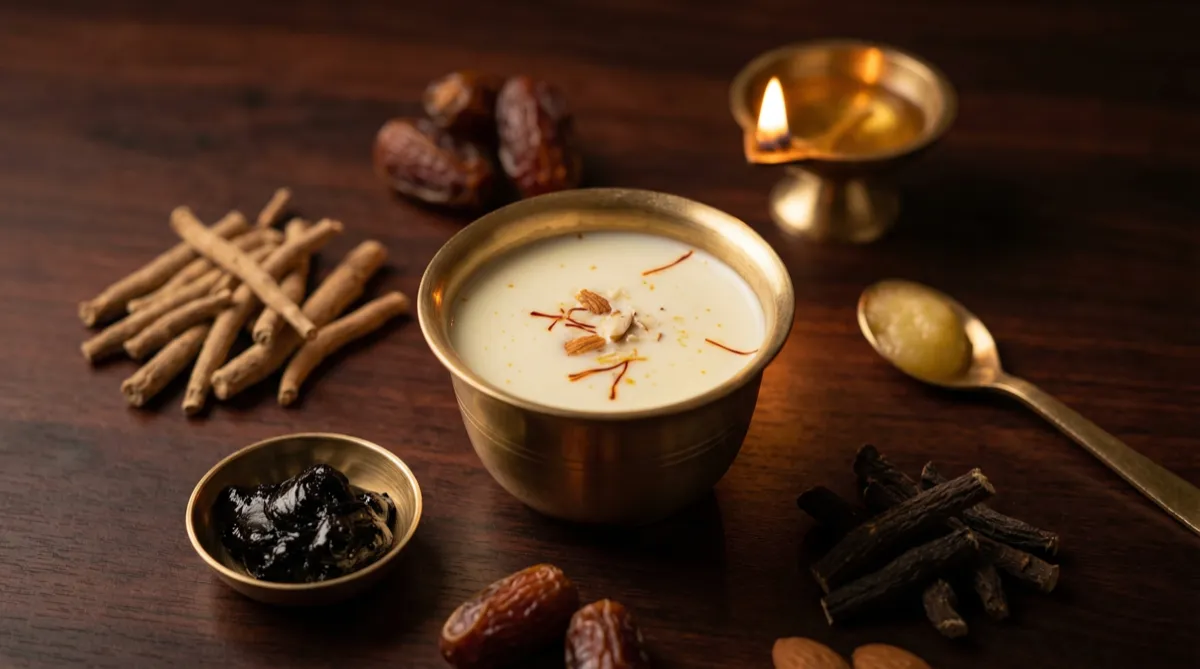
The Ayurvedic approach distinguishes clearly between stimulation and nourishment. Stimulation forces activity from depleted tissue. Nourishment rebuilds the tissue so that activity arises naturally. Charaka describes Vajikarana formulations not as stimulants but as deep tissue nourishers — preparations that support the entire chain from Rasa to Shukra, taken over weeks and months with appropriate dietary and lifestyle support. The classical protocol includes specific dietary recommendations (ghee, milk, almonds, dates, and other Shukra-nourishing foods), lifestyle adjustments (adequate rest, reduced excess, emotional contentment), and formulations that are prescribed based on individual constitution and the specific pattern of depletion.
There is an important psychological dimension as well. Ayurveda recognises that sexual wellness is inseparable from mental state. Anxiety, performance pressure, unresolved stress, and sleep deprivation all aggravate Vata — and Vata aggravation is one of the primary causes of sexual dysfunction in the Ayurvedic framework. A man whose mind is racing cannot settle into his body. This is not a character flaw or a deficiency; it is a predictable consequence of Vata imbalance. Addressing the nervous system, the sleep cycle, and the mental environment is as much a part of Vajikarana as any formulation.
It is also worth noting that the same concern manifests differently depending on constitution. A Vata-predominant man may experience anxiety-driven depletion, irregular patterns, and premature loss of reserves. A Pitta-predominant man is more likely to present with inflammation, intensity that leads to burnout, and heat-related aggravation. A Kapha-predominant man may report heaviness, low motivation, and a sense of congestion or stagnation. Recognising these patterns is part of why understanding your Prakriti matters — the same symptom requires different approaches depending on the constitutional ground it arises from.
Did You Know?
Charaka (Sutrasthana 17.74–75) describes Para Ojas as existing in a quantity of only eight drops (Ashtabindu), seated in the heart, and states that its complete loss is incompatible with life. For centuries, this was dismissed as mysticism. But modern cardiology has identified a strikingly parallel concept: the heart produces and responds to natriuretic peptides and other signalling molecules in extremely minute quantities that regulate fluid balance, blood pressure, and stress response throughout the body. The heart is not just a pump — it is an endocrine organ. Charaka’s placement of the body’s most vital essence “in eight drops at the heart” may be the earliest description of this principle: that the heart holds a regulatory substance in tiny quantity whose loss is fatal.
Something worth reflecting on: the human body produces approximately 10 million new cells every second. This continuous regeneration depends entirely on the quality of the raw materials supplied to it. When Ayurveda describes the Rasa-to-Shukra transformation chain, it is describing the body’s internal supply chain for this constant rebuilding process. A man eating irregularly, sleeping poorly, and living under chronic stress is not just “tired” — he is providing degraded raw materials to a system that is trying to rebuild 10 million cells per second. The visible symptoms — fatigue, low vitality, poor recovery — are downstream consequences of this upstream supply chain failure. This is why Ayurveda never treats the symptom alone: the seven-tissue chain must be restored from the first dhatu onward.
What a Consultation Involves
A men’s wellness consultation at Santana Laxmi begins with a comprehensive assessment that goes well beyond the presenting complaint. Whether a man comes for fatigue, urinary concerns, sexual wellness, or general vitality, the approach is the same: understand the whole picture before addressing the specific concern.
Constitution assessment (Prakriti) establishes the baseline. A Vata-predominant man depletes differently from a Kapha-predominant one. The same symptom — say, low energy — may reflect Vata exhaustion in one person and Kapha stagnation in another. The guidance would be opposite in each case. Knowing the constitution prevents the common mistake of applying a one-size-fits-all approach.
Lifestyle audit examines the daily patterns that are either sustaining or eroding vitality: meal timing and composition, sleep quality and timing, physical activity levels, work patterns (particularly seated work), screen exposure, caffeine and alcohol intake, and stress management. Many men are surprised to find that the root of their concern is not exotic or mysterious — it is the accumulated effect of daily habits that quietly drain the system over years.
Agni assessment evaluates digestive and metabolic capacity. The practitioner examines appetite patterns, digestion quality, elimination regularity, and signs of Ama accumulation. Since the entire seven-tissue chain depends on Agni, this assessment is foundational. A man with excellent diet but weak Agni will not extract adequate nourishment from his food. A man with moderate diet but strong Agni may fare better.
Pulse assessment (Nadi Pariksha) and traditional examination methods provide information about dosha states, tissue health, and channel function that complements the verbal history. The practitioner integrates all of this — constitution, lifestyle, Agni, pulse — to develop guidance that addresses the individual pattern, not just the presenting symptom.
If you are considering a men’s wellness consultation, you can learn more about the process and request a consultation here.
When to See a Urologist or Specialist
Responsible Ayurvedic practice recognises the limits of its scope and the situations where medical evaluation is the priority. The following are situations where a man should see a urologist or specialist — not instead of Ayurvedic guidance, but before or alongside it.
Blood in urine (haematuria) requires medical investigation to rule out infection, stones, or more serious conditions. This is not something to manage with traditional approaches alone. Sudden changes in urinary pattern — acute retention, sudden onset of incontinence, or significant pain — warrant prompt medical evaluation.
Significant prostate symptoms that are progressing rapidly or causing substantial disruption to daily life should be evaluated with modern diagnostics, including PSA testing and imaging where appropriate. Fertility evaluation requires semen analysis and hormonal testing that only a specialist can provide. Ayurvedic guidance can support the body during this process, but it does not replace the diagnostic information these tests provide.
Erectile dysfunction with cardiovascular risk factors deserves particular attention. Erectile difficulties can be an early indicator of cardiovascular disease — the blood vessels involved are small and show dysfunction before larger vessels are affected. A man with erectile difficulties who also has high blood pressure, diabetes, a history of smoking, or a family history of heart disease should have a cardiovascular evaluation. This is a case where the symptom is potentially a warning sign for something more serious, and dismissing it as “just stress” could be genuinely dangerous.
Ayurveda works alongside these evaluations, not instead of them. A man who has had proper medical assessment and wants to address the constitutional and lifestyle foundations of his concern is the ideal candidate for Ayurvedic guidance. The two systems complement each other: modern medicine provides diagnostic precision and acute intervention; Ayurveda provides constitutional understanding, lifestyle correction, and long-term support for the body’s own capacity to maintain health.
What Current Evidence Says
Vajikarana as a therapeutic category has drawn attention from both the Central Council for Research in Ayurvedic Sciences (CCRAS) and international researchers. CCRAS has conducted clinical studies on classical Vajikarana formulations, reporting improvements in parameters related to vitality and reproductive health, though many studies are limited by small sample sizes and the need for more rigorous methodology.
The World Health Organization’s traditional medicine strategy acknowledges the importance of traditional systems, including Ayurveda, in addressing men’s health concerns — particularly in regions where these systems represent a significant portion of healthcare delivery. The WHO framework emphasises integration rather than opposition between traditional and modern approaches.
Research published in peer-reviewed journals has examined several herbs traditionally classified under Vajikarana for their effects on testosterone levels, sperm parameters, and markers of vitality. While some results are promising, systematic reviews consistently note the need for larger, well-designed, placebo-controlled trials before definitive claims can be made. The evidence is encouraging but preliminary. What is well-established is that the lifestyle interventions central to the Ayurvedic approach — dietary modification, stress reduction, adequate sleep, regular physical activity — have strong evidence bases for improving men’s health outcomes across multiple domains.
This article is for educational purposes only and does not constitute medical advice. Men’s health concerns — including prostate symptoms, urinary difficulties, sexual dysfunction, and persistent fatigue — require proper clinical evaluation by a qualified healthcare provider. Do not self-prescribe herbal preparations or discontinue prescribed medication based on this article. Any Ayurvedic formulations should only be taken under the guidance of a qualified practitioner who has assessed your individual constitution, current condition, and health history. Always inform both your medical doctor and your Ayurvedic practitioner about all treatments you are receiving. If you experience blood in urine, sudden urinary changes, chest pain, or other acute symptoms, seek medical attention promptly.