
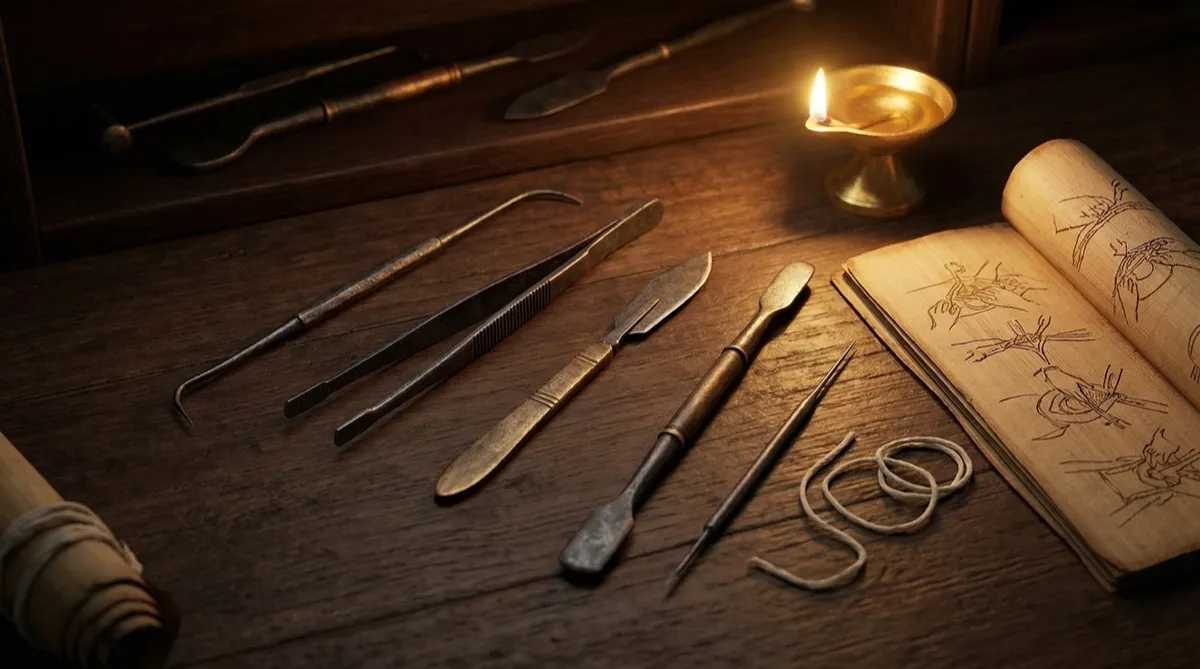
Arsha — One of Ayurveda’s Most Extensively Documented Conditions
Piles are one of those conditions people suffer with silently for years — embarrassed to discuss it, self-medicating with creams, and assuming it is just something they have to live with. Ayurveda not only took it seriously enough to dedicate entire chapters to it, but made a distinction that changes how you think about the condition entirely: not all piles are the same, and treating them as if they are is why most treatments only provide temporary relief.
The classical classification begins with a fundamental distinction that modern medicine does not typically make: Sahaja versus Janmottara. Sahaja Arsha refers to congenital piles — a constitutional tendency present from birth, rooted in the Prakriti of the individual and often observed to run in families. Janmottara refers to acquired piles — those that develop during life as a result of dietary patterns, lifestyle factors, and progressive dosha aggravation. This distinction matters because it shapes the entire approach. A person with Sahaja Arsha carries a constitutional vulnerability that requires ongoing attention to diet, elimination habits, and lifestyle — not merely episodic intervention when symptoms flare. A person with Janmottara Arsha may be able to address the root cause more directly, since the condition arose from identifiable and correctable factors.
Beyond this primary division, Arsha is further classified by dosha involvement. Each of the three doshas produces a distinctly different type of piles — different in appearance, in symptom quality, in the nature of the discomfort, and in the dietary and lifestyle factors that aggravate or relieve it. There is also a Sannipataja type involving all three doshas simultaneously, and a Raktaja type where blood vitiation is the primary driver. Sushruta’s six-fold classification in Chikitsa Sthana represents one of the most detailed typologies of any anorectal condition in the history of medicine.
The Three Dosha Types of Piles
Vataja Arsha presents with dry, hard, irregular growths that cause intense pain. The pain is often described in the classical texts as cutting, pricking, or needle-like — characteristic of Vata’s sharp and mobile qualities. The growths tend to be rough, darkish in colour, and irregular in shape. Constipation is almost always present, because Vata’s drying quality depletes moisture in the colon. There may be flatulence, abdominal distension, and a general sense of irregularity in bowel function. The pain tends to worsen in cold weather, after travel, after irregular meals, and during periods of stress or sleep deprivation — all classic Vata-aggravating circumstances. Bleeding, when it occurs, tends to be minimal and frothy. The dominant experience is pain and dryness rather than bleeding.
Pittaja Arsha is an altogether different presentation. The growths are soft, reddish or yellowish, and inflamed. The hallmark is bleeding — often bright red, sometimes profuse. There is a burning sensation rather than the cutting pain of Vataja type. The area around the anus may be tender, warm, and swollen. These are the piles worsened by spicy food, sour foods, alcohol, and excessive heat or sun exposure. The individual may also experience thirst, irritability, loose stools, and a sensation of heat radiating from the pelvic region. Pitta’s qualities — hot, sharp, liquid, spreading — manifest clearly in this presentation. Sushruta emphasised addressing Pittaja Arsha promptly because the ongoing blood loss can produce weakness, pallor, and debility over time.
Kaphaja Arsha presents differently again. The growths are large, soft, smooth, broad-based, and whitish or pale. Rather than sharp pain or active bleeding, the dominant symptoms are itching, a heavy or dragging sensation in the pelvic floor, and mucoid discharge. Digestion is typically sluggish, with a persistent feeling of incomplete evacuation. These piles develop slowly over time in individuals with Kapha-predominant constitutions or those whose diet is heavy in sweet, oily, and cold foods. They are often the most chronic of the three types — less dramatic in presentation but more persistent, more resistant to resolution, and more likely to recur if the underlying Kapha accumulation is not addressed.
Why does this dosha-based classification matter clinically? Because the dietary guidance, lifestyle modifications, and formulation approach differ fundamentally for each type. What soothes a Vataja presentation — warm, oily, grounding — would aggravate a Pittaja one. What reduces Kapha accumulation — light, dry, stimulating — would worsen Vata dryness. A practitioner who does not distinguish between these types is working without the precision that Sushruta and Charaka explicitly considered essential. This is one of the clearest illustrations of why Ayurveda insists on individual assessment before any approach is formulated.
Did You Know?
Sushruta’s six-fold classification of Arsha (haemorrhoids) in Sushruta Samhita Chikitsa Sthana is one of the most detailed anorectal typologies in all of ancient medical literature. He classified haemorrhoids by dosha involvement, affected tissue layer, and prognosis simultaneously — a multi-dimensional diagnostic approach that modern colorectal classification systems only adopted in the 20th century with the Goligher grading scale. Sushruta was doing multi-axis clinical classification over 2,000 years before the West formalised the concept.
Parikartika and Bhagandara — Fissure and Fistula
While piles (Arsha) receives the most public attention, the classical texts describe two other distinct anorectal conditions that are frequently confused with piles but have different pathologies, different causes, and different implications. Understanding these distinctions is important because the approach for each differs significantly.
Parikartika corresponds closely to what modern medicine calls an anal fissure. The name itself is descriptive — derived from “parikartana,” meaning cutting or tearing. The primary symptom is a sharp, cutting pain during and after defecation, as though a blade were being drawn across the tissue. Charaka identifies Parikartika as a condition arising primarily from Vata-Pitta vitiation. Vata contributes the dryness that makes the tissue rigid and prone to tearing. Pitta contributes the inflammation that prevents healing and produces the burning sensation that persists long after the bowel movement is complete. The condition is self-perpetuating: pain causes sphincter spasm, spasm reduces blood flow to the wound, reduced blood flow impairs healing, and the fissure deepens with each bowel movement. Breaking this cycle requires addressing both the dryness and the inflammation simultaneously — not merely one or the other.
Bhagandara is a fundamentally different and more serious condition — corresponding to what modern medicine calls a fistula-in-ano. Sushruta Samhita devotes an entire chapter (Nidana Sthana Chapter 4) to Bhagandara, classifying it into five types based on dosha predominance. The word literally means “that which tears or disrupts the region around the anus.” Unlike a fissure, which is a surface tear, a fistula involves the formation of an abnormal channel — a tract that connects an internal opening inside the anal canal to an external opening on the skin surface. Sushruta describes the pathogenesis as beginning with a localised abscess (Pidika) in the perianal region, which, if not properly addressed, ruptures and forms a persistent communicating channel. This tract can harbour infection, discharge pus, and become a chronic, recurring problem. The level of anatomical detail in Sushruta’s descriptions — including the direction, depth, and discharge characteristics of each type — is remarkable for a text composed over two millennia ago.
The distinction between these three conditions — Arsha, Parikartika, and Bhagandara — is not academic. Each has a different aetiology, different dosha involvement, different prognosis, and different management considerations. A person who assumes that every anorectal complaint is “just piles” may be overlooking a fissure that needs specific Vata-Pitta pacification, or worse, a fistula tract that requires careful clinical evaluation. Sushruta was explicit about the importance of accurate assessment before any intervention — a principle that remains as essential today as it was when he first articulated it.
Did You Know?
Sushruta’s Kshara Sutra — a medicated alkaline thread technique for managing fistula-in-ano — predates the modern seton technique by over 2,000 years. In 1991, the World Health Organisation recognised Kshara Sutra as a validated surgical procedure, making it one of the very few traditional medical techniques from any civilisation to receive formal WHO recognition. A 2,500-year-old Ayurvedic para-surgical method, still clinically relevant today.
Here is a fact that reframes the entire condition. The human body moves roughly 30 tonnes of food through the digestive tract over a lifetime. The anorectal region handles the final stage of every single one of those meals — day after day, decade after decade. It is the most mechanically stressed junction in the entire digestive system. Ayurveda classified the anus as a Marma point (vital junction) and the colon as the primary seat of Vata dosha — not because of superstition, but because of precise clinical observation. When the body’s most worked junction is governed by the body’s most volatile dosha, the margin for error is thin. This is why even minor disruptions in diet, hydration, or elimination habits can produce disproportionate effects in this region. The classical physicians understood this vulnerability through thousands of years of watching what happens when people ignore it.
Root Cause: Mandagni and Apana Vata
If you ask what Ayurveda considers the foundational cause of most anorectal conditions, the answer is deceptively simple: Mandagni — weak digestive fire. Charaka Samhita is unequivocal on this point. When Agni is impaired, digestion is incomplete. Incomplete digestion produces Ama — a heavy, sticky metabolic residue that compromises the quality of the stool. Either the stool becomes too hard and dry (when Vata dominates the imbalance) or too loose, heavy, and mucoid (when Kapha dominates). Both extremes disrupt the normal function of the lower digestive tract and place chronic strain on the anorectal tissues.
The critical mechanism involves Apana Vata — the downward-moving aspect of Vata that governs elimination, urination, and reproductive functions. When Mandagni produces hard, dry stools, the individual strains during defecation. Repeated straining disrupts Apana Vata, which in turn affects the vascular cushions in the anal canal — the structures that, when chronically engorged, become what we call piles. Once Apana Vata is disturbed, a self-reinforcing cycle begins: disturbed Apana Vata further impairs coordinated elimination, which causes more straining, which further aggravates Apana Vata. The condition perpetuates itself until the upstream cause — the weak Agni — is addressed.
The dietary connection is direct and extensively documented in the classical texts. Charaka specifically identifies Viruddha Ahara — incompatible food combinations — as a significant contributor to Mandagni and by extension to Arsha. Foods that are excessively dry, astringent, or light aggravate Vata. Foods that are excessively spicy, sour, or heating aggravate Pitta. Foods that are excessively heavy, cold, or sweet increase Kapha and Ama production. Each dietary pattern contributes to the type of Arsha that corresponds to its dosha affinity. Irregular meal timing, eating before the previous meal is digested, suppressing the urge to defecate (Vegadharana), and prolonged sitting are all identified as contributory factors in the classical texts.
This is why Charaka’s approach to Arsha begins with Agni correction — not with local symptom management. Unless the digestive fire is strengthened and Ama production reduced, any intervention that addresses only the local symptoms deals with the branches while the root continues to produce new growth. The emphasis on correcting Agni first is not a detour away from the anorectal condition. It is the direct path to addressing what sustains it. This principle — that Arsha is fundamentally a disease born of Mandagni — is one of the clearest examples of Ayurveda’s insistence on identifying and addressing root causes rather than managing downstream symptoms.
The classical texts add another layer of significance to this anatomical region. In Sushruta Samhita’s enumeration of the 107 Marma points — vital anatomical zones where structures, channels, and vital energy converge — the anus is classified as Guda Marma, a Sadyahpranahara (immediately vital) Marma point. This classification elevates anorectal conditions beyond mere local discomfort. When a region is designated as a Marma, it means that the classical tradition considered it a site of concentrated vital function, where careless or aggressive intervention can have disproportionate consequences. This Marma classification is one reason why Sushruta emphasised precise, graduated approaches such as Kshara Sutra for anorectal conditions, rather than crude excision — and why the classical texts consistently counsel careful, individualised assessment before any intervention in this region.
The Kshara Sutra Tradition
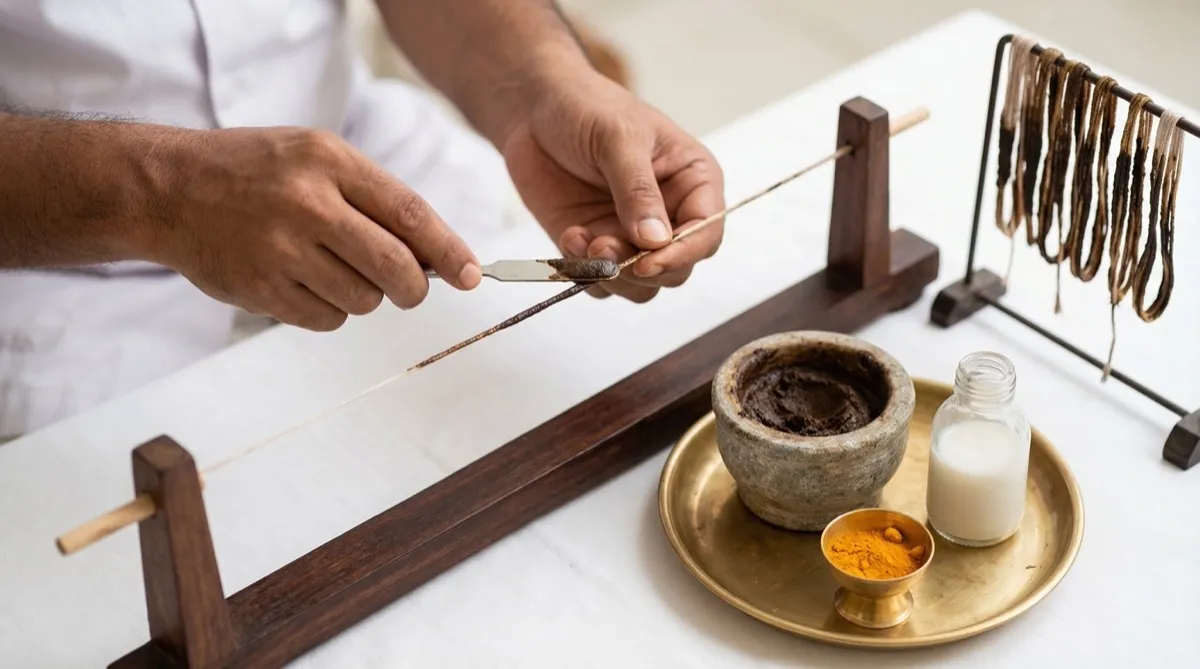
Among Ayurveda’s many contributions to the history of medicine, one that deserves particular recognition is the Kshara Sutra technique described by Sushruta. This is a para-surgical method — a medicated thread application — that Sushruta described for the management of fistula tracts and certain types of haemorrhoidal growths. It represents one of the earliest documented instances of a minimally invasive surgical technique in any medical tradition worldwide, and it remains one of the most tangible demonstrations of the sophistication of classical Ayurvedic surgery.
The technique involves a specially prepared thread that is coated with multiple layers of alkaline and medicinal preparations through a specific, repeatable process. Sushruta’s descriptions of the preparation methodology, application technique, and post-procedural care are remarkably systematic and detailed. The principle behind the technique — gradual, controlled tissue management rather than acute surgical excision — is one that modern colorectal surgery has independently validated. The seton technique used in contemporary fistula surgery operates on a strikingly similar principle: a thread placed through the fistula tract that allows gradual cutting and simultaneous healing, preserving sphincter function while eliminating the abnormal channel.
It is important to be clear about what we are saying here and what we are not. This article discusses Kshara Sutra as a matter of classical knowledge and historical contribution — not as a prescription or recommendation. The technique, in its modern standardised form, is practised by specially trained practitioners in controlled clinical settings, often within government-supported Ayurvedic institutions and teaching hospitals. It is not a home remedy, not a self-treatment, and not something to be attempted outside of qualified clinical supervision. The Indian Council of Medical Research and the Central Council for Research in Ayurvedic Sciences (CCRAS) have studied Kshara Sutra in clinical trials, and it remains a recognised para-surgical procedure within the Ayurvedic system. Our purpose in discussing it is educational: to acknowledge that Ayurveda’s engagement with anorectal conditions extends beyond dietary guidance and formulations into a sophisticated para-surgical tradition that continues to be studied, refined, and practised.
Did You Know?
Charaka listed Vegadharana — the habitual suppression of natural urges, including the urge to defecate — as a direct cause of disease in Charaka Samhita Sutrasthana Chapter 7. He considered it so important that he dedicated an entire chapter to it. Modern gastroenterology has confirmed exactly what Charaka observed: chronic suppression of the defecation reflex leads to rectal desensitisation, harder stools, and a significantly increased risk of haemorrhoids. A clinical insight from over 2,000 years ago, now validated by rectal manometry studies in the 21st century.
What a Consultation Involves
When someone seeks Ayurvedic guidance for anorectal concerns, the consultation begins where Charaka said it should begin: with a thorough assessment of digestion. What is the nature of the appetite? How is the stool — dry, hard, loose, mucoid, irregular? Are there gas, bloating, or a feeling of incomplete evacuation? How much water is consumed daily? What does the typical diet look like, and when are meals taken? These are not preliminary pleasantries. They are the diagnostic foundation, because the state of Agni determines whether the anorectal condition will persist, recur, or resolve.
Following the digestive assessment, the practitioner evaluates the specific dosha pattern. Is this a Vataja presentation with dryness, hardness, and cutting pain? A Pittaja presentation with inflammation, active bleeding, and burning? A Kaphaja presentation with heaviness, itching, and mucoid discharge? Or a mixed pattern? The answer determines the formulation approach, because formulations for anorectal conditions in the Ayurvedic tradition are not one-size-fits-all — they are tailored to the specific dosha involvement and the current strength of the individual’s Agni.
Dietary guidance is typically detailed and specific. It addresses not only what to eat and what to avoid, but when to eat, how much, and in what combinations. The classical texts provide precise guidance about which tastes and food qualities aggravate each type of Arsha. For Vataja presentations, the emphasis is on warm, moist, well-oiled foods. For Pittaja, cool, bland, soothing foods that do not inflame. For Kaphaja, light, warm, well-spiced foods that do not increase heaviness. These are targeted dietary frameworks based on individual assessment. For related insights on how digestive assessment informs the broader approach, see our digestion and liver consultation page.
The timeline is honest. Anorectal conditions that have developed over months or years do not resolve in days. Sustained dietary changes, Agni correction, and formulation support over a realistic period are typically needed. Individuals who expect instant relief are likely to be disappointed; those who commit to the process of restoring Agni and correcting the underlying dosha imbalance often find that the improvements, when they come, are more stable and self-sustaining than what symptom suppression alone achieves.
When to Seek Conventional Care
Responsible Ayurvedic practice recognises the boundaries of what traditional guidance can address and when modern medical evaluation is essential. Several situations require prompt conventional medical assessment, and an ethical practitioner will recommend this clearly and without hesitation.
Heavy or uncontrolled rectal bleeding requires immediate medical evaluation. While minor bleeding can be associated with common haemorrhoidal conditions, significant or persistent bleeding must be investigated to rule out other causes. Prolapse at grade 3 or 4 — where tissue has prolapsed and cannot be manually reduced, or remains permanently prolapsed — typically requires surgical evaluation. Abscess formation with fever, swelling, and severe throbbing pain indicates infection that may require drainage and antibiotic management. Fever accompanying anorectal symptoms suggests active infection that needs medical attention. And any presentation that raises suspicion of malignancy — unexplained weight loss, progressive changes in bowel habits in older adults, family history of colorectal conditions — must be investigated with appropriate modern diagnostic methods including colonoscopy.
Ayurvedic guidance can work alongside conventional care in meaningful ways. Dietary modifications, Agni-focused approaches, and lifestyle adjustments do not conflict with medical management. But they should not delay necessary evaluation when the signs listed above are present. Sushruta himself classified when surgical intervention was necessary versus when conservative approaches sufficed — a distinction that reflects clinical pragmatism, not ideological commitment to one approach over another. The Ayurvedic tradition, at its best, has always recognised the appropriate role of surgical intervention.
What Current Evidence Says
The Kshara Sutra technique has been the subject of clinical research, particularly through trials supported by the Central Council for Research in Ayurvedic Sciences (CCRAS) under India’s Ministry of Ayush. Studies have compared Kshara Sutra application with conventional surgical approaches for fistula-in-ano management, with some trials reporting favourable outcomes in terms of recurrence rates and healing profiles. The WHO Traditional Medicine Strategy acknowledged Kshara Sutra as a procedure of interest within traditional medicine research. These studies, while promising, are limited by small sample sizes and study design constraints, and further rigorous research is needed.
Dietary and lifestyle modifications — including adequate fibre intake, sufficient hydration, regular physical activity, and avoidance of prolonged straining — are well-established in both Ayurvedic and conventional guidelines as foundational approaches to haemorrhoidal management. A 2019 clinical practice guideline from the American Society of Colon and Rectal Surgeons recommends fibre supplementation and lifestyle modification as first-line management for Grade I and II haemorrhoids — principles closely aligned with the Ayurvedic emphasis on Agni correction and proper stool formation.
Research into classical Ayurvedic formulation categories used in anorectal care remains in early stages. The NCCIH (National Center for Complementary and Integrative Health) notes that while complementary approaches for gastrointestinal conditions are widely used, the evidence base for most specific interventions requires further development through well-designed clinical trials. Traditional clinical experience spans centuries, but well-designed randomised controlled trials remain limited. The evidence base is growing but does not yet support definitive claims about efficacy for specific outcomes.
This article is for educational purposes only and does not constitute medical advice. Anorectal conditions require proper clinical evaluation for accurate diagnosis and appropriate management. Seek immediate medical care for heavy rectal bleeding, fever with perianal swelling, sudden severe pain, or any change in bowel habits accompanied by unexplained weight loss. Do not self-diagnose or self-prescribe based on this article. Any Ayurvedic formulations should only be taken under the guidance of a qualified practitioner who has assessed your individual constitution, current condition, and health history. Always inform both your medical doctor and your Ayurvedic practitioner about all treatments you are receiving.