
Kaumara Bhritya — One of Ayurveda’s Eight Classical Branches
The world’s oldest dedicated pediatric text was not written in London or Vienna. It was written in India — the Kashyapa Samhita — over 1,500 years before Europe recognised pediatrics as a medical specialty. And its core insight still holds: children are not small adults. Their bodies work differently, and treating them like adults is where most health problems begin.
This is not a modern addition. The Kashyapa Samhita, one of the oldest Ayurvedic texts, is devoted primarily to pediatric care and the health of mothers and children. It addresses everything from neonatal care and feeding practices to the stages of childhood development and the vulnerabilities unique to each stage. The fact that Ayurveda designated an entire branch to children tells us something important: the ancient practitioners understood that children are not simply smaller versions of adults. They have different physiological priorities, different digestive capacities, and different susceptibilities — and their care must reflect this.
Charaka Samhita and Sushruta Samhita also contain significant references to childhood health, but the Kashyapa Samhita remains the primary classical reference for understanding the Ayurvedic approach to children’s wellness. Its insights into feeding, immunity building, and the natural progression of childhood development are remarkably detailed and form the foundation of what practitioners draw upon today when working with families.
Did You Know?
The Kashyapa Samhita is the oldest dedicated pediatric text in world history. It was composed more than 1,500 years before the West recognised paediatrics as a medical specialty. Europe’s first dedicated pediatric text appeared in 1472 — but the Kashyapa Samhita had already documented neonatal care, feeding stages, and child immunity in astonishing detail. These are concepts that modern paediatrics only formalised in the 20th century.
Why Children Are Not Small Adults
One of the most fundamental principles in Ayurvedic pediatric thinking is this: childhood is a Kapha-dominant period of life. This is not a disease state or an imbalance. It is the natural and necessary order of things. Kapha dosha governs growth, tissue building, stability, and the formation of structure. A child’s body is doing the most intensive tissue-building work it will ever do — forming bones, muscles, organs, and neural pathways at a pace that will never be replicated in adult life. This requires Kapha’s qualities: heaviness, moisture, stability, and cohesion.
This natural Kapha dominance explains many things that parents observe but may not fully understand. Children produce more mucus than adults. They tend toward congestion. Their bodies are softer, more moist, more pliable. They sleep more. They gain weight more easily when overfed. All of these are expressions of the Kapha-dominant constitution that nature has designed for the growth period. They are not problems to be suppressed but features to be understood and supported.
At the same time, a child’s Agni (digestive fire) is still developing. It is not as strong or as stable as an adult’s. This is precisely why children are more susceptible to digestive disturbances, food sensitivities, and the consequences of inappropriate foods. Their digestive systems are still learning to process the world. Feeding a child the same foods, in the same quantities, at the same times as an adult ignores this fundamental difference. An adult with strong Agni might tolerate cold, raw, heavy, or complex foods. A child’s developing Agni may not — and the result is Ama (toxins) production, which in children often manifests as recurring colds, mucus accumulation, skin issues, or poor appetite.
Classical Ayurveda recognises three stages of childhood, each with its own dietary and care considerations. The Ksheerapa stage (roughly birth to one year) is the period of exclusive or primary milk feeding. The Ksheerannada stage (roughly one to two years) is the transition period where milk is gradually supplemented with soft, cooked foods. The Annada stage (roughly two years onward) is when the child transitions to a primarily food-based diet. Each stage has its own Agni capacity, its own nutritional requirements, and its own vulnerabilities. Feeding practices that are appropriate for one stage may be premature or harmful in another.
Common Childhood Concerns Through the Ayurvedic Lens
When parents bring children to an Ayurvedic consultation, certain patterns appear repeatedly. Understanding how Ayurveda interprets these patterns helps explain why the approach differs from simply addressing symptoms.
Recurring colds and respiratory congestion are perhaps the most common childhood concern. In the Ayurvedic framework, this is understood as Kapha accumulation compounded by weak Agni. The child’s naturally Kapha-dominant constitution means they already have a tendency toward mucus production. When Agni is further weakened — by cold foods, irregular meal times, heavy or difficult-to-digest meals, or eating before the previous meal is digested — Ama is produced. This Ama combines with the existing Kapha tendency and accumulates in the respiratory channels (Pranavaha Srotas). The result is what parents experience as “my child catches every cold that goes around.” The child is not catching more germs than other children; their internal environment is more hospitable to Kapha-Ama accumulation in the respiratory tract.
Poor appetite (Mandagni) in children is frequently a source of parental anxiety. In Ayurvedic understanding, a child’s appetite naturally fluctuates more than an adult’s because their Agni is still developing stability. However, chronically poor appetite often indicates that Agni has been dampened — by snacking between meals (which never allows the previous food to fully digest), by cold or heavy foods that Kapha-dominant digestion struggles to process, or by eating under stress or distraction. Forcing a child to eat when Agni is weak does not solve the problem; it often makes it worse by adding more undigested food to an already overwhelmed system.
Allergies and skin rashes are increasingly common in modern children. Ayurveda understands allergic tendencies through the framework of Ama interacting with Rakta dhatu (blood tissue). When Ama enters the blood, it creates a state of heightened reactivity. The body responds to substances it would normally tolerate because the blood is already carrying an inflammatory load. Skin rashes, particularly those with heat, redness, or itching, are understood as Pitta in Rakta — excess heat and metabolic waste expressing through the skin, which is one of the body’s primary channels for eliminating what it cannot process internally.
Growth support is another area where Ayurvedic understanding adds depth. Growth depends on the quality of Rasa dhatu (the first tissue formed from digested food) and its sequential nourishment of Rakta dhatu (blood) and the remaining tissues. If Agni is weak and Rasa dhatu is poorly formed, every downstream tissue receives inadequate nourishment. This is why Ayurveda emphasises the quality of a child’s digestion as the foundation of their growth — not simply the quantity of food consumed, but how well that food is actually being transformed into tissue.
Did You Know?
Charaka Samhita (Sharira Sthana, Chapter 8) describes three feeding stages — Ksheerapa (milk only), Ksheerannada (milk + soft food), and Annada (solid food) — mapped to a child’s developing digestive capacity. Remarkably, modern WHO infant feeding guidelines follow almost the exact same pattern: exclusive breastfeeding until 6 months, gradual complementary feeding, then transition to family foods. What Ayurveda discovered through observation thousands of years ago, modern nutritional science is now confirming.
Understanding Your Child’s Prakriti
While childhood is broadly Kapha-dominant, every child is born with their own unique Prakriti (constitutional type). Observing this innate constitution helps parents understand why siblings raised in the same household can respond so differently to the same food, routine, or environment. Vata-predominant children tend to be thin-framed, active, creative, and imaginative, often with irregular appetite and a tendency toward restless sleep. Pitta-predominant children are typically determined, sharp-minded, warm-bodied, with strong digestion and intense focus. Kapha-predominant children are generally calm, sturdy, affectionate, and steady, with slower starts but strong endurance once engaged. Most children display a combination of two doshas, with one more prominent. Recognising these patterns is not about labelling a child but about understanding what kind of food, routine, and environment naturally supports them — and what might create unnecessary strain.
Beyond Kapha — Vata and Pitta Patterns in Children
Because childhood is a Kapha-dominant period, it is easy to assume that all childhood concerns are Kapha-related. They are not. Children with strong Vata tendencies may experience anxiety, restlessness, constipation, difficulty settling into sleep, or variable appetite that confuses parents. Children with Pitta dominance may show skin inflammation, irritability, overheating, intense emotional reactions, or loose stools. These patterns are often overlooked when the assumption is that every childhood issue stems from Kapha excess. Recognising which dosha is actually involved changes the direction of dietary and lifestyle support entirely — what soothes a Vata child may aggravate a Pitta child, and vice versa. This is why individualised assessment, rather than generalised childhood advice, matters so much in the Ayurvedic approach. Understanding Agni and digestion becomes especially important here, as each dosha type processes food differently.
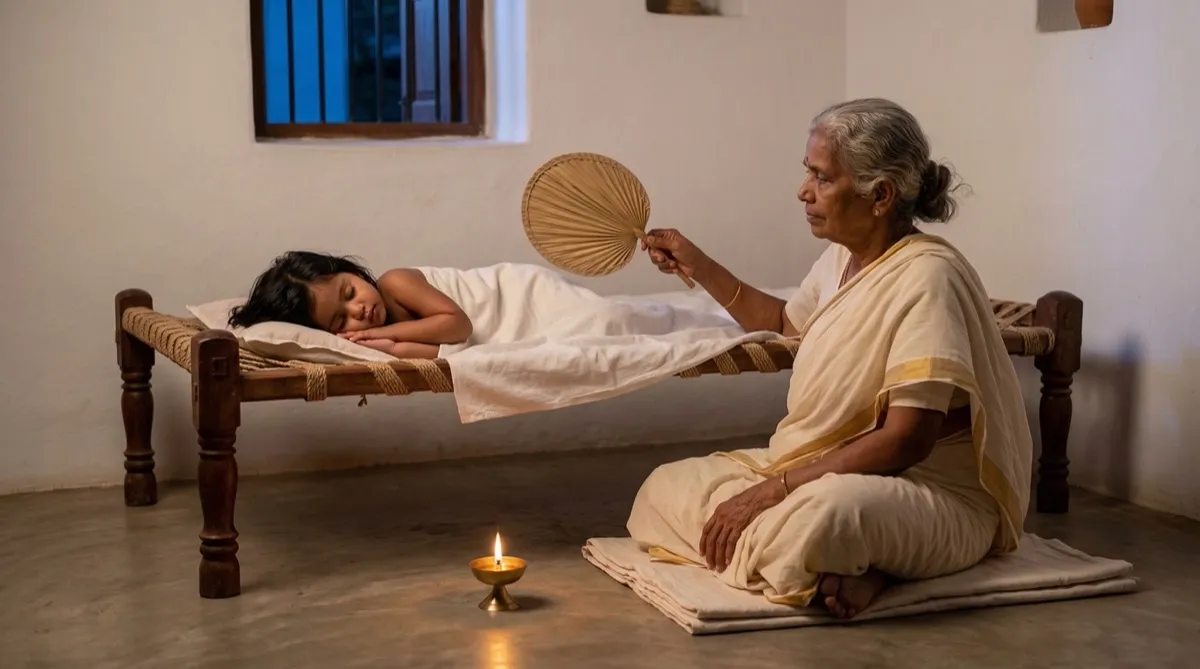
There is a dimension of childhood health that goes beyond food and medicine: sleep. A child’s body does not grow during the day. It grows at night. The deepest tissue repair, bone elongation, neural pathway formation, and immune strengthening happen during deep sleep — what modern science calls slow-wave sleep. Ayurveda understood this intuitively, which is why the classical texts place such emphasis on early bedtimes for children, a calm evening routine, and avoiding stimulating activities after sunset. A child who sleeps deeply and wakes naturally is a child whose body has had the time and stillness to build itself properly. No formulation can compensate for what eight to ten hours of deep, undisturbed sleep accomplishes every single night.
Building Immunity the Classical Way
Classical Ayurveda has a specific tradition for building immunity in children: the Lehana tradition. Lehana refers to the practice of giving children carefully prepared nutritive pastes and formulations designed to strengthen Agni, build Ojas (the essence of vitality and immunity), and support the development of robust tissue. This was not a casual practice but a structured, age-appropriate system described in the Kashyapa Samhita and other classical texts. The specific formulations were always decided by the practitioner based on the child’s individual constitution, age, and health status — never self-administered.
Modern children face immunity challenges that classical practitioners could not have anticipated. Processed foods with artificial colours, preservatives, and refined sugars directly weaken Agni and increase Ama production. Irregular schedules — late nights, inconsistent meal times, inadequate sleep — disrupt the natural rhythms that support immune function. Excess screen time displaces physical activity, outdoor exposure, and the natural sensory experiences that support healthy development. The result is a generation of children whose immunity is often compromised not by any single factor but by a cumulative pattern of lifestyle disruptions that classical Ayurveda would immediately recognise as Agni-weakening and Ama-producing.
The Ayurvedic approach to childhood immunity centres on Ojas — the subtle essence that represents the body’s deepest reserves of vitality, resilience, and immune intelligence. Ojas is not a single substance but the refined product of healthy digestion and tissue formation. When Agni is strong and all seven dhatus are properly nourished, Ojas is naturally abundant. When Agni is weak, tissues are poorly formed, and Ama accumulates, Ojas is depleted. A child with strong Ojas recovers quickly from illness, has bright eyes and good energy, sleeps well, and has a stable appetite. Supporting Ojas is not about giving children supplements — it is about ensuring that the foundations of digestion, sleep, routine, and appropriate food are in place so that the body can produce its own resilience.
Did You Know?
In the Lehana tradition described in the Kashyapa Samhita, specially prepared mixtures were applied to a newborn’s tongue with honey — a practice intended to stimulate the body’s protective responses. Modern immunology has now identified the concept of oral mucosal immunity — the idea that the immune system can be stimulated through the mucous membranes of the mouth. The ancient Ayurvedic practitioners may not have named the mechanism, but they identified the root insight thousands of years ahead of its time.
The Bala Framework — Three Types of Childhood Strength
Ayurveda describes childhood resilience through three distinct types of Bala (strength). Sahaja Bala is the innate strength a child is born with — inherited constitution, genetic resilience, and the vitality carried forward from the parents’ health at the time of conception. Kalaja Bala is time-dependent strength — it fluctuates with the child’s age, the season, and the time of day. A child’s strength naturally varies across these cycles. Yuktikrita Bala is acquired strength — built through appropriate diet, daily routine, adequate sleep, and attentive care. This is the type of Bala that parents and practitioners can most directly influence. Together, these three form a uniquely Ayurvedic framework for understanding why some children seem naturally robust while others need more careful support, and where parental effort can make the greatest difference.
Abhyanga — Oil Massage as Pediatric Practice
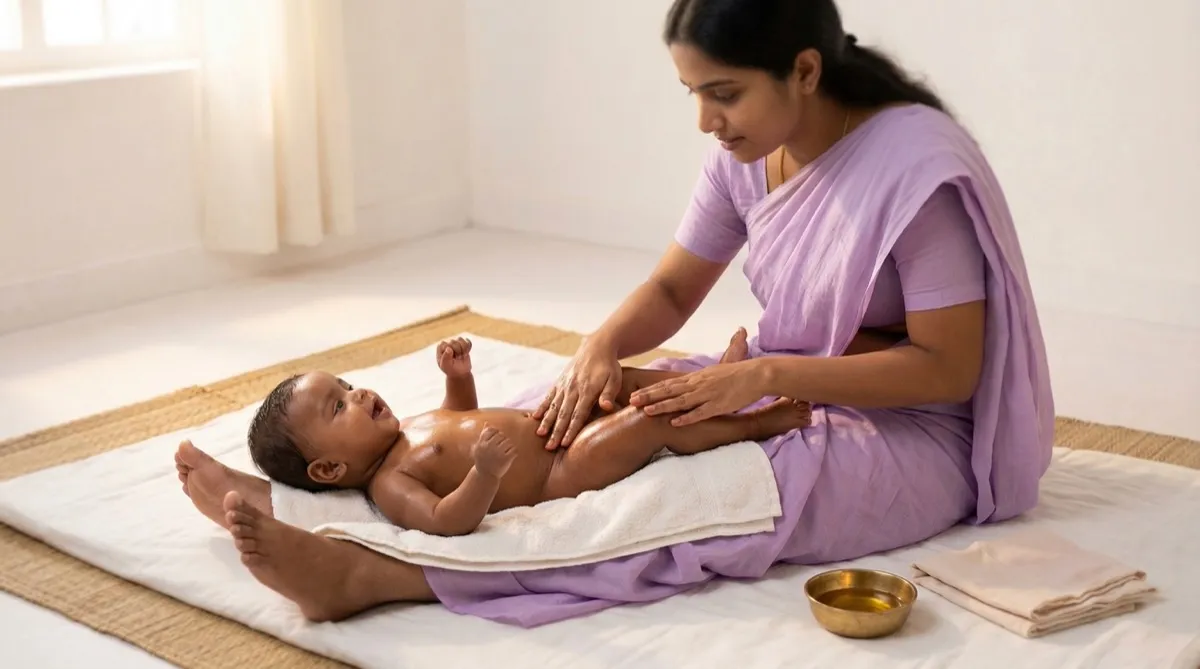
Daily oil massage (Abhyanga) for infants and young children is one of the most widely practised and enduring Ayurvedic traditions. Classical texts describe it as essential for calming Vata, strengthening developing tissues, promoting restful sleep, and supporting healthy weight gain. Across Indian households, this practice has been passed down through generations of mothers and grandmothers — a quiet, tactile ritual that modern research increasingly recognises for its benefits in infant bonding, nervous system regulation, and growth support.
Diet Wisdom — Why Grandmothers Got It Right
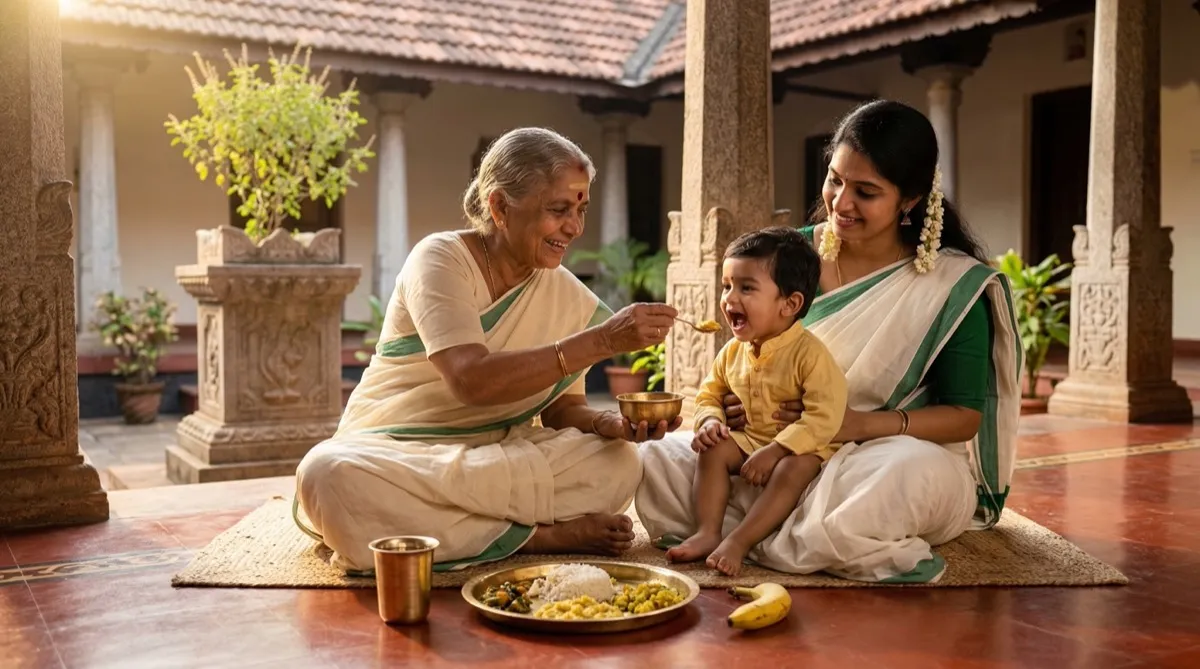
Across Indian households, traditional feeding practices for children have followed remarkably consistent patterns for generations. Warm, freshly cooked food. Ghee mixed into rice and dal. Seasonal fruits rather than imported, off-season varieties. Avoiding cold drinks and cold foods for young children. Light dinners before sunset. These practices were not arbitrary cultural preferences — they were, whether families realised it or not, closely aligned with Ayurvedic principles for supporting a child’s developing Agni.
Warm, cooked food is easier for a child’s still-developing digestive fire to process than raw or cold food. Ghee is considered one of the most important substances in Ayurvedic nutrition for children — it is a carrier of fat-soluble nutrients, it supports Agni without aggravating it, and it nourishes all seven dhatus. Seasonal eating ensures that children receive foods that are naturally aligned with the dosha predominance of each season. Early, light dinners allow complete digestion before sleep, when Agni naturally dims.
Some modern dietary advice for children contradicts these traditional principles. Raw food diets, cold smoothies for breakfast, excessive fruit juices, and late-evening meals are increasingly common in urban households. From the Ayurvedic perspective, these practices challenge a child’s developing Agni in ways that can lead to Ama accumulation, Kapha imbalance, and the very health concerns — recurring colds, poor appetite, allergies — that parents then seek help for. This does not mean every traditional practice is automatically correct or that every modern approach is wrong. It means that the underlying logic of traditional feeding — warm, cooked, seasonal, timed, and appropriate to the child’s digestive capacity — deserves more respect than it often receives.
Consider this: a newborn cannot understand words, cannot follow instructions, cannot describe symptoms. Yet the body responds powerfully to one thing from the very first breath — touch. The skin is not just a covering. It is the body’s largest organ, containing millions of nerve receptors that communicate directly with the brain and the immune system. When a mother massages her infant with warm oil, she is not just moisturising skin. She is delivering information through the nervous system — calming signals that reduce cortisol, stimulate growth hormones, and strengthen the developing immune response. This is why Abhyanga is not considered a luxury in Ayurveda. It is considered as essential as food. The ancient practitioners understood what modern neonatal research has confirmed: that for an infant, loving touch is not just emotional comfort. It is a biological necessity for healthy development.
What a Consultation Involves
An Ayurvedic consultation for a child is a gentle, unhurried process. There are no invasive procedures. The practitioner observes the child’s general disposition, skin quality, energy level, and behaviour. Parents are asked about the child’s daily routine, sleep patterns, appetite, bowel habits, and the specific concerns that brought them in.
A detailed family dietary review is an important part of the consultation. What the child eats, when they eat, how food is prepared, and how the child responds to different foods all provide information about Agni status and dosha tendencies. The practitioner is not simply cataloguing foods but understanding the digestive pattern — is Agni variable (Vata), overactive (Pitta), or sluggish (Kapha)? This determines the direction of dietary guidance.
Agni evaluation in children requires particular sensitivity. Children cannot articulate their digestive experience the way adults can. The practitioner relies on observable signs — tongue coating, appetite patterns, stool consistency, energy levels after eating, and the child’s general vitality. These signs, interpreted through the Ayurvedic framework, provide a clear picture of how well the child’s digestive system is functioning and where support may be needed. For more about the areas a consultation may address, see our consultation areas page.
When to See a Pediatrician
A pediatrician is always the first point of contact for any acute illness in a child. This is not a suggestion — it is an unqualified imperative. Fever, breathing difficulty, persistent vomiting, diarrhoea, dehydration, unusual rash, lethargy, or any sudden change in a child’s condition requires immediate medical evaluation by a qualified pediatrician. Children can deteriorate rapidly, and delays in appropriate medical care can have serious consequences. No Ayurvedic consultation replaces this.
Developmental concerns — delayed milestones, speech delays, motor development issues, or behavioural changes — require pediatric assessment. These are areas where early medical intervention can make a significant difference, and waiting or seeking alternative approaches first may mean losing valuable time during critical developmental windows.
Vaccinations are non-negotiable. Ayurveda does not replace vaccination. The classical immunity-building approaches described in Ayurvedic texts complement modern preventive medicine — they do not substitute for it. Any practitioner who suggests otherwise is acting irresponsibly. Ensure your child’s vaccination schedule is complete and up to date as advised by your pediatrician.
Failure to thrive — persistent poor weight gain, growth that falls off expected curves, or unexplained weight loss — requires thorough pediatric investigation to rule out underlying medical conditions. Behavioural concerns, including significant anxiety, aggression, social withdrawal, or attention difficulties, should be evaluated by qualified medical and developmental specialists.
Ayurvedic guidance for children works best as a supportive, complementary layer alongside regular pediatric care — not as a replacement for it. It can support digestion, help establish healthy routines, and provide dietary wisdom rooted in centuries of observation. But it should never delay or replace the medical attention that acute illness, developmental concerns, or preventive care (including vaccination) require.
What Current Evidence Says
The Central Council for Research in Ayurvedic Sciences (CCRAS), under the Ministry of Ayush, has conducted studies on traditional pediatric formulations and practices, including Lehana and Swarnaprashana traditions. While these studies provide preliminary evidence of safety and traditional use patterns, they acknowledge the need for larger, methodologically rigorous clinical trials to establish efficacy by modern evidence standards.
The World Health Organization emphasises that child health requires an integrated approach, with immunisation, nutrition, and access to qualified medical care as foundational pillars. Traditional medicine systems, including Ayurveda, are acknowledged as part of the health landscape in many countries, but the WHO consistently stresses that they should complement rather than replace evidence-based pediatric care.
Many of the dietary and lifestyle practices that Ayurveda recommends for children — warm cooked foods, regular meal times, adequate sleep, limited processed food, seasonal eating — are increasingly supported by nutritional science and pediatric research as beneficial for childhood health and development. The alignment between traditional feeding wisdom and modern nutritional understanding is an area of growing interest in integrative health research.
Important: This article is for educational purposes only and does not constitute medical advice. Children’s health requires particular caution. Never delay seeking pediatric medical care for any acute illness, developmental concern, or emergency. Do not self-prescribe any preparations — Ayurvedic or otherwise — for children. All formulations for children must only be given under the direct guidance of a qualified practitioner who has individually assessed the child. Ayurveda does not replace vaccination, pediatric check-ups, or medical treatment. Always keep your child’s pediatrician informed about any complementary approaches you are considering. When in doubt, consult your pediatrician first.