

Galaganda — What Ayurveda Knew Before Modern Endocrinology
Your thyroid problem is not just a thyroid problem. The weight gain, the fatigue, the brain fog, the hair falling out — they are all downstream effects of a metabolic fire that has been dimming for years. Ayurveda saw this pattern 2,500 years before the thyroid gland even had a name.
What makes Sushruta’s classification remarkable is its precision. He distinguished three types of Galaganda based on dosha predominance. Vataja Galaganda presents as a swelling that is dry, rough, dark in colour, and variable in size — it may fluctuate, sometimes appearing larger, sometimes smaller. Pain is a feature, often radiating or referred. The quality of the swelling reflects Vata’s dry, mobile, and irregular nature. Pittaja Galaganda manifests with heat, redness, tenderness, and sometimes a burning sensation in the throat region. The swelling may be warm to the touch, and inflammatory symptoms predominate. Kaphaja Galaganda is the most commonly encountered form — a smooth, firm, cold, heavy swelling that grows slowly, is often painless in its early stages, oily to the touch, and tends to be stable rather than fluctuating.
These dosha-based classifications correspond closely to modern clinical presentations. The Vataja type parallels irregular, sometimes nodular thyroid changes associated with fluctuating thyroid function. The Pittaja type resembles inflammatory thyroiditis. The Kaphaja type aligns with simple goitre and the slow, progressive enlargement seen in iodine-deficient or autoimmune hypothyroidism. The ancient clinicians observed the same phenomena modern endocrinologists observe — through a different but internally consistent conceptual framework.
The underlying pathology, as Ayurveda understood it, centred on the Meda-Kapha connection. Sushruta identified Kapha and Meda dhatu (fat tissue) as the primary substrates involved in Galaganda formation. When Kapha accumulates and Meda dhatu is improperly metabolised, the resulting excess tends to deposit in areas where the channels (srotas) are narrow or vulnerable — particularly Medo Vaha Srotas (the fat tissue channels) and Rasa Vaha Srotas (the plasma and lymphatic channels), both of which are intimately connected to thyroid function. The throat region — a junction point where multiple srotas converge — is particularly susceptible. This is why Ayurveda considers Galaganda not merely a local problem but a reflection of systemic metabolic dysfunction, specifically involving impaired Meda Dhatvagni (the metabolic fire governing fat tissue transformation). Charaka Samhita reinforces this systemic view, connecting neck swellings to disturbances in Agni, Rasa dhatu, and Meda dhatu. Vagbhata, in the Ashtanga Hridaya (Uttara Tantra), further elaborated the classification and management principles for Galaganda, consolidating the insights of both Charaka and Sushruta into a comprehensive framework. Together, these texts recognised that Galaganda produced effects on digestion, metabolism, tissue nourishment, mental clarity, and reproductive function — observations that modern endocrinology now confirms as features of thyroid dysfunction.
Hypothyroidism Through the Ayurvedic Lens
Hypothyroidism — the clinical state of insufficient thyroid hormone production — is the most common thyroid disorder, affecting an estimated 10 to 11 percent of the Indian population according to recent epidemiological data. Its symptoms are familiar: weight gain despite unchanged diet, persistent fatigue, cold intolerance, dry skin, constipation, hair loss, low mood or depression, and a general sense that the body has slowed down. From a modern perspective, these symptoms arise because insufficient thyroid hormone means every cell operates at reduced metabolic capacity.
From the Ayurvedic perspective, this picture is immediately recognisable as a state of Kapha-Meda accumulation with weakened Agni. Every symptom of hypothyroidism has a direct Ayurvedic correlate. Weight gain reflects Meda dhatu accumulation due to impaired Meda Dhatvagni. Fatigue and lethargy are classic Kapha symptoms — heaviness (Guru), dullness (Manda), coldness (Shita). Cold intolerance reflects insufficient metabolic heat, which Ayurveda understands as diminished Agni at multiple levels. Constipation indicates Mandagni — slow digestive fire unable to process food efficiently, leading to incomplete transformation and sluggish elimination. Depression and low mood correspond to Kapha’s mental qualities — Tamas (inertia), heaviness of mind, withdrawal.
But Ayurveda goes deeper than listing symptom correspondences. It asks: why has this Kapha-Meda state developed? Picture the dhatu chain as a line of dominoes. When Jatharagni (the central digestive fire) weakens, it produces Ama — heavy, sticky metabolic waste — that topples the first domino. The chain wobbles through the early tissues, but the critical collapse happens at Meda (the fourth tissue, governing fat metabolism): Meda Dhatvagni fails, fat accumulates, and now every domino behind it falls harder. Asthi (the fifth tissue — bone) is starved of proper nourishment, leading to the joint stiffness and osteopenia so common in thyroid patients. Majja (the sixth — marrow and nerve tissue) receives even less, producing the cognitive fog and sluggish nerve function that hypothyroidism is known for. The reproductive tissue at the end of the chain is deprived most of all. This is the thyroid-specific domino pattern: a cascade that hits Meda, Asthi, and Majja hardest, because those are precisely the tissues the thyroid axis is meant to fuel.
This is why hypothyroidism rarely exists in isolation. Clinically, it co-occurs with high cholesterol (impaired Meda transformation), joint stiffness (Asthi dhatu involvement), cognitive fog (Majja dhatu — the nervous tissue — is undernourished), and menstrual irregularities (the reproductive tissue at the end of the chain is deprived). Ayurveda would predict exactly these associations because they all trace back to the same root: weakened Agni producing systemic Kapha-Ama accumulation that progressively impairs each tissue level.
Hyperthyroidism — When Pitta Drives Excess
If hypothyroidism is the Kapha picture, hyperthyroidism is unmistakably Pitta-Vata. The symptoms speak for themselves: rapid heartbeat, tremor, anxiety, irritability, heat intolerance, weight loss despite increased appetite, excessive sweating, loose stools, and a feeling of being driven or wired. Modern medicine understands this as excess thyroid hormone accelerating metabolism throughout the body. Ayurveda sees the metabolic fire — Agni — burning too hot, too fast, consuming the tissues rather than nourishing them.
In Ayurvedic terms, this is Tikshna Agni — sharp, excessive digestive and metabolic fire. Tikshna Agni processes food and tissue too quickly, leading to Dhatu Kshaya (tissue depletion). The person eats more but gains nothing because the metabolic fire is consuming nutrients before they can be properly assimilated and built into tissue. Weight loss occurs because Meda dhatu (fat tissue) and Mamsa dhatu (muscle tissue) are being catabolised faster than they can be replenished. The body literally burns through its reserves.
The Vata component is equally important. Anxiety, tremor, insomnia, palpitations, and restlessness are all Vata manifestations. When Pitta pushes Vata into aggravation — a common sequence because excess heat destabilises the nervous system — the result is the characteristic hyperthyroid picture: someone simultaneously overheated and anxious, driven and depleted, burning bright and breaking down. The Pitta-driven metabolic excess creates Vata-type instability in the nervous and cardiovascular systems.
Classical texts describe conditions involving tissue wasting with heat and restlessness under various headings, including Dhatukshaya (tissue depletion) and specific Pitta Vikruti states. The Ayurvedic approach to these states prioritises cooling the excess Agni, grounding the displaced Vata, and nourishing the depleted tissues — a simultaneous three-directional intervention that addresses all the driving forces rather than targeting a single mechanism.
- Weight gain, lethargy, cold sensitivity
- Slow metabolism, heavy feeling
- Constipation, low mood, brain fog
- Weight loss, anxiety, heat sensitivity
- Rapid metabolism, restlessness
- Palpitations, tremor, excessive sweating
Did You Know?
Sushruta classified Galaganda (neck swelling) and described its connection to systemic metabolic disturbance centuries before the thyroid gland was identified in Western anatomy in the 17th century. The Ayurvedic recognition that a neck-region condition could affect digestion, weight, mood, and reproductive function anticipated modern endocrinology by more than a thousand years.
The Autoimmune Connection — Hashimoto’s and Ama
The majority of thyroid disorders in clinical practice are autoimmune in nature. Hashimoto’s thyroiditis, where the immune system attacks the thyroid gland, is the most common cause of hypothyroidism. Graves’ disease, where autoantibodies stimulate excess thyroid hormone production, is the most common cause of hyperthyroidism. This raises a fundamental question: why does the body’s defence system turn against its own tissues?
Ayurveda does not have a word for “autoimmunity,” but it has a conceptual framework that addresses the phenomenon with surprising precision. The key concept is Ama. When Agni is chronically impaired, the metabolic waste (Ama) that accumulates is not merely inert debris. It is a biologically active substance that, over time, begins to coat and infiltrate the dhatus (tissues). When Ama embeds itself deeply in a tissue, the body’s natural intelligence — Prana and the immune function that Ayurveda associates with Ojas — can no longer distinguish between the tissue and the toxin coating it. The defence mechanism attacks both.
This concept of Ama-embedded-in-dhatu creating self-destructive immune responses is strikingly parallel to modern immunological understanding of molecular mimicry and loss of self-tolerance. In Hashimoto’s, thyroid peroxidase antibodies attack the very enzymes the thyroid needs to produce hormones. In the Ayurvedic framework, this corresponds to Ama accumulating in the throat region (Kantha), particularly in the Meda and Kapha-rich tissues there, triggering the body’s defences to attack the area indiscriminately.
Ojas is Ayurveda’s answer to the question: what makes the body recognise self from non-self? The role of Ojas here is not abstract — it is the immune intelligence that allows the body to distinguish its own tissues from foreign material. When Agni is chronically impaired and Ama accumulates, Ojas production declines, and that discrimination falters. A vicious cycle develops: weakened Ojas makes the immune system more likely to misidentify its own tissues as threats; the resulting autoimmune attack damages tissue, producing more Ama; more Ama further depletes Ojas. In autoimmune thyroid conditions, this cycle is precisely what drives the progressive destruction of thyroid tissue. Breaking it requires addressing the root — Agni — rather than simply suppressing the immune response at the surface.
This is why an Ayurvedic approach to autoimmune thyroid conditions does not focus on the thyroid in isolation. It addresses the systemic factors that allowed Ama to accumulate, Ojas to decline, and the immune system to lose its discriminating capacity. The thyroid is the site where the problem manifests, but it is rarely where the problem originates.
Did You Know?
Charaka described Galaganda (goiter) as a disease of the Medo Dhatu (fat tissue channel) — modern endocrinology confirms thyroid dysfunction profoundly affects lipid metabolism. The tissue-level connection Ayurveda identified matches what took modern medicine until the 20th century to map.
Here is a connection most people never make: the thyroid gland and the gut share an embryological origin. Both develop from the same tissue in the foetus — the foregut endoderm. This is not a metaphorical link. The thyroid literally begins its existence as a budding outgrowth from the floor of the developing pharynx, migrating downward to its final position in the throat. Modern research on the gut-thyroid axis now shows that intestinal permeability (commonly called “leaky gut”) is strongly associated with autoimmune thyroid conditions like Hashimoto’s. The gut and thyroid are not just functionally connected — they are developmental siblings. Ayurveda’s foundational insight that Jatharagni (the central digestive fire in the gut) governs the health of all tissues, including the thyroid-region tissues, reflects an understanding of this connection that embryology and immunology are only now mapping in molecular detail.
Did You Know?
The world’s first documented use of iodine-rich substances to address goitre comes from Ayurvedic and Chinese texts, not from Western medicine. Charaka and Sushruta referenced marine-origin substances and specific mineral preparations in the management of Galaganda — centuries before Coindet introduced iodine treatment in Switzerland in 1820. The clinical observation that certain natural substances from coastal regions could reduce neck swelling predates the chemical isolation of iodine as an element by over a thousand years.
What a Consultation Involves
When someone with thyroid concerns seeks Ayurvedic guidance, the consultation follows a structured three-system assessment designed to understand the full picture — not just the thyroid in isolation, but the metabolic, constitutional, and tissue-level factors that have produced the current imbalance.
Agni correction is the first priority. The practitioner assesses the state of Jatharagni (central digestive fire) through detailed questioning about digestion, appetite patterns, elimination, tongue coating, and pulse quality. Is the Agni too low (Mandagni, as in most hypothyroid presentations)? Too sharp (Tikshna Agni, as in hyperthyroid states)? Variable and unpredictable (Vishama Agni, suggesting Vata involvement)? The answer determines the foundational approach, because without addressing Agni, no downstream intervention will hold.
Dosha balance assessment determines whether the primary driver is Kapha (the sluggish, accumulative pattern), Pitta (the inflammatory, overactive pattern), or Vata (the variable, depleting pattern) — or, as is common in chronic thyroid conditions, a combination. Prakriti (birth constitution) and Vikriti (current state of imbalance) are both evaluated — understanding what Prakriti means and how it shapes health is foundational to this assessment. A person with a Kapha constitution developing hypothyroidism follows a different trajectory and requires different guidance than a Vata constitution person with the same TSH levels.
Dhatu nourishment assessment examines which tissues are affected. In hypothyroidism, Meda and Rasa dhatu are typically in excess while downstream tissues (Asthi, Majja, Shukra/Artava) are often depleted. In hyperthyroidism, multiple tissues may be depleted simultaneously. The practitioner uses pulse assessment (Nadi Pariksha), tongue examination, and detailed symptom mapping to determine the tissue-level picture and guide the nourishment strategy.
This three-system approach — Agni, dosha, and dhatu — ensures that the guidance addresses root mechanisms rather than chasing symptoms. To learn more about how metabolic assessment works in practice, see our metabolic balance consultation page.

Ahara — Diet Through the Six-Taste Framework
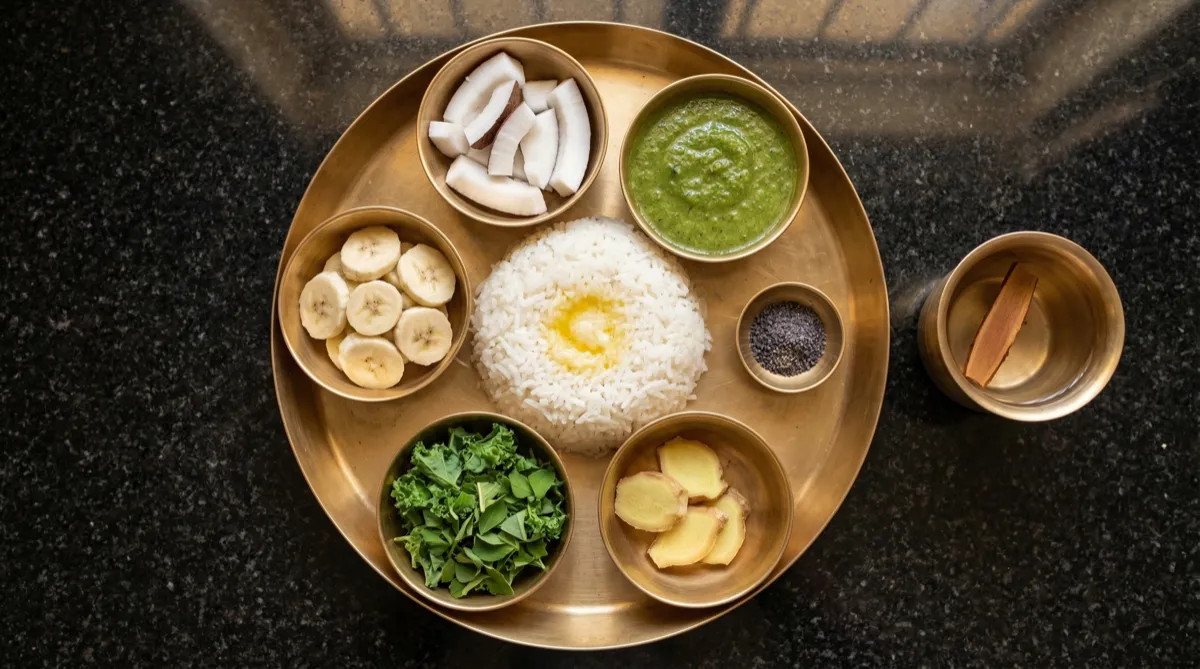
Ayurveda organises dietary guidance through the six tastes (Shadrasa) — sweet, sour, salty, pungent, bitter, and astringent — each of which influences the doshas differently. For the Kapha-dominant pattern commonly seen in hypothyroidism, dietary emphasis traditionally favours bitter, pungent, and astringent tastes, which are light, warming, and stimulating to Agni. Foods that are light, warm, and easy to digest are preferred, while heavy, cold, excessively sweet, or oily foods — which further dampen an already sluggish Agni — are generally reduced. For the Pitta-dominant pattern associated with hyperthyroidism, the approach shifts towards sweet, bitter, and cooling tastes that calm the overactive metabolic fire. Spicy, sour, and fermented foods, which tend to increase heat and further aggravate Pitta, are typically minimised. In both cases, the dietary guidance is always personalised to the individual’s constitution, current state of imbalance, and digestive capacity — there is no single thyroid diet in Ayurveda, only the right diet for the person in front of the practitioner.
Dinacharya — Daily Routine and Thyroid Health
Because thyroid health is fundamentally about metabolic regulation, daily routine (Dinacharya) plays a significant role in supporting Agni. Regular meal times help maintain consistent digestive fire — irregular eating is one of the most common contributors to Agni disturbance. Moderate, consistent exercise supports metabolism without aggravating Vata, which excessive or erratic exercise can do, potentially worsening thyroid instability. Adequate sleep is essential — sleep deprivation directly weakens Agni and increases Ama production. Stress management through structured daily routine reduces the Vata-Pitta dysregulation that often underlies or worsens thyroid imbalance. In the Ayurvedic view, these seemingly simple daily habits are not supplementary to treatment — they form the foundation upon which all other guidance rests.
CRITICAL: Ayurveda Works Alongside Thyroid Medication, Not Instead Of
This point cannot be stated too strongly. If you are taking levothyroxine, methimazole, carbimazole, or any other thyroid medication prescribed by your doctor, do not stop or reduce it based on Ayurvedic advice or any other complementary approach. Thyroid medication manages hormone levels that your body cannot currently regulate on its own. Stopping thyroid medication abruptly can have serious, even dangerous consequences — including myxoedema crisis in severe hypothyroidism or thyroid storm in hyperthyroidism.
Ayurveda and thyroid medication address different levels of the problem. Medication provides the thyroid hormone that the body needs now, maintaining safe and functional hormone levels in the blood. Ayurvedic guidance supports the body’s underlying metabolic function — Agni, dosha balance, dhatu nourishment, Ama clearance — aiming to strengthen the systems that influence thyroid health over time. These two approaches are complementary, not competitive. One works at the hormonal-replacement level; the other works at the constitutional-metabolic level.
Continue all prescribed medications. Continue all scheduled blood work and lab monitoring — TSH, T3, T4, and thyroid antibody levels as recommended by your endocrinologist or physician. Share your Ayurvedic guidance with your medical doctor, and share your lab results with your Ayurvedic practitioner. The best outcomes happen when both systems are informed and working together.
When to see an endocrinologist: If you have not had your thyroid evaluated by a medical specialist; if your symptoms are changing or worsening; if you are pregnant or planning pregnancy (thyroid function is critical for foetal development); if you have significant thyroid enlargement or nodules; or if your medication needs frequent adjustment — these are all situations where specialist endocrine evaluation is essential and should not be delayed. If any practitioner tells you to stop your thyroid medication, seek a second opinion from your endocrinologist immediately.
Did You Know?
Sushruta described surgical removal of Galaganda with specific instruments and post-operative care — one of the earliest documented thyroidectomy-like procedures in medical history, roughly 2,600 years before Theodor Kocher won the Nobel Prize for thyroid surgery in 1909.
What Current Evidence Says
Research on traditional medicine approaches to thyroid health is an active area of investigation. The Central Council for Research in Ayurvedic Sciences (CCRAS), under India’s Ministry of Ayush, has conducted studies on classical formulations traditionally used for Galaganda and metabolic conditions, with some studies showing improvements in thyroid function markers and symptom scores. However, most studies have been small-scale, and large, randomised controlled trials meeting international standards remain limited.
The World Health Organization (WHO), in its Traditional Medicine Strategy 2014–2023, recognised the role of traditional medicine systems in primary healthcare and called for integration with evidence-based practice. The WHO has also noted the importance of quality, safety, and appropriate use of traditional medicine alongside conventional treatment — a position that aligns with the integrative approach described in this article.
Lifestyle interventions — including dietary modification, stress management, and physical activity — have well-established evidence for supporting thyroid health and are recommended by both endocrinological guidelines and Ayurvedic practice. The emphasis on gut health, inflammation reduction, and metabolic support that characterises Ayurvedic dietary guidance has parallels in emerging research on the gut-thyroid axis and the role of intestinal permeability in autoimmune thyroid conditions.
This article is for educational purposes only and does not constitute medical advice. Thyroid disorders require proper clinical evaluation, including blood tests (TSH, T3, T4, thyroid antibodies) and medical imaging where indicated. Do not stop, reduce, or modify any prescribed thyroid medication based on this article or any complementary approach. Levothyroxine, methimazole, and other thyroid medications are essential for managing hormone levels and must only be adjusted by your prescribing doctor. Any Ayurvedic formulations should only be taken under the guidance of a qualified practitioner who has assessed your individual constitution and health history. Always inform both your medical doctor and your Ayurvedic practitioner about all treatments you are receiving. If you experience rapid heart rate, severe fatigue, significant weight changes, difficulty swallowing, or neck swelling, seek medical attention promptly.