
Weight in Ayurveda: It’s Not About the Number
You have counted calories. You have downloaded the apps. You have done the Monday restart, the juice cleanse, the intermittent fasting protocol your colleague swore by. And here you are, roughly where you started — except now you also feel guilty about it. Here is something that might change how you think about the whole thing: Ayurveda does not have a concept of “ideal weight.” There is no chart, no formula, no universal number. This is not because the classical texts lacked precision — they are extraordinarily precise about anatomy, physiology, and diagnostics. It is because Ayurveda understood, thousands of years before modern metabolic science, that healthy weight is not a fixed target. It is a dynamic state that varies from person to person based on their constitutional makeup, their digestive capacity, and the quality of their tissue nourishment. Your friend who eats the same food and stays lean? That is not unfair. That is a different constitution processing the same inputs through a completely different metabolic architecture.
The classical texts describe two distinct weight disorders — and neither one mentions a number. Sthaulya refers to excessive accumulation of Meda Dhatu (fat tissue) and other bodily substances, producing a state we would recognise as obesity. Karshya refers to the depletion of tissues, producing emaciation — a body that cannot hold its substance. Both are considered disorders of Dhatu (tissue) metabolism. They are defined not by what a scale reads, but by whether the seven Dhatus — the fundamental tissues that constitute the body — are being formed, nourished, and maintained in proper proportion.
This is where Prakriti becomes essential. Your constitutional type — your Prakriti — determines your natural body structure. A Kapha-predominant person is naturally heavier, broader, with denser bones and more tissue mass. This is not a problem to solve. It is how their body is designed to function. A Vata-predominant person is naturally lighter, leaner, with a narrower frame and less tissue density. This is not a deficiency. It is their constitutional baseline. A Pitta-predominant person falls somewhere between, with a medium, muscular build. The goal in Ayurveda is not to make every body look the same. The goal is Sama Dhatu — balanced tissue formation where each of the seven Dhatus receives adequate nourishment relative to your specific constitution.
Charaka Samhita (Sutra Sthana, Chapter 21) devotes an entire chapter to the management of Sthaulya and Karshya. The approach is instructive: the text does not recommend a standard intervention for everyone who is overweight or underweight. Instead, it begins with a thorough assessment of Prakriti, Vikriti (current imbalance), Agni (digestive capacity), and the state of each Dhatu. The treatment that follows is entirely individual. Two people who appear similarly overweight may receive completely different guidance — because the doshic mechanism driving their weight imbalance is different. This individualisation is not a refinement. It is the foundation of the entire approach.
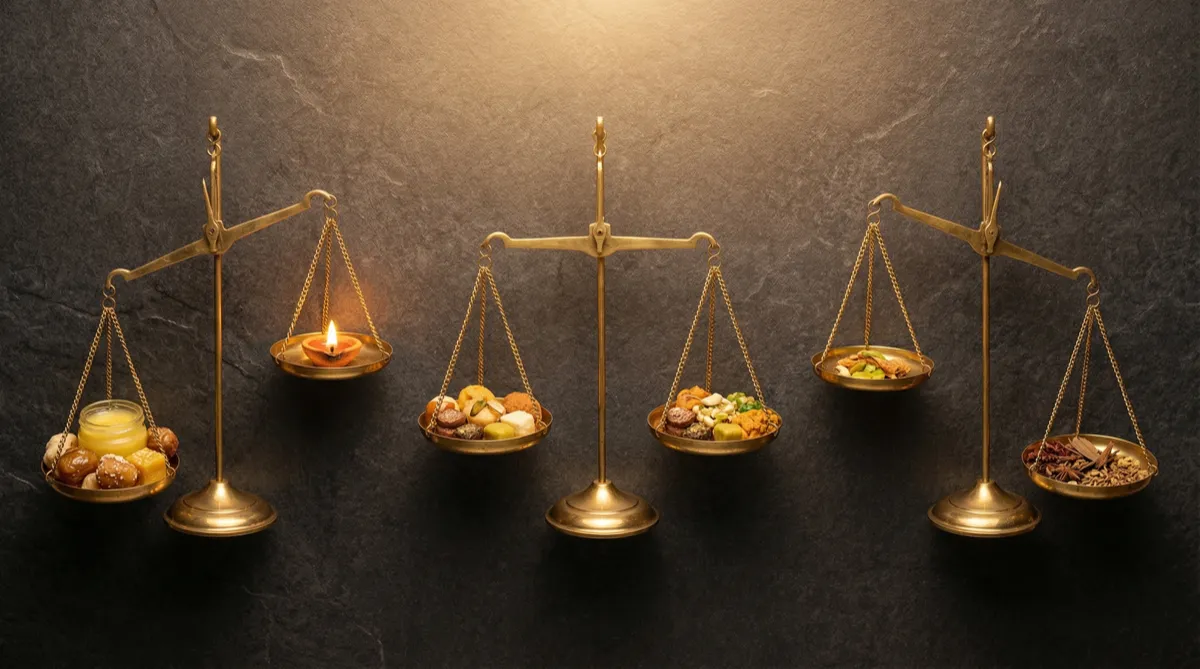
Agni and Ama: The Real Drivers of Weight Imbalance
Forget everything you have been told about calories for a moment. Ayurveda says the single most important factor in weight is not what you eat or how much — it is how well you transform what you eat. That transformative power is called Agni, and it is not a metaphor. Agni is the digestive and metabolic fire that operates at every level of your body — from the stomach to individual tissues. When Agni is functioning well, food is completely digested, nutrients are efficiently absorbed, and each tissue receives exactly what it needs. When Agni is disturbed, the entire cascade of tissue nourishment fails — and weight imbalance is one of the most visible consequences. Two people can eat the exact same meal: one transforms it into energy and strong tissue; the other stores it as fat and toxic residue. The difference is Agni. For a thorough understanding of Agni and its role in health, see our article on Agni and Digestion.
Mandagni — weak or sluggish digestive fire — is the most common driver of weight gain in Ayurvedic understanding. When Agni is weak, digestion is incomplete. Incompletely digested material does not simply pass through the body. It accumulates as Ama — a toxic, heavy, sticky residue that clogs the channels (Srotas) through which nutrients are supposed to flow. As Ama accumulates, it preferentially lodges in Meda Dhatu (fat tissue), causing that tissue to expand even as other tissues are starved of nourishment. This explains something that many people struggling with weight experience intuitively but cannot articulate: they feel simultaneously heavy and malnourished. The waistline grows, but the muscles are weak, the energy is low, the skin is dull, and every cold seems to linger. The body is not over-nourished. It is mis-nourished — and no calorie counter in the world can capture that distinction.
On the other end, Tikshna Agni — an overactive, sharp digestive fire — burns through nutrients before they can be properly absorbed and distributed. The result is Karshya: tissue depletion. The person eats adequately but cannot hold weight. Nutrients are consumed by the fire before they reach the deeper tissues. This is not a fast metabolism to be envied. It is a Pitta-driven imbalance that, left unaddressed, depletes Ojas (vitality) and weakens the body’s reserves.
Beyond the central Jatharagni (stomach fire), Ayurveda describes Dhatvagni — tissue-level fires that operate within each of the seven Dhatus. Each Dhatu has its own Agni that governs the transformation of that specific tissue. When Medodhatvagni (the Agni of fat tissue) is weak, Meda Dhatu accumulates disproportionately. When Mamsadhatvagni (the Agni of muscle tissue) is weak, muscle wastes even when fat increases. This layered understanding of metabolic fire explains why weight problems are never just about calories in and calories out. They are about how efficiently your body transforms what it receives at every level of tissue formation.
Why Dieting Fails: The Ayurvedic Explanation
Here is a number that should bother you: according to meta-analyses published in the American Journal of Clinical Nutrition, roughly 80% of people who lose weight through dieting regain it within a year. Not because 80% of people lack discipline. Because the approach itself is incomplete. The modern premise — eat less, move more, create a caloric deficit — sounds logical. It has the authority of thermodynamics behind it. And it treats every human body like a bank account where you just need to balance the ledger. Ayurveda says this fails because it ignores the one thing that actually determines what your body does with food: the strength of your digestive fire.
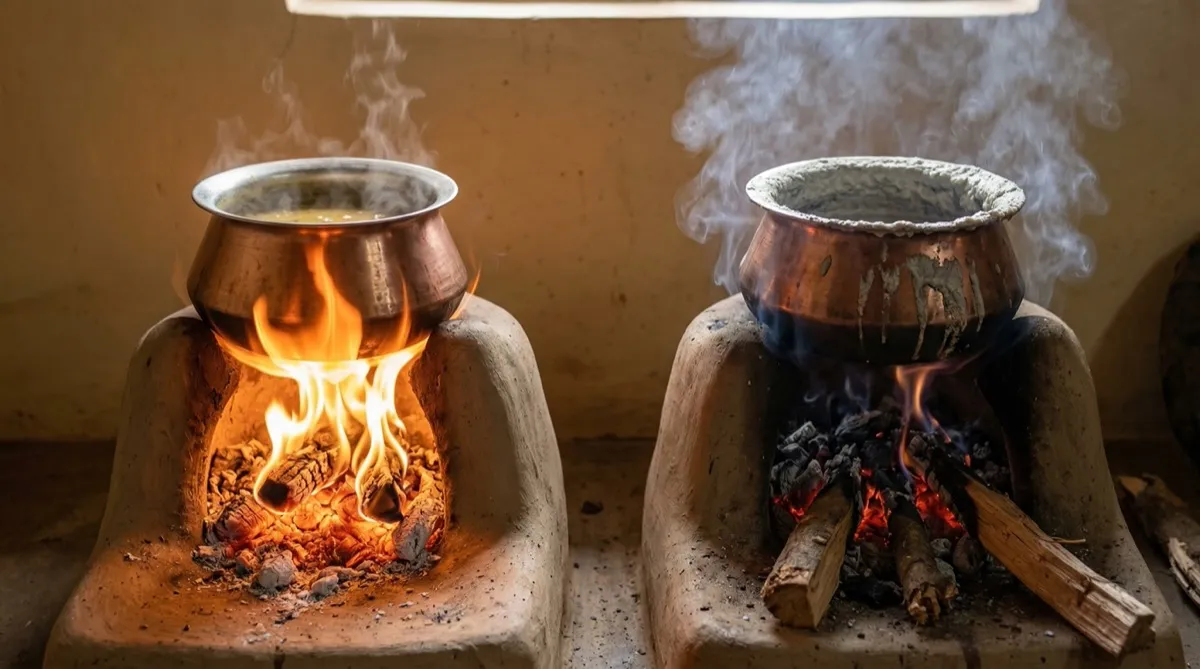
Calorie restriction, when applied without regard to Agni, does not strengthen digestion — it weakens it further. Think of Agni as a fire. If the fire is already low and you reduce the fuel, the fire does not burn brighter. It dims. Mandagni becomes even more sluggish when food intake is drastically cut. The result is less Ama from new food, but also less capacity to clear existing Ama. The person loses some weight initially — mostly water and muscle tissue, the very tissues they needed — but the underlying metabolic weakness that caused the weight gain remains untouched. The moment normal eating resumes, the weakened Agni cannot handle it, Ama accumulates faster than before, and the weight returns. Often with interest. This is the yo-yo cycle that millions recognise from bitter experience — and Ayurveda would say it was predictable from the start, because the fire was never addressed.
Crash diets are particularly destructive from an Ayurvedic perspective because they aggravate Vata — the dosha of irregularity, depletion, and instability. Severe caloric restriction creates lightness and dryness in the body, both Vata qualities. The nervous system becomes agitated. Sleep suffers. Anxiety increases. And then something paradoxical happens: the body, sensing deprivation, responds by increasing Kapha — the dosha of storage, conservation, and holding on. This is not a metaphor. It is what modern science calls “metabolic adaptation” — the body downregulating its metabolic rate in response to perceived famine. Ayurveda described this Vata-triggers-Kapha-storage mechanism centuries ago.
The Ayurvedic alternative is not starvation but Langhana — therapeutic lightening. Langhana is a carefully calibrated approach that reduces heaviness and Ama without destroying Agni. It includes specific dietary adjustments (warm, light, cooked foods that are easy to digest), particular spices that kindle Agni without aggravating Pitta, adequate hydration with warm water, and movement appropriate to the individual’s constitution. The difference between Langhana and dieting is the difference between strengthening the fire and starving it. One addresses the root cause. The other creates a temporary deficit that the body will eventually correct, often overcorrecting in the process.
Fasting in Ayurveda is also fundamentally different from modern intermittent fasting trends. Ayurvedic fasting is prescribed based on the individual’s Prakriti, current Vikriti, Agni strength, and season. A Kapha person with strong Agni may benefit from periodic light fasting. A Vata person with weak Agni may be harmed by it. The blanket application of fasting protocols without constitutional assessment is, from an Ayurvedic perspective, as reckless as prescribing the same medicine to every patient regardless of their condition.
Did You Know?
Sushruta Samhita (Sutra Sthana 15.32) describes how the body responds to sudden food deprivation: Vata dosha increases rapidly, driving the body into a conservation mode where it holds onto every bit of stored energy more tightly. Modern endocrinology calls this the “starvation response” — where the body drops thyroid hormone (T3) levels, increases cortisol, and downregulates resting metabolic rate by up to 23%, as demonstrated in the landmark 2016 “Biggest Loser” study published in Obesity. Sushruta’s observation that aggressive depletion (Karshana) without proper Agni management leads to worse outcomes than the original condition was written roughly 2,500 years before researchers tracked the same phenomenon on national television.
Dosha-Specific Approach to Weight
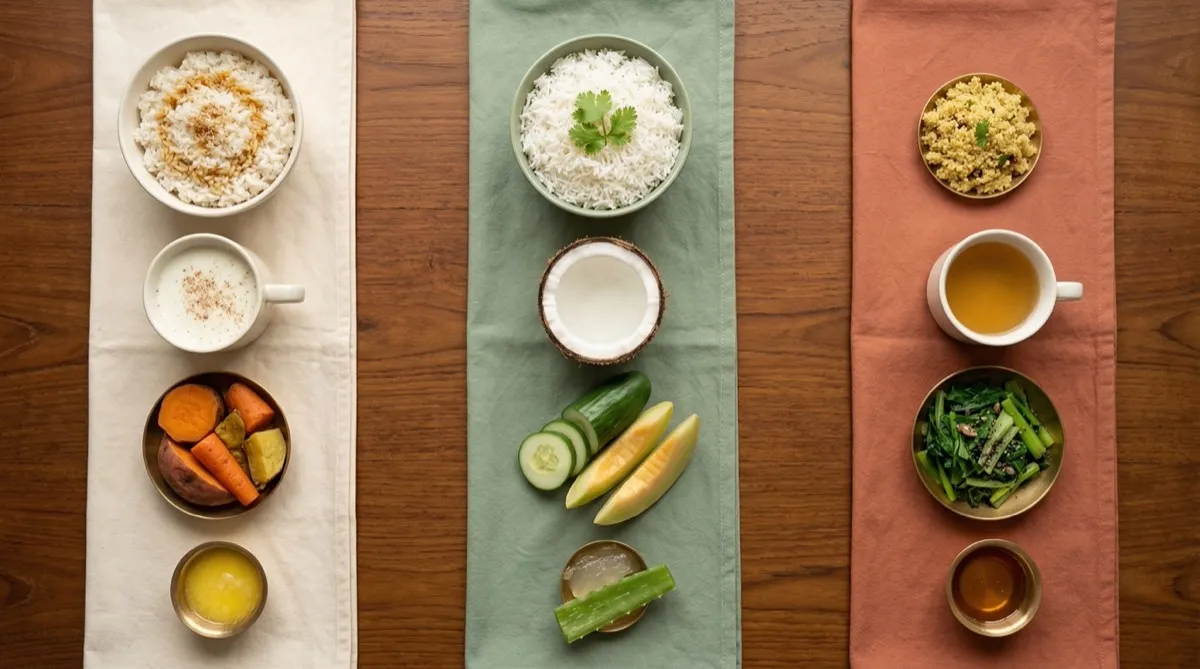
This is where Ayurveda does something no modern diet book does: it asks who you are before telling you what to eat. Your friend who lost 10 kilos on a high-protein plan? That may have been perfect for her Pitta constitution. For your Vata constitution, the same plan might cause anxiety, insomnia, and rebound weight gain within months. Generic weight management advice fails precisely because it ignores the doshic mechanism driving the imbalance. What follows is a framework, not a prescription — individual assessment always determines the specific approach.
Kapha-type weight imbalance is the most common pattern associated with excess weight. The presentation is characteristic: heavy, slow metabolism, water retention, lethargy, resistance to change, a tendency to skip meals and then overeat, emotional eating driven by comfort-seeking rather than hunger. The underlying mechanism is Mandagni with Ama accumulation in Meda Dhatu, compounded by Kapha’s natural tendency toward heaviness and storage. The approach requires stimulation: warming foods and spices (ginger, black pepper, cumin in cooking), light and dry food qualities over heavy and oily, vigorous physical movement (brisk walking, active yoga, anything that generates warmth and sweat), and a structured daily routine that prevents the stagnation Kapha naturally gravitates toward. The key insight is that Kapha needs activation, not deprivation.
Vata-type weight imbalance typically manifests as underweight, though it can also present as irregular weight fluctuations. The pattern includes irregular appetite (ravenous one day, no appetite the next), anxiety-driven eating or forgetting to eat entirely, difficulty absorbing nutrients even from good food, and a tendency toward gas, bloating, and constipation that further compromises nutrition. The underlying mechanism is Vishama Agni — irregular digestive fire that alternates between too strong and too weak. The approach is the opposite of what Kapha needs: grounding, warmth, routine, and nourishing foods. Warm, cooked, slightly oily foods. Regular meal times without exception. Calming practices rather than intense exercise. And above all, stability — because Vata imbalance is fundamentally a disorder of irregularity.
Pitta-type weight imbalance often involves stress-eating, inflammation-related weight gain, and a metabolism that runs hot until it burns out. Pitta individuals may maintain weight easily for years through sheer metabolic force, then suddenly gain weight when stress tips Agni from Tikshna (sharp) to disturbed. The pattern includes intense cravings (especially for spicy, salty, and fried foods), eating too much too fast, acid reflux and inflammation that interfere with proper digestion, and irritability that drives emotional eating. The approach requires cooling: regular, moderate meals at consistent times, reduction in stimulants and intensity, cooling foods and preparations, and practices that reduce the internal heat driving the imbalance. Pitta weight management is less about what to eat and more about reducing the inflammatory, stress-driven patterns that disrupt an otherwise strong Agni.
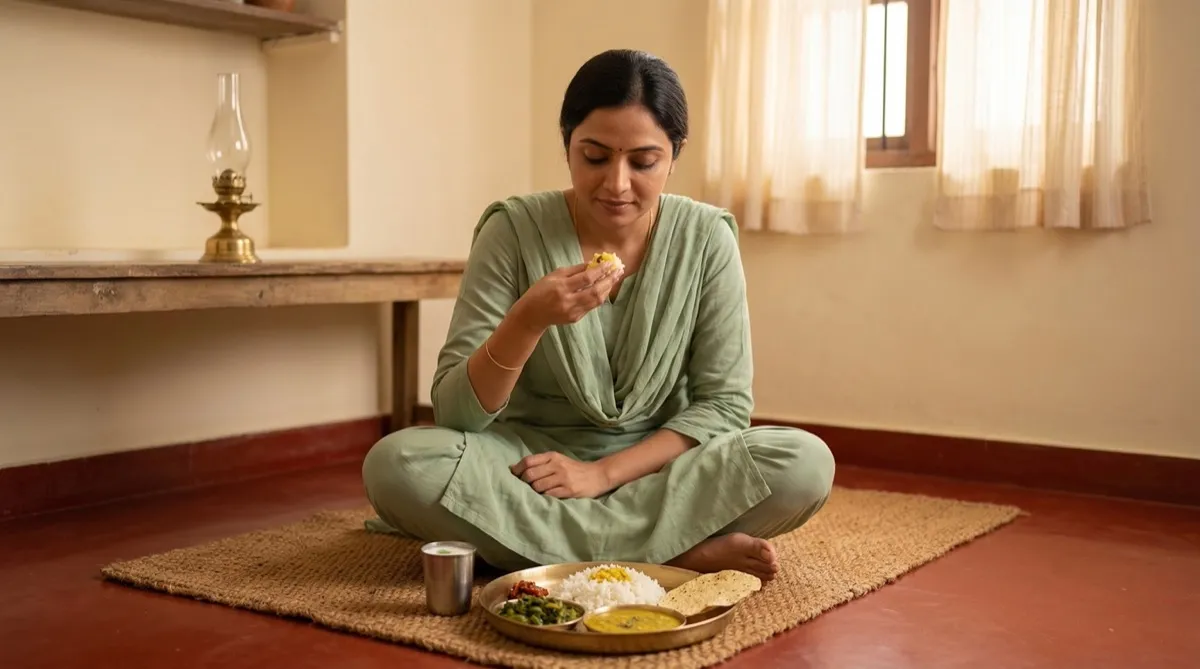
Here is a fact about food that almost nobody considers: the emotional state in which you eat may matter as much as what you eat. When you sit down to a meal in a state of stress, anger, or distraction, the nervous system is in sympathetic dominance — the “fight or flight” mode. In this state, blood flow is diverted away from the digestive organs and toward the muscles, brain, and heart. Digestive enzyme secretion drops. Gut motility changes. The body is physiologically incapable of complete digestion while it believes it is under threat. Eating while scrolling through stressful news, arguing, or rushing produces measurably different metabolic outcomes than eating the same food in a calm, seated, attentive state. Ayurveda codified this thousands of years ago in the concept of Ahara Vidhi — the rules of eating that include not just what to eat but how: seated, calm, attentive, without rushing, and ideally in pleasant company. These were not table manners. They were digestive prescriptions. The food is identical. What the body does with it is not.
Diet and Lifestyle: Practical Principles
If the dosha-specific approach above feels overwhelming, here is the good news: regardless of your Prakriti, certain dietary and lifestyle principles support healthy weight across the board. These are not weight-loss tricks or 30-day challenges. They are foundational practices — some almost embarrassingly simple — that create the conditions under which the body naturally moves toward its constitutional balance. Many of these were common sense in your grandparents’ generation. They only seem radical now because the modern food environment has moved so far from them.
Eat warm, cooked, seasonal food. This is the single most important dietary principle in Ayurveda, and its relevance to weight is direct. Warm, cooked food is easier for Agni to process than cold, raw food. Easier processing means more complete digestion. More complete digestion means less Ama formation. Less Ama means clearer channels and better tissue nourishment. The cascade is simple and logical. A person who switches from cold smoothies and salads to warm soups, cooked vegetables, and freshly prepared meals will often notice changes in digestion, energy, and body composition within weeks — not because of calorie changes but because of improved Agni function.
Make lunch the largest meal. Agni follows the sun — it is strongest at midday when the sun is at its peak. This is when the body is best equipped to handle the heaviest meal. A substantial, nourishing lunch allows the body to digest and distribute nutrients during its period of peak metabolic capacity. Dinner should be lighter and earlier — ideally before 7 PM — because Agni naturally diminishes in the evening. Eating heavy meals late at night when Agni is low is one of the most reliable ways to generate Ama and accumulate Meda Dhatu — a pattern that Ayurveda links to Prameha and other metabolic disorders.
Drink warm water throughout the day, not cold. Cold water dampens Agni — the same way pouring cold water on a fire reduces its intensity. Warm water supports digestive function, helps dissolve and mobilise Ama, and keeps the Srotas (channels) open for proper nutrient flow. Sipping warm water between meals, rather than drinking large quantities with meals (which dilutes digestive secretions), is one of the simplest and most effective Ayurvedic practices for metabolic health.
Exercise should match your Prakriti. Kapha individuals benefit from vigorous, sweat-inducing exercise — brisk walking, running, active sports. Vata individuals do better with gentler, more grounding movement — walking, gentle yoga, swimming. Pitta individuals thrive with moderate, cooling exercise — swimming, hiking, non-competitive activity. The modern assumption that more intense exercise is always better ignores the reality that exercise is itself a metabolic intervention that interacts with your doshic balance. The wrong type of exercise for your constitution can aggravate the very imbalance you are trying to correct.
Adequate sleep is non-negotiable. Sleep deprivation aggravates both Vata and Kapha in ways that directly promote weight imbalance — Vata aggravation disrupts hormonal signalling (modern research confirms that sleep deprivation increases ghrelin and decreases leptin), while Kapha accumulation in the morning creates heaviness and sluggishness that persists throughout the day. The Ayurvedic emphasis on sleeping before 10 PM and waking before 6 AM aligns with circadian biology and supports the metabolic rhythms that maintain healthy weight. Dinacharya — the structured daily routine — is not separate from weight management. It is weight management. For a complete guide, see our article on Dinacharya.
Did You Know?
Charaka Samhita (Sutra Sthana 21.4) lists eight specific complications of Sthaulya (obesity) — including shortened lifespan, difficulty with physical exertion, excessive sweating, excessive hunger, excessive thirst, body odour, reduced sexual vitality, and impaired function. But what makes this truly jaw-dropping is verse 21.9, where Charaka explains the mechanism: excess Meda Dhatu blocks the channels that nourish other tissues, so the body keeps demanding more food even as it starves internally. Read that again. The person is obese and simultaneously malnourished at the cellular level — always hungry because the signal that says “you have enough” never reaches the brain. Modern endocrinology did not name this phenomenon — leptin resistance — until 1994, when Jeffrey Friedman at Rockefeller University identified the leptin hormone. Charaka described the exact same feedback loop over 2,000 years earlier, without microscopes, without hormones, without labs.
Did You Know?
In 2018, a study at King’s College London involving identical twins — same DNA, same upbringing — found that they responded to the same meals with dramatically different blood sugar, insulin, and fat storage patterns. Some twins stored fat from a meal that their identical sibling burned immediately. The researchers concluded that genetic code alone could not explain metabolic individuality — the gut microbiome, sleep patterns, stress levels, and meal timing were equally powerful determinants. Ayurveda’s insistence on Prakriti-based individualisation — that two people with the same body weight may need entirely different dietary approaches — was dismissed for decades as unscientific. The twin study confirmed exactly this: metabolism is personal. There is no universal “right diet.” The right approach for your body depends on your constitution, your digestive capacity, and the specific pattern of imbalance driving your weight — which is precisely what Ayurvedic assessment aims to identify.
What Current Evidence Says
Gut microbiome research increasingly validates the Ayurvedic concept of Agni. Studies published in Nature (2014) and Cell Host & Microbe (2019) demonstrate that the gut microbiome directly influences metabolic rate, fat storage, and the body’s response to different foods — and that this microbiome composition varies significantly between individuals. The Ayurvedic observation that different constitutions digest the same food differently is consistent with what microbiome science now describes as personalised metabolic responses.
Chrononutrition — the study of how meal timing affects metabolism — supports the Ayurvedic emphasis on eating the largest meal at midday. Research in the International Journal of Obesity (2013) and Cell Metabolism (2022) demonstrates that eating the majority of calories earlier in the day is associated with better weight outcomes, improved insulin sensitivity, and reduced inflammatory markers compared to late eating patterns. The Ayurvedic practice of a light, early dinner is consistent with these findings.
Studies on mindful eating, reviewed in Obesity Reviews (2014) and the American Journal of Clinical Nutrition (2017), show that eating slowly, without distraction, and with awareness of hunger and satiety cues significantly reduces caloric intake and improves metabolic markers. The NCCIH under NIH recognises mindfulness-based interventions as complementary approaches to weight management. Anti-inflammatory dietary patterns, such as those emphasising warm, cooked, seasonal whole foods — closely mirroring Ayurvedic dietary principles — have been associated with reduced visceral fat and improved metabolic health in multiple population-level studies reviewed by the WHO.
This article is for educational purposes only and does not constitute medical advice. Weight management involves complex metabolic, hormonal, and psychological factors that require individual assessment. If you are experiencing significant or unexplained weight changes, consult a qualified healthcare provider to rule out underlying medical conditions. Ayurvedic consultation can complement your care, but should not replace medical evaluation. Never discontinue prescribed medication or medical nutrition advice without consulting your doctor.